VISISIONSHARE (blog header)_edited

Friday, October 22, 2010

WHEN IN DOUBT...

shout_logo

Why shaking someone’s beliefs turns them into stronger advocates.

You don’t have to look very far for examples of people holding on to their beliefs in the face of overwhelming evidence to the contrary....

That might be depressing, but it’s not unexpected. In a new study, David Gal and Derek Rucker from Northwestern University have found that when people’s confidence in their beliefs is shaken, they become stronger advocates for those beliefs. The duo carried out three experiments involving issues such as animal testing, dietary preferences, and loyalty towards Macs over PCs. In each one, they subtly manipulated their subjects’ confidence and found the same thing: when faced with doubt, people shout even louder.

Read about the study at Discover.

Thursday, October 21, 2010

SPIRITUAL ENVIRONMENTALISM

Wangari Maathai
Photo: Gianluigi Guercia/AFP/Getty Images


Spiritual Environmentalism: Healing Ourselves by Replenishing the Earth

via HuffPost

By Wangari Maathai
2004 Noble Peace Prize Laureate. Founder, Green Belt Movement

During my more than three decades as an environmentalist and campaigner for democratic rights, people have often asked me whether spirituality, different religious traditions, and the Bible in particular had inspired me, and influenced my activism and the work of the Green Belt Movement (GBM). Did I conceive conservation of the environment and empowerment of ordinary people as a kind of religious vocation? Were there spiritual lessons to be learned and applied to their own environmental efforts, or in their lives as a whole?

When I began this work in 1977, I wasn't motivated by my faith or by religion in general. Instead, I was thinking literally and practically about solving problems on the ground. I wanted to help rural populations, especially women, with the basic needs they described to me during seminars and workshops. They said that they needed clean drinking water, adequate and nutritious food, income, and energy for cooking and heating. So, when I was asked these questions during the early days, I'd answer that I didn't think digging holes and mobilizing communities to protect or restore the trees, forests, watersheds, soil, or habitats for wildlife that surrounded them was spiritual work.

However, I never differentiated between activities that might be called "spiritual" and those that might be termed "secular." After a few years I came to recognize that our efforts weren't only about planting trees, but were also about sowing seeds of a different sort -- the ones necessary to give communities the self-confidence and self-knowledge to rediscover their authentic voice and speak out on behalf of their rights (human, environmental, civic, and political). Our task also became to expand what we call "democratic space," in which ordinary citizens could make decisions on their own behalf to benefit themselves, their community, their country, and the environment that sustains them.

In this context, I began to appreciate that there was something that inspired and sustained the GBM and those participating in its activities over the years. Many people from different communities and regions reached out to us because they wanted us to share the approach with others. I came to realize that the work of the GBM was driven by certain intangible values. These values were: love for the environment; a gratitude and respect for Earth's resources; a capacity to empower and better oneself; and a spirit of service and volunteerism. Together, these values encapsulate the intangible, subtle, nonmaterialistic aspects of the GBM as an organization. They enabled us to continue working, even through the difficult times.

Of course, I'm aware that such values are not unique to the Green Belt Movement. They are universal; they can't be touched or seen. We cannot place a monetary value on them: in effect, they are priceless. These values are not contained within certain religious traditions. Neither does one have to profess a faith in a divine being to live by them. However, they do seem to be part of the our human nature and I'm convinced that we are better people because we hold them, and that humankind is better off with them than without them. Where these values are ignored, they are replaced by vices such as selfishness, corruption, greed, and exploitation.

Through my experiences and observations, I have come to believe that the physical destruction of the earth extends to us, too. If we live in an environment that's wounded -- where the water is polluted, the air is filled with soot and fumes, the food is contaminated with heavy metals and plastic residues, or the soil is practically dust -- it hurts us, chipping away at our health and creating injuries at a physical, psychological, and spiritual level. In degrading the environment, therefore, we degrade ourselves.

The reverse is also true. In the process of helping the earth to heal, we help ourselves. If we see the earth bleeding from the loss of topsoil, biodiversity, or drought and desertification, and if we help reclaim or save what is lost -- for instance, through regeneration of degraded forests -- the planet will help us in our self-healing and indeed survival. When we can eat healthier, nonadulterated food; when we breathe clean air and drink clean water; when the soil can produce an abundance of vegetables or grains, our own sicknesses and unhealthy lifestyles become healed. The same values we employ in the service of the earth's replenishment work on us, too. We can love ourselves as we love the earth; feel grateful for who we are, even as we are grateful for the earth's bounty; better ourselves, even as we use that self-empowerment to improve the earth; offer service to ourselves, even as we practice volunteerism for the earth.

Human beings have a consciousness by which we can appreciate love, beauty, creativity, and innovation or mourn the lack thereof. To the extent that we can go beyond ourselves and ordinary biological instincts, we can experience what it means to be human and therefore different from other animals. We can appreciate the delicacy of dew or a flower in bloom, water as it runs over the pebbles or the majesty of an elephant, the fragility of the butterfly or a field of wheat or leaves blowing in the wind. Such aesthetic responses are valid in their own right, and as reactions to the natural world they can inspire in us a sense of wonder and beauty that in turn encourages a sense of the divine.

That consciousness acknowledges that while a certain tree, forest, or mountain itself may not be holy, the life-sustaining services it provides -- the oxygen we breathe, the water we drink -- are what make existence possible, and so deserve our respect and veneration. From this point of view, the environment becomes sacred, because to destroy what is essential to life is to destroy life itself.

Wangari Maathai is the 2004 Nobel Peace Prize Laureate. Her latest book is Replenishing the Earth: Spiritual Values for Healing Ourselves and the World (Doubleday Religion), from which this piece is excerpted.


Wednesday, October 20, 2010

MERCADO DO BOSQUE


IMG_3912

Mercado do Bosque is one of the old-style neighborhood markets in Rio Branco. Its unique ambiance is sort of a relic in a neighborhood being built up with apartment buildings and modern shops. It is best-known as the only 24 hour place to get a bite to eat and can be packed at 3am. I wandered around with my camera during the slow period between breakfast and lunch.


IMG_3900


IMG_3929


IMG_3914


IMG_3910


IMG_3916


IMG_3928


IMG_3930


IMG_3923


IMG_3903


IMG_3932


IMG_3897


Tuesday, October 19, 2010

MIDDAY SUN AND RAINBOW -- TODAY OVER RIO BRANCO AC BRASIL

IMG_3958

We felt blessed.


Saturday, October 16, 2010

THE SOCIAL PHOTOGRAPHY OF TATIANA CARDEAL


It's been awhile since I last showed the works of one of my favorite Brazilian photographers, Tatiana Cardeal. Above is a slideshow of the favorites of the viewers or her photos at flickr.

For more about Tatiana and her photographic mission check out her blog.


Friday, October 15, 2010

A REUNION IN BRAZIL

Kelipie at Impanema with Lou
Kelpie and Lou at Ipanema beach in Rio de Janeiro

Kelpie Wilson and I have known each other for nearly 40 years, all the way back to the 1973-74 academic year at the University of Illinois where she was a politically-oriented freshman and I was the out-going "radical" professor who had become that year's "campus cause." Somehow, without even knowing each other personally we were destined to struggle for the same forest cause. As they say in Brazil, we were companheiros.

Back then we soon went our separate ways -- she to leave school to be an auto mechanic and then to return to school in California to become a mechanical engineer; I to leave school to be a carpenter/woodworker and then a backwoods guy in Oregon. We met again as we were both drawn to defense of the Siskiyou National Forest and the Kalmiopsis Wilderness. In the late 1980s Kelpie joined the Siskiyou project as a networker and rose to be its executive director and my boss. I was the storyteller and hermit. She was the one who stayed in the office and made things happen.

Siskiyou Project & Friends 2001
Siskiyou Project and friends (2001).

As the Clinton-Gore years passed to Bush-Cheney, Kelpie and her husband George perfected their owner-built off-the-grid home and she got busier than ever -- writing a novel and manuals for an alternate energy company and then becoming the environmental editor of truthout.org. Meanwhile, I started to spend more and more time in Brazil where I depended on the Internet for news from the States. My "filter" was mostly the articles that Kelpie selected as "important." One day her story about terra preta/biochar arrived and I was hooked.

Indeed, it was the terra preta vision that brought us both to the 3rd International Biochar Initiative meetings in Rio de Janeiro in September -- she as the IBI communications editor and I as a forest defender fascinated with Amazônia and its cultures.

Following the Rio meetings, Kelpie traveled to Manaus for a field trip to sites of terra preta de índios (photo essay here and here) where she listened to "Happy Birthday" being sung to her as she stood in a terra preta research pit.

Kelpie in the pit
Kelpie in the pit.

After Manaus, Kelpie traveled to far western Brazil to visit my new stomping grounds in Acre (bordering with Bolivia and Peru) where we spent time in the state capital of Rio Branco and in the countryside of Capixaba.

IMG_3616

Nowadays, Acre is leaping into the 21st Century. In A Walk Through Time in Rio Branco I wrote:


In Brazil, where global warming was barely on the public agenda only a year ago, a new national political debate about sustainable development has emerged along with a growing awareness of global interrelatedness at every level – cultural, economical, ecological and political. Finding the sustainable balance among the many contradictory and opposing forces has already emerged as a major theme of the 2010 presidential election in Brazil and has erupted at Copenhagen.

I have no "crystal ball" to see the future but one thing does seem certain. The pace of change and development is moving faster and faster. Today, the rainbows and satellites are rising above the homes of Rio Branco and across Amazônia.

The 21st Century is about information. And the information is making us aware of our common planetary predicament. It is also giving us unparalleled opportunities to participate in creating the future for life on earth.

Kelpie came to gain and share information -- to learn from the people of this place and to bring news about terra preta and the new biochar tools.

With Flavio Encarnação as our guide, we started with the historical site of one of the early districts of Rio Branco and witnessed the old ways of gathering and curing rubber:


With the archeologist and geolyph researcher Alceu Ranzi, we visited a few of the 100s of archeological sites (ironically being revealed as a result of deforestation) that date back to the ancient inhabitants who are thought to have been here 1,000 to 2,000 year ago.


And then on to spend a few days at the community of Fortaleza in the rural district of Capixaba. Although Acre has approximately 80% of its land still in forest, the eastern portion of the state has been particularly hard hit as shown in this map of the deforestation up until 2006 (releasing 100 million tons of carbon).

Deforestation in Eastern Acre up to 2006

I have previously written of my struggles to confront the dilemmas of development in this region (Chico Mendes, Capixaba and Change and Walking in Beauty). At the time, Kelpie commented with great empathy on both of those posts and concluded, "I think that engagement is what is important, not the ultimate outcome, which we will never know." Now she was here to see for herself.

It was a rough introduction traveling from the town of Capixaba to the rural site of Fortaleza -- 15km on a motorcycle across dusty roads through clearcut landscapes parched from the drought and under smoke-laden skies from the regional fires. What a relief to arrive at Fortaleza (the Fortress) where there's an on-going effort at small-scale farming combined with preserving the remaining forest.


When she saw the abandoned pottery kiln, of course she said, "this needs to be making biochar."

IMG_3502

Probably, our most fun experience came during an afternoon canoe trip on the Xipamanu river which borders with Bolivia. The day was hot despite the fact that the sun was nearly obscured by smoke and due to the drought the river was too low to use the motor on the big dugout canoe which had to be pushed along with poles and dragged over submerged logs. A round-trip that normally takes about 2 hours took more than 5 and we returned well after dark. It was quite an adventure but each little challenge or disaster was greeted with laughter and harder work. Kelpie and I agreed about the result, it was one of the best river trips ever!


Returning to Rio Branco, Kelpie began a series of biochar presentations. It started slowly with just a few folks in attendance at the library of the forest.

IMG_3238

But they surely spread the word and Kelpie's presentation at the Secretariat of the Environment brought out 15 people and all 3 local TV channels.


And next came the AgroForestry Extension and Family Production Service where 40 specialists were fascinated by biochar's potential for applications in Acre.


On the way to the airport, at lunch with Janaina, Luis, and Yara, Kelpie managed to squeeze in one last presentation and it all ended at the airport with a happy farewell and fond wishes that she will return.


And what was the impact of this flurry of activity?

Just a few days after her departure, Flavio Encarnação, who is a professor of theater and who volunteered to be Kelpie's local translator, was himself giving a biochar presentation to the director of the Chico Mendes Park during the local 10/10/10 Climate Change Work Party which drew 75 to carry forth the work.

IMG_3874

As Kelpie said, "I think that engagement is what is important, not the ultimate outcome, which we will never know."

What is clear is that Kelpie planted some good seeds and many Acreanos are grateful for her visit.


Wednesday, October 13, 2010

Tuesday, October 12, 2010

Monday, October 11, 2010

10-10-10 WORK PARTY  in 
RIO BRANCO AC, BRAZIL 
and BEYOND

10-10-10 350 #2


On October 10, 2010 people at more than 7347 events in 188 countries got to work to take on the climate crisis. Here's how the days events unfolded at Uninorte City University in Rio Branco AC, Brazil.

Vera Reis welcomed a group of about 75 people who turned up early on a Sunday morning. Vera and the students in her environmental studies class, conceived and organized the day's events.

P1080660


Federal University of Acre ecology professor and Woods Hole Research Center scientist Foster Brown made an eloquent plea for citizen action to counter the trends in global warming, saying the time is running out.

IMG_3824


After reviewing the current scientific understanding of climate change, he spoke of the 350.org movement and how it is making the abstractions of science and the invisible workings of the atmosphere visible to people around the world.


The audience watched with concern, wondering what might be done to alter the dangerous trajectory that humans have been taking on earth. How might real change begin? Here?

IMG_3828


Foster told the inspiring story of Acre's own Frei Heitor who once imagined:

Imagine, he said, that he and Father Andre, another Italian missionary, convinced each other how to live in harmony with the earth and with each other. On the next day, Friar Heitor and Father Andre convinced two others. On the third day the four of them convinced four more, and so on for subsequent days. How many days would it take to convince the world’s population to live in harmony? Friar Heitor worked out this calculation during a canoe trip up the Acre River in April.

“Thirty-three days!” He exclaimed, banging his fist on my knee. “We can change the world, in a month, if we want to!”

Everyone headed outside to create a human 350 icon and show off the tree seedlings that they intend to plant, a performance leading to action.


Then Flavio Encarnação told the story of the fertile Amazon soils called Terra Preta de Índios and how modern day pyrolysis could make biochar from agricultural or organic wastes and be used to sequester carbon in the soil and increase plant productivity, offering partial solutions for both global warming and hunger.

IMG_3871

Which led to further conversations with Marta about the possibility that biochar might be used to restore a forest on degraded land adjacent to the Chico Mendes Park, right here in Rio Branco.

IMG_3874


And so it goes. First there's a good idea like the 350.org movement or the International Biochar Initiative. Then a conversation gets started. And then comes local action. It might not happen in the 33 days of Frei Heitor but surely this is how the world can be changed.

Here are some early highlights of how it is starting to happen around the world.


Many thanks to Vera, Foster, Flavio and all the other volunteers who made 10/10/10 DIA GLOBAL DE SOLUÇÕES CLIMÁTICS in Rio Branco a most successful day.

Flavio, Vera and Foster


Saturday, October 09, 2010

Monday, October 04, 2010

HAPPY SAINT FRANCIS

IMG_3451

Today is his day.


VIVA SÃO FRANÇISCO VIVA!
NO JOKE

tiririca

This clown is most-voted Deputy in Brazil's election.


SAO PAULO | Sun Oct 3, 2010 10:52pm EDT

SAO PAULO (Reuters) - Voters the world over complain about having clowns for politicians, but Brazilians embraced the idea on Sunday by sending a real one to Congress with more votes than any other candidate.

Francisco Everardo Oliveira Silva, better known by his clown name Tiririca, received more than 1.3 million votes in Sao Paulo state in Brazil's presidential and congressional elections. That was more than double the votes of the second-placed candidate in Brazil's most populous state.

Tiririca caught the attention of disillusioned voters by asking for their support with the humorous slogan: "It can't get any worse" and a promise to do nothing more in Congress than report back to them on how politicians spend their time.

"What does a congressman do? The truth is I don't know, but vote for me and I'll tell you," the 45-year-old said in his campaign advertisements.

The clown, whose stage name means "grumpy," usually appears in public wearing a blond wig, a red hat and a garish outfit. He survived a last-minute attempt by public prosecutors to bar him from running because of evidence that he is illiterate.

His candidacy may not have been as spontaneous or innocent as it might appear.

Tiririca's well-financed campaign will help elect other politicians because under Brazil's election rules he can pass his substantial excess votes on to other candidates in his coalition, which includes the ruling Workers' Party.

(Reporting by Stuart Grudgings; Editing by Terry Wade)

View Tiririca's campaign clips (in Portuguese) at YouTube

Also, for a hippie flash from the US past, check out stories of the "Nobody For President" campaign of the great hippie clown Wavy Gravy


FLY NOT WITH WINGS

FLY NOT WITH WINGS

Anyone who lives close to the world of animals and nature knows that Bambi-style romantic idealism is not very real. Indeed, the pecking order can get pretty brutal. The chicken on the ground in the photo above can't walk because the other chickens, noticing a weakness, almost killed it. However, one of its sisters began to stand guard and protect it. When the folks at the Fortaleza community (in Capixaba AC, Brazil) noticed what was happening, a special pen was built for the two -- well protected from animals on-the-hunt but open at he top so that the healthy one would be free to leave. Months later, she has chosen not to use her wings to soar to freedom but to remain at her crippled companion's side.

The perfectly fitting poem arrived today from Panhala:

Not With Wings

Here soar
Not with wings,

But with your moving hands and feet
And sweating brows -

Standing by your Beloved's side
Reaching out to comfort this world

With your cup of solace
Drawn from your vast reservoir of Truth.

Here soar
Not with your eyes and senses

That turn their backs
On the earth's sweet stumbling dance
Which needs you.

Here love, O here love,
With your mouth tender and open upon your lover,

And with your heart on duty
To the souls of rivers, children, forest animals,
All the shy feathered ones and laughing, jumping,
Shining fish.

O here, pilgrim,
Love
On this holy battleground of life

Where there are bleeding men
Who are calling for a sacred drink,
A gentle word or touch from man
or God.

Hafiz, why just serve and play with angels?
They are already content.

Brew your knowledge well for men
With aching minds and guts,

And for those wayfarers who have gained
The rare courageous thirsts
That can never be relinquished
Until Union!

Hafiz,
Leave your recipes in golden drums.

Tie those barrels to the backs of camels
Who will keep circumambulating the worlds,

Giving nourishment
To all our tender wondrous spheres.

O here love, O love right here.
Find your happiness, dear wayfarer,

With your beautiful lips and body
So sweetly opened,

Yielding their vital gifts upon
This magnificent
Earth.

~ Hafiz ~


(The Subject Tonight is Love - versions of Hafiz by Daniel Ladinsky)

MARINA SILVA FORCES BRAZIL'S PRESIDENTIAL CANDIDATES TO CARRY THE CAUSE INTO A SECOND ROUND

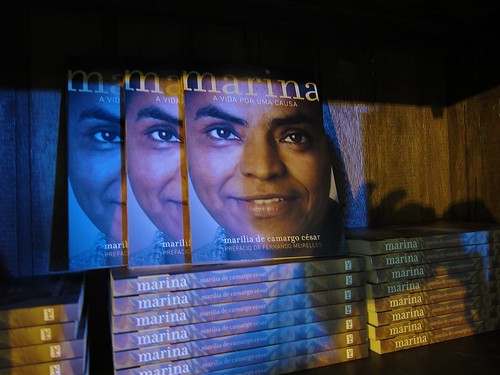
IMG_2051
"Marina - A Life for a Cause"

Marina Silva, with a surprisingly strong showing of 20%, has forced Brazil's presidential election into a second-round run-off between the leading candidates Dilma Rousseff and José Serra. Now, both the right and the left must compete for her support and supporters whose strong campaign has centered on the cause of sustainability.


Here is the Economist's quick analysis of the nearly complete results.

A RUN-OFF IN THE OFFING

Oct 4th 2010, 1:14 by H.J. | BRASÍLIA

WITH 97% of the votes counted, it is now certain that Brazil’s presidential race will go to a second round. Dilma Rousseff, the chosen successor of Luiz Inácio Lula da Silva, the popular president, made an unexpectedly poor showing, at just over 46% of all votes counted so far. That will rise a smidgen, since the last votes to come in are those from the poor north-eastern states, where Llua is revered. But her expected gains there will not be enough to secure an absolute majority, and thus avoid a run-off on October 31st.

That two-horse race will be between Ms Rousseff and José Serra of the centre-right Party of Brazilian Social Democracy (PSDB). He is currently on just under 33%, and Marina Silva of the Green Party has amassed almost 20%. That is an extraordinary result for her: until just a couple of weeks before the end of the race she was polling below 10%. Even though she had picked up a couple of percentage points since then, just this morning analysts were saying that she would be delighted with 15%.

The run-off will depend on how Ms Silva’s voters split between Ms Rousseff and Mr Serra. They might be influenced by Ms Silva’s endorsement, should she issue one—and since as a presidential candidate she has had to step down as a senator, she might well accept the offer of a job in a future cabinet in return. Although she does not like Ms Rousseff, whom she blames for the un-green policies that pushed her to leave Lula’s government and join the Green Party, I just can’t see her throwing her lot in with Mr Serra. Staying aloof from both would risk leaving her jobless, and at risk of losing the political momentum that is clearly building behind her.

I’m learning these results in probably the most atypical part of Brazil. The capital, Brasília, has far fewer poor people and many more well-educated ones than the country at large. Here, Ms Silva got more votes than either Ms Rousseff or Mr Serra. By contrast, in Ms Silva’s home state of Acre, in the north of Brazil—poor, rural and with high illiteracy rates—she did poorly.

So what happened to Ms Rousseff? Voter complacency, perhaps: front-runners often do a little worse than expected as their supporters think they needn’t bother turning out. Voting in Brazil is compulsory, but only 80% actually attend polling stations on the day. As everywhere, the stay-aways generally tend to be poorer and to live in rural areas—which in Brazil means they tend also to support Ms Rousseff's Workers' Party. Scandals may also have played a part: although voters told pollsters they were not terribly bothered by accusations of influence-peddling in the chief-of-staff’s office, which was Ms Rousseff’s patch until she stepped down to start campaigning, a few may have thought again. Ms Silva is becoming fashionable, and her life history is the closest of all the candidates’ to the sainted Lula’s. He, after all, stood for president and lost three times before finally being elected.

Wednesday, September 29, 2010

A DEEP BOW OF GRATITUDE TO JOE RILEY

It is so easy, in this complex and difficult world of our uncertain collective future, to fall into anger or despair in reaction to the many atrocities against people and nature. I have these "difficult moments" almost daily in an endless process of finding some balance in face of harsh realities.

One of my persistent guides toward balance comes from Joe Riley's great Panhala email and web service that provides a fountain of inspiring poetry and images.

Here are two recent arrivals:

Through the Mist to Royal Basin

Waking

Get up from your bed,
go out from your house,
follow the path you know so well,
so well that you now see nothing
and hear nothing
unless something can cry loudly to you,
and for you it seems
even then
no cry is louder than yours
and in your own darkness
cries have gone unheard
as long as you can remember.

These are hard paths we tread
but they are green
and lined with leaf mould
and we must love their contours
as we love the body branching
with its veins and tunnels of dark earth.

I know that sometimes
your body is hard like a stone
on a path that storms break over,
embedded deeply
into that something that you think is you,
and you will not move
while the voice all around
tears the air
and fills the sky with jagged light.

But sometimes unawares
those sounds seem to descend
as if kneeling down into you
and you listen strangely caught
as the terrible voice moving closer
halts,
and in the silence
now arriving
whispers

Get up, I depend
on you utterly.
Everything you need
you had
the moment before
you were born.

~ David Whyte ~


In the Middle

In the Middle

of a life that's as complicated as everyone else's,
struggling for balance, juggling time.


The mantle clock that was my grandfather's
has stopped at 9:20; we haven't had time
to get it repaired. 


The brass pendulum is still,
the chimes don't ring. 


One day you look out the window,
green summer, the next, and the leaves have already fallen,
and a grey sky lowers the horizon. 


Our children almost grown,
our parents gone, it happened so fast. 


Each day, we must learn
again how to love, between morning's quick coffee
and evening's slow return. 


Steam from a pot of soup rises,
mixing with the yeasty smell of baking bread. 


Our bodies
twine, and the big black dog pushes his great head between;
his tail is a metronome, 3/4 time. 


We'll never get there,
Time is always ahead of us, running down the beach, urging
us on faster, faster, but sometimes we take off our watches,
sometimes we lie in the hammock, caught between the mesh
of rope and the net of stars, suspended, tangled up
in love, running out of time.

~ Barbara Crooker ~