VISISIONSHARE (blog header)_edited
Showing posts with label Brazil. Show all posts

Wednesday, May 30, 2012

GREENPEACE DECIDES TO KISS BRAZIL'S NEW FOREST CODE


codigo florestal brasil

Yup, you read right. After the recent series of line-item vetoes by President Dilma Rousseff, no one knows what Brazil's latest Codigo Florestal text means, only that there will be another period of time for wiggling the weasel words to get final passage in Congress. This places the tough negotiations beyond the global spotlight of the upcoming RIO+20 (June 15-22). Many, suspect that this was the smoke-and-mirrors strategy in the first place. When the Senate compromise that satisfied no one failed to gain support in the lower House, the ruraliststas (extremists among the agribusiness interests) were allowed free-rein, resulting in an ecological nightmare and allowing Dilma to veto the most onerous clauses without defining a clear forest policy. Cleverly, Greenpeace has decided to challenge the whole process.

Thursday, May 24, 2012

TOMORROW IS D-DAY FOR THE AMAZON


"D" is for Dilma's Decision, Deforestation, Development, Dams and Drought


Dilma Rousseff, President of Brazil 
Dilma Rousseff, President of Brazil

Tomorrow, 25 May 2012, is the deadline for Brazil's President Dilma Rousseff to decide whether to accept or veto (in whole or part) the devastating new national Forest Code that was passed recently by the Brazilian Congress.

Andrew Revkin of the NY Times blog Dot Earth suggested that I might submit a "Postcard From Acre" describing the view from my perch in Brazil's western-most Amazonian state which borders on Bolivia and Peru.

Monday, June 08, 2009

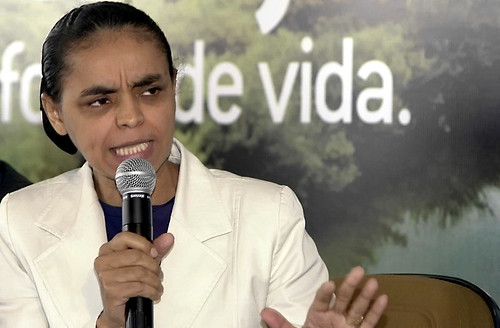
"THE THIRD WORST DAY OF MY LIFE", says Marina Silva

Marina Silva
Brazil to sanction illegal colonization in 230,000 sq mi of Amazon rainforest


NOTE: Last year, Marina Silva, a longtime heroine of the international environmental community, resigned from her post as Minister of Environment in protest of Brazil's development policies. Now, there is a fast-growing grassroots movement of citizens working on promoting Marina Silva's name as a candidate for the presidency. Here is the website (in Portuguese).

Mongabay reports on Brazil's program to turn lawlessness into law.

Go to original article.

(June 08, 2009) Brazil moved a step closer to passing a controversial law that would allow landowners who illegally deforested land in the Amazon to get legal title to these holdings. Environmentalists say HB 458 — which now only needs the signature of President Lula, an avid supporter — will legitimize years of illegal colonization and may promote new deforestation.

"This could be a big step backward for Amazonian conservation," said William F. Laurance, a researcher at the Smithsonian Tropical Research Institute who has spent nearly three decades staying the Brazilian Amazon. "The Amazonian environment is the clear loser here."

The proposed law will enable a claimant gain title for properties up to 1,500 hectares (3,700 acres) provided the land was occupied before December 2004. Critics note the law favors industrial developers over small holders, allowing those controlling 400-1500 ha to sell their holdings after three years. Farmers or ranchers holding under 400 ha have to wait 10 years to sell.

Former Environment Minister Marina Silva said the Senate's passage of HB 458 was the third worst day of her life, following the death of year father and the assassination of her mentor Chico Mendes, a leader of a rubber tapper union based in the Brazilian state of Acre. She added the law would undermine Brazil's progress in formulating and implementing environmental protections, including the setting aside of 523,592 square kilometers of protected areas between 2003 and 2009, an amount accounting for three-quarters of global protected areas established during that period.

HB 458 would grant land title to 300,000 properties illegally established across some 600,000 square kilometers (230,000 square miles) of protected Amazon forest, more than offsetting the conservation gains of the past six years.

Development interests — including large-scale agroindustrial firms, cattle ranchers, loggers, and plantation forestry companies — have lobbied intensely to get HB 458 passed. Supporters of the legislation say that while it will legitimize land-grabs prior to December 2004, HB 458 move may improve governance in an otherwise lawless region where conflict over land and complete disregard of environmental regulations is widespread.

Friday, June 05, 2009

THE NEXT STEPS


According to treehugger there are some steps you can take to help limit deforestation in the Amazon. Here are their suggestions for action:

You may have seen how a new Greenpeace report ties together the Brazilian cattle industry, deforestation and several popular global shoe brands who are using what is in essence 'deforestation leather'. If you didn't see the story the first time around, check out this quick video which summarizes the issues, dig into the full Slaughtering the Amazon report, and then take action:

Tell Nike, Timberland, Adidas, Reebok, Clark's, and Geox that you don't want your shoes contributing to global climate change by increasing deforestation in the Amazon.

The cattle industry is now the driving factor in deforestation in the Amazon, with cattle pastures now occupying land the size of Iceland. Cattle raising in Brazil is responsible for 14% of all the tropical deforestation in the world, and is their largest source of greenhouse gas emissions. Including emissions from deforestation, Brazil is the third largest emitter of greenhouse gases in the world.

All told, global deforestation and agriculture is a greater source of greenhouse gas emissions than the entire transport sector.

There's more background info and some hopeful signs here.

Monday, June 01, 2009

SLAUGHTERING THE AMAZON

slaughtering-the-amazon-cover
In a series of major reports, Greenpeace is explaining to the world that beef production is the main driver of deforestation in Amazônia. Earlier this year, it issued a report showing that nearly 80 percent of land deforested in the Amazon from 1996-2006 is now used for cattle pasture.

The most recent report, Slaughtering the Amazon, charges that major international companies are unwittingly driving the deforestation of the Amazon rainforest through their purchases of leather, beef and other products supplied from the Brazil cattle industry. Greenpeace found that Brazilian beef companies are important suppliers of raw materials used by leading global brands, including Adidas/Reebok, Nike, Carrefour, Eurostar, Unilever, Johnson & Johnson, Toyota, Honda, Gucci, Louis Vuitton, Prada, IKEA, Kraft, Tesco and Wal-Mart, among others.

Clearly, the intention is to sensitize major global consumers and the corporations that manufacture and deliver beef-related products to bring pressure for real operative conservation practices in Brazil. A few years ago a campaign targeting soybean production resulted in an industry-led soy moratorium on planting in illegally logged areas of the Brazilian Amazon. Similarly, consumer consciousness may be able to reduce the linkage between ranching and future illegal deforestation. As with the soy campaign the hope is that eco-sensitive public opinion in the marketplace -- as in the EU -- might become a wedge toward better practices on the ground.

The global market is capable of delivering carrots as well as sticks. Recently, emerging global climate policies such as REDD have been offering the possibilities of new market incentives. Already they seem to be producing something of a rapprochement between antagonists like Minister of Environment Carlos Minc and Soy King and Mato Grosso Governor Blairo Maggi who recently agreed to new policies intended to guide landowners into a new era of protecting the environment in exchange for payments for ecosystem services.

There are, of course, many doubts concerning the details and distrust of market mechanics. But, also, there are high profile campaigns by world leaders -- such as Prince Charles and Wangari Maathai -- and cautious support from many large environmental groups for payments for avoided deforestation. At this early point, the new carbon economy is full of contradictions and Greenpeace and several other environmental groups remain highly skeptical of using carbon offsets for avoided deforestation.

It's definitely not going to be easy to birth a new era of harmony between conservation and development policies, either for the global economy or for Amazônia where the Brazilian Ministry of Environment has often been sabotaged in Congress or on the ground by the more powerful constituencies of the ministries of Agriculture, Energy and Transportation. Indeed, Minister Minc is already facing many of the obstacles that drove his predecessor Marina Silva to her resignation.

As politics and personalities and promises grab the headlines it is important keep in view the pictures of what is happening on the ground where we citizens of Planet Earth -- in Brazil and in the world -- may be losing the future of the Amazon forest.


Photos of Mato Grosso and Para by Leonardo F. Freitas.


*********

More Information -- The Guardian UK has an excellent series on the latest Greenpeace Report:

Amazon rainforests pay the price as demand for beef soars

Supermarkets accused over destruction of rainforest

How our appetite for beef is felling the Amazon

Wednesday, May 13, 2009

AMAZING SÃO PAULO (1943)


A film sponsored by the U.S. Office of the Coordinator of Inter-American Affairs to promote friendly relations with South American countries. It's fascinating both for the 1940's views of São Paulo and for the views of progress common to that era.

no more >>>

Monday, May 11, 2009

HOW TO HAVE A GOOD FIGHT


Roda de Capoeira e Circo at the 2nd Mostra Zezito de Circo in Brasilia

Leave it to the Brazilians to turn a fight into a dance. Whether it is a sport, a martial art or a war dance, Capoeira shows how to turn a battle into a celebration of freedom.

Capoeira is an Afro-Brazilian art form that involves movements from martial arts, games, and dance. It was created in Brazil by the slaves brought from Africa, especially from Angola some time after the 16th century.

Today it has spread around the world and it has many evolving forms, some of which are presented in the video above. It was performed with added circus flair and innovations during Brasilia's second festival of popular circus culture by Grito de Liberdade (Cry of Liberty).


Wednesday, May 28, 2008

VIOLENCE!


It's incredibly interesting to see how differently the same event can be reported. That was certainly the case last week when the Indians gathered to protest the building of dams along the Xingu River in the Amazon basin.

First, here is the video report from Brazil's GLOBO:


Here is how the altercation was reported to the world via the Associated Press:

Indians attack Brazil official over proposed dam

GO TO ORIGINAL

By ALAN CLENDENNING – May 20, 2008

ALTAMIRA, Brazil (AP) — Painted and feathered Indians waving machetes and clubs slashed an official of Brazil's national electric company Tuesday during a protest over a proposed hydroelectric dam.

Mobs of Indians from different tribes surrounded Eletrobras engineer Paulo Fernando Rezende minutes after he gave a presentation to a gathering debating the impact of the Belo Monte dam on traditional communities living near this small, remote city in the Amazon region.

Rezende emerged shirtless, with a deep, bloody gash on his shoulder, but said "I'm OK, I'm OK," as colleagues rushed him to a car.

It was not immediately clear whether Rezende was intentionally slashed or received the cut inadvertently when he was surrounded and pushed to the floor. Police said they were still investigating and no one was in custody.

Tensions were running high at the meeting, where about 1,000 Amazon Indians met with activists to protest the proposed dam on the Xingu River. Environmentalists warn it could destroy the traditional fishing grounds of Indians living nearby and displace as many as 15,000 people.

"He's lucky he's still alive," said Partyk Kayapo, whose uses his tribe's name as his last. "They want to make a dam and now they know they shouldn't."

Following the attack, Kayapo and dozens more members of his tribe danced in celebration with their machetes raised in the air, their faces painted red and wearing little more than shorts and shell necklaces.

*****************************

From another viewpoint, here is how it was reported by The Independent UK writer PATRICK CUNNINGHAM, whose blog "Encontro Xingu ‘08" was established to cover the event:

GO TO ORIGINAL

Encontro Xingu - Day 2

Indians continued to arrive throughout the day. There are now over 600 people from 35 ethnic groups, including old friends from the Xingu Indigenous Park.

The morning saw a review of the 1989 gathering, and an emotional speech from Marcelo Kamaiura, who talked about proposals for six so-called ’small’ dams on the headwaters of the river in Mato Grosso State. His impassioned call for unity of all the people, Indian and non-Indian alike, the length of the river, drew huge applause. Riverside dwellers and small-scale family farmers reinforced this call.

The afternoon began with the arrival of a few new communities, each of which made a stirring entry, singing and Indians dancing in the hall of the gymnasium. dancing their way into the hall. Professor Oswaldo Sevá, who lectures in engineering at Campinas University and has a long and detailed understanding about the history of the several previous attempts to dam the Xingu explained the extent of flooding local people could expect. He highlighted many shortcomings, from the engineering, economic, social and environmental perspectives. In plain language he detailed which areas would be flooded and explained the reasons why it is highly likely that Eletrobras will not stop at a single dam, which on its own would not be viable.

Next it was the turn of the Eletrobras representative, Paulo Fernando Vieira Souto Rezende. He used a bewildering series of charts, lists, statistics and maps in what appeared to be an attempt to confuse everybody in the room. In a haranguing presentation, he seemed intent on talking over the heads of his entire audience.

His approach did not go down well with the Indians, who became increasingly preoccupied as he continued. It went down no better with the small farmers and riverside dwellers, who broke into a fit of spontaneous booing and chanting in opposition to the proposals. The Indians continued to listen in silence until he had finished.

A few minutes later, the Indians suddenly rose up in unison, chanting and dancing across the room. A mixed group of warriors and women, some with babies and small children, approached the table where Rezende was sitting, chanting and brandishing their war clubs and machetes. Rezende was pushed to the floor and the Indians, their anger patent, poked at him with their weapons. His shirt was torn from his back, and he received a deep cut in his upper arm.

The police and security guards failed to respond, and it was left to the bravery of some of the organisers, who put themselves between the Indians and Rezende to protect him, receiving symbolic threats themselves.

The episode was over quickly, and order was rapidly restored.

This was not an attempt to inflict serious harm, and it is much more likely that Rezende’s injury was the result of an unlucky or over-excited jab. The Indians accused the unfortunate Eletrobras representative of lying. They were carrying war clubs and long machetes, and Rezende could easily have suffered far worse. The Indians were trying to make their point and felt they had no other option, feeling powerless in the face of this serious threat to their culture, their way of life and their homes.


*********************************

Since the gathering in Altamira, the Brazilian media have focused mostly on the issue of violence. GLOBO included a special report in its extremely popular weekend TV magazine FANTASTICO and here's the text (computer) translated into rough English. As you can see, the focus is on the engineer and the Indians associated with the confrontation and there is very little about the many consequences of building the dam.

While the Brazilian mainstream media are preoccupied with the "hot" story, various blogs and NGOs have been struggling to deliver the deeper messages.


Encontro Xingu ‘08 provides great coverage of the whole event with in-depth analysis by David Cunningham and lots of wonderful photos by Sue Cunningham.

The Xingu Encounter was also reported by International Rivers along with English translations of the declarations of the Xingu Peoples.

And here's the (computer) translated final statement of the broad coalition of Brazilian grassroots organizations that are opposing building of the Belo Monte dam.


Friday, May 23, 2008

INDIANS PROTEST AMAZON DAM

INDIAN WOMAN WITH MACHETE
AP PHOTO

Xingo River Indians Confront
Brazil's Power Giant's Plan


[NOTE: Don't miss the videos below.]

[UPDATE: 2008-05-23 04:33:40 - ALTAMIRA, Brazil (AP) - An organizer of a week-long protest against an Amazon dam project says Indians and activists have canceled Friday's demonstration march to the Xingu River on fears of spiraling violence. Marcelo Salazar says he fears counter-demonstrators might retaliate for an attack on an engineer with Brazil's national electric company.
Link to article]

By Patrick Cunningham in Altamira, Brazil
THE INDEPENDENT
Friday, 23 May 2008


The Amazonian city of Altamira played host to one of the more uneven contests in recent Brazilian history this week, as a colourful alliance of indigenous leaders gathered to take on the might of the state power corporation and stop the construction of an immense hydroelectric dam on a tributary of the Amazon.

At stake are plans to flood large areas of rainforest to make way for the huge Belo Monte hydroelectric dam on the Xingu river. The government is pushing the project as a sustainable energy solution, but critics complain the environmental and social costs are too high.

For people living beside the river, the dam will bring an end to their way of life. Thousands of homes will be submerged and changes in the local ecology will wipe out the livelihoods of many more, killing their main food sources and destroying their raw materials.

For the 10,000 tribal indians of the Xingu, whose lives have changed little since the arrival of Europeans five centuries ago, this will be a devastating blow.

"This is the second time we are fighting this battle," says Chief Bocaire, a young leader of the Kayapo, one of more than 600 Indians from 35 ethnic groups who gathered in record numbers in Altamira. The Indians had travelled hundreds of miles to get there in an area with hardly any roads. The roads that do exist are mostly dirt tracks, impassable in bad weather and difficult and dangerous at the best of times. For most it has been an odyssey of several weeks, traveling in small boats to reach the roads.

"In 1989, our parents defeated a similar proposal with the help of the international media. Now it is back. But we are ready to fight again. This time we speak their language, and we are more determined than ever," says Chief Bocaire.

With so much at stake, tensions spilled over into violence this week when an engineer from the power company Eletrobras was caught up in a melee with Indians wielding machetes. Paulo Fernando Rezende had his shirt ripped from him and was left with a deep cut to his shoulder.

~~~~~~~~~~~~~~~~~~~~~~~~~~~~~~~~~~~~~~~~~~~~~~~~~
VIDEO FROM GLOBO 5-21-2008


~~~~~~~~~~~~~~~~~~~~~~~~~~~~~~~~~~~~~~~~~~~~~~~~~~~
UPDATE FROM GLOBO 5-22-2008

(rough translation) Federal Police investigate images where one of the organizers of the event, in which an engineer of Eletrobrás was attacked, is allegedly buying facões (machetes) and appears in the company of an Indian.


~~~~~~~~~~~~~~~~~~~~~~~~~~~~~~~~~~~~~~~~~~~~~~~~~~~~

Nineteen years ago, the Indians called on the support of the rock star Sting and the late Body Shop founder Anita Roddick. Pictures of the pair alongside Chief Raoni, with his lower lip distended by a traditional lip plate, sent their message to the outside world.

The reservoir will flood up to 6,140 square kilometres (2,371 square miles). Scientists say it will cause a dramatic increase in greenhouse-gas emissions. from the decomposition of organic matter in the stagnant water of the reservoir.

"Hydroelectric dams have severe social impacts," Philip Fearnside, one of the world's leading rainforest scientists explains, "including flooding the lands of indigenous peoples, displacing non-indigenous residents and destroying fisheries."

Dr Fearnside said the project helps aluminium plants looking to cash in on exports but does little for local needs, and in fact increases the health risks to local populations, including malaria.

For three months in the dry season, the flow of the Xingu reduces to a trickle and the dam's turbines will stop working, unable to maintain the supply of power and necessitating the use of inefficient fossil-fuel power stations.

Last November, Chief Bocaire delivered a letter to President Luis Inacio Lula da Silva. Signed by 78 leaders, the letter demanded that all dam be halted.

But Glenn Switkes, of International Rivers, says: "The Lula government and its political allies are closing ranks to ensure it goes ahead no matter what the cost. The construction cost could be more than £5bn, and Belo Monte will not be feasible without building other dams upstream to regulate the flow of the Xingu – and that means facing off with the Kayapo."

[FINAL UPDATE: It's too bad that the media diverted so much attention to the "violence" (which even the engineer seemed to downplay) but, fortunately, it seems to have all ended peacefully with a ritual swim in Xingu River and the world has surely heard from the Indians. Here is the report from AP.]


Another Video arrived today (25 May 2008) from Reuters:


And here's an
IMPORTANT RELATED ARTICLE
on efforts by Brazil to limit international organizations in Amazon.


Saturday, May 17, 2008

CAN DEVELOPMENT SAVE THE AMAZON?

Unger.o8.
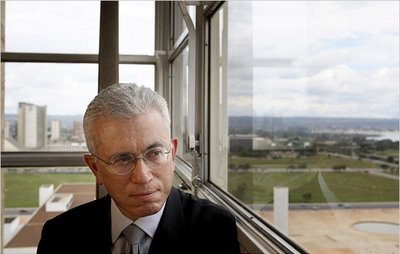
Roberto Mangabeira Unger coordinates Amazon planning in Brasilia.

To use a phrase from my younger days,
"This is the $64,000 question."

Here is what Unger says:


Go to Original

INTERVIEW
Development crucial to saving the Brazilian Amazon
By Todd Benson
Reuters

SAO PAULO, May 16 (Reuters) - The best way to preserve the Amazon rain forest is to develop the region and bring viable economic alternatives to the millions of people who live there, a Brazilian cabinet member said on Friday.

Roberto Mangabeira Unger, a former Harvard law professor picked by President Luiz Inacio Lula da Silva to coordinate an Amazon sustainable development plan, also said Brazil would not be lectured to by foreign countries about conservation.

"We are taken aback by those who scold us, who warn us, since we see countries around the world that are talking from a high chair after having devastated their own forests," Unger, minister for strategic affairs, said in an interview.

"The Amazon is not just a collection of trees. It is also, and above all, a group of people," he added, noting that the vast region is home to 27 million people out of Brazil's total population of 185 million.

"If these people lack economic opportunities, the practical result will be disorganized economic activity, and disorganized economic activity will lead relentlessly to deforestation. The only way to preserve the Amazon is to develop it."

Unger was thrown into an unwanted spotlight this week when Marina Silva, a former rubber tapper who was hailed globally as a champion of the green movement, resigned her post as environment minister after losing a slew of battles in her efforts to protect the Amazon.

According to aides, the last straw came last week when Lula overlooked Silva and instead chose Unger to oversee the implementation of a government initiative to develop the Amazon in a sustainable way.

CALLED LULA GOVERNMENT 'MOST CORRUPT'

Unger, who three years ago denounced the Lula administration as the "most corrupt in Brazil's history," defended the president's decision to put him in charge of the Amazon initiative.

"The people who think it's natural for development of the Amazon to be undertaken by an environment ministry just don't understand that the Amazon is more than a forest," he said.

"An environment ministry lacks the instruments to deal with all the many problems of transport, energy, education, and of industry that are required to formulate and to implement a comprehensive development program."

Unger, who was born in Brazil but has lived most of his life in the United States, has long been politically active in Latin America. He is best known for his efforts to push for an alternative to neoliberalism, the label often given to the view that free-market economics and development go hand-in-hand.

But he is a newcomer to the environmental debate in Brazil, raising doubts about whether he is the right person to oversee the Amazon plan.

Jorge Viana, a Lula ally and former governor of the Amazon state of Acre, said in a radio interview on Thursday: "I respect Professor Mangabeira Unger, he's a Harvard professor, the professor of the professors. But when it comes to the Amazon, I think he's a student."

Silva's successor in the Environment Ministry, Carlos Minc, has suggested that Viana might be better equipped for the job.

Unfazed, Unger is already moving forward with the plan and is about to embark on a tour of the Amazon to hammer out development strategies with state governors.

"The Amazon is the frontier, not just of geography but of the imagination. It is our great national laboratory," he said. "It is the space in which we can best rethink and reorganize the whole country, and define this new model of development."

The International Media are starting to explode with stories on recent events in Brasilia and the Amazon. Here's a pretty critical view from SPIEGEL Online and a special in-depth series from BBC on seeking an Amazon solution . Mongabay maintains an on-going aggregator of Amazon conservation news where you can find a lot of in-depth scientific analysis that is not reported in the general media.


Wednesday, May 14, 2008

BRAZIL'S MINISTER OF ENVIRONMENT
MARINA SILVA RESIGNS


Marina Silva

Marina Silva, a longtime darling of the international environmental community, resigned yesterday in protest of Brazil's development policies.

[UPDATE 15 May 2008: More analysis from the Independent and from the BBC.]


Brazil's Environment Minister Marina Silva Resigns
Go to Original

By Adriana Brasileiro and Heloiza Canassa

May 13 (Bloomberg) -- Brazil's Environment Minister Marina Silva quit today after five years in office, citing difficulties in implementing a nationwide environmental agenda.

``During my trajectory, Your Excellency was a witness of the growing resistance found by our team in important sectors of the government and society,'' Silva wrote in a letter to President Luiz Inacio Lula da Silva today. A copy of the letter was e-mailed by Environment Ministry spokeswoman Gerusa Barbosa.

Silva, 50, a former rubber tapper, strengthened laws for logging and farming in the Amazon. She also made it harder for companies to obtain licenses for port, energy and transportation projects.

``She was the environment's guardian angel,'' said Frank Guggenheim, executive director for Greenpeace in Brazil. ``Now Brazil's environment is orphaned.''

Silva gave up after being forced to share some of her responsibilities for drafting policies for the sustainable development of the Amazon region, Guggenheim said.

Strategic Matters Minister Roberto Mangabeira Unger this year designed a plan for sustainable development in the Amazon and last week presented the plan to Lula and his ministers.

Lula last year also removed the responsibilities for environmental licensing from Brazil's Environmental Agency Ibama, weakening Silva's power over concessions for infrastructure projects.

Silva's Efforts

Ibama's president, Bazileu Alves Margarido Neto, also tendered his resignation today following Silva's decision, a spokeswoman with the agency said.

Carlos Minc, Rio de Janeiro state's secretary for the Environment and a Green Party founder, will replace Silva, Folha de S. Paulo's online edition reported today. Rio de Janeiro's state Secretariat didn't return messages seeking confirmation. Barbosa at the Environment Minister declined to comment.

Silva was born in the state of Acre, in the western part of Brazil's Amazon region, and worked extracting rubber from trees in the forests. She met Amazon activist Chico Mendes, and joined his efforts to organize peaceful demonstrations against deforestation. Mendes was assassinated in 1988.

She was elected to Brazil's Senate in 1994 and was appointed Environment Minister in 2003, when Lula won the election for his first four-year term in office.

Environmentalists say her years as ministers were filled with conflicts with government officials and investors, as she set more rigid rules for logging licenses and blocked infrastructure projects that didn't respect legislation.

``She relentlessly stood up to agriculture barons and developers who didn't care what they did to the environment, and she paid a high price for that,'' Guggenheim said.

Monday, April 21, 2008

WHY BOTHER?

Michael Pollan - Salon Photo
Michael Pollan graphic from Salon.


"Why Bother" is the title of a brilliant article that appeared yesterday in the NY Times Magazine. In it Michael Pollan asked why, -- if half of the world is standing in line wanting to experience the American habits of material consumption [it used to be called the "American Standard of Living"] -- why on earth, should Americans bother trying to reduce their carbon footprint? He actually offers some very good reasons. I urge you to consider what he says. Read the article.

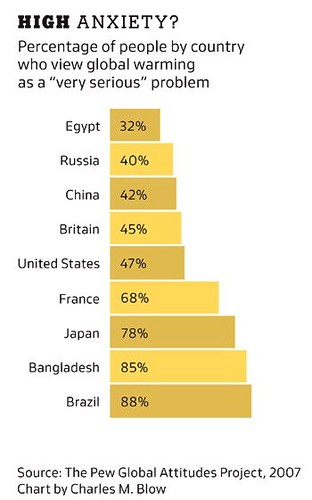
Meanwhile I am very pleased to report that Brazil is now the leader in public opinion considering global warming as a "very serious problem."

Concern about Global Warming

You may wonder why I am pleased? It is because Brazil is both a natural resource giant and a rapidly developing economy. The United States did not have much of an ecological consciousness as it bulldozed its development path through the destruction of 90% of its original forests. But Brazil, with 80% of its vast forests (an area the size of Western Europe) and a treasure trove of natural beauties still in a pristine state has an opportunity to choose more ecologically aware strategies. The already developed world can best "make up" for its own highly destructive ways of the past by supporting Brazil in its efforts to find better ways now.

Friday, November 23, 2007


"GOD IS BRAZILIAN"
, Brazilian President
Luiz Inacio Lula da Silva said on Tuesday in response to his
government's announcement earlier this month that massive
new oil reserves had been discovered offshore.

And, the discovery of TERRA PRETA
may prove that She is Black.

Aparecida


This image is of the much-revered Black Madonna of Brazil, Nossa Senhora de Conceição Aparecida -- Our Lady of Conception Who Appeared.

The story is that a statue of the Virgin made around 1650 was somehow lost. Then, in 1717, some government people were traveling north to the gold mining region of Minas Gerais where the precious metal was called Ouro Preto due to a dark coating on the nuggets. Along the way fishermen cast their nets in a river hoping to catch fish for a big banquet. Instead of fish, they found the statue -- all darkened by years in the river bed. The travelers went on but the statue was kept in a little family shrine.

Soon the statue appeared to have healing and wish-granting powers -- at least for some faithful ones -- and a cult began to grow around it. As time passed, it had to be housed in larger and larger quarters and came to be venerated throughout Brazil. In 1929, the Virgin was proclaimed Queen of Brazil and its official Patron Saint. Today its Basilica, in the city of Aparecida near São Paulo, receives about 7 million visitors yearly and is the largest Marian shrine in the world.

From the first time I saw this great Black Madonna, the symbol appeared as an icon of the power of the earth. And, nowadays, there is a possible parallel with the story of 200 hundred years ago. As the Brazilian state oil firm Petrobras looks for and discovers another kind of Ouro Preto in the form of oil extracted from the ocean depths, Terra Preta soil from deep in Amazônia may be emerging as the healing force of the earth.

It would be Brazil's great good fortune to receive both.


Sunday, November 18, 2007

“What we do in the next two to three
years will determine our future. This
is the defining moment.”


-- Rajendra Pachauri,
director of the UN's International Panel on Climate Change


The story that defines what we might do has been
emerging from Brazil.

It's a golden opportunity.


First, the story...

Once upon a time, way back in the sixteenth century, the Spanish Conquistador Francisco de Orellanawas the first European explorer to travel down length of the Amazon River. Starting in Peru and into the Rio Negro, a huge tributary, upriver from present-day Manaus, the exploration traversed the continent to the Atlantic Ocean. For Orellana and his unfortunate companions it was a terrible trip plagued with every kind of adversity which, in the end, left him as the sole survivor to return to the Court of the King of Spain to tell the story.

But what a story it was. We might even speculate that Orellana survived the ordeal in order to complete his mission of telling of having found Eldorado -- fantastic golden cities in the heart of the forest of the New World. Orellana reported something even more unbelievable than gold -- there was an advanced indigenous civilization with many high density human settlements. Huge Indian populations were living along the waterways of Amazônia and, according to Orellana, at one place there was a city of continuous side-by-side houses stretching for twenty miles. His tale was both fantasic and fabulous. I doubt that the Spanish Court could really embrace the thought of a civilization more advanced than their own but they sure could imagine the gold.

Gold lust inspired many later adventures across the New World but none could find the fabled Eldorado. It was nearly a century later that missionaries came to the region explored by Orellana, but they reported finding only small nomadic bands of hunter-gathers roaming the forest. The obvious conclusion was that Orellana had fabricated a great tale to mask his own failed expedition. And, much later, a whole generation of modern scientists confirmed the implausibility of an Eldorado in the forest by noting that the nutrient poor Amazon soils could not have supported a large-scale agriculture which is the prerequisite of civilization.

But this "well etablished view" that the Amazon basin could not have contained large human populations has started to crumble. First with new research in Bolivia and, more recently, in central Amazõnia, scientists are discovering tell-tale signs of ancient large-scale populations. The indians appear to have figured out how to transform the nutrient-poor yellowish soils into deep deposits of an extremely fertile dark earth called terra preta de indio. What are these tell-tale signs? Terra preta soils are loaded with pottery sherds and charcoal. The pieces of ceramic are in the contour of large pots and vessels that could have been used only by stationary populations. And the charcoal -- apparently char from cleared forest -- has been ground into small pieces indicating that these soils were "made" by the local residents.

The resulting soils are amazingly fertile -- sometimes producing nearly 800% more plant growth compared with nearby untreated soil -- and clearly capable of supporting a large-scale agriculture. Also anthropologists have found at least one small tribe with an hierarchical cultural structure suggesting a distant past of living among large sedentary populations and not always as nomadic hunter-gathers.

Recent efforts to map the areas of terra preta soils along the Tapajos River have unearthed esquisite 2000 year-old pottery. Carbon dating of soils in some other areas suggest that they may be 2500-4000 years old -- and still fully fertile which is extraordinary in the Amazon where heavy rainfall typically leaches the nutrients out of the soils rather quickly. Interestingly, the mapping efforts are revealing a close correspondence with the Eldorado areas talked about by Orellana.

So what happened to these lost civilizations? No one knows for certain. There's little hard evidence because there is no stone in the area and the wooden structures were quickly reclaimed by the tropical forest. But the best speculation is that the first European expeditions carried in diseases -- smallpox, measels, flu, even the common cold -- to a population that had so harmoniously co-evolved with its niche that it had no disease ... and no need for immunity. After a catastrophic die-off there were only a few survivors who had devolved back into hunter-gathers. The sole legacy of the civilization remained hidden in the soil.

Today, in some areas, terra preta is harvested and sold as potting soils. If a limited amount (about 20 cm deep) is retained and the area then left fallow it will grow back to full depth in about 20 years. Apparently -- get this! -- terra preta soils develop into organic communities that are capable of growing like a biotic culture as in sourdough bread or yogurt, truly a living earth.

Five years ago, England's BBC did a special TV documentary called The Secret of Eldorado that concluded with these words: "So there is a true irony to the story of the hunt for El Dorado. There was once a great civilisation in the Amazon, one the Europeans destroyed even as they discovered it, but the Amazonians may have left us a legacy far more precious than the gold the Conquistadors were seeking. That black earth, the terra preta, may mean a better future for us all."

A golden opportunity.

At the time of the 2002 BBC documentary, a better future was understood as gaining the ability to BOTH save the rainforest and feed more people. But, now, global warming has added an incredibibly important new dimension -- the need to remove CO2 from the atmosphere and sequester it somewhere. This is exactly what terra preta does because 1) plants that grow faster, also remove CO2 from the atmosphere faster and 2) if the agricultural waste (unused portions of the plants) are made into charcoal, it can be used to renew the soil and sequester carbon.

The result of such a system would mean better soil, more food, cleaner fuel, less deforestation and, if Kyoto is revised to include payment for carbon negative sequestration in the soil, developing countries like Brazil and poor farmers everywhere will be paid to save the earth, while growing both food and fuel. This is why terra preta is being called the "new black gold".

Everyone, who thinks of Brazil, knows of its gifts of samba and soccer which are world renown. But Brazil is also the place where the gift of light emerges out of darkness. When gold was discovered in the state of Minas Gerais, it was given the name ouro preto (black gold) because the nuggets had a dark coating. Later, when a statue of the Virgin with dark skin was discovered in a river bed, it was named, Nossa Senhora Conceição de Aparecida (Our Lady of Conception who Appeared) because it appeared to have wish-granting and healing powers. And, for me, this image is one of the great symbols of the fertility and abundance of Mother Earth.

Nossa Senhora Conceição de Aparecida

This Black Madonna became the patroness of Brazil and the center of the largest healing shrine in the world. Perhaps She is also a powerful symbol for the possibility of healing the earth.

Nowadays, we have the rediscovery of an empowering dark earth brew called terra preta, along with speculation of an ancient and highly advanced Indian civilization. Perhaps terra preta will be Brazil's greatest gift yet to the world. Perhaps we can all spread the story about how there once was a time when large numbers of people lived in a bountiful harmony with the earth in a place called Eldorado and that, with love and care and attention, we can repeat the performance.

Here are links to more information:

Australian Broadcasting Company video (11 min) about the global terra preta movement.

GREAT BBC Documentary "The Secret of El Dorado" (49 min video)

Full transcript of BBC El Dorado documentary.

Easy to read primer on Terra Preta.

Expandable Google map of Terra Preta sites.

Pdfs of the best magazine articles.

Continuous updates of all relevant links.

How biofuels can become carbon-negative and save the planet.

US Senator introduces bio-char legislation.

Research confirms bio-char in soil increases yields.

Biopact on the IPCC bio-fuel recommendations.

UPDATE: This post has been linked in a roundup by Global Voices Online, and translated to Portuguese here.


Saturday, November 17, 2007

WHALE FOUND 1000 MILES INSIDE AMAZON

whale-amazon-reuters
Residents of Brazil's Amazon basin try to help a minke whale reach deeper water.
Photograph: Reuters


By Tom Phillips reporting in the Guardian.

Biologists and villagers in a remote corner of the Amazon rainforest were searching for a 12-tonne whale yesterday that had reportedly lost its way and become stranded 1,000 miles from the ocean.
The five-metre long (16ft) creature, which biologists said was probably a minke whale, became stranded on a beach on the Tapajos river, 39 miles from the city of Santarem. Environmental experts said the whale had probably become separated from its group in the Atlantic Ocean, off northern Brazil, after falling ill or being hit by a boat.

The whale appeared to have entered the Amazon near the city of Belem before reaching the Tapajos, a tributary of the Amazon. Efforts to rescue the animal began on Tuesday, after local fishermen contacted environmental officials in Santarem by radio. On Thursday biologists arrived at the scene by boat and isolated the sandbank.

Residents of Piquiatuba, an isolated settlement of about 70 families in the Amazon state of Para, also helped to try and free their unexpected visitor, splashing water onto its skin to protect it from the scorching sun. Images broadcast on Brazilian television showed dozens of fishermen and curious locals crowded together in the river around the whale's large grey fin.

On Thursday night after rescuers managed to free the whale it disappeared into the waters. Environmentalists used helicopters and boats to try and find the whale, without success.

"What we can definitely say is that it lost its way," Fabia Luna, a government biologist involved in the rescue, told Globo television. "It entered the river, which on its own is unusual. But then to have travelled around 1,500km is both strange and adverse."

"It is very atypical [to find] a whale in Amazonia," Katia Groch, a whale expert from the Instituto Baleia Jubarte (humpback whale institute), told the Folha de Sao Paulo newspaper. "It may have lost its way, perhaps because of illness. We will only know when we can examine it."

Although the whale's presence was only confirmed this week, Daniel Cohenca, the regional head of Ibama, Brazil's environmental agency, said it may have been in the region for up to two months.

In recent weeks residents near the Tapajos river are said to have become alarmed at the presence of an unidentified animal. Some locals had ordered their children not to swim in the river after rumours spread that a "big cobra" had been spotted.

"There are people who just don't understand how this kind of animal survived in fresh water," said Cohenca.

Rescuers fear that, alone, the whale will have difficulty returning to the Atlantic.

"It is outside of its normal habitat, in a strange situation, under stress and far from the ocean," said Groch. "The probability of survival is low."

SEND PRAYERS

Friday, November 09, 2007

AMAZÔNIA: WHAT WILL BE THE FUTURE?
1016co_nasa

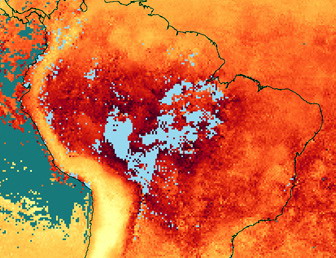
The above photo from NASA shows the concentrations of carbon monoxide (grey areas) hovering over Amazônia during September 2007. Carbon monoxide indicates smoke, fire, greenhouse gas pollution and, of course, deforestation. Burning and cutting the tropical rainforests now contributes more than 20% of global greenhouse gas pollution.

It is now believed that the eastern half of the Amazon forest, located in Brazil, may be seriously at risk. "It's not out of the question to think that half of the basin will be either cleared or severely impoverished just 20 years from now," stated Dr. Daniel Nepstad, head of the Woods Hole Research Center's Amazon program. "The nightmare scenario is one where we have a 2005-like year that extended for a couple years, coupled with a high deforestation where we get huge areas of burning, which would produce smoke that would further reduce rainfall, worsening the cycle. A situation like this is very possible." Read more at Mongabay.

The future Amazon will be the result of choices made by Brazil and the rest of the world in coming years. John Terborgh, writing in the current NY Review of Books tells us how it looks from the highest levels in Brazil:

What is the attitude of the Brazilian government toward a possible climatic calamity in the Amazon? On being shown the predictions of some climate models, President Luiz Inácio Lula da Silva reputedly posed two alternatives. If the rest of the world is so concerned about the future of the Amazon, then let the rich countries pay us not to cut it down. Otherwise, if the forest is going to succumb to drought and fire, then we ought to cut it down first so that we can benefit from the resources before they are lost to the ravages of nature.

Not everyone will be happy with these alternatives, but Lula's pronouncements may not be that far off the mark. The Amazon is being logged at a prodigious rate and with further improvements in transportation envisioned under the Avança Brasil program, logging, and with it the risk of fire, is bound to spread over much of the basin. Slowing or stopping the logging would require a political will that simply doesn't exist in a country obsessed with maximizing development.

Which of Lula's alternatives will the future bring, a green Amazon supported by an international community united against the specter of radical climate change, or a brown Amazon, parched by deforestation and scorched by fire? In my view, the prospects of the green alternative will be determined by the treaty that will succeed Kyoto. At Kyoto, it was decided not to include forests in a system by which carbon emissions are controlled through "cap-and-trade"—i.e., by allowing countries that cut back on emissions to receive tradable credits for doing so. Many now feel that the omission was a mistake because forests store such huge stocks of carbon. Yet how forests will be brought into a second-generation treaty is anyone's guess. Short of significant international intervention through financial incentives or other mechanisms, the business-as-usual scenario will certainly prevail.


Kyoto is about to be reformulated. The choice over the future of Amazônia is likely to come soon. There's been some foolish talk about who owns the Amazon forest. Without doubt, it is owned by Brazil and its neighbors. But the financial choice over its future is clearly owned by all of us.


Wednesday, November 07, 2007

US Ethanol Subsidies Help Fuel Range Wars and Fires in the Amazon


On Monday (11-05-07) US National Public Radio ran a feature segment on "All Things Considered" about the record 2007 fire
season in the Amazon and the situation in Mato Grosso. The photo at the left shows a fire that was intentionally set on neighboring property in the struggle over land titles but spread and eventually burned 90% of John Carter's 22,000 acre ranch.
(photo credit: npr)
Click to hear John tell the story.

This year's fire season dominated the US news for many days as a "national disaster" was declared in southern California because Santa Ana winds whipped about 25 fires into a local frenzy. But compared to the Amazon it would seem no more than a few embers. Mongabay reported some astonishing fire statistics -- depending on which satellite data set is used, this season there were between 50,729 and 72,329 Amazon fires, close to or more than the all-time record.

Here is a NASA satellite view of the fires burning in the states of Mato Grosso, Para and Amazônas on September 29, 2007. The most intense burning is located in areas that had been opened by roads, and now the fires were spreading across agricultural lands and protected reserves as well. Road-building comes first, then a mix of development and protection but fire respects neither.

1016nasa

Unfortunately, these data seem to end speculation that the reductions of fire and deforestation seen in Brazil across the last 2-3 years were the results of aggressive new government initiatives of regulation, monitoring and enforcement. Instead, it appears that variations in the amount fire and deforestation are more closely correlated with fluctuations in global commodity prices, which now are recovering from a recent slump.

While many factors influence the rate of fire and deforestation, the main driving force seems to be the planting of soybeans. The Mongabay report offered the views of two leading scientists:


Dr. Philip M. Fearnside, one of the most widely cited experts on the Amazon, says that the rise of soy in the region has provided support for infrastructure projects which, in turn, have fueled forest destruction.

"Soybean farms cause some forest clearing directly. But they have a much greater impact on deforestation by consuming cleared land, savanna, and transitional forests, thereby pushing ranchers and slash-and-burn farmers ever deeper into the forest frontier," he explained after co-authoring a 2004 paper in Science on the impact of soy. "Soybean farming also provides a key economic and political impetus for new highways and infrastructure projects, which accelerate deforestation by other actors."

"What’s most striking is that fires in 2007 have increased dramatically in the main soy-production states in the Brazilian Amazon—Mato Grosso, Para, Maranhao, and Tocantins—but have dropped or remain stable in other Amazonian states," said Dr. William Laurance, a senior researcher at the Smithsonian Tropical Research Institute (STRI) in Panama and another noted Amazon scientist. "Clearly, soy farming is becoming a major driver of land-use change in the Amazon. The international consumers of Brazilian soy need to understand its key role in driving Amazon deforestation"
Rhett A. Butler, 2007 Amazon Fires Among the Worst Ever, October 22, 2007.

And what has caused soybean prices to recover in the global market? Many factors, but chief among them are the new US ethanol agricultural subsidies that have been been causing midwestern farmers to shift from beans to corn. The new "greening of fuel" in the US -- supposedly to fight global warming -- is a big force fueling the fires in the Amazon. It is now thought that, tropical deforestation accounts for more than 20% of the greenhouse gas emissions worldwide, which is more than the amount contributed by the entire transportation sector.

It's a small world where everything is connected to everything. There simply is no people, nor place, nor process that does not bump up against everything else.


Tuesday, November 06, 2007

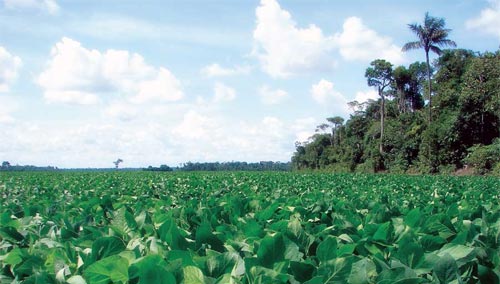
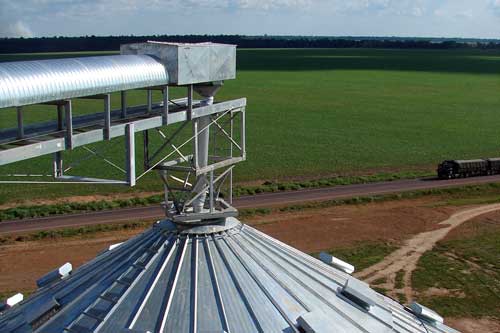
SOY IN THE AMAZON

joseph-01-thumbnail
Photo by Pat Joseph

Pat Joseph, writing in the special South American edition of the Virginia Quarterly Review, has given us one of the most thorough, honest and challenging reports on the dynamics of deforestation in the Cerrado and Amazon that I have encountered. I'm going to draw heavily from it in this post. I really urge you to read it in full as there's no way a few excerpts can do it justice.

Pat's report is from Mato Grosso State which in recent years has been the scene of massive burning, deforestation and a center stage for global environmental concern.

He traveled the area with an "americano-brasilieiro" agricultural consultant who wrote him an email saying:

Dear Pat: I am a Brazil/Mato Grosso fanatic. I love the pioneer spirit, the wide-open spaces, and positive attitude among the dynamic farmers in the area. Lucas do Rio Verde, Mato Grosso, is the Garden of Eden in my opinion. My friends there are a pioneer success story. ... in the middle of “soybean ground zero” on the whole planet.

joseph-02-thumbnail
Photos and italicized text above and below from Virginia Quarterly Review

I know this success story. I was born in Chicago. Later, I lived for 14 years among the corn and soybean fields of central Illinois. Many of my friends were the children of the similarly enterprising pioneer families that had drained the wetlands and wiped out the native prairie. They were hard-working, ambitious, and no-nonsense Midwesterner farmers and also very friendly, generous and justifiably proud folks, mostly of German heritage. Just like in Mato Grosso, except for the fact that the average farm size in Illinois was about 600 acres, whereas here it can run 20,000 acres (and upwards) and the new success stories can put Horatio Alger to shame.

I didn't remain in Illinois, I found that I just wasn't a flatlander by nature. In 1982 I moved from the corn and bean fields to the forests and mountains of Oregon seeking the romance of wild places and wilderness solitude. I was part monk, part adventurer, part burned-out political activist and part hippie dropout. Oregon seemed like the perfect spot. I even found a place to live in the Illinois Valley, the river of which begins at a spring flowing from a mountain called Chicago Peak. But, as a midwesterner, I had no idea of the massive deforestation taking place in National Forests. When I saw it, I was shocked. My new home, where I had come to get away from it all, quickly thrust me back into politics as a tree-hugging hermit activist trying to save the remaining 10% of the US ancient forests.

Twenty-five years later, I am now in Brazil, as sort of a spiritual pilgrim following the Queen of the Forest by exploring the path of Santo Daime. And that leads me to places like Acre State where I am finding the spirit of America in Amazônia and facing the classic dilemma confronting a visitor from a rich and consuming society to a new world of economic development and rising expectations. One can not look at this most incredible forest on earth, witness the massive deforestation and not wonder, "whose forest is this anyway, does it not also belong to the world?"

That very same question confronted Pat Joseph in Mato Grosso (two states away from Acre but also in what is called the Amazon "arc of deforestation"). Here's his description of the historical context and the confrontation he faced on the ground:

Settlement of the Brazilian Amazon was sparked by the paranoia of the military government. The generals who ran the country for two decades worried that their unsettled borders and vast empty interior would tempt foreign encroachment on Brazilian soil. Occupar para não entregar. That was the slogan. One of many. “Occupy so as not to surrender.” Another was, “Land without men for men without land.” The generals built roads to encourage migration, then did little to manage how the process unfolded. ...

Even today, an undercurrent of paranoia runs through Brazilian society when it comes to the Amazon, their sense of threatened sovereignty stoked in part by the ill-considered comments of well-meaning politicians such as Al Gore, who once insisted that, “Contrary to what Brazilians think, the Amazon is not their property. It belongs to all of us.” One need only imagine how Americans would feel if foreign leaders made similar pronouncements about, say, Alaska. Not long before I arrived in Brazil, David Miliband, the British environment secretary, was touting a proposal—one enthusiastically supported by Tony Blair—to set up an international trust that would effectively buy a vast portion of the Amazon and manage it as a preserve. The Brazilian response to the idea was swift and unequivocal. President da Silva issued a resounding demurral. “The Amazon,” he said flatly, “is not for sale.”

On a long bus ride across the Cerrado, I sat next to a schoolteacher on vacation and a pastor who was returning to his flock. ... While reclined in his seat, the young pastor ... turned his head toward me and said, “Tell me, why do Americans worry so much about our forest when they cut theirs down in the name of progress?”

In one form or another, I’d had the question put to me many times in Brazil. ... the pastor had a point. What difference did it make that our frontier had closed a century ago? All that meant was that our ancestors did the dirty work for us. And dirty work it was. In conquering the continent, North American settlers had exercised every kind of depravity. We dammed and straightened and diverted our rivers and riprapped their banks. We overgrazed our prairies and drained our wetlands. We cut down our old-growth forests and introduced alien species that grew like weeds in their stead. We hunted down and poisoned predators because they ate our livestock and “our” game. We killed off most of the bison and decimated the salmon. Even now, we’re draining our aquifers, blowing the tops off mountains to get at the coal seams, sinking wells in the gas fields of the West as fast as we can. And how did it all look from Brazil? The United States exploited its resources with a vengeance, and it was rich, the most powerful country in the world. To Brazilians, our high-minded concerns about the rainforest were the rankest sort of hypocrisy—or worse, a conspiracy to keep Brazil from developing into a major economic force in the hemisphere.

Near the end of my trip, Kory and I spent a morning in Sinop being lectured to by the president of the rural syndicate (a coalition of local farmers and loggers). Antonio Galvan is an irascible man with steely eyes, the build of a wrestling coach, and a voice like a broken horn. He was clearly annoyed by the presence in his office of two meddlesome gringos, and, after one question, set off on a tirade that lasted the better part of an hour. His rant was peppered with the words absurd and ridiculous, each point punctuated by a forearm pounding the desk. If you don’t want me to farm, then pay me, Galvan cried. Bam. No one else in the world produces and preserves at the same time! We leave 80 percent of the Amazon untouched! We leave the forest along the rivers standing! Bam. Who else does this? Don’t tell me about how many football fields of Amazon are disappearing every minute. It’s absurd! Bam. Ridiculous!


If you think that Pat Joseph might be exaggerating the tensions facing an outside reporter or (worst) an environmentalist in Mato Grosso, just watch this video from Greenpeace:


What can I say about this? Yes, I (and many friends) have "been there, done that." We sat in front of the bulldozers, climbed the trees, faced the angry locals, made it all the way to the national and international media, and guess what? The big trees are still being cut in Oregon. I came to Brazil in hopes of finding a better way, one that might go beyond the first step of raising awareness (thank God for Greenpeace), to find a path along which true preservation and local sustainability might be achieved. So here in Brazil, I am doing something that I wasn't very good at back in Oregon -- I am listening to the local people.

I read the words of the local leader Antonio Galvan:

If you don’t want me to farm, then pay me.

We leave 80 percent of the Amazon untouched!

No one else in the world produces and preserves at the same time!


I believe that he is asking the right questions:

Who will pay the developing world to avoid the the easy but mistaken path that was followed by the developed world?

Brazilian law requires that 80% of the forest be preserved. But so what, when much of the present logging is done illegally? What will give local people an incentive to follow the rules and protect the forest?

It's true that no one protects and produces at the same time -- at least that's the way it has been. But there is a new world of global warming that demands that we do both and a dream of restoration and renewal that promises that we can.

These, indeed, are the three questions that must be answered. I will be discussing them in coming posts. Stay tuned, and please read Pat's full story Soy in the Amazon.

Monday, November 05, 2007

SOUTH AMERICA IN THE TWENTY-FIRST CENTURY

252_252_2007F-cvr

The Virginia Quartery Review has produced a GREAT special edition on South America. Editor Daniel Alarcón says, "After eighteen months of work, we are extraordinarily proud of this project and delighted finally to be able to share it with you. We hope that you will be as challenged and enthralled in reading this issue as we were in editing it."

"Enthralled" may be too weak a word. You really should check it out. I found the article "Soy in the Amazon" by Pat Roberts to be an absolute "must read."


Tuesday, October 30, 2007

Magical Matutu

IMG_6214

The Matutu Valley of southern Minas Gerais, Brazil is one of those magical places, almost mythic like a Rivendel or Shambala or a fantasy kingdom. It keeps drawing me back to reconnect with the land, the places and the people. And, of course, there is always a new batch of photos.


The magnificient Mantiqueira mountains, the magical temples, churches, pioneer buildings, shops, trout farms, and wonderful people all make this a place not to be missed.

IMG_6321

IMG_6346

IMG_6660

IMG_2553

The plants and flowers are spectacular.

IMG_2971

IMG_3413

IMG_2951

IMG_6300


And this time there was a great day of horse riding up on the Maçieira with Guilherme França and friends.

IMG_6098

IMG_6097

See the full collection here.