The Big Biochar Experiment is a UK-wide initiative and is the largest study on the use of biochar on British allotments to date. The Experiment aims to gather data to assess the effects of biochar on plant productivity and soil health of widely used fruit and vegetable varieties in the UK. The team is comprised of members of Oxford Biochar Ltd, Earthwatch, the Environmental Change Institute (Oxford University), and the UK Biochar Research Centre. Project partner Dr. Dan Bebber of Earthwatch said, “Biochar holds great potential for addressing some of our greatest challenges, including climate change and food security. This novel experiment will provide important insights on biochar's applicability to the UK farming industry, and allow people to get involved in real science."Wednesday, February 22, 2012
BIG BIOCHAR EXPERIMENT IN UK
The Big Biochar Experiment is a UK-wide initiative and is the largest study on the use of biochar on British allotments to date. The Experiment aims to gather data to assess the effects of biochar on plant productivity and soil health of widely used fruit and vegetable varieties in the UK. The team is comprised of members of Oxford Biochar Ltd, Earthwatch, the Environmental Change Institute (Oxford University), and the UK Biochar Research Centre. Project partner Dr. Dan Bebber of Earthwatch said, “Biochar holds great potential for addressing some of our greatest challenges, including climate change and food security. This novel experiment will provide important insights on biochar's applicability to the UK farming industry, and allow people to get involved in real science."Monday, April 25, 2011
To follow the unraveling mystery of biochar check out the International Biochar Initiative.
Mongabay's interview with Laurens Rademakers on the promise of biochar.
My "biochar reunion" with Kelpie Wilson in Brazil.
Saturday, November 06, 2010
This excellent short video is to promote the new book of Albert Bates, "The Biochar Solution: Carbon Farming and Climate Change."
"The Biochar Solution" doesn't make your eyes glaze over. Rather, it offers a clearly expressed view of ancient and future farming practice and wisdom from a guy whose feet are on the ground and whose hands are in the soil. Albert's opus is at the same time full of science and spirit. I give it 5 stars, for sure.
Friday, October 15, 2010

Kelpie and Lou at Ipanema beach in Rio de Janeiro
Kelpie Wilson and I have known each other for nearly 40 years, all the way back to the 1973-74 academic year at the University of Illinois where she was a politically-oriented freshman and I was the out-going "radical" professor who had become that year's "campus cause." Somehow, without even knowing each other personally we were destined to struggle for the same forest cause. As they say in Brazil, we were companheiros.
Back then we soon went our separate ways -- she to leave school to be an auto mechanic and then to return to school in California to become a mechanical engineer; I to leave school to be a carpenter/woodworker and then a backwoods guy in Oregon. We met again as we were both drawn to defense of the Siskiyou National Forest and the Kalmiopsis Wilderness. In the late 1980s Kelpie joined the Siskiyou project as a networker and rose to be its executive director and my boss. I was the storyteller and hermit. She was the one who stayed in the office and made things happen.

Siskiyou Project and friends (2001).
As the Clinton-Gore years passed to Bush-Cheney, Kelpie and her husband George perfected their owner-built off-the-grid home and she got busier than ever -- writing a novel and manuals for an alternate energy company and then becoming the environmental editor of truthout.org. Meanwhile, I started to spend more and more time in Brazil where I depended on the Internet for news from the States. My "filter" was mostly the articles that Kelpie selected as "important." One day her story about terra preta/biochar arrived and I was hooked.
Indeed, it was the terra preta vision that brought us both to the 3rd International Biochar Initiative meetings in Rio de Janeiro in September -- she as the IBI communications editor and I as a forest defender fascinated with Amazônia and its cultures.
Following the Rio meetings, Kelpie traveled to Manaus for a field trip to sites of terra preta de índios (photo essay here and here) where she listened to "Happy Birthday" being sung to her as she stood in a terra preta research pit.

Kelpie in the pit.
After Manaus, Kelpie traveled to far western Brazil to visit my new stomping grounds in Acre (bordering with Bolivia and Peru) where we spent time in the state capital of Rio Branco and in the countryside of Capixaba.

Nowadays, Acre is leaping into the 21st Century. In A Walk Through Time in Rio Branco I wrote:
In Brazil, where global warming was barely on the public agenda only a year ago, a new national political debate about sustainable development has emerged along with a growing awareness of global interrelatedness at every level – cultural, economical, ecological and political. Finding the sustainable balance among the many contradictory and opposing forces has already emerged as a major theme of the 2010 presidential election in Brazil and has erupted at Copenhagen.
I have no "crystal ball" to see the future but one thing does seem certain. The pace of change and development is moving faster and faster. Today, the rainbows and satellites are rising above the homes of Rio Branco and across Amazônia.
The 21st Century is about information. And the information is making us aware of our common planetary predicament. It is also giving us unparalleled opportunities to participate in creating the future for life on earth.
Kelpie came to gain and share information -- to learn from the people of this place and to bring news about terra preta and the new biochar tools.
With Flavio Encarnação as our guide, we started with the historical site of one of the early districts of Rio Branco and witnessed the old ways of gathering and curing rubber:
With the archeologist and geolyph researcher Alceu Ranzi, we visited a few of the 100s of archeological sites (ironically being revealed as a result of deforestation) that date back to the ancient inhabitants who are thought to have been here 1,000 to 2,000 year ago.
And then on to spend a few days at the community of Fortaleza in the rural district of Capixaba. Although Acre has approximately 80% of its land still in forest, the eastern portion of the state has been particularly hard hit as shown in this map of the deforestation up until 2006 (releasing 100 million tons of carbon).

I have previously written of my struggles to confront the dilemmas of development in this region (Chico Mendes, Capixaba and Change and Walking in Beauty). At the time, Kelpie commented with great empathy on both of those posts and concluded, "I think that engagement is what is important, not the ultimate outcome, which we will never know." Now she was here to see for herself.
It was a rough introduction traveling from the town of Capixaba to the rural site of Fortaleza -- 15km on a motorcycle across dusty roads through clearcut landscapes parched from the drought and under smoke-laden skies from the regional fires. What a relief to arrive at Fortaleza (the Fortress) where there's an on-going effort at small-scale farming combined with preserving the remaining forest.
When she saw the abandoned pottery kiln, of course she said, "this needs to be making biochar."

Probably, our most fun experience came during an afternoon canoe trip on the Xipamanu river which borders with Bolivia. The day was hot despite the fact that the sun was nearly obscured by smoke and due to the drought the river was too low to use the motor on the big dugout canoe which had to be pushed along with poles and dragged over submerged logs. A round-trip that normally takes about 2 hours took more than 5 and we returned well after dark. It was quite an adventure but each little challenge or disaster was greeted with laughter and harder work. Kelpie and I agreed about the result, it was one of the best river trips ever!
Returning to Rio Branco, Kelpie began a series of biochar presentations. It started slowly with just a few folks in attendance at the library of the forest.

But they surely spread the word and Kelpie's presentation at the Secretariat of the Environment brought out 15 people and all 3 local TV channels.
And next came the AgroForestry Extension and Family Production Service where 40 specialists were fascinated by biochar's potential for applications in Acre.
On the way to the airport, at lunch with Janaina, Luis, and Yara, Kelpie managed to squeeze in one last presentation and it all ended at the airport with a happy farewell and fond wishes that she will return.
And what was the impact of this flurry of activity?
Just a few days after her departure, Flavio Encarnação, who is a professor of theater and who volunteered to be Kelpie's local translator, was himself giving a biochar presentation to the director of the Chico Mendes Park during the local 10/10/10 Climate Change Work Party which drew 75 to carry forth the work.

As Kelpie said, "I think that engagement is what is important, not the ultimate outcome, which we will never know."
What is clear is that Kelpie planted some good seeds and many Acreanos are grateful for her visit.
Monday, October 11, 2010
RIO BRANCO AC, BRAZIL
and BEYOND

On October 10, 2010 people at more than 7347 events in 188 countries got to work to take on the climate crisis. Here's how the days events unfolded at Uninorte City University in Rio Branco AC, Brazil.
Vera Reis welcomed a group of about 75 people who turned up early on a Sunday morning. Vera and the students in her environmental studies class, conceived and organized the day's events.

Federal University of Acre ecology professor and Woods Hole Research Center scientist Foster Brown made an eloquent plea for citizen action to counter the trends in global warming, saying the time is running out.

After reviewing the current scientific understanding of climate change, he spoke of the 350.org movement and how it is making the abstractions of science and the invisible workings of the atmosphere visible to people around the world.
The audience watched with concern, wondering what might be done to alter the dangerous trajectory that humans have been taking on earth. How might real change begin? Here?

Foster told the inspiring story of Acre's own Frei Heitor who once imagined:
Imagine, he said, that he and Father Andre, another Italian missionary, convinced each other how to live in harmony with the earth and with each other. On the next day, Friar Heitor and Father Andre convinced two others. On the third day the four of them convinced four more, and so on for subsequent days. How many days would it take to convince the world’s population to live in harmony? Friar Heitor worked out this calculation during a canoe trip up the Acre River in April.
“Thirty-three days!” He exclaimed, banging his fist on my knee. “We can change the world, in a month, if we want to!”
Everyone headed outside to create a human 350 icon and show off the tree seedlings that they intend to plant, a performance leading to action.
Then Flavio Encarnação told the story of the fertile Amazon soils called Terra Preta de Índios and how modern day pyrolysis could make biochar from agricultural or organic wastes and be used to sequester carbon in the soil and increase plant productivity, offering partial solutions for both global warming and hunger.

Which led to further conversations with Marta about the possibility that biochar might be used to restore a forest on degraded land adjacent to the Chico Mendes Park, right here in Rio Branco.

And so it goes. First there's a good idea like the 350.org movement or the International Biochar Initiative. Then a conversation gets started. And then comes local action. It might not happen in the 33 days of Frei Heitor but surely this is how the world can be changed.
Here are some early highlights of how it is starting to happen around the world.
Many thanks to Vera, Foster, Flavio and all the other volunteers who made 10/10/10 DIA GLOBAL DE SOLUÇÕES CLIMÁTICS in Rio Branco a most successful day.

Thursday, August 12, 2010

With the report last week of biochar's potential for reducing nitrogen pollution and the just-released report that biochar may be able to reduce overall concentrations of atmospheric carbon by as much as 12 percent, biochar news is really on a roll.
Here's the round-up of recent news from the International Biochar Initiative:
- Charcoal takes some heat off global warming Press Release: Pacific Northwest National Laboratory08/10/2010
- Delivering biochar's triple win BBC News08/10/2010
- Biochar Could Put Huge Global Dent in Greenhouse Gases Discovery News08/10/2010
- Biochar Alone Could Offset 12% of All Human Greenhouse Gas Emissions: Study Treehugger08/10/2010
- Green machine: Don't burn plant waste, bury it New Scientist08/10/2010
Most interestingly, biochar seems to be bridging the chasm of political polarity.
Here is conservative Andrew Sullivan saying at The Daily Dish, "The Only Solution May Be Technology" and liberal Brad Plumer saying at The New Republic, "Yes, Biochar Really Might Be Magical."
Might Biochar not only be a nature and people win/win but a left/right political win/win as well?
If you are new to the biochar concept, here is a brief video introduction (with translation into Portuguese).
Here is one of the leading biochar experts, Johannes Lehmann, Associate Professor of soil biogeochemistry at Cornell University, discussing the characteristics of naturally occurring terra preta including its agricultural and carbon sequestering benefits. He then turns to considering the factors involved with implementation industrial biochar systems for large-scale carbon sequestration and energy provision. Watch this for the BIG PICTURE.
For the "small is beautiful" side of the biochar vision, check out the extraordinary work of the Biochar Fund among traditional farmers in Africa. Incredibly inspiring!
Finally, the global International Biochar Initiative Conference will be held next month in Rio de Janeiro where the latest-and-greatest advances will be presented and a whole new global citizen's movement of earth healers will be launched.
Thursday, August 05, 2010

THE NITROGEN PROBLEM:
While greening farms worldwide, much nitrogen washes into lakes, rivers, and the sea, causing rampant algae growth. More nitrogen billows from power-plant smokestacks, blowing in the wind until it settles as acid rain. Still other nitrogen gases remain in the atmosphere consuming the ozone layer. Nitrous oxide is nearly 300 times as potent as carbon dioxide – considered the leading cause of climate change – and the third most threatening greenhouse gas overall.
Concern about nitrogen pollution is increasing. Last September, disruption of the nitrogen cycle topped the list of global tipping points in this Nature study. Other scientists have ranked nitrogen pollution as one of the top threats to global biodiversity. The Christian Science Monitor reported on the many modes and moods of nitrogen here.
A BIOCHAR SOLUTION:
New Study Says Biochar Reduces Emissions and Runoff
Biochar proponents now have an additional benefit to tout, in addition to increasing crop yields and carbon storage of soil: According to a long-term study in Australia, biochar both reduces nitrous oxide emissions from soil by 73%, and reduces inorganic nitrogen runoff from fields by up to 94%.
The study in the Journal of Environmental Quality, done by Bhupinder Pal Singh of Industry & Investment New South Wales and Balwant Singh from the University of Sydney, found that initially biochar produced inconsistent effects. Early on it appeared that biochar increased nitrous oxide emissions. However, after four months the effect was reversed, with aging of biochar in the soil cited as a possible reason for the switch from adverse to beneficial effects, in terms of emissions.
"The impacts of biochars on nitrous oxide emissions from soil are of interest because even small reductions in nitrous oxide emissions can considerably enhance the greenhouse mitigation value of biochar, which is already proven to be a highly stable carbon pool in the soil environment," according to senior author Bhupinder Pal Singh. "This research highlights that impacts of biochar on nitrogen transformations in soil may change over time and hence stresses the need for long-term studies to assess biochar's potential to reduce nitrogen losses from soil." (Science Daily)
It's still way too early to claim that biochar is the proverbial silver bullet techno-fix but this news sure puts a smile on my face without a whiff of laughing gas.
NOTE: There's an excellent compendium of biochar reports covering everything from the backyard to the laboratory here.
Monday, June 21, 2010

via Daily Kos
by brasilaaron
Thu Jun 17, 2010 at 11:20:12 AM PDT
Terra Preta do Indio means "Indian Black Earth" in Portuguese (in Brazil Indian is a term frequently used where in the US we would say Native American) and is a remnant of indigenous agricultural practices of the Amazon region. They are often also referred to as Amazonian Dark Earth (ADE). It is generally a highly fertile and dark soil that is prized by Amazonian farmers whereas most native upland soils of the Amazon are highly weathered, nutrient poor red or yellow clays and easily exhausted by even brief bouts of agriculture.
ADE are a somewhat magical combination of charred vegetable remains, bones and pottery shards. I say magical beause nobody has been able to figure EXACTLY what made them this way or how to reproduce them effectively.
I became fascinated by ADE while writing a term paper in grad school and pretty much everything that I am going to write about has been researched, presented and written about extensively in the excellent book called "Amazonian Dark Earths: Explorations in Space and Time" eds. Bruno Glaser and William Woods which covers pretty much every aspect of their discovery, description and research as does the excellent book "Amazonian dark earths: origin properties management" by Johannes Lehmann,C. Dirse Kern and Bruno Glaser. Most of my diary will draw from these books. There is also an excellent Terra Preta Nova (TPN means New Black Earths) research group at Cornell University headed by Dr. Johannes Lehmann and also a TPN research group at the Universidade Federal de Piracicaba in the state of Sao Paulo, Brasil.
This is an extremely condensed version of how ADEs formed:
Amazonian peoples, intentionally or not, combined charred wood, organic remains including bones and shells, and pottery shards in the soil. Over time areas where these products were combined changed from the normally highly oxic, highly leached, infertile red or yellow clays of the Amazon into very deep, dark, extremely fertile soils. The darkness of these soils reflects the extremely high levels of carbon (C) in the soil; some of this C is the charred material itself and much of the C is the organic material formed off of the charred substrate. It is not entirely clear to what extent each of the varying components is responsible for the altered characteristics of these soils, but what is clear is that these soils can remain fertile for hundreds of years or under continuous agricultural exploitation. Normally, Amazonian soils become depleted and unproductive after as short as 3 years of use due to extremely rapid oxidation (decomposition) of the C-based organic material. The TPN groups are trying to figure out how to reproduce the properties of these soils.
Carbon
Amazonian Dark Earth begins with carbon (C) and carbon is a curious thing. It is the building block from which all life is constructed. It forms complex bonds and structures that allow it to resist decay, to various degrees, and can form the substrate which can allow for soils to become fertile, which promote further growth and re-structuring of the C atom and its molecule derivatives. When trapped in high pressure, low-oxygen environments for millions of years, it can form petroleum, coal and natural gas. Its gaseous form in the atmosphere helps keep the planet warm. Lately, humans have developed technology that can allow for this life-giving atom to threaten our existence on the planet through poisoning (as we are witnessing in the Gulf of Mexico and Niger Delta and Ecuadorian Amazon basin etc etc etc) or potentially through massive climate change. So how can carbon help save us from ourselves?
Capturing Carbon
Anybody who knows gardening knows that if you throw composted matter or manure in the garden you can create dark soils that are teeming with fertility. The secret is partly the nutrients like N, P, K, Ca and others bound in the decayed organic matter, but also the decomposing C itself, which helps build all sorts of biotic communities in the soil. These biotic critters improve the tilth of the soil and increase water-use efficiency. These biotic communities also accumulate carbon in the soil, this is a form of sequestering carbon from the atmosphere into the soil. Anybody who has paid attention to the "global warming" debate knows that one of the catch-words for solving the problem is sequestration of the C in the atmosphere. If we can sequester C in the garden with compost, why not just compost everything in the world and sequester all the carbon and presto-whamo, global warming will be put on the skids? Well, as it turns out organic carbon will eventually decompose and release CO2 back into the atmosphere. So while adding organics to farming soil is undoubtedly a good thing, it is principally from a fertility aspect, and not a long-term C-sequestration aspect. World wide, agriculture is the largest source of C into the atmosphere, but it doesn't have to be that way.
Pyrolized C and Amazonian Dark Earths
When organic material is pyrolized, or charred, as in making charcoal, C forms a peculiar ring which is highly resistant to decay, unlike normal organic C. Carbon-dating has put some pieces of charcoal in ADE sites at 2,000 years old, so we know that pyrolized C can remain undecayed for at least 2,000 years. It could almost be considered "permanent" sequestration considering that the life-span of organic C in tropical soils is up to 10 years. Recent research on pyrolized C has yielded decidedly mixed reviews on this subject, which is why I stated earlier that it is unclear how each of the components of ADE affect the result.
But this is where ADE soils get interesting, it appears that aside from sequestering C in the soil simply by being C-based, charcoal may provide structure for biotic communities within the soil to proliferate in various ways. First, the surface area of the charcoal itself provides lots of nooks and crannies for bacteria and fungi to hang out. Second, and most important because this gets at why these soils become and stay so fertile, is that pyrolized-C acts as something of a "nutrient sponge", holding onto to essential plant nutrients like P, K, N, Ca, Mg and others for easy exchange. Otherwise these minerals would leach out of the bottom of the soil and be lost to the ecosystem, which is why Amazonian soils are so tragically nutrient poor. The soil biota feeds off of these easily exchangeable nutrients captured by the bits of charcoal and create an extremely fertile, C-rich soil environment. It appears that as long as there is abundant charcoal in the soil, there will be an opportunity to create these C-rich soils which could sequester C for long periods of time.
What to do about it
Many agronomists have been testing various methodologies for applying charred organic material to soils with varying amounts of success at fertility enhancement and sequestration potential. One way to reduce the C-input potential of agriculture would be to char organic residues on farms and apply them back to the farming soil. This would provide benefits such as increased soil aeration, increased water efficiency, increased fertility as well as C-sequestration. However, traditional methods of producing charcoal can produce massive quantities of methane and nitrous oxides, which have even greater greenhouse "forcing" effects. So, to prevent the creation of even more powerful greenhouse gases, a machine needs to be used that can capture the gases, which can then be burned for the pyrolizing process itself or used in other ways.
Conclusion
Agricultural practices world-wide are one of the largest driving forces of greenhouse gas emissions through burning (slash-and-burn ag. is often cited as a culprit) and through decomposition of soil-bound C. I remain strongly convinced that applying charred organic material to agricultural soils remains the single most effective mechanism that we have to combat climate change because it can be practiced on an extremely wide scale and pretty much every type of farmer can do it, ie., we don't need to go super high-tech to do it. An ancillary benefit will be enhanced soil fertility, which has the C-positive effect of reducing the demand for new, non-agricultural soils to be brought under the plow. Using char in your garden or farm does not automatically make the resulting food organic, but using char can go a long way towards making organic farming more practical, effective and cost-friendly. Plus, deep, black, soft soil is a beautiful thing to behold, and create.
Sunday, June 06, 2010
[OOPS! The Agence France-Presse (AFP) has blocked this video from being embedded on other (non-paying) websites. To watch it, you must click TWICE on the video window -- once to bring up the refusal notice and again to go to the AFT post of it at YouTube. (The Mainstream Media still doesn't understand the open-source movement but that's another story.)]
The biochar movement has been growing quickly, primarily as a result of speculation that it may provide a counter response for global warming. As you can see in the video, the media sound-byte mongers are already claiming that it may be a "silver bullet." This may overwhelm biochar's main promise which is to establish a reciprocal relationship between humans and nature resulting in health, renewal and restoration for the whole earth community. The true harvest of biochar must be healthy soils and not merely carbon credits.
You can keep posted on the many exciting developments at the website of the International Biochar Initiative.
Thursday, April 29, 2010
HAITI AND THE WORLD
Here is a "controlled" burn that is not "out of control" and it might help save the world.
WorldStove founder Nathaniel Mulcahy has just completed two months of work in Haiti, setting up a pilot project that will provide biochar-producing stoves and jobs for the Haitian people. The project was featured in an Earth Day press release from the UN Special Envoy to Haiti (former President Clinton) as an example of "building back better" by incorporating environmental sustainability in the recovery effort.
Via International Biochar Initiative
Before WorldStove, Mulcahy was an award-winning industrial designer creating consumer products for large corporations like Emerson Appliances. Eight years ago, while lying in bed recovering from a life-threatening accident, he realized that he needed to focus his energies on innovative designs to improve the quality of life for people who were less fortunate. The result was his invention of the fuel efficient, low emissions LuciaStove, named after the canine companion who saved his life.
Before WorldStove, Mulcahy was an award-winning industrial designer creating consumer products for large corporations like Emerson Appliances. Eight years ago, while lying in bed recovering from a life-threatening accident, he realized that he needed to focus his energies on innovative designs to improve the quality of life for people who were less fortunate. The result was his invention of the fuel efficient, low emissions LuciaStove, named after the canine companion who saved his life. .
The original breakthrough that set the LuciaStove apart from similar gasifer stoves was Mulcahy’s patented design which uses Bernoulli-principle-driven venturis to create a negative pressure while a flame cap based on Fibonacci spiral geometry prevents oxygen from entering the pyrolysis chamber (this is the shape emblazoned in the World Stove logo). The combination delivers better air control for cleaner combustion of the gases produced from the biomass it uses as fuel. It also produces a nitrogen gas charged biochar (the stove excludes oxygen but not nitrogen) that has a nearly neutral pH (7-7.5) making it ideal for many agricultural applications.
Video showing Lucia in pyrolytic mode courtesy of World Stove
To develop and distribute his invention, Mulcahy founded WorldStove LLC, based in Amherst, Massachusetts (USA) and in Tortona, Italy. Mulcahy says that people are often surprised that such a sophisticated design would be used for such a simple product, a cook stove for developing countries. He answers: “Why should we provide developing nations with stoves that look like cast off scrap? Style or elegance of design usually only involves added thought, not added cost.”
Mulcahy considers it a matter of respect not only to offer a high quality, efficient stove to the world’s poor, but to make sure that the stove is adapted to people’s needs and not the other way around. WorldStove pilot projects in several African countries, Indonesia, and the Philippines have encountered all manner of local conditions that have required changes in the stove setup or manufacturing techniques.
The adaptability of the Lucia stove faced its greatest test in Haiti this winter where Mulcahy carried out a WorldStove Pilot Program in the short space of two months. He not only redesigned the stove to be produced with available tools and materials, but he also completed a camp survey. Crowded camp conditions and the fact that since the quake more children have been forced to take responsibility for cooking made safety a top priority, so Mulcahy developed a Haitian specific pot stand with heat-shield and windscreen to accommodate the wide variety of pots used in Haiti and protect children from burns.
(Photos above: Left: Children have taken on more cooking responsibilities since the earthquake. Right: The blue flame indicates that the Haiti Lucia stove is burning cleanly and efficiently; courtesy of World Stove)
Local versions of the Lucia stove must be tuned to work with available fuels. Peanut shells need different conditions than rice hulls, for instance. An un-tuned stove will smoke and leave behind un-charred material. So, Mulcahy conducted a fuel availability assessment to guide his stove design and dissemination plan. Read the report Fuel Options in Post-Earthquake Haiti here. http://stoves.bioenergylists.org/en/content/fuel-options-post-ea
One of the best moments of Mulcahy’s two months in Haiti was the day he first tuned a locally-built stove to run on the donated pellets. He said, “With only three handfuls of pellets, we cooked a plateful of rice, beans and meat sauce for 21 people.”
Another prize moment was the day that Mulcahy showed up late to a village artisan’s shop only to find the artisan already engaging a crowd of people demonstrating the stove and explaining how the biochar would help restore their soils. “That’s ownership,” Mulcahy said, “and that’s success.” The metal workers started adding lovely decorations of trees and birds to the stoves. Mulcahy said he was told that the pictures represent what will happen if people use the stoves to make biochar – the trees and birds will come back to Haiti.
(Photos above: Left: Nathaniel Mulcahy showing designs that metal workers added to the stove wind screens. Right: The metal workers say that trees and birds will return to Haiti when the soil is rebuilt with biochar; courtesy of World Stove)
Almost a third of the land in Haiti has lost so much topsoil that it is not arable. As a result, Haiti can no longer feed itself and people have fled to the cities where they were most vulnerable during the earthquake. Biochar can be a critical factor not only in restoring topsoil to Haiti but in revitalizing the rural economy.
In preparation for the next phase of the Haiti project, World Stove has established preliminary agreements with 48 agricultural cooperatives that will provide crop waste for pellet production. The farmers will receive a proportionate amount of biochar in return.
Such agreements are part of the WorldStove Five Step Program http://worldstove.com/wp-content/uploads/download/five_step.pdf for integrating stove production and distribution with fuel supplies, crop improvement and job creation. This Five Step model starts with a Stove Hub where stoves are manufactured and progresses to adding a pellet mill and biochar soil-building programs. The model always includes a distribution and exchange program that may use micro-finance, donations or barter, depending on local conditions.
Mulcahy said that the Haiti experience has confirmed the usefulness of the Five Step Program, while adding some new features – like using biochar for much-needed sanitation. Mulcahy built two aerobic composting toilets that use biochar for odor control and composting efficiency. The resulting biochar compost will be used to build soil.
WorldStove is now mapping out the next stage of the Haiti program, working with United Nations Environmental Programme (UNEP), the World Food Programme (WFP) and the Haitian Government to build stove-manufacturing hubs and create thousands of jobs making pellets and distributing biochar in the rural areas.
While this next stage is getting organized, Mulcahy is turning his efforts towards other work, including launching new consumer products for the developed world like a BBQ grill and a home heating furnace. There is also new work in Ghana, Togo, Sierra Leone and Afghanistan that had been placed on hold for Haiti. Mulcahy invites anyone who is interested in learning more about next steps in Haiti or contributing to the next phase of activity, to visit the WorldStove website, www.worldstove.com. For updates, you can sign up for the World Stove Twitter feed @WorldStove and YouTube channel http://www.youtube.com/user/WorldStove.Friday, April 23, 2010

If one asks this question from the point-of-view of Africa, much of which is convulsing after centuries of ruthless exploitation and resource extraction, the political and ecological views often seem dismal -- war, famine and crisis management.
However, a small but proverbial light at the end of a very dark tunnel may be emerging from grass-roots work with local farmers such as the promising projects of the Biochar Fund which seek to transform traditional agriculture into a tool for healing and recovery. The key is to focus on how people and nature might work together for the benefit of all. People of place are assisted in attaining the most democratic of all reforms -- the ability to help themselves and in the process to provide carbon capture and sequestration services for all of us.
The people-vs-nature polarity that dominated the conquests by "civilization"of indigenous people, the more recent spread of industrialism and even the 20th Century conservation ideologies of preserving the environment from people. But the paradigm no longer points the way toward progress. People and nature have never been separate except where there have never been people, which today is nowhere.Clinging to this false dichotomy of separation of people and nature is what makes possible the war between the two. Slowly, we are arriving at another understanding that people and nature are connected and that both have rights.

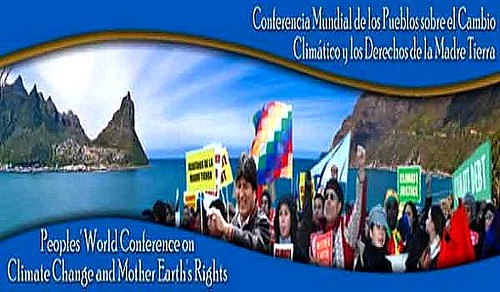
This transcendence of the old-school natural-vs-social ecology argument has arrived with the 21st Century emphasis on sustainability. But it is also true that there are many problems that people-of-the-land have no control over, such as melting glaciers. One response has been to replace the old people-vs-nature polarity with another dominant theme from the past -- rich vs poor. And this theme has its own set of contradictions which were evident at the Peoples' World Conference on Climate Change and Mother Earth's Rights, including rejections of proposals whereby rich countries might off-set their carbon emissions with payments for avoided deforestation in developing countries (REDD).
The tendency remains to see future possibilities as zero-sum or win-lose because that's the way it's been and continues to be. Naomi Klein has an excellent report of the challenges. initiatives and visions put forth at Cochabamba. Chief among them is the vision that a more democratic approach may offer the process to break the logjam that gave the world the failures of COP-15.
In Copenhagen, leaders of endangered nations like Bolivia and Tuvalu argued passionately for the kind of deep emissions cuts that could avert catastrophe. They were politely told that the political will in the north just wasn't there.
More than that, the United States made clear that it didn't need small countries like Bolivia to be part of a climate solution. It would negotiate a deal with other heavy emitters behind closed doors, and the rest of the world would be informed of the results and invited to sign on, which is precisely what happened with the Copenhagen accord.
When Bolivia and Ecuador refused to rubberstamp the accord, the US government cut their climate aid by $3m and $2.5m respectively. "It's not a freerider process," explained US climate negotiator Jonathan Pershing. (Anyone wondering why activists from the global south reject the idea of "climate aid" and are instead demanding repayment of "climate debts" has their answer here.)
Pershing's message was chilling: if you are poor, you don't have the right to prioritise your own survival. When Morales invited "social movements and Mother Earth's defenders … scientists, academics, lawyers and governments" to Cochabamba for a new kind of climate summit, it was a revolt against this experience of helplessness, an attempt to build a base of power behind the right to survive.
The Bolivian government got the ball rolling by proposing four big ideas: that nature should be granted rights that protect ecosystems from annihilation (a "universal declaration of Mother Earth rights"); that those who violate those rights and other international environmental agreements should face legal consequences (a "climate justice tribunal"); that poor countries should receive various forms of compensation for a crisis they are facing but had little role in creating ("climate debt"); and that there should be a mechanism for people around the world to express their views on these topics ("world people's referendum on climate change").
Democracy as a crisis response surely has its detractors. Recently James Lovelock, co-creator of the Gaia Hypothesis and climate visionary, was interviewed by Leo Hickman in the Guardian:
It is obvious, both from talking to Lovelock and reading his work, particularly his most recent books, that he doesn't have the highest opinion of mankind's capabilities to see the long game and act accordingly.
"I don't think we're yet evolved to the point where we're clever enough to handle as complex a situation as climate change," he responds, when asked whether we are up to the task as a species of tackling climate change. "We're very active animals. We like to think, 'Ah yes, this will be a good policy,' but it's almost never that simple. Wars show this to be true. People are very certain they are fighting a just cause, but it doesn't always work out like that. Climate change is kind of a repetition of a wartime situation. It could quite easily lead to a physical war."
Hopelessness is a response, one senses, never far from a Lovelock audience. He is not one to toss around crumbs of comfort when he believes they're not justified, and displays a great deal of contempt for what he believes to be the naive idealism and ideologies of much of the current environmental movement – a significant proportion of which still looks up to him with a certain reverence. For example, it was his high-profile switch a few years ago to promoting nuclear energy as the best hope for saving ourselves that helped convince many environmentalists to rethink their instinctive opposition to this technology. Now, he says, he is not convinced that any meaningful response to "global heating", as he likes to call it, can be achieved from within the modern democracies of the western world.
"We need a more authoritative world," he says resolutely. "We've become a sort of cheeky, egalitarian world where everyone can have their say. It's all very well, but there are certain circumstances – a war is a typical example – where you can't do that. You've got to have a few people with authority who you trust who are running it. They should be very accountable too, of course – but it can't happen in a modern democracy. This is one of the problems.
"What's the alternative to democracy? There isn't one. But even the best democracies agree that when a major war approaches, democracy must be put on hold for the time being. I have a feeling that climate change may be an issue as severe as a war. It may be necessary to put democracy on hold.
His views on carbon emissions trading, as is being touted by the EU and others, are equally dismissive: "I don't know enough about carbon trading, but I suspect that it is basically a scam. The whole thing is not very sensible. We have this crazy idea that we are setting an example to the world. What we're doing is trying to make money out of the world by selling them renewable gadgetry and green ideas.
But Lovelock is not a bundle of total despair. In an earlier interview with NEW SCIENTIST magazine he was asked:
So are we doomed?
There is one way we could save ourselves and that is through the massive burial of charcoal. It would mean farmers turning all their agricultural waste - which contains carbon that the plants have spent the summer sequestering - into non-biodegradable charcoal, and burying it in the soil. Then you can start shifting really hefty quantities of carbon out of the system and pull the CO2 down quite fast.
Would it make enough of a difference?
Yes. The biosphere pumps out 550 gigatonnes of carbon yearly; we put in only 30 gigatonnes. Ninety-nine per cent of the carbon that is fixed by plants is released back into the atmosphere within a year or so by consumers like bacteria, nematodes and worms. What we can do is cheat those consumers by getting farmers to burn their crop waste at very low oxygen levels to turn it into charcoal, which the farmer then ploughs into the field. A little CO2 is released but the bulk of it gets converted to carbon. You get a few per cent of biofuel as a by-product of the combustion process, which the farmer can sell. This scheme would need no subsidy: the farmer would make a profit.
The best part of a biochar strategy is that farmers and gardeners of every type -- rich and poor, large and small, technologically advanced and simple -- can do it.
So, maybe a people of the land reconnected with ancient indigenous wisdom approach does hold the secret to our most promising future. When stripped of political ideologies and posturing, the reconnection of people to land, to indigenous wisdom, and to each other was the most intriguing and deeper theme of the People's World Climate Conference.
Do we dare say, YES WE CAN?
Tuesday, April 13, 2010

(AP Photo/Andre Penner)
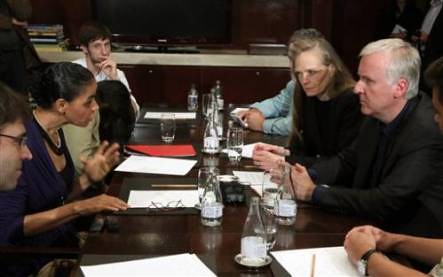
Brazil's Senator and presidential candidate of the Green Party Marina Silva, met with Hollywood film maker James Cameron, in Sao Paulo, Sunday, April 11, 2010 and briefed him on the environmental challenges facing Amazônia and indigenous cultures.
James Cameron has been in Brazil to offer help to the coalition of environmentalists and indigenous peoples who have been in a long-time struggle against the Belo Monte dam, which Cameron calls, "a real life 'Avatar'." He also says that he is collecting information for a sequel to the movie.
Wouldn't it be wonderful if Avatar 2.0 was able to tell a story of terra preta and biochar? It would be an audaciously HOPEFUL story and much more realistic than the romance of forest dwellers defeating the juggernaut of modern civilization in an epic war.
Avatar 2.0 could be the story in which the wisdom of ancient cultures leads modern civilization back from the brink of disaster by showing how agriculture might become earth healing and renewing, thus saving the forest, indigenous cultures and all of us.
WHAT A CONCEPT!
Saturday, October 17, 2009

Photo - Agence France-Presse — Getty Images
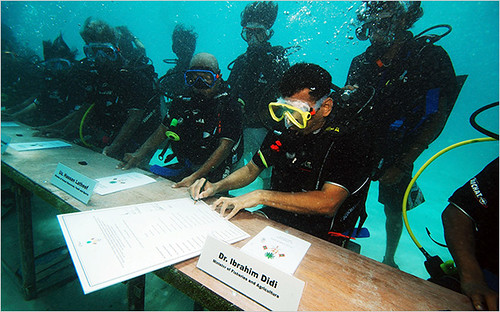
Recently, the island nation of Maldives, affirmed its commitment to biochar as an important means of meeting the country's goal to be "Zero Carbon" by 2020. Now they are meeting underwater to highlight the desperate challenge that this climate change frontline state is facing.
via NY Times
Maldives Government Dives for Climate Change
GIRIFUSHI, Maldives (AP) -- Members of the Maldives' Cabinet donned scuba gear and used hand signals Saturday at an underwater meeting staged to highlight the threat of global warming to the lowest-lying nation on earth.
President Mohammed Nasheed and 13 other government officials submerged and took their seats at a table on the sea floor -- 20 feet (6 meters) below the surface of a lagoon off Girifushi, an island usually used for military training.
With a backdrop of coral, the meeting was a bid to draw attention to fears that rising sea levels caused by the melting of polar ice caps could swamp this Indian Ocean archipelago within a century. Its islands average 7 feet (2.1 meters) above sea level.
''What we are trying to make people realize is that the Maldives is a frontline state. This is not merely an issue for the Maldives but for the world,'' Nasheed said.
As bubbles floated up from their face masks, the president, vice president, Cabinet secretary and 11 ministers signed a document calling on all countries to cut their carbon dioxide emissions.
The issue has taken on urgency ahead of a major U.N. climate change conference scheduled for December in Copenhagen. At that meeting countries will negotiate a successor to the Kyoto Protocol with aims to cut the emission of greenhouse gases such as carbon dioxide that scientists blame for causing global warming by trapping heat in the atmosphere.
Wealthy nations want broad emissions cuts from all countries, while poorer ones say industrialized countries should carry most of the burden.
Dozens of Maldives soldiers guarded the event Saturday, but the only intruders were groupers and other fish.
Nasheed had already announced plans for a fund to buy a new homeland for his people if the 1,192 low-lying coral islands are submerged. He has promised to make the Maldives, with a population of 350,000, the world's first carbon-neutral nation within a decade.
''We have to get the message across by being more imaginative, more creative and so this is what we are doing,'' he said in an interview on a boat en route to the dive site.
Nasheed, who has emerged as a key, and colorful, voice on climate change, is a certified diver, but the others had to take diving lessons in recent weeks.
Three ministers missed the underwater meeting because two were not given medical permission and another was abroad.
Monday, September 07, 2009

A great question for Labor Day in the US and Independence Day in Brazil.
Andy Revkin at the NY Times has revisted the discussion of "Wealth, Work and Well-Being" at his Dotearth blog as sort of a Labor Day "special". The question of "what is happiness?" is core to the discussion.
I tossed in my 2 cents worth and he picked my comment as an "Editor's Choice". (Thanks Andy.) Here's what I had to say:
It's a lovely sunny Monday morning here in São Paulo where we are also celebrating a holiday, Brazilian Independence Day. And the thought of independence, of freedom from the past, brings me to yet another comment.
What is happiness? I believe it is freedom from the burdens of the past. It is independence from attachments to concepts that hold us back, that prevent us from stepping freely in the promises of future possibilities. If you are anything like me, perhaps you will see that a major bondage is our individual and collective judgments learned in the past or, indeed, our judgments of the past and of who we are.
Yes, there is a world of suffering. Yes, greed too often runs amok. Yes, our world needs to change. But why is it that in seeking a better world we so often end up judging each other for our very human qualities? Why do we think that we must change Human Nature? Do we really believe that to be human is to remain trapped in some sort of an Original Sin?
The Hebrew word for "sin" simply means to "miss the mark", to err or to be somehow "off-target". It's not a condemnation. It's how we learn and evolve. It's called, "trial and error". There's nothing "wrong" with that. It's simply our learning program.
As humans, we seem to have three main tendencies -- we expand the use of our tools, we multiply our numbers, and we generate a lot of waste. Is this wrong? Does it make us a failure? An experiment turned bad? Does the earth need a new Operating System? A whole new species?
I have come to believe that the answer is, "NO". We don't need a new OS, a White Leopard to replace Human Nature. But we desperately need a new configuration. Let me offer two examples of how Human Nature might be re-configured, one ancient and one quite contemporary:
My first example is the Potlatch ceremonies of the tribal peoples of the Pacific Northwest. The Potlatch was a great Giveaway ceremony that has been mistakenly interpreted by some romantic moderns as a great example of altruism, a replacement of competition with mutuality. But it was nothing of the kind. Indeed, it was an aggressive and often insulting competition through which families vied for status and type-A young warriors competed for the attention of the prettiest chicks. A young warrior would never accumulate possessions that would inhibit his prowess as a hunter. The way to advance was to give it all away and attract what he really wanted -- sort of a google principle.
The point is that these people did not try to change human nature. They configured greed, lust, envy, status and power competition into something that was communally beneficial.
My second example also has ancient roots but is now emerging in a contemporary form.
As Andy points out repeatedly, sustainability is the great 21st Century challenge as we head toward 9 billion people. Greater efficiency can offer some relief but it ultimately leads to more taking of the earth's resources. Aggregate consumption increases with development. Waste multiplies with numbers even as family size decreases. We still expand our takings, multiply our consumption and put our waste into the air and water. This is not "bad" Human Nature but rather a bad configuration. It violates Natural LAW (Land, Air, Water) by forgetting that the Land (soil) must be renewed.
Here's where we come back to Brazil and the terra preta practices of ancient Amazonian peoples who are now thought to have once supported high density populations of millions living in balance with the forest. They apparently achieved this feat by putting their waste not into the air or water (as industrial societies have done and still do) but by converting it all into a charcoal based soil amendment that increased soil stability and fertility. They did not stop wasting. They turned waste into an earth renewing resource.
Here's the seminal BBC documentary The Secret of El Dorado and here's the contemporary International Biochar Initiative that is carrying the ancient terra preta configuration into modern forms.
No, there's nothing fundamentally flawed with Human Nature. We just need to re-configure it into becoming more fully human which means, more relational, more reciprocal and, thus, more sustainable.
Finally, to come full circle, the global 2010 IBI meeting will be held in -- you guessed it -- Rio de Janeiro, Brazil.
What is happiness? I think it is whatever lessens our problems and helps us reconnect -- to the earth, to each other, and to ourselves. We are learning now in fits and starts how to be more fully human. With luck, one day we will be able to reach for happiness no longer as consumers but as creators.
As the wise Hopi elder said, "This could be a very good time."
Tuesday, September 01, 2009
A chocolate maker and music promoter aim to create a £1bn biochar industry, in a controversial effort to fight climate change.
David Adam, environment correspondent
guardian.co.uk, Thursday 27 August 2009
Go to original article and comments
In a patch of woodland on the outskirts of Hastings, on the English south coast, a group of men huddle around a brick laboratory as smoke curls from its two chimneys. The men are trying, with some chemical trickery, to bring a lucrative piece of South America to Sussex, to spark what they believe could be a £1bn industry in Britain.
The business is controversial. Some maintain it should be outlawed, and others say that only full-scale legalisation would control the risks. Until the fuss dies down, the men have decided to bury the powder they make in a nearby field.
Craig Sams, a millionaire chocolate maker, and Dan Morrell, a former music promoter and entrepreneur, are producing charcoal, and their aim is to get rich by selling it to tackle global warming.
Together Sams and Morrell make Carbon Gold, a company they have set up to exploit the growing interest in green solutions to climate change. The brick laboratory is, they claim, Britain's first dedicated facility to produce biochar, which is what you call charcoal when you are selling it as a solution to global warming.
Their idea is a low-tech take on the futuristic concept of carbon capture and storage. Carbon, in the form of wood from trees and agricultural waste, can be turned to
charcoal and buried in the ground, so storing it away from the atmosphere. If enough carbon can be buried in this way, then it could bolster so-far feeble global attempts to address climate change through cuts greenhouse gas emissions.
Making and burying biochar to help reduce carbon levels in the atmosphere has some heavy green backing, including scientist and author James Lovelock and Jim Hansen of Nasa. The journal Nature Reports Climate Change said that biochar "could be the closest contender yet for a silver-bullet solution to climate change".
But it also has some high profile critics. Writing in this newspaper in March, George Monbiot said: "The idea that biochar is a universal solution that can be safely deployed on a vast scale is as misguided as Mao Zedong's Great Leap Backwards." He added: "According to the magical thinkers who promote it, the new miracle stops climate breakdown, replaces gas and petroleum, improves the fertility of the soil, reduces deforestation, cuts labour, creates employment, prevents respiratory disease and ensures that when you drop your toast it always lands butter side up."
Good idea or bad, if Sams and Morrell have their way, green consumers who want to offset the damaging emissions from their flights or cars will soon be able to pay Carbon Gold to make biochar on their behalf. Within weeks, the company expects to be approved by the offset industry's unofficial watchdog. Bigger markets could follow: the firm is among those lobbying for biochar credits to be included in the UN's clean development mechanism - a global carbon trading scheme used by countries such as Britain to meet ambitious carbon targets. A decision could be made as soon as December, at key climate talks in Copenhagen.
Morrell, who founded Future Forests, which later became the Carbon Neutral Company, said: "Biochar is the only technology that enables us to take invisible carbon dioxide out of the atmosphere, transform it into black lumps of pure carbon and, by ploughing it into the soil, prevent it from going back into the atmosphere."
He added: "We don't want to clear-cut woodland and turn it to dust. That's slightly alarmist. We're not saying this is the answer to global warming, but I don't see why it can't be one of a suite of solutions."
The duo's biochar facility runs on wood from surrounding trees, part of a woodland owned by Sams. By lighting a fire in a chamber beneath and fiddling with the way air flows through the device, the team says it can convert about a third of the carbon locked in the wood to charcoal in 24 hours. The wood part burns and is part baked, in a process called pyrolysis.
Biochar is not emissions free - the rest of the carbon from the wood goes up in smoke, but Morrell says it is better for the climate than burning or leaving it to rot, which can produce methane. He says their primary targets are large agricultural sites such as vineyards and olive producers, which have large amounts of waste cuttings.
Under Carbon Gold's business model, the firm would supply the technology to farmers and others, and take a cut of the valuable carbon credits generated by each tonne of carbon they store. It is already working on a similar project in Belize.
"It's almost like a franchise," says Sams, a founder of Green and Black's chocolate and former chair of the Soil Association. "It's the same principle as McDonalds," he adds, then wishes he hadn't.
Morrell's answer to the critics of biochar is a rule book produced by the company that is currently being considered by the Voluntary Carbon Standard, which regulates carbon offsets. Morrell says it includes safeguards to make sure wood and other feedstocks used are sustainable, as well as to preserve biodiversity and to give work to local people. "Of course it will be easier to just clear cut forest, but we think we can set the bar high enough to keep those people out."
There could be other benefits too, he says. Biochar could help make more soil productive, because it offers a surface for bugs to thrive. Charcoal mixed into the ground by Indian tribes centuries ago is often credited for the acclaimed rich and dark terra preta soils of the Amazon basin. If benefits can be proven, and Carbon Gold says local soil scientists are investigating, then biochar could perhaps claim extra carbon credits based on reduced fertiliser use. Sams is already experimenting with charcoal sprayed and ploughed onto a field next to the Sussex woodland.
Mike Childs, climate campaigner with Friends of the Earth, said: "The problems with biochar are largely the same as biofuel. If you manage it properly then making limited amounts is OK, sensible and useful. But there is massive pressure on forests for land and protecting ecosystems, and the potential to produce lots [of biochar] comes up against those pressures. In the short term it is not the answer to climate change."
Friday, August 14, 2009
The International Biochar movement took a major step of expansion this week with the first US biochar conference at the University of Colorado. There's a fine update by Bill Hewitt at GRIST on the current status of the biochar movement. Due to slow Internet connections I can't post any of the pics but here are the text and links of this fine update:
Go to original at Grist
Imagine a system that can:
- (potentially) store billions of tons of carbon in soil for centuries;
- dramatically reduce agricultural waste, forest debris and some municipal solid waste, thus eliminating the production of greenhouse gases that result from their decomposition;
- generate energy to both power itself and a surplus for use in surface transportation or electricity generation; and
- greatly increases the productivity of agricultural soil, thus reducing the need for expensive and polluting fertilizers.
This is the promise of biochar—the carbon-rich remains of “burning” organic matter via an oxygen-free process. According to the International Biochar Initiative (IBI), biochar “has four value streams: waste reduction, energy production, soil fertilization, and carbon sequestration.” This has implications for both developing and developed economies—- and, most importantly, the interrelated problems of global warming and food security.
Based on the work of researchers in the Amazon who discovered the startling properties of terra preta, land that had been improved hundreds and, in some cases, thousands of years ago, soil scientists have been pursuing a way to replicate the success of the Amazonian Indians in producing spectacular fertility in the midst of the relatively infertile rainforest.
One of the key components of terra preta is charcoal. Modern biochar, however, isn’t derived from the same process that agricultural societies have been using for millenia to produce charcoal. Instead, biochar is a product of the breaking down of biomass by a controlled thermal degradation—not burning. The most prevalent method of producing biochar is through pyrolysis.
The first step in biochar production is providing feedstock. This can be agricultural waste that would otherwise sit in the field to decompose or be burned, in both cases generating greenhouse gases. Other sources are forest debris or waste products like the enormous fraction of municipal solid waste comprised of grass cuttings and leaves. The feedstock is placed into a pyrolysis chamber—a nearly airtight device that intensifies heat but limits exposure to oxygen to avoid burning. The chamber can be a small unit processing as little as a few pounds of biomass for a family’s cooking and gardening needs, or a large one with a capacity of as much as a 100 tons per day.
Since pyrolysis is performed with little or no oxygen present, it produces no combustion byproducts such as black carbon (soot), carbon monoxide or carbon dioxide. Instead, gases such as hydrogen and biofuels are produced, which can be used to provide the necessary heat for the pyrolysis process with some left over for other uses.
The remaining solid material—the biochar—can be used as a soil additive that, according to most of the research to date, has a remarkable ability to enhance agricultural or horticultural productivity.
One key international governmental organization, the United Nations Convention to Combat Desertification (UNCCD), believes “the role of the soil in capturing and storing carbon dioxide is often one missing information layer in taking into consideration the importance of the land in mitigating climate change.”
The UNCCD, along with the IBI, pushed hard to include biochar in the draft negotiating text for the upcoming Copenhagen climate talks. This means that biochar and other methods of employing agriculture to mitigate carbon emissions may well lead to the issuing of offset credits for these methods. This is the big prize that could lead to the massive deployment of biochar production worldwide.
Biochar has been embraced by worthies such as Chris Goodall and James Lovelock. Tim Flannery, in his foreword to Biochar for Environmental Management, says: “The biochar approach provides a uniquely powerful solution, for it allows us to address food security, the fuel crisis and the climate problem, and all in an immensely practical manner. With its careful evaluation of every aspect of biochar, this book represents a cornerstone of our future global sustainability.”
Dr. Johannes Lehmann—co-editor of Biochar for Environmental Management, chairman of the IBI, and a professor at Cornell University—is one of the driving forces behind the growing recognition of biochar’s value. Like any good scientist, however, he’s conservative in his prognostications. His current work focuses on generating and evaluating research on biochar production and use. His group at Cornell, for instance, is evaluating scores of different chars from around the world.Lehmann does not endorse growing biomass on a massive scale as biochar feedstock—something George Monbiot accused biochar boosters of advocating in a somewhat infamous Guardian column from March.
“It doesn’t make any sense to grow biomass on land specifically and solely for the purpose of generating energy or biochar or a combination,” Lehmann said. “It makes the most sense to talk about agricultural waste.”
Lehmann considers forest debris and yard waste to be prime candidates for biochar production. But he is circumspect about which wastes might be most cost-effective. Collecting corn stover from fields for the purpose of generating char and energy might be ineffective, but the massive amounts of waste generated by sugar cane production could work very well. Similarly, if money and effort must be expended to collect forest debris for biochar production, then it might not be worthwhile. However, it could be cost-effective if the debris is being collected anyway for fire prevention.
Biomass is often left on the ground to decompose, creating huge amounts of greenhouse gas emissions, or is burned in the fields or in forest fires, creating carbon dioxide. Biomass, usually scrub wood or animal dung, is also burned in open cooking fires throughout the developing world, a practice that has drastic dire health impacts for the people routinely exposed to the smoke, mostly women and children. It also generates black carbon (or soot), increasingly being identified as a powerful driver of climate change second only to carbon dioxide.
Among the many projects in which Lehmann is involved is comprehensive research and development on pyrolyzing cookstoves that produce both clean heat and biochar for use by farmers. “You can dramatically expand your feedstock options when you switch from burning to charring,” he said. What matters in all of this, Lehmann emphasizes, is looking carefully at the costs and benefits in each situation, performing “whole systems analysis, from cradle to grave.”
Biochar could get a big boost in the United States if the Waxman-Markey bill is passed. The legislation would allow agricultural and forestry projects to qualify as carbon offsets, a move that sparked outcry from some environmental groups concerned that Congress would prevent regulators from measuring the full carbon footprint of U.S. farming practices.
Nevertheless, offsets retain considerable support in Congress. Sen. Tom Harkin (D-Iowa), chairman of the Senate Agriculture Committee, is a biochar booster. “As part of the overall effort to lessen the effects of global warming, biochar is an exciting method for sequestering carbon,” he said in a statement for this article. “It is a truly innovative option not only because it sequesters carbon, but also because it improves soil condition and reduces the amount of water and fertilizer required on farms.”
William Hohenstein, the director of USDA’s Office of Global Climate Change, sees biochar in the context of a comprehensive policy construct, along with conservation tillage, tree planting, and other mitigation methods. He envisions the inclusion of these methods in a system of offsets, both domestically and internationally. The Agricultural Research Service, meanwhile, concluded in a recent report that the costs of processing crop residue into biochar and incorporating it into farmland soils could be offset by giving farmers the ability to sell credits for the carbon sequestered by the biochar.

Saturday, August 01, 2009

photo via Carbon Gold
This is a MAJOR step for biochar which is destined to become a global technology for reducing global warming AND feeding more people AND protecting the rights of indigenous peoples.
Carbon Gold Promote Strict Regulations With World's First Biochar Methodology
by Leonora Oppenheim, London, UK on 07.31.09
Today the world's first biochar methodology has been published for public consultation by the Voluntary Carbon Standard. This ground breaking paper has been submitted by the UK based biochar project developers Carbon Gold. They are confident that their methodology will help create an ethical and sustainable structure for a potential biochar offsetting industry. This method of turning waste biomass into charcoal has been lauded as a miracle solution to rising CO2 emissions, but skeptics have also warned that there is plenty of room for error and exploitation.
Organic Farming + Carbon Offsets = Carbon Gold
Carbon Gold may not ring any bells for you, but the big names behind this new company certainly will. Two very successful UK eco-entrepreneurs are now selling the biochar dream, one being Craig Sams, founder of Green + Blacks chocolate and the other being Dan Morrel founder of Future Forests, now The Carbon Neutral Company. Together they are uniting their experience and skills, in organic farming and carbon offsetting respectively, to commercialise the use of biochar as a Clean Development Mechanism.
Monbiot's Warning
Both Sams and Morrell, whilst evangelical about the benefits of biochar as a way to sequester carbon and enrich soil fertility, are well aware of the potential pitfalls an unregulated market could fall into. George Monbiot's polemical article on biochar in The Guardian a few months ago painted an alarming image of biochar enthusiasts turning 1.4 billion hectares of the planet's surface into charcoal, taking over valuable crop fields and exploiting indigenous people's land .
Sustainable + Ethical Methodology
Naturally Monbiot is deeply skeptical of any silver bullet solution to climate change and so should we be, but Carbon Gold is stepping into the ring on the right foot with a methodology and a statement of principles which aims to create a "sustainable, social and environmental policy under which any biochar project should be developed." If the Voluntary Carbon Standard approves the Methodology then all future biochar projects can be independently verified and certified.
Assessing Carbon Emissions
Carbon Gold's Biochar Methodology has been developed in collaboration with greenhouse house gas emissions assessors Ecometrica and claims to "set out the carbon accounting methods and detailed instructions on how to calculate the reduced or avoided emissions from a biochar project." The accompanying Statement of Principles adds that all projects will only use "biomass feedstocks derived from surplus biomass that is a by-product of agricultural or forestry activities and which would otherwise be burned or left to decay."
Respecting Indigenous Land Rights
We are also impressed by the stated social principles which guarantee local employment and training, health and safety, and land rights, paying "due regard to the principles enshrined in the Convention on the Rights of Indigenous People." We look forward to hearing more from Carbon Gold about the potentials uses of appropriate technologies and community supported implementation of biochar projects. It looks like Carbon Gold are setting off in the right direction, but will this methodology be enough to allay Monbiot's fears of ending up being surrounded by a famine struck blackened charcoal landscape?