VISISIONSHARE (blog header)_edited

Tuesday, April 14, 2009

MARIA FLOR
SOUZA NASCIMENTO


IMG_8491

Born on 11 April 2009 bringing a new generation to the line of Mestre Conselheiro Luiz Mendes do Nascimento.

Daughter of Suzi and Neto

IMG_8288_edited-crop

Granddaughter of Luza and Saturnino

IMG_8444_edited

Great Granddaughter of Padrinho Luiz and Madinha Rizelda

IMG_2209_edited-1-crop

With great joy and gratitude,

we say

WELCOME MARIA FLOR


Monday, April 13, 2009

I'M GUILTY

Andrew Sullivan speculates that narcissism may explain blogging.

Kudos to him for unearthing this gem:

"Subclinical narcissists are happy. They are less likely to be depressed, sad or anxious, and rate their subjective well-being more highly. They're less reactive to stress, and recover more rapidly from it. Mild narcissism also seems to help people recover from accidents or other trauma—it gives them an unrealistic sense of their own invulnerability, and they believe that they will be able to handle whatever else life throws at them."

Or, as Ted Turner put it, "If I only had a little humility, I'd be perfect."
Read the full fascinating article in Carl Vogel's,A Field Guide To Narcissism. It's pretty funny even if you see traces of yourself.
QUOTE OF THE DAY

Paul Krugman writing about Republicans in his NY Times column says,

"... it doesn’t feel right to make fun of crazy people."

'nuff said!

Full Krugman column is here. It's a good read.

Sunday, April 12, 2009

HAPPY EASTER FROM BUJARI

IMG_2838

The extended family of Luiz Mendes maintains two spiritual centers in Acre -- one in the municipality of Bujarí near Rio Branco and the other at Vila Fortaleza in the municipality of Capixaba. This year Easter was celebrated at both locations.


When the spiritual works are a bit smaller, Padrinho Luiz often calls them "festinhas grandissimas" (GREAT little festivals) because the strong energy of a few people who really know how to perform together in spiritual union can really rock and send a marvelous light into the world.

And this was certainly the case last night at Bujari as people celebrated the continuing rebirth of the Master with love and joy.

First we sang the hymns of Francisco Ribero (a contemporary of Mestre Irineu)


And then the hymnal "Pequenininho" of Saturnino


The energy seemed particularly special because, in addition to the spirit of the risen Christ, a new generation of the Luiz Mendes family had been born. Earlier in the day Maria Flor arrived -- daughter of Suzi and Neto, granddaughter of Luza and Saturnino, and great granddaughter of Padrinho Luiz and Madrinha Rizelda.

There are more photos (and a good story) of an earlier "work" at Bujari here.


A CARBON TAX?

I've been focused on "cap-and-trade" as a way to address greenhouse gas emissions and filter funds to preserving forests and restoring soils with biochar but Tom Friedman is beginning to convince me that a carbon tax integrated with a true energy-and-environment policy may be the better way.

The problem is that while this may be a GREAT domestic policy, it does not channel funds from the developed industrial world to the developing world where the heaviest new environmental damage is taking place. In the final analysis it's gonna be a nation's politics -- one-by-one -- that determines whether to sustain or deplete its natural resources.

Here's how Costa Rica addressed the issue and became one of the world's most inspiring examples.

April 12, 2009

Go to Original

By THOMAS L. FRIEDMAN

Liberia, Costa Rica

Sailing down Costa Rica’s Tempisque River on an eco-tour, I watched a crocodile devour a brown bass with one gulp. It took only a few seconds. The croc’s head emerged from the muddy waters near the bank with the footlong fish writhing in its jaws. He crunched it a couple of times with razor-sharp teeth and then, with just the slightest flip of his snout, swallowed the fish whole. Never saw that before.

These days, visitors can still see amazing biodiversity all over Costa Rica — more than 25 percent of the country is protected area — thanks to a unique system it set up to preserve its cornucopia of plants and animals. Many countries could learn a lot from this system.

More than any nation I’ve ever visited, Costa Rica is insisting that economic growth and environmentalism work together. It has created a holistic strategy to think about growth, one that demands that everything gets counted. So if a chemical factory sells tons of fertilizer but pollutes a river — or a farm sells bananas but destroys a carbon-absorbing and species-preserving forest — this is not honest growth. You have to pay for using nature. It is called “payment for environmental services” — nobody gets to treat climate, water, coral, fish and forests as free anymore.

The process began in the 1990s when Costa Rica, which sits at the intersection of two continents and two oceans, came to fully appreciate its incredible bounty of biodiversity — and that its economic future lay in protecting it. So it did something no country has ever done: It put energy, environment, mines and water all under one minister.

“In Costa Rica, the minister of environment sets the policy for energy, mines, water and natural resources,” explained Carlos M. Rodríguez, who served in that post from 2002 to 2006. In most countries, he noted, “ministers of environment are marginalized.” They are viewed as people who try to lock things away, not as people who create value. Their job is to fight energy ministers who just want to drill for cheap oil.

But when Costa Rica put one minister in charge of energy and environment, “it created a very different way of thinking about how to solve problems,” said Rodríguez, now a regional vice president for Conservation International. “The environment sector was able to influence the energy choices by saying: ‘Look, if you want cheap energy, the cheapest energy in the long-run is renewable energy. So let’s not think just about the next six months; let’s think out 25 years.’ ”

As a result, Costa Rica hugely invested in hydro-electric power, wind and geo-thermal, and today it gets more than 95 percent of its energy from these renewables. In 1985, it was 50 percent hydro, 50 percent oil. More interesting, Costa Rica discovered its own oil five years ago but decided to ban drilling — so as not to pollute its politics or environment! What country bans oil drilling?

Rodríguez also helped to pioneer the idea that in a country like Costa Rica, dependent on tourism and agriculture, the services provided by ecosystems were important drivers of growth and had to be paid for. Right now, most countries fail to account for the “externalities” of various economic activities. So when a factory, farmer or power plant pollutes the air or the river, destroys a wetland, depletes a fish stock or silts a river — making the water no longer usable — that cost is never added to your electric bill or to the price of your shoes.

Costa Rica took the view that landowners who keep their forests intact and their rivers clean should be paid, because the forests maintained the watersheds and kept the rivers free of silt — and that benefited dam owners, fishermen, farmers and eco-tour companies downstream. The forests also absorbed carbon.

To pay for these environmental services, in 1997 Costa Rica imposed a tax on carbon emissions — 3.5 percent of the market value of fossil fuels — which goes into a national forest fund to pay indigenous communities for protecting the forests around them. And the country imposed a water tax whereby major water users — hydro-electric dams, farmers and drinking water providers — had to pay villagers upstream to keep their rivers pristine. “We now have 7,000 beneficiaries of water and carbon taxes,” said Rodríguez. “It has become a major source of income for poor people. It has also enabled Costa Rica to actually reverse deforestation. We now have twice the amount of forest as 20 years ago.”

As we debate a new energy future, we need to remember that nature provides this incredible range of economic services — from carbon-fixation to water filtration to natural beauty for tourism. If government policies don’t recognize those services and pay the people who sustain nature’s ability to provide them, things go haywire. We end up impoverishing both nature and people. Worse, we start racking up a bill in the form of climate-changing greenhouse gases, petro-dictatorships and bio-diversity loss that gets charged on our kids’ Visa cards to be paid by them later. Well, later is over. Later is when it will be too late.


Saturday, April 11, 2009

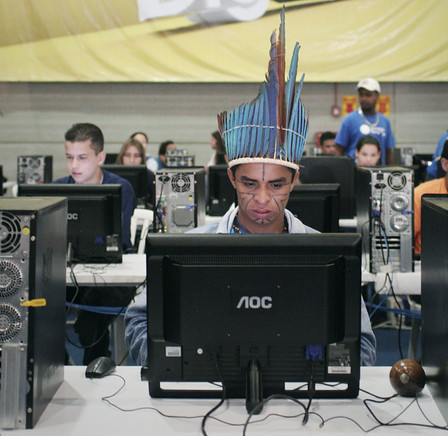
INDIGENOUS INTERNET

Indigenous Internet
Photo by Tatiana Reis at the digital inclusion area of Campus Party 2009.

Brazil's rich diversity of indigenous groups now has a a new set of cyber-tools to communicate with each other and the world. At a time when indigenous peoples, their cultures and their places are threatened world-wide, blogging has provided a new way to drum up support.

Deborah Icamiaba at Global Voices Online has a fascinating article along with lots of great photos here.


And here is the rest of it.

Wednesday, April 08, 2009

JUSTICE GETS ANOTHER CHANCE

Brazil Orders New Trials in Nun’s Death

Alexei Barrionuevo reports in the NY Times

RIO DE JANEIRO — A court in Brazil ordered new trials on Tuesday for two men accused of murdering an American-born nun in a land dispute in the Amazon rain forest.


Sister Dorothy, who was from Dayton, Ohio, was killed in 2005 after she fought to preserve a piece of jungle that ranchers wanted to clear for logging and cattle ranching. She spent about two decades fighting destruction of the Amazon, and was viewed as a leader in the movement for sustainable development there.

Go to full article.

Tuesday, April 07, 2009

SUSTAINABLE TIMBER BUYING IN ACRE

That's the idea of this new program in Acre State where the State and City governments have agreed in principle to buying only wood that has been certified as logged in sustainable fashion.


Of course the devil is in the details and enforcement is not always perfect. However, State and City governments are by far the largest purchasers of local wood and this is a most welcome development. Illegal logging is a big problem in the Brazilian domestic market and governments account for a huge purchasing power. They can be the trend-setters. The hope is that programs like this will spread to other states and cities in Brazil.
HOW MUCH STUFF?

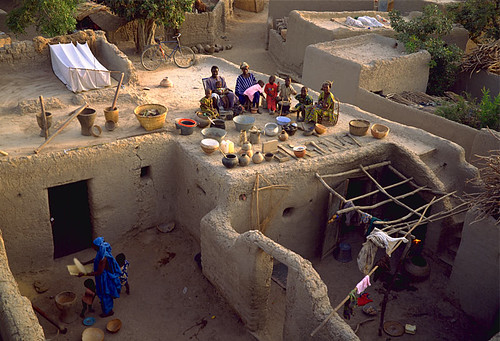
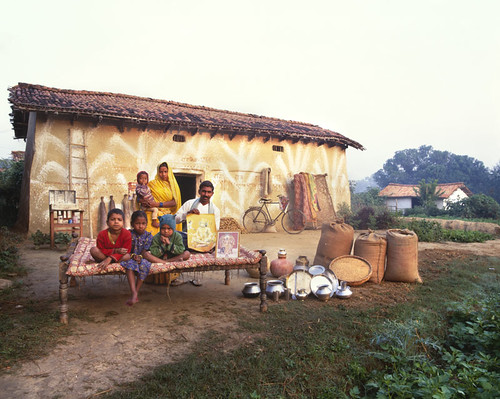
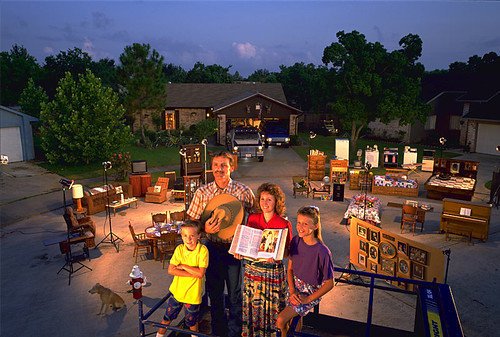
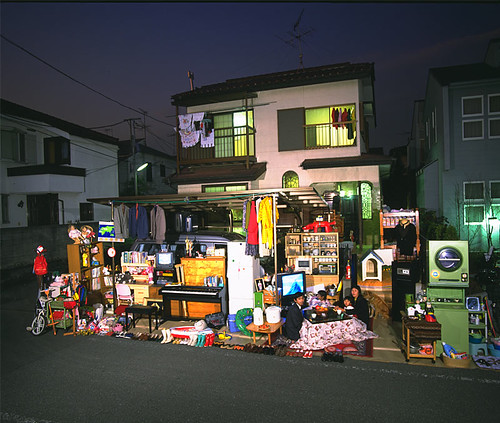
The following photos give a sense of the incredible range of ownership of material stuff in today's world.

Stuff in Japan...

mate-japan-l


Stuff in Mali...

mate-africa-l


Stuff in China...

mate-china-l


Stuff in India...

mate-india-l


Stuff in the US...

mate-us-l

All of the above photos are by Peter Menzel. There's more about these photos and his marvelous photography here and here.

The above photos are not intended as wholly representative of the countries and their economies but they help illustrate both the legitimate desire of many folks to gain access to material comforts and they also raise the question of "how much is enough?"

About a month ago Andrew Revkin explored the issue of The Endless Pursuit of Unnecessary Things. The full post (and links) is fascinating...


February 6, 2008, 10:32 am
‘The Endless Pursuit of Unnecessary Things’
By Andrew C. Revkin


Amid the flow of Super Tuesdays, Superbowl surprises, news about faltering energy projects and rising solar cities, I’ve been collecting threads that relate to a central theme of Dot Earth: the implications of humanity’s growing numbers and resource thirst.

Here are a few from the last few days:

- A radio commentary quoting one of the less-familiar dictums of Adam Smith, who is best known for championing economic growth, but in this case was warning about too much of a good thing.

- The hypnotically unnerving documentary “Manufactured Landscapes,” which glaringly displays the increasingly human-shaped face of Earth.

- A sociology paper proposing that the best way to lessen consumption for its own sake is to reduce how much people work. (Is there a win-win here, or am I missing something?)

- A paper in the journal Science on sustainability showing that, by one measure, afflictions related to affluence take away as many years of life as do ills associated with poverty.

These papers and observations all circle around the two questions at the heart of the sustainability puzzle that will largely determine the quality of human lives and the environment in which they are lived: How many? How much?

How many people will inhabit Earth in the next few generations?

How much stuff – energy, land, water, marine life – will they consume?

A few examples: The overlay of rising demand and lagging supply of oil or comparable liquid fuel will shape everything from economics to international conflict. The amount of coal extracted and burned (along with the oil) will influence climate for centuries to come. The extent of land used to grow fuel, food, or fiber will determine the costs of those necessities and also the fate of the world’s last untrammeled ecosystems.

Back to the related nuggets above.

I was listening to the public-radio program Marketplace and heard a guest commentary by Charles Handy, an expert on business management who founded the London Business School and is in residence at the Drucker School of Business of Claremont (Calif.) Graduate University.

He was musing on the ideas of two departed pillars of economics, Adam Smith and Peter Drucker, in relation to limits to growth.

An excerpt:

…I wonder how [Peter Drucker] would have reacted to some of the things that bother me. For instance, how would he respond to what I call “Adam Smith’s Great Conundrum?”

Adam Smith, the father of economics, 250 years ago, said: “An investment is by all right-minded people to be commended, because it brings comforts and necessities to the citizenry. But, if continued indefinitely, it will lead to the endless pursuit of unnecessary things.”

Now that I am living for a while in California, I am staggered by the amount of “unnecessary things” that I see in the malls that dot the suburbs. America is no different from anywhere else, of course — just more so.

The conundrum is this: All that stuff creates jobs — making it, promoting it, selling it. It’s literally the stuff of growth. What I’d love to ask Peter Drucker is: How do you grow an economy without the jobs and taxes that these unnecessary things produce?

Drucker saw business as the agent of progress. Its main responsibility, he said, was to come up with new ideas and take them to market. But not just any new ideas, please — only those that bring genuine benefits to the customers, and do not muck up the environment.

The market, unfortunately, does not differentiate between good and bad. If the people want junk, the market will provide. So we have to fall back on the conscience of our business leaders.

Then there was “Manufactured Landscapes,” a film examining how human demands for resources and products are transforming the physical world, and the environment experienced on a daily basis by humans caught up in the rush of urbanized, mechanized, work-centered life. It does so over the shoulder of the Canadian photographer Edward Burtynsky, who has made chronicling the face of the Anthropocene epoch his life’s work of late.

I saw a snippet of it when writing a post on the “urban age” last week, but finally had a chance to watch the DVD. It is an unforgettable experience, something like a mash-up of “Apocalypse Now” and “Modern Times.”

It is a sobering view, particularly the scenes in sprawling Chinese factory cities churning out the (unnecessary?) things that prosperous people seem to need in ever-rising amounts. Watch the hands of a young woman as she speeds through the 20 or so manipulations necessary to make an electronic device whose purpose she only can guess at. She makes 400 a day. Then watch as the camera pans cavernous halls full of similar workers, then cuts outdoors to the cordons of thousands of workers heading to yellow dormitories.

How many factories? How much stuff?

Then came “Sustainable Consumption and Worktime Reduction,” a paper by Juliet Schor, a sociologist at Boston College, that I stumbled on while surfing a 2005 special issue of the journal Industrial Ecology on the global impacts of cities. The entire issue is enlightening.

She chronicles how industrialized economies have generally translated productivity gains in the workplace into making more stuff (and money to buy stuff) instead of making less work (reducing work hours).

A world heading toward 9 billion, however, following that path of ever more work and money to buy ever more stuff, cannot be sustained, Professor Schor concludes:

Achieving a sustainable and equitable global solution is clearly incompatible with a worldwide replication of U.S. lifestyles or even the somewhat less damaging ecological impacts of the lifestyles of other industrialized countries. In such a situation, inhabitants of the global North can and should opt for a new economic and social vision based on quality of life, rather than quantity of stuff, with reduced work time and ecological sustainability at its core. Such a vision has the potential to create broad-based pressure for an alternative to the current system of ecologically destructive, inequitable consumer-driven growth. Indeed, the future of the planet increasingly depends on it.

This paper echoed ideas I explored in 2005, when writing on Bhutan’s experiment with “gross national happiness” as a substitute for the more familiar gross national product.

Finally, there was “Science and Technology for Sustainable Well-Being,” a paper in Science by John P. Holdren, the Harvard expert on energy, environment, development and lots of other things.

The paper is a sprawling portrait of a world poised between a livable path toward 9 billion and one wracked by disruption and suffering, along with a menu for limiting losses as we head into crunch time these next few decades. But one chart really grabbed my attention. By Dr. Holdren’s analysis, when you measure human tolls in years of life lost (e.g., a child cut down by disease loses decades; a grandmother dying of a stroke at 80 loses a few years.), the major afflictions of poverty and affluence do us in at roughly equal rates.

Childhood and maternal malnutrition, he estimates, erased 200 million life years in the year 2000. High blood pressure, cholesterol, obesity, and lack of physical activity erased 150 million life years. (There’s a long list of other causes, from war to tobacco.)

So at each end of the development ladder – from not enough to too much – we get into trouble.

So are we now locked into the “endless pursuit of unnecessary things?” In thinking about this warning from Adam Smith, I can’t help but feel bad for Thomas Malthus, who has taken all the heat from free-market champions of eternal growth over the years.

Maybe it was Adam Smith who was the first Malthusian prophet of doom.

Wednesday, April 01, 2009

CAN YOU BELIEVE IT?

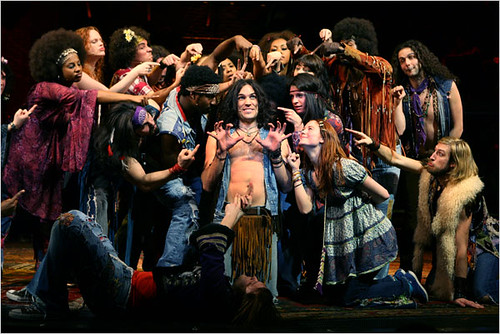
Hair600
Photo: Sara Krulwich/The New York Times

HAIR is back on Broadway. I saw it first run on Broadway in 1968. Good to know some things never die.

April 1, 2009
THEATER REVIEW | 'HAIR'
A Frizzy, Fizzy Welcome to the Untamed ’60s
By BEN BRANTLEY

You’ll be happy to hear that the kids are all right. Quite a bit more than all right. Having moved indoors to Broadway from the Delacorte Theater in Central Park — where last summer they lighted up the night skies, howled at the moon and had ticket seekers lining up at dawn — the young cast members of Diane Paulus’s thrilling revival of “Hair” show no signs of becoming domesticated.

On the contrary, they’re tearing down the house in the production that opened on Tuesday night at the Al Hirschfeld Theater. And any theatergoer with a pulse will find it hard to resist their invitation to join the demolition crew. This emotionally rich revival of “The American Tribal Love-Rock Musical” from 1967 delivers what Broadway otherwise hasn’t felt this season: the intense, unadulterated joy and anguish of that bi-polar state called youth.

....

But of course no stage can contain the hormone-stoked exuberance of those who inhabit it, whether they’re yipping, unzipping or tripping, both merrily and scarily. Know that you may find yourself in intimate contact with various dancing, cajoling tribe members. They may give you daisies or leaflets. They may even ask you to embrace them. Not that you haven’t already. Go to full review
BIOCHAR: The Latest

Biochar news is soaring through the Internet, and so is controversy. Bottom line -- BIOCHAR IS A MIRACLE CURE BUT LIKE OTHER POWERFUL REMEDIES IT MUST BE USED ONLY AS DIRECTED.

Here is a bunch from the March International Biochar Initiative newsletter:


Chapter 1 of Biochar for Environmental Management now Available Online

The Introduction, Foreward, and Chapter 1 in PDF Format of Biochar for Environmental Management is now available online at the IBI website, thanks to Earthscan Press. In March 2010, the entire book will be available on the IBI site to read online. For more information, click here.


IBI is pleased to announce the following new resources for biochar researchers, gardeners, farmers, and photographers.

IBI Biochar Trials Document Now Available

Many people all over the world are now experimenting with biochar in their home gardens. Farmers, nursery operators and schools are all looking for more information about how to use biochar. The interest is high, but until now, there has not been much information available outside of the academic world. The good news is that for all the budding experimentalists out there, IBI Extension Director Julie Major has compiled A Guide to Conducting Biochar Trials. This guide is now available to download as a pdf file from the IBI website.

A Guide to Conducting Biochar Trials will help you design your scientifically valid biochar experiment at any scale ranging from a few pots in a greenhouse to a large farm. The Guide contains data sheets for you to record the details of your design setup and your results. If you would like to register your project with the IBI, send an email with your contact information to Julie Major.

Biochar Bibliography: Search IBI's RefShare Database for Peer-Reviewed Articles Relevant to Biochar, Black Carbon, and Terra Preta.

This database offers up-to-date references with abstracts, whenever available. It is maintained and updated by IBI, and contains articles relating to a wide range of biochar-related topics organized in folders. Available here


Announcing the Biochar Gardens photo group on Flickr. Biochar Gardens is a place for farmers and gardeners to post pictures of their gardens, farms, containers and greenhouses that use soil amendments based on biochar. Please share pictures of your garden at all stages of growth, from preparing your soil to harvesting. Members would also love to see your pictures of composting and your methods for making charcoal and preparing your biochar soil amendments. You can indicate how you would like to share your photos and if you like, leave contact information so that potential users can get your permission to use your photos in their publications. See the photos here.

16 March 2009, BBC News, Engineer on turning sewage into charcoal. Video interview with German engineer Helmut Gerber as he demonstrates his pyrolysis machine. See it here


16 March 2009, BBC News, How to make your plants grow faster. Video interview with Dr Bruno Glaser from Bayreuth University in Germany as he shows results of his experiments with biochar. See it here.

12 March 2009, Nòva, Il bio-segreto di Eldorado. The bio-secret of Eldorado. Two video interviews here: one with inventor Nat Mulcahy demonstrating his pyrolyzing biomass stove, and one with Franco Miglietta, a researcher at the Institute of Biometeorology, CNR, in Florence, Italy, showing his biochar field trials. See it here.

March/April, Orion Magazine, Plants Suck, by Bill McKibben who says: "After twenty years of studying climate change, if I'm sure of anything, it's that there's no one fix that will save the world." And also, "If you could continually turn a lot of organic material into biochar, you could, over time, reverse the history of the last two hundred years. During those two centuries we've taken millions of years of compressed organic material-weeds and sticks and dinosaurs and plankton-and drilled and mined them up to the surface so we could burn them. All that ancient biomass is now up in the atmosphere, causing problems. Big problems, like melting the ice caps. The biggest problems ever." Read more here.


30 March 2009, CNN, Can 'biochar' save the planet?, by Azadeh Ansari. Focus of this article is on researchers in Athens, Georgia. Includes interviews with research engineer Brian Bibens, biochar researcher Christoph Steiner, and Eprida CEO, Danny Day. Read more here.

28 March 2009, Green Left Weekly, Can biochar help stop climate change?, by Renfrey Clarke. Review of Australian biochar research finds much promise and calls for more investment: "Private capital, meanwhile, remains unwilling to take the risks involved in developing a large-scale biochar industry. The need is obvious for governments to step in." Read more here.

28 March 2009, The Guardian, Letters: Credit and criticism for biochar. Several letters in response to George Monbiot including one from IBI Executive Director, Stephen Brick.: "We don't have all the answers on biochar production and utilization; indeed the mission of the International Biochar Initiative (IBI) is to seek these answers, objectively and quickly." Read more here.


27 March 2009, The Guardian, Charleaders must cool enthusiasm for setting fire to the planet, by George Monbiot. Monbiot responds to rebuttals of his March 24 column. Read more here.

27 March 2009, The Guardian, This gift of nature is the best way to save us from climate catastrophe, by Peter Read. Read more here.

26 March 2009, The New Republic, Saving the world-with monster microwaves, by Rob Inglis. A look at Carbonscape's microwave biochar technology and the controversy aired in The Guardian. Read more here.

26 March 2009, G-Online, Biochar - a solution to climate change?, by Katie Lee. A review of biochar research in Australia with quotes from Annette Cowie, forest scientist for New South Wales's Department of Primary Industries in Sydney, Australia. Read more here.


25 March 2009, The Guardian, We never said biochar is a miracle cure, by Pushker Kharecha and Jim Hansen. Response from NASA climate scientists to Monbiot: "It is unfortunate that George Monbiot has insinuated that one of us (Jim Hansen) is a believer in biochar as a "miracle" solution for the climate crisis. If he is basing this on our published papers, then he has grossly misunderstood them." Read more here.

25 March 2009, Solve Climate, Biochar and George Monbiot's misguided rant, by Max Ajl: "Monbiot is right to pillory ... vast plantations of socially and ecologically disruptive fast-growing monoculture trees. But that doesn't mean biochar isn't a good idea, even if it makes for good copy to attack it and its proponents in the harshest terms." Read more here.

25 March 2009, Environmental Research Web, Competing to solve climate change. "UK based newspaper the Financial Times and sustainable development charity Forum for the Future are running a competition to find the most innovative solution to the effects of climate change... The winner will receive $75,000 donated by global electronics giant Hewlett-Packard." One of the finalists is the biochar producer Carbonscape. Read more here.

25 March 2009, Greentech Media, Cars into electricity, corncobs into ammonia. Review of some pyrolysis technologies including processes to make ammonia-based fertilizer and biochar from crop waste. Read more here.

24 March 2009, The Guardian, Biochar: Much is unknown but this is no reason to rule it out, by Chris Goodall. Goodall, author of Ten Technologies to Save the Planet responds to Monbiot: "George
Monbiot is right to tell biochar enthusiasts to calm down... Nevertheless in his eagerness to get us to tone down our enthusiasm he goes too far. Biochar is a useful and important way to help reduce
atmospheric concentrations of CO2." Read more here.

24 March 2009, The Guardian, Biochar: let the Earth remove CO2 for us, by James Lovelock. Earth scientist James Lovelock responds to Monbiot's column critical of biochar and its proponents. "George Monbiot is wrong to dismiss biochar out of hand - burying carbon is one way to tackle climate change." Read more here.

24 March 2009, The Guardian, Woodchips with everything. It's the Atkins plan of the low-carbon world, by George Monbiot. The Guardian's environmental columnist criticizes biochar and its proponents:"The latest miracle mass fuel cure, biochar, does not stand up; yet many who should know better have been suckered into it." Read more here.

24 March 2009, Reuters, Harnessing pig power for clean energy, by Gerard Wynn. Discusses the challenges of soil carbon sequestration, including biochar. Read more here.

23 March 2009, ISTOÉ Magazine, And the good news of the land, article in Portuguese about Brazil's terra preta, biochar research, and the upcoming IBI conference in Sao Paulo in 2010. Read more here.

23 March 2009, The Engineer, Green giants? In-depth analysis of technology developments in China and India with mention of biochar as a preferred sequestration technology along with information on India's Environmental Engineering Research Institute [NEERI] where biochar research is ongoing. Read more here.

23 March 2009, Farm and Dairy, No-till works, but is not always applicable for storing carbon. Article compares no-till methods to other soil carbon sequestration techniques including biochar.
Read more here.

19 March 2009, InSciences, Climate change is such a serious threat to national security that military organizations are now part of the solution. Report on the Climate Change & Security at Copenhagen
conference and discussion of "fast-action" mitigations that include reduction of soot emissions and increased use of biochar. Read more here.

19 March 2009, Business Day, The colour of carbon, by Denise McNabb. Report on progress and setbacks for emissions trading schemes in Australia and New Zealand and news that "Cit Investment Research ... is also sceptical about the magnitude of achievable abatement from forestry and biochar..."
Read more here.

19 March 2009, CNET News, Manmade biomass coal offers storage and fuel, by Candace Lombardi. Report on Carbonscape's Black Phantom machine: "The invention combines two popular environmental efforts: using biochar for carbon capture and storage (CCS), and developing alternative fuel sources from biomass." Read more here.

Additional stories on the Black Phantom are here and here and here.

17 March 2009, Canadian Business Online, Alterna Energy extols virtues of biocarbon, by Joe Castaldo. "Inside the boardroom of Alterna Energy's office in Prince George, B.C., a row of what appear to be coal briquettes rest on a ledge. Company president and co-founder Leonard Legault picks one of them up, rests the plum-sized object in his hand and explains, 'This is a carbonized apple.'" Read more here.

16 March 2009, BBC News, Biochar: Is the hype justified?, by Roger Harrabin. "A growing worldwide movement is now bringing together the soil scientists fascinated by the benefits of biochar..." The author interviews some of the scientists, including Bruno Glaser of University of Bayreuth where new studies show that "biochar may almost double plant growth in poor soils." Read more here.

15 March 2009, The Prep, BioChar Experiment. Report on biochar science project in the newsletter of Seton Hall Preparatory School: "Environmental Science teacher Dave Snyder has partnered up his class with a cutting edge green start-up that is modernizing some environmentally positive agricultural techniques that actually go back centuries." Includes detailed description of experimental method. Read more here.

14 March 2009, Waikato Times, Prizewinner is a gas. Jake Martin, 17, won three of the top prizes in New Zealand's Realise the Dream national awards for science students for his wood gasifier that produces biochar which Jake uses to fertilize his mum's vegetable garden. Read more here.

12 March, 2009, The Guardian, Battersea woman wins eco award, by Katie Wilson. "A Battersea woman and her team beat off stiff international competition last week to be crowned winners of the Cooling the Planet environmental award." Their idea was to use hydro-pyrolysis to produce energy and biochar from landfill waste.Read more here,

12 March 2009, Il Sole 24 Ore, Lucia Stove, born in Tortona, is the solution to bring energy and biochar to villages, by Marco Magrini. The story of Nat Mulcahy and how he came to invent his co-axial gasification stove that produces biochar. In Italian. Read more here.

12 March 2009, Cornell Sun, Univ. turns waste into renewable energy. The Cornell University Renewable Bioenergy Initiative will use multiple approaches to produce energy from university biomass waste, including pyrolysis. "Having many different complementary bioenergy approaches under one roof is especially intriguing because we have in our landscapes multiple feedstocks that require differential treatment," said Prof. Johannes Lehmann, crop and soil sciences. Read more here.

11 March 2009, The Australian, Carbon hopes push case for charcoal, by Jill Rowbotham. In-depth review of pyrolysis research in Australia, biochar and climate policy and the struggle to produce enough biochar to supply research programs. Read more here.

4 March 2009, BBC News, Big problems need big solutions, by Tim Lenton. Lenton discusses implications of his study on geo-engineering. He says: "Perhaps the most potent option, on the century timescale at least, is to grow plants to get CO2 out of the air and then convert their biomass to both charcoal and (bio)fuels." Biochar is also attractive as a potentially income-generating option. All other options are likely to cost money. Read more here.

25 February 2009, New Scientist, Hacking the planet: The only climate solution left?, by Catherine Brahic. A look at geo-engineering options. Includes an interesting graphic side-by-side view of biochar and other options. Graphic is here and Read more here.

Industry Press Releases

20 March 2009, Carbonscape, NZ company makes shortlist in UK climate challenge. Read more here.

23 March 2009, Mantria Industries, Mantria Industries, LLC and Carbon Diversion Inc. release EternaGreen BioChar specs. Read more here.

30 March 2009, EternaGreen, BioChar Brokers offers first online and retail sales of EternaGreen™ BioChar. Read more here.


AFFLUENZA

Maureen Dowd's op-ed No More Hummer Nation gave me the idea that it might be a good time to provide the wiki link with resources for dealing with this problem. Surely the pandemic of depression in the "developed" world suggests that something is amiss. Here's where you can find out more.


POLIDORO AND HIS PARROTS


Polidoro and his parrots live at Vila Fortaleza. He is the son of Solange and a grandson of Luiz Mendes. The beautiful song is a Santo Daime hymn of Rosana Cristiane Pereira. Polidoro's birds don't sing or fly but they bring much love and joy which is what the hymn is about.

Note: The hymn refers to vovo beija-flor (grandfather humming-bird) in a reference to Padrinho Sebastião, the founder of Mapia which is the largest Santo Daime community in the forest.


Pigeons fly cell phones into Brazilian prison

In what is truly a case of "innovation without borders" natural and digital technologies combine with intriguing but less-than-desirable results.

By STAN LEHMAN

Go to original

SAO PAULO (AP) — Inmates have devised an innovative way to smuggle in cell phones into a prison farm in Brazil: carrier pigeons.

Guards at the Danilio Pinheiro prison near the southeastern city of Sorocaba noticed a pigeon resting on an electric wire with a small cloth bag tied to one of its legs last week.

"The guards nabbed the bird after luring it down with some food and discovered components of a small cell phone inside the bag," police investigator Celso Soramiglio said Tuesday.

One day later, another pigeon was spotted dragging a similar bag inside the prison's exercise yard. Inside the bag was the cell phone's charger, Soramiglio said.

The birds were apparently bred and raised inside the prison, smuggled out, outfitted with the cell phone parts and then released to fly back.

"Pigeons instinctively fly back home, always," the investigator said.

Soramiglio said that police have not discovered who raised the pigeons nor the name of the inmate who was going to receive the cell phone, but that he hoped the telephone carrier would provide the information.

"Some of them are members of organized crime groups that use cell phones to talk to family and friends and to give and receive orders for criminal actions outside and inside prisons," Soramiglio said.

He did not want to elaborate further until investigations conclude.

In 2006, Sao Paulo's notorious First Capital Command used cell phones to coordinate a wave of assaults on police, banks and buses that left more than 200 people dead in South America's largest city.

The gang's leaders are based in prisons, and use smuggled cell phones to plan and execute drug deals, kidnappings and bank robberies.


The Price Is Not Right

New York Times columnist Thomas Friedman definitely has the right idea...


April 1, 2009
Op-Ed Columnist
The Price Is Not Right
By THOMAS L. FRIEDMAN

Go to original.

I don’t expect much from the G-20 meeting this week, but if I had my wish, the leaders of the world’s 20 top economies would commit themselves to a new standard of accounting — call it “Market to Mother Nature” accounting. Why? Because it’s now obvious that the reason we’re experiencing a simultaneous meltdown in the financial system and the climate system is because we have been mispricing risk in both arenas — producing a huge excess of both toxic assets and toxic air that now threatens the stability of the whole planet.

Just as A.I.G. sold insurance derivatives at prices that did not reflect the real costs and the real risks of massive defaults (for which we the taxpayers ended up paying the difference), oil companies, coal companies and electric utilities today are selling energy products at prices that do not reflect the real costs to the environment and real risks of disruptive climate change (so future taxpayers will end up paying the difference).

Whenever products are mispriced and do not reflect the real costs and risks associated with their usage, people go to excess. And that is exactly what happened in the financial marketplace and in the energy/environmental marketplace during the credit bubble.

Our biggest financial-services companies, some of which came to be seen as too big to fail, engaged in complex financial trading schemes that did not adequately price in the costs and risks of a market reversal. A.I.G., for instance, was selling insurance for all kinds of financial instruments and did not have anywhere near adequate reserves to cover claims if things went badly wrong, as they did. And our biggest energy companies, utilities and auto companies became dependent on cheap hydrocarbons that spin off climate-changing greenhouse gases, and we clearly have not forced them, through a carbon tax, to price in the true risks and costs to society from these climate-changing fuels.

“When the balance sheet of a company does not capture the true costs and risks of its business activities,” and when that company is too big to fail, “you end up with them privatizing their gains and socializing their losses,” Nandan Nilekani, the co-chairman of the Indian technology company Infosys, remarked to me. That is, everyone gets to rack up their private profits today and pay them out in current bonuses and dividends. But any catastrophic losses — if the company is too big to fail — “get socialized and paid off by taxpayers.”

This is why we need new banking regulation that reins in the leverage and speculative trading that big banks and insurance companies can undertake so they never again become simultaneously too reckless to regulate but too big fail and taxpayers are forced to pay off the toxic assets they accumulate. And this is also why we need a tax on carbon — so we and our power utilities don’t become permanently addicted to cheap coal that makes for lower electricity prices today but spits out toxic greenhouse gases that have to be paid for by future generations tomorrow.

That’s what “Market to Mother Nature” accounting is all about. It begins with the premise that the distinction between the G-20 and the Copenhagen climate change negotiations is totally artificial. They are just flip sides of the same global problem — how we as a world keep raising standards of living for more and more people in ways that will not, as a byproduct, have both the Market and Mother Nature producing huge amounts of toxic assets.

The old system, which has reached its financial and environmental limits, worked like this: We built more and more stores in America to sell more and more stuff, which was made in more and more Chinese factories powered by more and more coal that earned more and more dollars to buy more and more U.S. T-bills that got recycled back to America in the form of cheap credit to build more and more stores and more and more houses that gave rise to more and more Chinese factories. ...

This system was a powerful engine of wealth creation and lifted millions out of poverty, but it relied upon the risks to the Market and to Mother Nature being underpriced and to profits being privatized in good times and losses socialized in bad times. This capitalist engine doesn’t need to be discarded; it needs some fixes. For starters, we need to get back to basics — accountable lending, prudent saving, reasonable leverage and, most important, more engineering of goods than just financial products.

Some of our biggest financial firms got away from their original purpose — to fund innovation and to finance the process of “creative destruction,” whereby new technologies that improve people’s lives replace old ones, said the Columbia University economist Jagdish Bhagwati, in an interview in The American Interest. Instead, he added, too many banks got involved in exotic and incomprehensible financial innovations — to simply make money out of money — which ended up as “destructive creation.”

“Destructive creation” has wounded both the Market and Mother Nature. Smart regulation and carbon taxation can heal both.