OBAMA'S LOVE FOR LULA
Well love maybe over-doing it...
but it surely was at least a brilliant media ploy because Lula (though incredibly popular) is regularly trashed by the Brazilian mainstream media.
Thiana Biondo of global-voices-on-line asks, "Brazil: Does the country play a new role in the world?" and gives an excellent round-up of Brazilian reactions.

Thursday, April 16, 2009


OBAMA DOES THE RIGHT THING
Today, US President Barack Obama released the memos that the Bush/Cheney Administration relied on to justify torture (with only the proper names censored). These are not all the memos. The American Civil Liberties Union is asking for more releases but the damaging information that was only known in "leaked versions" before has now been officially revealed.
Andrew Sullivan describes the memos "... as chilling an artefact as you are ever likely to read in a democratic society, the work clearly not of a lawyer assessing torture techniques in good faith, but of an administration official tasked with finding how torture techniques already decided upon can be parsed in exquisitely disingenuous ways to fit the law, even when they clearly do not. This is what Hannah Arendt wrote of when she talked of the banality of evil.
To read a bureaucrat finding ways to describe and parse away the clear infliction of torture on a terror suspect well outside any "ticking time bomb" scenario is to realize what so many of us feared and sensed from the shards of information we have been piecing together for years. It is all true. These memos form a coda to the Red Cross report, confirming its evidentiary conclusions, while finding exquisite, legalistic and preposterous ways to deny the obvious.
I do not believe that any American president has ever orchestrated, constructed or so closely monitored the torture of other human beings the way George W. Bush did. It is clear that it is pre-meditated; and it is clear that the parsing of torture techniques that you read in the report is a simply disgusting and repellent piece of dishonesty and bad faith. Read more from Sullivan
President Obama declared that the main purpose of these revelations was to put an end to the practices. He further declared that the CIA officials who conducted the procedures would not be prosecuted but it is still unknown as to whether the policies will be traced to higher-level officials and if they will be held accountable for war crimes.
Read President Obama's Statement
Read the memos
Human Rights groups are criticizingCIA immunity on interrogations.
Sullivan's Daily Dish is a great site for following many further developments and reactions.
THE GREAT IMMIGRATION DEBATE

"Give me your tired, your poor,
Your huddled masses yearning to breathe free,
The wretched refuse of your teeming shore.
Send these, the homeless, tempest-tossed to me,
I lift my lamp beside the golden door!"
Some of the core elements of America's global archetype are about to be tested as the US enters the great immigration debate.
Tim Egan -- one of my favorite writers at the NY Times -- offers a very interesting story followed by some challenging comments.
Wednesday, April 15, 2009
O CONSERTO DO GATO
The title is a joke in Portuguese. O Concerto do Gato means "the concert of the cat" but O Conserto do Gato means "the fixing of the cat." (Thanks to Ana for this insight.)
I love this cartoon and I'm posting it for its pure fun. If you run across videos that tickle or otherwise impress you let us know so that they can be spread around.
Tuesday, April 14, 2009
BOTTLED WATER BLUES

It seems that buying bottled water is not very good for the planet.
I just learned at GRIST -- see Avoid the bottled water blues -- that “Production of plastic water bottles requires three times the water the bottle will eventually hold. That’s not even getting into the 17 million barrels of oil or the 2.5 million tons of carbon dioxide resulting from plastic bottle production.”
What's the solution? Use a home filter and carry your own water as you travel about. Buying bottled water is a convenience habit.
Read the full GRIST story here.
MARIA FLOR
SOUZA NASCIMENTO

Born on 11 April 2009 bringing a new generation to the line of Mestre Conselheiro Luiz Mendes do Nascimento.
Daughter of Suzi and Neto

Granddaughter of Luza and Saturnino

Great Granddaughter of Padrinho Luiz and Madinha Rizelda
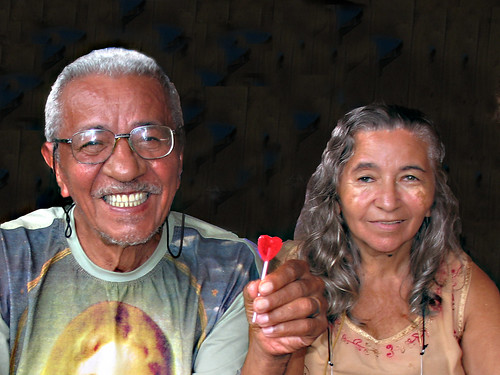
With great joy and gratitude,
we say
WELCOME MARIA FLOR
SOUZA NASCIMENTO
Born on 11 April 2009 bringing a new generation to the line of Mestre Conselheiro Luiz Mendes do Nascimento.
Daughter of Suzi and Neto
Granddaughter of Luza and Saturnino
Great Granddaughter of Padrinho Luiz and Madinha Rizelda
With great joy and gratitude,
we say
WELCOME MARIA FLOR
Monday, April 13, 2009
I'M GUILTY
Andrew Sullivan speculates that narcissism may explain blogging.
Kudos to him for unearthing this gem:
"Subclinical narcissists are happy. They are less likely to be depressed, sad or anxious, and rate their subjective well-being more highly. They're less reactive to stress, and recover more rapidly from it. Mild narcissism also seems to help people recover from accidents or other trauma—it gives them an unrealistic sense of their own invulnerability, and they believe that they will be able to handle whatever else life throws at them."
Or, as Ted Turner put it, "If I only had a little humility, I'd be perfect."
Read the full fascinating article in Carl Vogel's,A Field Guide To Narcissism. It's pretty funny even if you see traces of yourself.
QUOTE OF THE DAY
Paul Krugman writing about Republicans in his NY Times column says,
"... it doesn’t feel right to make fun of crazy people."
'nuff said!
Full Krugman column is here. It's a good read.
Paul Krugman writing about Republicans in his NY Times column says,
"... it doesn’t feel right to make fun of crazy people."
'nuff said!
Full Krugman column is here. It's a good read.
Sunday, April 12, 2009
HAPPY EASTER FROM BUJARI
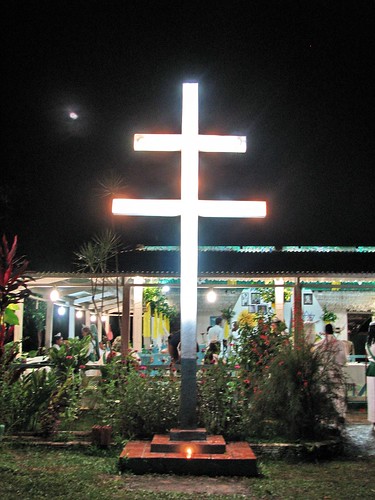
The extended family of Luiz Mendes maintains two spiritual centers in Acre -- one in the municipality of Bujarí near Rio Branco and the other at Vila Fortaleza in the municipality of Capixaba. This year Easter was celebrated at both locations.
When the spiritual works are a bit smaller, Padrinho Luiz often calls them "festinhas grandissimas" (GREAT little festivals) because the strong energy of a few people who really know how to perform together in spiritual union can really rock and send a marvelous light into the world.
And this was certainly the case last night at Bujari as people celebrated the continuing rebirth of the Master with love and joy.
First we sang the hymns of Francisco Ribero (a contemporary of Mestre Irineu)
And then the hymnal "Pequenininho" of Saturnino
The energy seemed particularly special because, in addition to the spirit of the risen Christ, a new generation of the Luiz Mendes family had been born. Earlier in the day Maria Flor arrived -- daughter of Suzi and Neto, granddaughter of Luza and Saturnino, and great granddaughter of Padrinho Luiz and Madrinha Rizelda.
There are more photos (and a good story) of an earlier "work" at Bujari here.
A CARBON TAX?
I've been focused on "cap-and-trade" as a way to address greenhouse gas emissions and filter funds to preserving forests and restoring soils with biochar but Tom Friedman is beginning to convince me that a carbon tax integrated with a true energy-and-environment policy may be the better way.
The problem is that while this may be a GREAT domestic policy, it does not channel funds from the developed industrial world to the developing world where the heaviest new environmental damage is taking place. In the final analysis it's gonna be a nation's politics -- one-by-one -- that determines whether to sustain or deplete its natural resources.
Here's how Costa Rica addressed the issue and became one of the world's most inspiring examples.
April 12, 2009
Go to Original
By THOMAS L. FRIEDMAN
Liberia, Costa Rica
Sailing down Costa Rica’s Tempisque River on an eco-tour, I watched a crocodile devour a brown bass with one gulp. It took only a few seconds. The croc’s head emerged from the muddy waters near the bank with the footlong fish writhing in its jaws. He crunched it a couple of times with razor-sharp teeth and then, with just the slightest flip of his snout, swallowed the fish whole. Never saw that before.
These days, visitors can still see amazing biodiversity all over Costa Rica — more than 25 percent of the country is protected area — thanks to a unique system it set up to preserve its cornucopia of plants and animals. Many countries could learn a lot from this system.
More than any nation I’ve ever visited, Costa Rica is insisting that economic growth and environmentalism work together. It has created a holistic strategy to think about growth, one that demands that everything gets counted. So if a chemical factory sells tons of fertilizer but pollutes a river — or a farm sells bananas but destroys a carbon-absorbing and species-preserving forest — this is not honest growth. You have to pay for using nature. It is called “payment for environmental services” — nobody gets to treat climate, water, coral, fish and forests as free anymore.
The process began in the 1990s when Costa Rica, which sits at the intersection of two continents and two oceans, came to fully appreciate its incredible bounty of biodiversity — and that its economic future lay in protecting it. So it did something no country has ever done: It put energy, environment, mines and water all under one minister.
“In Costa Rica, the minister of environment sets the policy for energy, mines, water and natural resources,” explained Carlos M. Rodríguez, who served in that post from 2002 to 2006. In most countries, he noted, “ministers of environment are marginalized.” They are viewed as people who try to lock things away, not as people who create value. Their job is to fight energy ministers who just want to drill for cheap oil.
But when Costa Rica put one minister in charge of energy and environment, “it created a very different way of thinking about how to solve problems,” said Rodríguez, now a regional vice president for Conservation International. “The environment sector was able to influence the energy choices by saying: ‘Look, if you want cheap energy, the cheapest energy in the long-run is renewable energy. So let’s not think just about the next six months; let’s think out 25 years.’ ”
As a result, Costa Rica hugely invested in hydro-electric power, wind and geo-thermal, and today it gets more than 95 percent of its energy from these renewables. In 1985, it was 50 percent hydro, 50 percent oil. More interesting, Costa Rica discovered its own oil five years ago but decided to ban drilling — so as not to pollute its politics or environment! What country bans oil drilling?
Rodríguez also helped to pioneer the idea that in a country like Costa Rica, dependent on tourism and agriculture, the services provided by ecosystems were important drivers of growth and had to be paid for. Right now, most countries fail to account for the “externalities” of various economic activities. So when a factory, farmer or power plant pollutes the air or the river, destroys a wetland, depletes a fish stock or silts a river — making the water no longer usable — that cost is never added to your electric bill or to the price of your shoes.
Costa Rica took the view that landowners who keep their forests intact and their rivers clean should be paid, because the forests maintained the watersheds and kept the rivers free of silt — and that benefited dam owners, fishermen, farmers and eco-tour companies downstream. The forests also absorbed carbon.
To pay for these environmental services, in 1997 Costa Rica imposed a tax on carbon emissions — 3.5 percent of the market value of fossil fuels — which goes into a national forest fund to pay indigenous communities for protecting the forests around them. And the country imposed a water tax whereby major water users — hydro-electric dams, farmers and drinking water providers — had to pay villagers upstream to keep their rivers pristine. “We now have 7,000 beneficiaries of water and carbon taxes,” said Rodríguez. “It has become a major source of income for poor people. It has also enabled Costa Rica to actually reverse deforestation. We now have twice the amount of forest as 20 years ago.”
As we debate a new energy future, we need to remember that nature provides this incredible range of economic services — from carbon-fixation to water filtration to natural beauty for tourism. If government policies don’t recognize those services and pay the people who sustain nature’s ability to provide them, things go haywire. We end up impoverishing both nature and people. Worse, we start racking up a bill in the form of climate-changing greenhouse gases, petro-dictatorships and bio-diversity loss that gets charged on our kids’ Visa cards to be paid by them later. Well, later is over. Later is when it will be too late.
Saturday, April 11, 2009
INDIGENOUS INTERNET
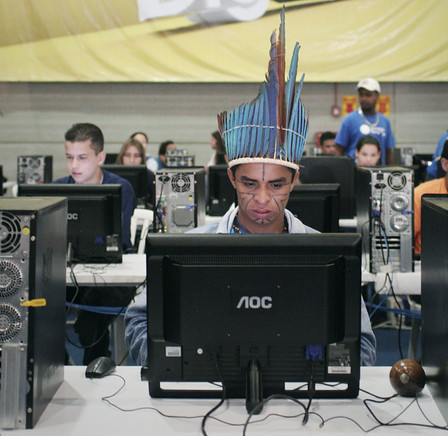
Photo by Tatiana Reis at the digital inclusion area of Campus Party 2009.
Brazil's rich diversity of indigenous groups now has a a new set of cyber-tools to communicate with each other and the world. At a time when indigenous peoples, their cultures and their places are threatened world-wide, blogging has provided a new way to drum up support.
Deborah Icamiaba at Global Voices Online has a fascinating article along with lots of great photos here.
And here is the rest of it.
Wednesday, April 08, 2009
JUSTICE GETS ANOTHER CHANCE
Brazil Orders New Trials in Nun’s Death
Alexei Barrionuevo reports in the NY Times
RIO DE JANEIRO — A court in Brazil ordered new trials on Tuesday for two men accused of murdering an American-born nun in a land dispute in the Amazon rain forest.
Sister Dorothy, who was from Dayton, Ohio, was killed in 2005 after she fought to preserve a piece of jungle that ranchers wanted to clear for logging and cattle ranching. She spent about two decades fighting destruction of the Amazon, and was viewed as a leader in the movement for sustainable development there.
Go to full article.
Tuesday, April 07, 2009
SUSTAINABLE TIMBER BUYING IN ACRE
That's the idea of this new program in Acre State where the State and City governments have agreed in principle to buying only wood that has been certified as logged in sustainable fashion.
Of course the devil is in the details and enforcement is not always perfect. However, State and City governments are by far the largest purchasers of local wood and this is a most welcome development. Illegal logging is a big problem in the Brazilian domestic market and governments account for a huge purchasing power. They can be the trend-setters. The hope is that programs like this will spread to other states and cities in Brazil.
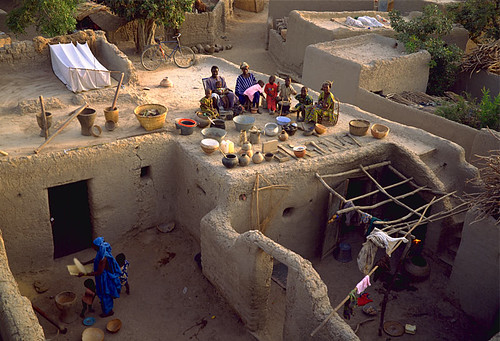
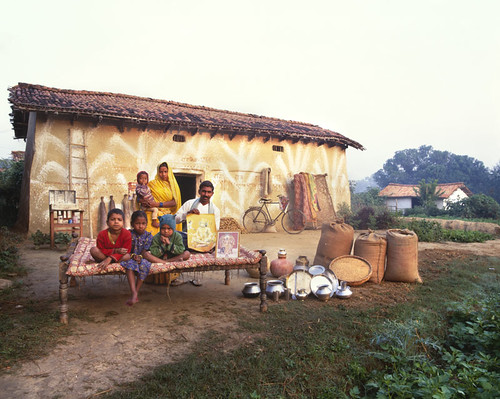
HOW MUCH STUFF?
The following photos give a sense of the incredible range of ownership of material stuff in today's world.
Stuff in Japan...
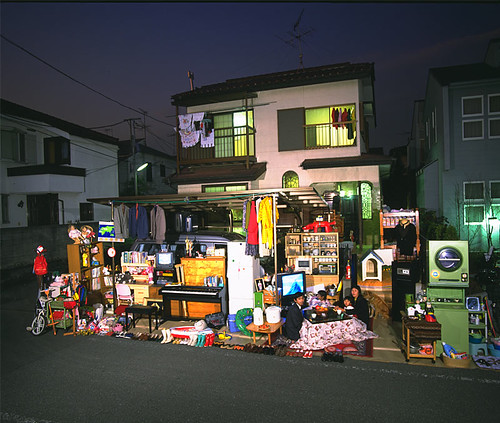
Stuff in Mali...
Stuff in China...

Stuff in India...
Stuff in the US...
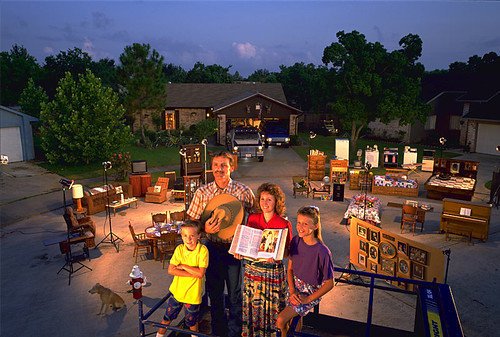
All of the above photos are by Peter Menzel. There's more about these photos and his marvelous photography here and here.
The above photos are not intended as wholly representative of the countries and their economies but they help illustrate both the legitimate desire of many folks to gain access to material comforts and they also raise the question of "how much is enough?"
About a month ago Andrew Revkin explored the issue of The Endless Pursuit of Unnecessary Things. The full post (and links) is fascinating...
February 6, 2008, 10:32 am
‘The Endless Pursuit of Unnecessary Things’
By Andrew C. Revkin
The following photos give a sense of the incredible range of ownership of material stuff in today's world.
Stuff in Japan...
Stuff in Mali...
Stuff in China...
Stuff in India...
Stuff in the US...
All of the above photos are by Peter Menzel. There's more about these photos and his marvelous photography here and here.
The above photos are not intended as wholly representative of the countries and their economies but they help illustrate both the legitimate desire of many folks to gain access to material comforts and they also raise the question of "how much is enough?"
About a month ago Andrew Revkin explored the issue of The Endless Pursuit of Unnecessary Things. The full post (and links) is fascinating...
February 6, 2008, 10:32 am
‘The Endless Pursuit of Unnecessary Things’
By Andrew C. Revkin
Amid the flow of Super Tuesdays, Superbowl surprises, news about faltering energy projects and rising solar cities, I’ve been collecting threads that relate to a central theme of Dot Earth: the implications of humanity’s growing numbers and resource thirst.
Here are a few from the last few days:
- A radio commentary quoting one of the less-familiar dictums of Adam Smith, who is best known for championing economic growth, but in this case was warning about too much of a good thing.
- The hypnotically unnerving documentary “Manufactured Landscapes,” which glaringly displays the increasingly human-shaped face of Earth.
- A sociology paper proposing that the best way to lessen consumption for its own sake is to reduce how much people work. (Is there a win-win here, or am I missing something?)
- A paper in the journal Science on sustainability showing that, by one measure, afflictions related to affluence take away as many years of life as do ills associated with poverty.
These papers and observations all circle around the two questions at the heart of the sustainability puzzle that will largely determine the quality of human lives and the environment in which they are lived: How many? How much?
How many people will inhabit Earth in the next few generations?
How much stuff – energy, land, water, marine life – will they consume?
A few examples: The overlay of rising demand and lagging supply of oil or comparable liquid fuel will shape everything from economics to international conflict. The amount of coal extracted and burned (along with the oil) will influence climate for centuries to come. The extent of land used to grow fuel, food, or fiber will determine the costs of those necessities and also the fate of the world’s last untrammeled ecosystems.
Back to the related nuggets above.
I was listening to the public-radio program Marketplace and heard a guest commentary by Charles Handy, an expert on business management who founded the London Business School and is in residence at the Drucker School of Business of Claremont (Calif.) Graduate University.
He was musing on the ideas of two departed pillars of economics, Adam Smith and Peter Drucker, in relation to limits to growth.
An excerpt:
…I wonder how [Peter Drucker] would have reacted to some of the things that bother me. For instance, how would he respond to what I call “Adam Smith’s Great Conundrum?”
Adam Smith, the father of economics, 250 years ago, said: “An investment is by all right-minded people to be commended, because it brings comforts and necessities to the citizenry. But, if continued indefinitely, it will lead to the endless pursuit of unnecessary things.”
Now that I am living for a while in California, I am staggered by the amount of “unnecessary things” that I see in the malls that dot the suburbs. America is no different from anywhere else, of course — just more so.
The conundrum is this: All that stuff creates jobs — making it, promoting it, selling it. It’s literally the stuff of growth. What I’d love to ask Peter Drucker is: How do you grow an economy without the jobs and taxes that these unnecessary things produce?
Drucker saw business as the agent of progress. Its main responsibility, he said, was to come up with new ideas and take them to market. But not just any new ideas, please — only those that bring genuine benefits to the customers, and do not muck up the environment.
The market, unfortunately, does not differentiate between good and bad. If the people want junk, the market will provide. So we have to fall back on the conscience of our business leaders.
Then there was “Manufactured Landscapes,” a film examining how human demands for resources and products are transforming the physical world, and the environment experienced on a daily basis by humans caught up in the rush of urbanized, mechanized, work-centered life. It does so over the shoulder of the Canadian photographer Edward Burtynsky, who has made chronicling the face of the Anthropocene epoch his life’s work of late.
I saw a snippet of it when writing a post on the “urban age” last week, but finally had a chance to watch the DVD. It is an unforgettable experience, something like a mash-up of “Apocalypse Now” and “Modern Times.”
It is a sobering view, particularly the scenes in sprawling Chinese factory cities churning out the (unnecessary?) things that prosperous people seem to need in ever-rising amounts. Watch the hands of a young woman as she speeds through the 20 or so manipulations necessary to make an electronic device whose purpose she only can guess at. She makes 400 a day. Then watch as the camera pans cavernous halls full of similar workers, then cuts outdoors to the cordons of thousands of workers heading to yellow dormitories.
How many factories? How much stuff?
Then came “Sustainable Consumption and Worktime Reduction,” a paper by Juliet Schor, a sociologist at Boston College, that I stumbled on while surfing a 2005 special issue of the journal Industrial Ecology on the global impacts of cities. The entire issue is enlightening.
She chronicles how industrialized economies have generally translated productivity gains in the workplace into making more stuff (and money to buy stuff) instead of making less work (reducing work hours).
A world heading toward 9 billion, however, following that path of ever more work and money to buy ever more stuff, cannot be sustained, Professor Schor concludes:
Achieving a sustainable and equitable global solution is clearly incompatible with a worldwide replication of U.S. lifestyles or even the somewhat less damaging ecological impacts of the lifestyles of other industrialized countries. In such a situation, inhabitants of the global North can and should opt for a new economic and social vision based on quality of life, rather than quantity of stuff, with reduced work time and ecological sustainability at its core. Such a vision has the potential to create broad-based pressure for an alternative to the current system of ecologically destructive, inequitable consumer-driven growth. Indeed, the future of the planet increasingly depends on it.
This paper echoed ideas I explored in 2005, when writing on Bhutan’s experiment with “gross national happiness” as a substitute for the more familiar gross national product.
Finally, there was “Science and Technology for Sustainable Well-Being,” a paper in Science by John P. Holdren, the Harvard expert on energy, environment, development and lots of other things.
The paper is a sprawling portrait of a world poised between a livable path toward 9 billion and one wracked by disruption and suffering, along with a menu for limiting losses as we head into crunch time these next few decades. But one chart really grabbed my attention. By Dr. Holdren’s analysis, when you measure human tolls in years of life lost (e.g., a child cut down by disease loses decades; a grandmother dying of a stroke at 80 loses a few years.), the major afflictions of poverty and affluence do us in at roughly equal rates.
Childhood and maternal malnutrition, he estimates, erased 200 million life years in the year 2000. High blood pressure, cholesterol, obesity, and lack of physical activity erased 150 million life years. (There’s a long list of other causes, from war to tobacco.)
So at each end of the development ladder – from not enough to too much – we get into trouble.
So are we now locked into the “endless pursuit of unnecessary things?” In thinking about this warning from Adam Smith, I can’t help but feel bad for Thomas Malthus, who has taken all the heat from free-market champions of eternal growth over the years.
Maybe it was Adam Smith who was the first Malthusian prophet of doom.
Subscribe to:
Posts (Atom)


