HOT GYPSY JAZZ GUITARS
"Awe-inspiring" says David Pescovitz at boingboing: "German guitarist Joscho Stephan is perhaps the world's greatest living Gypsy jazz guitarist. When my friend Marina Gorbis turned me on to him this morning, I asked if she thinks he may even be better than the Gypsy legend himself, Django Reinhardt. "Well, Stephan can use all his fingers," she said. Fair enough. The other guys in the clip aren't bad either. Joscho Stephan"

Thursday, April 15, 2010


Wednesday, April 14, 2010
WAR AND WOMENS POWER

Sex and War: How Biology Explains Warfare and Terrorism and Offers a Path to a Safer World
Money quote:
"There is no one solution to the problem of war. But biology suggests — and quantitative studies support — the notion that if testosterone is the ultimate weapon of mass destruction, then the birth control pill may be the ultimate prescription for peace."
The provocative work of Hayden and Potts is attracting lots of web attention. Here's an excellent Shambhala SunSpace interview and a fascinating video with Hayden and Potts.
And now an article via Truthout
Make Birth Control, Not War
Monday 12 April 2010
by: Thomas Hayden and Malcolm Potts
The human tendency toward war is based on biology, but the right family planning policies can redirect the world toward peace.
Close your eyes for a moment and cast your mind back to the dominant news stories of early 2010. The economy in tatters? Certainly. Global stalemate on climate negotiations and unbreakable gridlock in Congress? Of course. And don't forget the terror — on Christmas Eve, 2009, a lone Nigerian man boards an airplane in Lagos and travels some 18 hours toward Detroit in what can only have been a dizzying combination of anxiety, fear and elation, and a grandiose sense of his own destiny. It all ends with a little ineffectual fumbling in the underpants, cut short by the heroism of Umar Farouk Abdulmutallab's fellow passengers.
The official response to the underwear bomber reveals the usual inability of large bureaucracies to connect the dots or take meaningful action on real threats. Instead of understanding and reassessment, we get yet another late, inappropriate and costly escalation in airport security and political infighting about the treatment of Abdulmutallab — all of it embedded in an unacknowledged but resolute refusal to see the bigger picture.
Meanwhile, the real killing continues to elude the headlines. It is on the Afghanistan-Pakistan border, in Afghanistan's Helmand Province where allied Western soldiers struggle with the almost impossible task of attacking the Taliban without killing civilians. It is in Darfur and the Congo, where death tolls are in the millions, not the thousands, and it is in Nigeria, where Christians and Muslims meet. Here is primeval warfare in full abundance, where bands of men are knit together by ancient bonds of shared violence. They are motivated to kill their neighbors systematically and deliberately, not just by lust for land and resources but also by hatred of the "other" and a too-seldom acknowledged love of war and warring ways. It is in these places, and scores of others where the violence simmers just below the surface, that people live close to one of the darkest realities of human nature.
Humans — human males, really — are not peaceful animals. They are in fact a spectacularly violent species, and very nearly uniquely so. Despite high-minded modern wishes and the received wisdom of three generations of anthropologists and sociologists, warfare is not an aberration in human development, nor is it a learned, culturally determined behavior. War and its ancillary behaviors — including racism, slavery, mass rape and the subjugation of women — are not cultural problems and thus do not have neat, sociological solutions. Along with terrorism, these most destructive of human behaviors derive clearly and directly from our biology, bequeathed to us by an evolutionary pathway that we share with just one other extant species, the chimpanzees.
War, simply put, is in our genes. It is a complex behavior built up out of a series of emotions and impulses that are, in general, expressed more in men than in women, and more in young men than in old. It arose early in our evolutionary history because the most violent of our pre-human male ancestors had more offspring than their more peaceful or timid competitors; it has been with us as long as we have been a species and in all probability will be with us as long as we remain one. Our warlike impulses cannot be stopped with enhanced airport imaging, extrajudicial treatment of terrorism suspects or any attempt at a literal "war on terror."
From biology, medicine, history, literature, political theory, sociology and evolutionary psychology, a clear picture emerges: War is a biological behavior. As robust science demonstrates — and common sense and the experience of warriors around the world and throughout history attest — war is part of the human condition. But does this mean that war is inevitable and peace an unattainable dream?
Emphatically, and demonstrably, no. Most of the world, despite economic challenges, is remarkably peaceful, and as improbable as it seems, the past century has actually been the most peaceful in known human history. The last soldiers who experienced the horrors of trench warfare in France have died, the guns are silent in Bosnia and Herzegovina, and the leaders of Pakistan and India are trying to talk to one another. The Vikings, who once personified the merciless terror of war for an entire continent, have become the Scandinavians, as resolute as anyone in the quest for tolerance at home, and peace and openness around the world.
Crucially, war's deep roots in our evolutionary past do not condemn us to a future as filled with warfare as our history has been. On the contrary, recognizing and accepting the centrality of war in human nature sheds new light on real, practicable policy prescriptions that can help make war less common in the future and less brutal when it does occur. Humans are complex, adaptable animals. And all genes, behavioral or not, are influenced by their environments. If humans truly want peace, they must seek to understand the biology of war and use that understanding to devise policies — chief among them, improved access to family planning services that can control some demographic drivers of war — so as to help the biology of peace win out.
The idea that warlike violence is not innate actually arose just recently. It can be traced back to Rousseau, and found full-throated proponents in Franz Boas, Margaret Mead, Ashley Montagu and other post-World War I anthropologists. Understandably shocked by the horrors of trench warfare and poison gas, these generally clear-minded academics sought evidence to distance humankind from such barbarism, and they found it — or so they thought — in an updated notion of the Noble Savage and the idea that civilization represents a fall from some earlier state of grace. But archaeologists such as Steven LeBlanc of Harvard and Lawrence Keeley of the University of Illinois at Chicago have found supposedly peaceful societies riddled with violence. Careful investigation reveals histories of murder and long-standing, pervasive and brutally lethal warfare in Mead's Pacific Islanders, the Copper River Inuit, the !Kung people of the Kalahari and many other purportedly "peaceful" societies. As LeBlanc writes in his clarifying 2003 book, Constant Battles, "Prehistoric warfare was common and deadly, and no time span or geographic region seems to have been immune."
Remarkably, the idea that violence and warfare are the fault of culture, not biology, remains widespread in academic circles. As recently as 1986, 20 international scholars drafted the Seville Statement on Violence at a UNESCO meeting asserting that, among other things, "It is scientifically incorrect to say that war or any other violent behavior is genetically programmed into our human nature." Several scientific associations, including the American associations of psychology, of anthropology and of sociology, voted to endorse the Seville Statement. But true science proceeds by observation, experiment and debate, and not by endorsing written statements. And the evidence — which we examined fully in our recent book, Sex and War: How Biology Explains Warfare and Terrorism and Offers a Path to a Safer World — reveals a very different story.
In 2009, fossil hunters in Ethiopia found "Ardi," a nearly complete skeleton of a 4.4 million-year-old ape with a brain slightly larger than that of a chimpanzee. She lived in an open savannah and walked upright, even though she still had an opposable toe, as chimps do, to climb trees. Identified as Ardipithecus ramidus, like other fossils such as the famous "Lucy," Ardi is not a "missing link" in the sense of a literal ancestor, but a cousin, a nearby branch on the tree of human evolution. Yet all the apes have a common ancestor, and Ardi is almost certainly descended from the branch of the ape family that gave rise to chimps and humans. We suggest that this chimp-human ancestor lived in small bands of related males who controlled a defined territory — just as do chimpanzees and virtually every hunter-gatherer society ever studied. And we suggest that war began when those ancestral males first banded together and, as present-day chimpanzees and more recent hunter-gatherers still do, left their territory, found a member of another troop and set about killing it in the most vicious way possible.
At its most basic, we define war as a form of organized violence in which groups of males band together and intentionally set out to kill members of their own species. Many species are violent, of course, and may appear to enjoy hunting and killing "for sport," as humans do. Quite a few predators hunt and kill in packs or coordinated teams. But it is exceedingly rare that they should intentionally hunt and kill members of their own species, as opposed to the occasional and largely accidental deaths that result from male mating competitions. Wolves may do so on occasion, and hyenas, and perhaps one or two other species. But when it comes to warring behavior as a regular, integral part of life, no species come close to human beings and chimpanzees. Taken with the reality that war has been a constant feature of human behavior around the world and throughout time, this commonality of humans and the chimps suggests very strongly that war is an inherited behavior that first evolved in a common ancestor we shared more than 7 million years ago.
So how did war first evolve? As Jane Goodall, Richard Wrangham and others have shown, we share with chimps, our closest living biological relatives, the bizarre propensity to attack and kill others of our own species. Chimpanzees live, as humans did for the vast majority of evolutionary time, in male-dominated social groups in which the males are all blood relatives and only females move between troops. The dominant males largely monopolize mating opportunities and take the best food and other resources. Younger males are left either to work their way up the in-group hierarchy or attempt surreptitious matings with females of their own troop or others — high-stakes strategies that often end in a beating or worse. But, in a unique evolutionary innovation, these young males can also band together and launch attacks on isolated members of neighboring out-groups, ultimately eliminating these "enemies" and securing the territory, resources and females they require to survive and pass on their genes.
Today, we see remarkably similar patterns of territorial raiding, brutal attacks and, ultimately, campaigns of extermination in both humans and chimpanzees. Just as the most successfully violent alpha male chimpanzees have more mates and more offspring than the losers, genetic surveys show that the great human warriors of history have left outsized impacts on the human gene pool. One study published in 2003 estimated that Genghis Khan has 16 million living descendants worldwide. It takes little imagination to see the evolutionary benefit of warfare to Khan and his cohorts, and it leads to the uncomfortable realization that we are all, by definition, the descendants of the victors in conflicts over resources, territory and the right to mate.
We are all descended, in other words, from particularly successful rapists, murderers and brigands. Human males today bear the marks of this legacy in the behaviors and impulses that still spur us on to lethal conflict — including the widespread and devastating association between war and rape — even when other solutions are both available and preferable.
There is no doubt that other apes, like people, can be empathetic. They will help one another or slow down a march so a sick or wounded animal can catch up. In her important 2009 book Mothers and Others: The Evolutionary Origins of Mutual Understanding, Sarah Blaffer Hrdy of University of California, Davis, underscores the ability of human mothers to assist one another in the long, arduous task of raising children. How can such intensely social, empathic animals also kill other members of their own species? We postulate that the key that unlocked the full fury of war was an evolved psychological mechanism that allows us to dehumanize (or "dechimpanzize") those we would attack. Tragically, human history is replete with episodes of dehumanizing behavior.
A famous Stanford prison experiment shows that nice young students randomly assigned in a psychology experiment to be "prison guards" will adopt and exploit these roles in a couple of days and emotionally abuse people randomly assigned to play the role of "prisoners." The study lasted only a few days, but the behavior was little different from that of American soldiers in Abu Ghraib abusing Iraqi prisoners. Dehumanizing our enemies is not an aberration — it is default human behavior. New York Times columnist Nicholas Kristof, reporting from the Congo, recently described a woman who, while she was being raped by soldiers, screamed to warn her neighbors. In revenge, her assailants cut off one leg with a machete, cooked the meat and ate it while the woman almost bled to death and her children looked on. When they tried to force her child to eat her mother's flesh, he refused, saying "shoot me." They did. Seemingly, the human ability to dehumanize others knows no limits — and most certainly has not disappeared from our shared evolutionary repertoire.
We go into more detail on the potential mechanisms for our evolved ability to dehumanize and kill our fellow humans in our book. But for a flavor of those root causes, let us suggest that the male sex hormone, testosterone, is in some ways the ultimate weapon of mass destruction. Testosterone levels are highest in men aged 19 to 30, a span that tracks closely the age distribution of convictions for violent crimes. Testosterone levels rise not just among men playing team sports but also their fans — and one need look no further than the passionate partisanship of team sports to see the "in-group" versus "out-group" dynamic that underlies both the camaraderie and cruelty of warfare. Women also secrete testosterone, but at about one-tenth the male level. Intriguingly, women's testosterone output does not change in response to competition.
In 2008, the world suffered the biggest economic collapse since the Great Depression. Like war, the global financial crisis had many specific and technical causes. But it was ultimately driven, in the words of one financial adviser in the City of London, by "a lot of alpha males with testosterone streaming out of their ears." This apparently flippant remark was actually an insightful analysis of the global crisis. Evolutionary psychologists Coren Apicella from Harvard and colleagues found that men with high testosterone levels make riskier investments, and others have observed that women make better investment managers over the long term than do men. The multimillion-dollar bonuses Wall Street bankers pay themselves, which for good reason infuriate the rest of society, can be best understood as a (predominantly male) troop displaying intense internal loyalty and total blindness to the outside world.
Six months after the publication of Sex and War, we were comforted to read two papers in Science. Two separate studies — Samuel Bowles writing one, and Adam Powell, Stephan Shennan and Mark Thomas the other — used different methodologies from ours but came to the conclusions we had.
Bowles, an economist and behavioral scientist who studies altruistic behavior, used a computer model of between-group competition together with a database of archaeological and ethnographic rates of adult mortality from warfare. His study supports the notion of "parochial altruism," in which humans developed the ability to be altruistic within an in-group, however defined, and callously violent to those outside it. In fact, Bowles' work suggests that the human compassion and altruism most people value today was made possible by the existence of warfare — that cooperation for both defense and offense within the group allowed the most successfully violent of our ancestors to flourish.
Powell and his co-authors focus on the evolution of technological and cultural complexity, as evidenced by the appearance of art, sophisticated tools — including such potential weapons as bows, boomerangs and spear-throwers — and long-distance trade. Their main purpose is to explain patterns of "modern" behavior in Africa and Eurasia. But in the process, they show convincingly that population growth and other demographic features may hold the key to some of our most complex behaviors.
Each particular war and battle has its own history and specific sets of grievances, turning points and precipitating triggers and personalities. But there is also a set of factors — social, political and environmental — that many wars and violent conflicts have in common. In fact, these shared characteristics are so common that statistical modeling of social, economic and environmental conditions can result in stunningly accurate predictions of armed conflict and unrest.
Briefly, the factors that seem most likely to increase the probability of open war or armed conflict include:
* Environmental stress and/or resource limitation.
* Extreme economic disparity within or between groups and lack of
opportunities, especially for young men.
* Subjugation of women and a culture of male dominance.
* A high proportion of young males relative to older males.
All of these factors interact in one way or another with the warlike biology of the human male, and each is influenced quite directly by population growth rate, and as a result, population age structure or the relative ratios of young to old in a society.
We argue in Sex and War that our warring behaviors are essentially a hangover from our evolutionary past. It also seems clear that these behaviors have been rendered wildly maladaptive in the dual modern contexts of stable societies with social norms that condemn wild warring on the one hand and allow weapons of mass destruction on the other. (With simple technology, the impulses of war can kill hundreds or thousands; with nuclear and biological weapons, they can potentially kill us all.)
But the problem with evolved traits is that they neither know nor care when they're no longer wanted. And as catastrophically troublesome as our warrior genes often are today, the conditions in which they rose to prominence also persist. Our prescription for a more peaceful future follows directly from that observation: To limit the damage from unchecked warfare, humanity must understand and limit the physical, cultural and demographic conditions that make it most likely to occur.
War is the ultimate zero-sum game. Whether one side or another wins, and no matter what short-term economic stimulation comes to pass, war represents a squandering of resources and the greatest imaginable waste of human effort, ingenuity and life. We cannot argue that wars are never justifiable or necessary. But whatever utility this unique set of behaviors once had, human culture and morality have moved beyond the point where wars of extermination are acceptable, and killing technologies have become far too deadly, and indiscriminately so, for our warring impulses to be given free rein.
But can humans change? The answer, thank goodness, is that we can — and in fact we already have. As mentioned earlier, the 20th century was more peaceful than any other, both in terms of the number of people directly involved in warfare and in the percentage of adult males dying in armed conflict. As just one example, the Soviet Union suffered the greatest casualties of World War II — perhaps 15 million died, representing 8 percent of the population. As unimaginably horrific as those losses were, they are small compared to violent death rates in hunter-gatherer societies. Among the hunter-gatherers of New Guinea, studies show, from 5 to 30 percent of adults typically die from raids and wars; in the Yanomamo of the northern Amazon basin, a staggering four out of 10 adults have participated in killing another person and 20 percent of people over 40 have lost a parent, child or sibling to violence.
Just as there are many factors that initiate wars, there are also many factors that can in theory be tweaked or refined to make war less likely. The clarifying lens of biology helps show that one factor influences them all: The population growth rate turns out to be a crucial component in the biology of war, for reasons both direct and indirect.
Foremost, growing populations are young populations, and young men are the true engines of war. They provide the recklessness and bravery, the intense inward loyalty and outward hostility, and the other raw behavioral "material" that can be shaped easily into small, tightly bonded fighting units, which in turn can be built up into armies of millions with each soldier still fighting, ultimately, for the men at his side. At the same time, women in rapidly growing populations are women spending a great deal of time having and raising children — and not, usually, taking an equal role in politics at any level outside the home. Careful statistical studies show that the probability of violent conflict increases as the ratio of young men in a society rises above that of older men, and that the probability of war falls as the percentage of women involved in local politics rises.
More tangentially, growing populations stress their environments and lead to competition for increasingly scarce natural resources. The link between environmental instability and violent conflict is made frighteningly clear in a 2009 study by researchers at Stanford University, New York University, Harvard University and the University of California, Berkeley. Extrapolating from historical correlations of temperature rise and increased armed conflict in sub-Saharan Africa, the researchers project that expected climate change alone could spur a 60 percent increase in armed conflicts by 2030. That projection, if it came true, would translate to an additional 459,000 deaths from war in just two decades, and that is without taking population growth into account — in the fastest-growing region of the world.
Growing populations, especially in poorer areas, also tend to overburden existing infrastructure and outstrip the available employment. This leads to high operating costs for businesses and lost opportunities for individuals. Educational opportunities are lost for the same reasons, and in many cultures, it is girls who lose out first when education is rationed.
There is no one solution to the problem of war. But biology suggests — and quantitative studies support — the notion that if testosterone is the ultimate weapon of mass destruction, then the birth control pill may be the ultimate prescription for peace.
It is sobering to think of how many millions of our forebears died of sword and siege and famine, but it is also heartening to realize that humans have already found many ways to rein in our most violent impulses. In light of the true, root, biological causes of warfare, it becomes obvious that there is much more humans can and should be doing now.
Let's look again at some of the main predictors of war in the light of one particularly well-known conflict, the alternating battles and standoffs between Israel and Hamas in the Gaza Strip. Young men, in general, are motivated to fight for resources, or in revenge for those killed, or because they feel a sense of injustice, and those emotional cues surely help motivate young Palestinians to risk their lives firing rockets at Israel, or to become suicide bombers on Israeli streets. Israel's desire to stop such attacks is understandable.
Interestingly, the Palestine Liberation Organization under Yasser Arafat showed very clearly what it takes to truly stop terrorism. In 1972, the terrorist group Black September, based in Beirut, gained world attention by killing Israeli athletes at the Munich Olympic Games. But Arafat had his eye on the possibility of gaining observer status at the United Nations. Afraid Black September might launch more high-profile raids and undermine his U.N. ambitions, the PLO flew eligible young female volunteers to Beirut and offered militant members of Black September $3,000, an apartment with a TV, long-term employment and $5,000 if they married and had a child. The offer was overwhelmingly accepted, and Black September as a terrorist movement collapsed almost overnight.
Since the Six-Day War in 1967, the population of the Occupied Palestinian Territory has grown from just over 1 million to 3.9 million. The average woman there has about five children, and the U.N. estimates that by 2050 the Palestinian population could reach a mind-boggling 8.8 million to 11.8 million. Two-thirds of the current population is under age 25, giving rise to an unemployed, volatile, testosterone-fueled group of young men — an endless source of terrorists. Adding to their frustrations, and their motivation to lash out, Arab society discourages premarital sex, and unemployed men don't have the resources needed to marry.
The world is not going to pay young Palestinians to marry. But we do have options. Gaza has few jobs and virtually no natural resources. Already, Palestinians pull more water out of the ground than falls from the sky, and their drinking water is increasingly saline. Palestinians also have a strong entrepreneurial tradition, however, and, like Singapore in the 1960s and 1970s, could build a future in their overcrowded space by living by their brains. Israel may understandably want to build a wall around Gaza, but without the free flow of goods, capital and ideas — and education at all levels for both sexes — the problem of Palestinian terrorism will get worse, not better.
In the early 1990s, one of us spent time in Gaza working with an Arab colleague to develop family planning services. Palestinian women wanted help from the international community, but no government or donor would provide the modest support needed to improve access to family planning. That opportunity to improve the lot of Gazans was lost, and the situation has deteriorated to the point where today's radical Palestinians claim, "the Palestinian womb is the one weapon that Palestinians have." In a tragic sense, they are right. But as a strategy for building a better future, rapid population growth could not be more wrong.
There is a popular notion that education and rising economic fortunes lead to decreasing family size. We argue elsewhere that, conversely, decreased family size is actually a prerequisite for economic growth and social stability. We suggest that the cases of China, South Korea and Thailand, and even post-revolution Iran, present particularly powerful examples. In each of these cases, governments realized early on that rapid population growth threatened their continued peace, stability and prosperity. In China by coercive means, and more by top-down social consensus building in South Korea, Thailand and Iran, these countries were able to slow population growth rates dramatically, and each has had a more prosperous-than-expected outcome as a result.
Other problems persist of course. But even in Iran, with its incongruously antagonistic government and truncated economy, the benefits of slowing population growth are plain to see. There are now more women in the University of Tehran than men, and while Iran's chaotic president may support terrorist groups, young Iranians are not strapping on explosive vests and killing people — they are marching peacefully in the streets demanding more openness, democracy and peace.
In his 2009 speech accepting the Nobel Peace Prize, Barack Obama noted, quite correctly, that "security does not exist where human beings do not have access to enough food, or clean water, or the medicine they need to survive. It does not exist where children cannot aspire to a decent education or a job that supports a family." He did not, however, mention his single most significant contribution to world peace to date: reversing the Bush-era policy of refusing U.S. development funds to any agency supporting the availability of family planning. And it doesn't matter whether the goal is specifically to build peace — that result will come if the policies succeed and women in the most impoverished areas of the world are simply able to determine their own family size.
We have argued that offering women a range of family planning is always associated with falling family size. This assertion has recently been validated by the analysis of what might be called a natural experiment. In Kenya between 1970 and the early 1990s, considerable emphasis was put on improving access to family planning, and average family size fell from 8 to 5. But then the focus was taken off of family planning, and health professionals migrated to work on the AIDS epidemic.
Kenya's fertility decline stalled as contraceptive use fell, and unwanted pregnancies and unsafe abortions increased dramatically. In 1990, it was estimated that the population of Kenya would grow from 23.5 million then to 54 million in 2050. As a result of the stalled fertility decline, today's estimate for 2050 population has been raised to 83 million. Already, the ethnic violence following the disputed presidential election of December 2007 has undermined generations of peaceful coexistence and friendship within Kenya; population increases of this magnitude could well turn Kenya into a failed state like its neighbor, Somalia. If population growth is not slowed again in Kenya, the results will be as horrifying as they are avoidable: Ethnic violence related to diminished access to resources will increase, and a once shining light for stability and prosperity in Africa will have been snuffed out for generations because of the lack of attention to family planning over the past 15 years.
In fact, we have just come through a "lost decade" of family planning — and by extension, a lost decade for building peace in the world. Especially in sub-Saharan Africa and parts of the Middle East, this lost emphasis on both domestic and international family planning programs is already having tragic consequences. The latest research shows that a "contraception gap" between rich and poor — already a common phenomenon around the world — is widening in those countries where the poor are already most vulnerable. (The wealthy have always been more able to find ways to separate sex from reproduction.) As the unmet demand for family planning continues to rise throughout the most impoverished nations, so too will the disparities in family size between rich and poor. Inevitably and as a direct consequence, the inequalities in education, health, employment and income will also continue to widen, infrastructure will continue to crumble, and the risk of food insecurity, environmental catastrophe and devastating warfare will continue to rise.
Ultimately, the decision to support family planning efforts comes down to making a moral choice. The profound success of humanitarian aid efforts and improved nutrition and health care for many in the developing world is greatly to be admired and celebrated. But in decreasing infant mortality, we have engendered a grim unintended consequence — millions of women throughout the developing world are now able to bear healthy children safely, but have no access to safe and effective contraception.
A prominent evolutionary biologist recently shared with one of us his recent realization that when it comes to vaccination and other means of preventing tropical illness, "to provide these measures without providing family planning assistance is tantamount to homicide/genocide." As important as it obviously is to work for greater health and longer life, we could not agree more emphatically that to do so without also giving people the ability to determine family size is to condemn them to an increased likelihood of overpopulation, poverty and environmental degradation, as well as a dramatic and quantifiable increase in the likelihood of bloody conflict.
It is not just perverse and foolhardy from a national security standpoint to pursue policies that increase the likelihood of famine, unemployment and war; it is morally wicked, on a historically vast scale, to condemn untold hundreds of millions of fellow humans to longer lives of decreasing opportunity and increasing misery. This is, of course, not an argument against health care and hygiene throughout the developing world, and it is emphatically no brief for eugenics or forced or coercive abortion, sterilization or contraception.
It is, rather, the strongest possible argument for the immediate, universal provision of the means of family planning and maternal health care, so that women throughout the world can have the freedom to choose the family size that's best for them. Those individual choices, made freely and without coercion, will inevitably lead to more stability, peace and prosperity. If those millions of women are denied the means to choose for themselves, then choice will diminish for the rest of us. We will all have continued population increase, a devastated environment and the looming prospect of a future just as bloody and war-filled as our past.
Sex and War: How Biology Explains Warfare and Terrorism and Offers a Path to a Safer World
Money quote:
"There is no one solution to the problem of war. But biology suggests — and quantitative studies support — the notion that if testosterone is the ultimate weapon of mass destruction, then the birth control pill may be the ultimate prescription for peace."
The provocative work of Hayden and Potts is attracting lots of web attention. Here's an excellent Shambhala SunSpace interview and a fascinating video with Hayden and Potts.
And now an article via Truthout
Make Birth Control, Not War
Monday 12 April 2010
by: Thomas Hayden and Malcolm Potts
The human tendency toward war is based on biology, but the right family planning policies can redirect the world toward peace.
Close your eyes for a moment and cast your mind back to the dominant news stories of early 2010. The economy in tatters? Certainly. Global stalemate on climate negotiations and unbreakable gridlock in Congress? Of course. And don't forget the terror — on Christmas Eve, 2009, a lone Nigerian man boards an airplane in Lagos and travels some 18 hours toward Detroit in what can only have been a dizzying combination of anxiety, fear and elation, and a grandiose sense of his own destiny. It all ends with a little ineffectual fumbling in the underpants, cut short by the heroism of Umar Farouk Abdulmutallab's fellow passengers.
The official response to the underwear bomber reveals the usual inability of large bureaucracies to connect the dots or take meaningful action on real threats. Instead of understanding and reassessment, we get yet another late, inappropriate and costly escalation in airport security and political infighting about the treatment of Abdulmutallab — all of it embedded in an unacknowledged but resolute refusal to see the bigger picture.
Meanwhile, the real killing continues to elude the headlines. It is on the Afghanistan-Pakistan border, in Afghanistan's Helmand Province where allied Western soldiers struggle with the almost impossible task of attacking the Taliban without killing civilians. It is in Darfur and the Congo, where death tolls are in the millions, not the thousands, and it is in Nigeria, where Christians and Muslims meet. Here is primeval warfare in full abundance, where bands of men are knit together by ancient bonds of shared violence. They are motivated to kill their neighbors systematically and deliberately, not just by lust for land and resources but also by hatred of the "other" and a too-seldom acknowledged love of war and warring ways. It is in these places, and scores of others where the violence simmers just below the surface, that people live close to one of the darkest realities of human nature.
Humans — human males, really — are not peaceful animals. They are in fact a spectacularly violent species, and very nearly uniquely so. Despite high-minded modern wishes and the received wisdom of three generations of anthropologists and sociologists, warfare is not an aberration in human development, nor is it a learned, culturally determined behavior. War and its ancillary behaviors — including racism, slavery, mass rape and the subjugation of women — are not cultural problems and thus do not have neat, sociological solutions. Along with terrorism, these most destructive of human behaviors derive clearly and directly from our biology, bequeathed to us by an evolutionary pathway that we share with just one other extant species, the chimpanzees.
War, simply put, is in our genes. It is a complex behavior built up out of a series of emotions and impulses that are, in general, expressed more in men than in women, and more in young men than in old. It arose early in our evolutionary history because the most violent of our pre-human male ancestors had more offspring than their more peaceful or timid competitors; it has been with us as long as we have been a species and in all probability will be with us as long as we remain one. Our warlike impulses cannot be stopped with enhanced airport imaging, extrajudicial treatment of terrorism suspects or any attempt at a literal "war on terror."
From biology, medicine, history, literature, political theory, sociology and evolutionary psychology, a clear picture emerges: War is a biological behavior. As robust science demonstrates — and common sense and the experience of warriors around the world and throughout history attest — war is part of the human condition. But does this mean that war is inevitable and peace an unattainable dream?
Emphatically, and demonstrably, no. Most of the world, despite economic challenges, is remarkably peaceful, and as improbable as it seems, the past century has actually been the most peaceful in known human history. The last soldiers who experienced the horrors of trench warfare in France have died, the guns are silent in Bosnia and Herzegovina, and the leaders of Pakistan and India are trying to talk to one another. The Vikings, who once personified the merciless terror of war for an entire continent, have become the Scandinavians, as resolute as anyone in the quest for tolerance at home, and peace and openness around the world.
Crucially, war's deep roots in our evolutionary past do not condemn us to a future as filled with warfare as our history has been. On the contrary, recognizing and accepting the centrality of war in human nature sheds new light on real, practicable policy prescriptions that can help make war less common in the future and less brutal when it does occur. Humans are complex, adaptable animals. And all genes, behavioral or not, are influenced by their environments. If humans truly want peace, they must seek to understand the biology of war and use that understanding to devise policies — chief among them, improved access to family planning services that can control some demographic drivers of war — so as to help the biology of peace win out.
The idea that warlike violence is not innate actually arose just recently. It can be traced back to Rousseau, and found full-throated proponents in Franz Boas, Margaret Mead, Ashley Montagu and other post-World War I anthropologists. Understandably shocked by the horrors of trench warfare and poison gas, these generally clear-minded academics sought evidence to distance humankind from such barbarism, and they found it — or so they thought — in an updated notion of the Noble Savage and the idea that civilization represents a fall from some earlier state of grace. But archaeologists such as Steven LeBlanc of Harvard and Lawrence Keeley of the University of Illinois at Chicago have found supposedly peaceful societies riddled with violence. Careful investigation reveals histories of murder and long-standing, pervasive and brutally lethal warfare in Mead's Pacific Islanders, the Copper River Inuit, the !Kung people of the Kalahari and many other purportedly "peaceful" societies. As LeBlanc writes in his clarifying 2003 book, Constant Battles, "Prehistoric warfare was common and deadly, and no time span or geographic region seems to have been immune."
Remarkably, the idea that violence and warfare are the fault of culture, not biology, remains widespread in academic circles. As recently as 1986, 20 international scholars drafted the Seville Statement on Violence at a UNESCO meeting asserting that, among other things, "It is scientifically incorrect to say that war or any other violent behavior is genetically programmed into our human nature." Several scientific associations, including the American associations of psychology, of anthropology and of sociology, voted to endorse the Seville Statement. But true science proceeds by observation, experiment and debate, and not by endorsing written statements. And the evidence — which we examined fully in our recent book, Sex and War: How Biology Explains Warfare and Terrorism and Offers a Path to a Safer World — reveals a very different story.
In 2009, fossil hunters in Ethiopia found "Ardi," a nearly complete skeleton of a 4.4 million-year-old ape with a brain slightly larger than that of a chimpanzee. She lived in an open savannah and walked upright, even though she still had an opposable toe, as chimps do, to climb trees. Identified as Ardipithecus ramidus, like other fossils such as the famous "Lucy," Ardi is not a "missing link" in the sense of a literal ancestor, but a cousin, a nearby branch on the tree of human evolution. Yet all the apes have a common ancestor, and Ardi is almost certainly descended from the branch of the ape family that gave rise to chimps and humans. We suggest that this chimp-human ancestor lived in small bands of related males who controlled a defined territory — just as do chimpanzees and virtually every hunter-gatherer society ever studied. And we suggest that war began when those ancestral males first banded together and, as present-day chimpanzees and more recent hunter-gatherers still do, left their territory, found a member of another troop and set about killing it in the most vicious way possible.
At its most basic, we define war as a form of organized violence in which groups of males band together and intentionally set out to kill members of their own species. Many species are violent, of course, and may appear to enjoy hunting and killing "for sport," as humans do. Quite a few predators hunt and kill in packs or coordinated teams. But it is exceedingly rare that they should intentionally hunt and kill members of their own species, as opposed to the occasional and largely accidental deaths that result from male mating competitions. Wolves may do so on occasion, and hyenas, and perhaps one or two other species. But when it comes to warring behavior as a regular, integral part of life, no species come close to human beings and chimpanzees. Taken with the reality that war has been a constant feature of human behavior around the world and throughout time, this commonality of humans and the chimps suggests very strongly that war is an inherited behavior that first evolved in a common ancestor we shared more than 7 million years ago.
So how did war first evolve? As Jane Goodall, Richard Wrangham and others have shown, we share with chimps, our closest living biological relatives, the bizarre propensity to attack and kill others of our own species. Chimpanzees live, as humans did for the vast majority of evolutionary time, in male-dominated social groups in which the males are all blood relatives and only females move between troops. The dominant males largely monopolize mating opportunities and take the best food and other resources. Younger males are left either to work their way up the in-group hierarchy or attempt surreptitious matings with females of their own troop or others — high-stakes strategies that often end in a beating or worse. But, in a unique evolutionary innovation, these young males can also band together and launch attacks on isolated members of neighboring out-groups, ultimately eliminating these "enemies" and securing the territory, resources and females they require to survive and pass on their genes.
Today, we see remarkably similar patterns of territorial raiding, brutal attacks and, ultimately, campaigns of extermination in both humans and chimpanzees. Just as the most successfully violent alpha male chimpanzees have more mates and more offspring than the losers, genetic surveys show that the great human warriors of history have left outsized impacts on the human gene pool. One study published in 2003 estimated that Genghis Khan has 16 million living descendants worldwide. It takes little imagination to see the evolutionary benefit of warfare to Khan and his cohorts, and it leads to the uncomfortable realization that we are all, by definition, the descendants of the victors in conflicts over resources, territory and the right to mate.
We are all descended, in other words, from particularly successful rapists, murderers and brigands. Human males today bear the marks of this legacy in the behaviors and impulses that still spur us on to lethal conflict — including the widespread and devastating association between war and rape — even when other solutions are both available and preferable.
There is no doubt that other apes, like people, can be empathetic. They will help one another or slow down a march so a sick or wounded animal can catch up. In her important 2009 book Mothers and Others: The Evolutionary Origins of Mutual Understanding, Sarah Blaffer Hrdy of University of California, Davis, underscores the ability of human mothers to assist one another in the long, arduous task of raising children. How can such intensely social, empathic animals also kill other members of their own species? We postulate that the key that unlocked the full fury of war was an evolved psychological mechanism that allows us to dehumanize (or "dechimpanzize") those we would attack. Tragically, human history is replete with episodes of dehumanizing behavior.
A famous Stanford prison experiment shows that nice young students randomly assigned in a psychology experiment to be "prison guards" will adopt and exploit these roles in a couple of days and emotionally abuse people randomly assigned to play the role of "prisoners." The study lasted only a few days, but the behavior was little different from that of American soldiers in Abu Ghraib abusing Iraqi prisoners. Dehumanizing our enemies is not an aberration — it is default human behavior. New York Times columnist Nicholas Kristof, reporting from the Congo, recently described a woman who, while she was being raped by soldiers, screamed to warn her neighbors. In revenge, her assailants cut off one leg with a machete, cooked the meat and ate it while the woman almost bled to death and her children looked on. When they tried to force her child to eat her mother's flesh, he refused, saying "shoot me." They did. Seemingly, the human ability to dehumanize others knows no limits — and most certainly has not disappeared from our shared evolutionary repertoire.
We go into more detail on the potential mechanisms for our evolved ability to dehumanize and kill our fellow humans in our book. But for a flavor of those root causes, let us suggest that the male sex hormone, testosterone, is in some ways the ultimate weapon of mass destruction. Testosterone levels are highest in men aged 19 to 30, a span that tracks closely the age distribution of convictions for violent crimes. Testosterone levels rise not just among men playing team sports but also their fans — and one need look no further than the passionate partisanship of team sports to see the "in-group" versus "out-group" dynamic that underlies both the camaraderie and cruelty of warfare. Women also secrete testosterone, but at about one-tenth the male level. Intriguingly, women's testosterone output does not change in response to competition.
In 2008, the world suffered the biggest economic collapse since the Great Depression. Like war, the global financial crisis had many specific and technical causes. But it was ultimately driven, in the words of one financial adviser in the City of London, by "a lot of alpha males with testosterone streaming out of their ears." This apparently flippant remark was actually an insightful analysis of the global crisis. Evolutionary psychologists Coren Apicella from Harvard and colleagues found that men with high testosterone levels make riskier investments, and others have observed that women make better investment managers over the long term than do men. The multimillion-dollar bonuses Wall Street bankers pay themselves, which for good reason infuriate the rest of society, can be best understood as a (predominantly male) troop displaying intense internal loyalty and total blindness to the outside world.
Six months after the publication of Sex and War, we were comforted to read two papers in Science. Two separate studies — Samuel Bowles writing one, and Adam Powell, Stephan Shennan and Mark Thomas the other — used different methodologies from ours but came to the conclusions we had.
Bowles, an economist and behavioral scientist who studies altruistic behavior, used a computer model of between-group competition together with a database of archaeological and ethnographic rates of adult mortality from warfare. His study supports the notion of "parochial altruism," in which humans developed the ability to be altruistic within an in-group, however defined, and callously violent to those outside it. In fact, Bowles' work suggests that the human compassion and altruism most people value today was made possible by the existence of warfare — that cooperation for both defense and offense within the group allowed the most successfully violent of our ancestors to flourish.
Powell and his co-authors focus on the evolution of technological and cultural complexity, as evidenced by the appearance of art, sophisticated tools — including such potential weapons as bows, boomerangs and spear-throwers — and long-distance trade. Their main purpose is to explain patterns of "modern" behavior in Africa and Eurasia. But in the process, they show convincingly that population growth and other demographic features may hold the key to some of our most complex behaviors.
Each particular war and battle has its own history and specific sets of grievances, turning points and precipitating triggers and personalities. But there is also a set of factors — social, political and environmental — that many wars and violent conflicts have in common. In fact, these shared characteristics are so common that statistical modeling of social, economic and environmental conditions can result in stunningly accurate predictions of armed conflict and unrest.
Briefly, the factors that seem most likely to increase the probability of open war or armed conflict include:
* Environmental stress and/or resource limitation.
* Extreme economic disparity within or between groups and lack of
opportunities, especially for young men.
* Subjugation of women and a culture of male dominance.
* A high proportion of young males relative to older males.
All of these factors interact in one way or another with the warlike biology of the human male, and each is influenced quite directly by population growth rate, and as a result, population age structure or the relative ratios of young to old in a society.
We argue in Sex and War that our warring behaviors are essentially a hangover from our evolutionary past. It also seems clear that these behaviors have been rendered wildly maladaptive in the dual modern contexts of stable societies with social norms that condemn wild warring on the one hand and allow weapons of mass destruction on the other. (With simple technology, the impulses of war can kill hundreds or thousands; with nuclear and biological weapons, they can potentially kill us all.)
But the problem with evolved traits is that they neither know nor care when they're no longer wanted. And as catastrophically troublesome as our warrior genes often are today, the conditions in which they rose to prominence also persist. Our prescription for a more peaceful future follows directly from that observation: To limit the damage from unchecked warfare, humanity must understand and limit the physical, cultural and demographic conditions that make it most likely to occur.
War is the ultimate zero-sum game. Whether one side or another wins, and no matter what short-term economic stimulation comes to pass, war represents a squandering of resources and the greatest imaginable waste of human effort, ingenuity and life. We cannot argue that wars are never justifiable or necessary. But whatever utility this unique set of behaviors once had, human culture and morality have moved beyond the point where wars of extermination are acceptable, and killing technologies have become far too deadly, and indiscriminately so, for our warring impulses to be given free rein.
But can humans change? The answer, thank goodness, is that we can — and in fact we already have. As mentioned earlier, the 20th century was more peaceful than any other, both in terms of the number of people directly involved in warfare and in the percentage of adult males dying in armed conflict. As just one example, the Soviet Union suffered the greatest casualties of World War II — perhaps 15 million died, representing 8 percent of the population. As unimaginably horrific as those losses were, they are small compared to violent death rates in hunter-gatherer societies. Among the hunter-gatherers of New Guinea, studies show, from 5 to 30 percent of adults typically die from raids and wars; in the Yanomamo of the northern Amazon basin, a staggering four out of 10 adults have participated in killing another person and 20 percent of people over 40 have lost a parent, child or sibling to violence.
Just as there are many factors that initiate wars, there are also many factors that can in theory be tweaked or refined to make war less likely. The clarifying lens of biology helps show that one factor influences them all: The population growth rate turns out to be a crucial component in the biology of war, for reasons both direct and indirect.
Foremost, growing populations are young populations, and young men are the true engines of war. They provide the recklessness and bravery, the intense inward loyalty and outward hostility, and the other raw behavioral "material" that can be shaped easily into small, tightly bonded fighting units, which in turn can be built up into armies of millions with each soldier still fighting, ultimately, for the men at his side. At the same time, women in rapidly growing populations are women spending a great deal of time having and raising children — and not, usually, taking an equal role in politics at any level outside the home. Careful statistical studies show that the probability of violent conflict increases as the ratio of young men in a society rises above that of older men, and that the probability of war falls as the percentage of women involved in local politics rises.
More tangentially, growing populations stress their environments and lead to competition for increasingly scarce natural resources. The link between environmental instability and violent conflict is made frighteningly clear in a 2009 study by researchers at Stanford University, New York University, Harvard University and the University of California, Berkeley. Extrapolating from historical correlations of temperature rise and increased armed conflict in sub-Saharan Africa, the researchers project that expected climate change alone could spur a 60 percent increase in armed conflicts by 2030. That projection, if it came true, would translate to an additional 459,000 deaths from war in just two decades, and that is without taking population growth into account — in the fastest-growing region of the world.
Growing populations, especially in poorer areas, also tend to overburden existing infrastructure and outstrip the available employment. This leads to high operating costs for businesses and lost opportunities for individuals. Educational opportunities are lost for the same reasons, and in many cultures, it is girls who lose out first when education is rationed.
There is no one solution to the problem of war. But biology suggests — and quantitative studies support — the notion that if testosterone is the ultimate weapon of mass destruction, then the birth control pill may be the ultimate prescription for peace.
It is sobering to think of how many millions of our forebears died of sword and siege and famine, but it is also heartening to realize that humans have already found many ways to rein in our most violent impulses. In light of the true, root, biological causes of warfare, it becomes obvious that there is much more humans can and should be doing now.
Let's look again at some of the main predictors of war in the light of one particularly well-known conflict, the alternating battles and standoffs between Israel and Hamas in the Gaza Strip. Young men, in general, are motivated to fight for resources, or in revenge for those killed, or because they feel a sense of injustice, and those emotional cues surely help motivate young Palestinians to risk their lives firing rockets at Israel, or to become suicide bombers on Israeli streets. Israel's desire to stop such attacks is understandable.
Interestingly, the Palestine Liberation Organization under Yasser Arafat showed very clearly what it takes to truly stop terrorism. In 1972, the terrorist group Black September, based in Beirut, gained world attention by killing Israeli athletes at the Munich Olympic Games. But Arafat had his eye on the possibility of gaining observer status at the United Nations. Afraid Black September might launch more high-profile raids and undermine his U.N. ambitions, the PLO flew eligible young female volunteers to Beirut and offered militant members of Black September $3,000, an apartment with a TV, long-term employment and $5,000 if they married and had a child. The offer was overwhelmingly accepted, and Black September as a terrorist movement collapsed almost overnight.
Since the Six-Day War in 1967, the population of the Occupied Palestinian Territory has grown from just over 1 million to 3.9 million. The average woman there has about five children, and the U.N. estimates that by 2050 the Palestinian population could reach a mind-boggling 8.8 million to 11.8 million. Two-thirds of the current population is under age 25, giving rise to an unemployed, volatile, testosterone-fueled group of young men — an endless source of terrorists. Adding to their frustrations, and their motivation to lash out, Arab society discourages premarital sex, and unemployed men don't have the resources needed to marry.
The world is not going to pay young Palestinians to marry. But we do have options. Gaza has few jobs and virtually no natural resources. Already, Palestinians pull more water out of the ground than falls from the sky, and their drinking water is increasingly saline. Palestinians also have a strong entrepreneurial tradition, however, and, like Singapore in the 1960s and 1970s, could build a future in their overcrowded space by living by their brains. Israel may understandably want to build a wall around Gaza, but without the free flow of goods, capital and ideas — and education at all levels for both sexes — the problem of Palestinian terrorism will get worse, not better.
In the early 1990s, one of us spent time in Gaza working with an Arab colleague to develop family planning services. Palestinian women wanted help from the international community, but no government or donor would provide the modest support needed to improve access to family planning. That opportunity to improve the lot of Gazans was lost, and the situation has deteriorated to the point where today's radical Palestinians claim, "the Palestinian womb is the one weapon that Palestinians have." In a tragic sense, they are right. But as a strategy for building a better future, rapid population growth could not be more wrong.
There is a popular notion that education and rising economic fortunes lead to decreasing family size. We argue elsewhere that, conversely, decreased family size is actually a prerequisite for economic growth and social stability. We suggest that the cases of China, South Korea and Thailand, and even post-revolution Iran, present particularly powerful examples. In each of these cases, governments realized early on that rapid population growth threatened their continued peace, stability and prosperity. In China by coercive means, and more by top-down social consensus building in South Korea, Thailand and Iran, these countries were able to slow population growth rates dramatically, and each has had a more prosperous-than-expected outcome as a result.
Other problems persist of course. But even in Iran, with its incongruously antagonistic government and truncated economy, the benefits of slowing population growth are plain to see. There are now more women in the University of Tehran than men, and while Iran's chaotic president may support terrorist groups, young Iranians are not strapping on explosive vests and killing people — they are marching peacefully in the streets demanding more openness, democracy and peace.
In his 2009 speech accepting the Nobel Peace Prize, Barack Obama noted, quite correctly, that "security does not exist where human beings do not have access to enough food, or clean water, or the medicine they need to survive. It does not exist where children cannot aspire to a decent education or a job that supports a family." He did not, however, mention his single most significant contribution to world peace to date: reversing the Bush-era policy of refusing U.S. development funds to any agency supporting the availability of family planning. And it doesn't matter whether the goal is specifically to build peace — that result will come if the policies succeed and women in the most impoverished areas of the world are simply able to determine their own family size.
We have argued that offering women a range of family planning is always associated with falling family size. This assertion has recently been validated by the analysis of what might be called a natural experiment. In Kenya between 1970 and the early 1990s, considerable emphasis was put on improving access to family planning, and average family size fell from 8 to 5. But then the focus was taken off of family planning, and health professionals migrated to work on the AIDS epidemic.
Kenya's fertility decline stalled as contraceptive use fell, and unwanted pregnancies and unsafe abortions increased dramatically. In 1990, it was estimated that the population of Kenya would grow from 23.5 million then to 54 million in 2050. As a result of the stalled fertility decline, today's estimate for 2050 population has been raised to 83 million. Already, the ethnic violence following the disputed presidential election of December 2007 has undermined generations of peaceful coexistence and friendship within Kenya; population increases of this magnitude could well turn Kenya into a failed state like its neighbor, Somalia. If population growth is not slowed again in Kenya, the results will be as horrifying as they are avoidable: Ethnic violence related to diminished access to resources will increase, and a once shining light for stability and prosperity in Africa will have been snuffed out for generations because of the lack of attention to family planning over the past 15 years.
In fact, we have just come through a "lost decade" of family planning — and by extension, a lost decade for building peace in the world. Especially in sub-Saharan Africa and parts of the Middle East, this lost emphasis on both domestic and international family planning programs is already having tragic consequences. The latest research shows that a "contraception gap" between rich and poor — already a common phenomenon around the world — is widening in those countries where the poor are already most vulnerable. (The wealthy have always been more able to find ways to separate sex from reproduction.) As the unmet demand for family planning continues to rise throughout the most impoverished nations, so too will the disparities in family size between rich and poor. Inevitably and as a direct consequence, the inequalities in education, health, employment and income will also continue to widen, infrastructure will continue to crumble, and the risk of food insecurity, environmental catastrophe and devastating warfare will continue to rise.
Ultimately, the decision to support family planning efforts comes down to making a moral choice. The profound success of humanitarian aid efforts and improved nutrition and health care for many in the developing world is greatly to be admired and celebrated. But in decreasing infant mortality, we have engendered a grim unintended consequence — millions of women throughout the developing world are now able to bear healthy children safely, but have no access to safe and effective contraception.
A prominent evolutionary biologist recently shared with one of us his recent realization that when it comes to vaccination and other means of preventing tropical illness, "to provide these measures without providing family planning assistance is tantamount to homicide/genocide." As important as it obviously is to work for greater health and longer life, we could not agree more emphatically that to do so without also giving people the ability to determine family size is to condemn them to an increased likelihood of overpopulation, poverty and environmental degradation, as well as a dramatic and quantifiable increase in the likelihood of bloody conflict.
It is not just perverse and foolhardy from a national security standpoint to pursue policies that increase the likelihood of famine, unemployment and war; it is morally wicked, on a historically vast scale, to condemn untold hundreds of millions of fellow humans to longer lives of decreasing opportunity and increasing misery. This is, of course, not an argument against health care and hygiene throughout the developing world, and it is emphatically no brief for eugenics or forced or coercive abortion, sterilization or contraception.
It is, rather, the strongest possible argument for the immediate, universal provision of the means of family planning and maternal health care, so that women throughout the world can have the freedom to choose the family size that's best for them. Those individual choices, made freely and without coercion, will inevitably lead to more stability, peace and prosperity. If those millions of women are denied the means to choose for themselves, then choice will diminish for the rest of us. We will all have continued population increase, a devastated environment and the looming prospect of a future just as bloody and war-filled as our past.
Tuesday, April 13, 2010
AN AUDACIOUS HOPE FOR Avatar 2.0
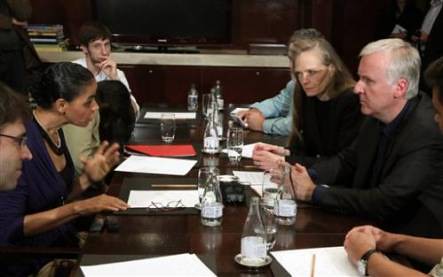
(AP Photo/Andre Penner)
Brazil's Senator and presidential candidate of the Green Party Marina Silva, met with Hollywood film maker James Cameron, in Sao Paulo, Sunday, April 11, 2010 and briefed him on the environmental challenges facing Amazônia and indigenous cultures.
James Cameron has been in Brazil to offer help to the coalition of environmentalists and indigenous peoples who have been in a long-time struggle against the Belo Monte dam, which Cameron calls, "a real life 'Avatar'." He also says that he is collecting information for a sequel to the movie.
Wouldn't it be wonderful if Avatar 2.0 was able to tell a story of terra preta and biochar? It would be an audaciously HOPEFUL story and much more realistic than the romance of forest dwellers defeating the juggernaut of modern civilization in an epic war.
Avatar 2.0 could be the story in which the wisdom of ancient cultures leads modern civilization back from the brink of disaster by showing how agriculture might become earth healing and renewing, thus saving the forest, indigenous cultures and all of us.
WHAT A CONCEPT!
(AP Photo/Andre Penner)
Brazil's Senator and presidential candidate of the Green Party Marina Silva, met with Hollywood film maker James Cameron, in Sao Paulo, Sunday, April 11, 2010 and briefed him on the environmental challenges facing Amazônia and indigenous cultures.
James Cameron has been in Brazil to offer help to the coalition of environmentalists and indigenous peoples who have been in a long-time struggle against the Belo Monte dam, which Cameron calls, "a real life 'Avatar'." He also says that he is collecting information for a sequel to the movie.
Wouldn't it be wonderful if Avatar 2.0 was able to tell a story of terra preta and biochar? It would be an audaciously HOPEFUL story and much more realistic than the romance of forest dwellers defeating the juggernaut of modern civilization in an epic war.
Avatar 2.0 could be the story in which the wisdom of ancient cultures leads modern civilization back from the brink of disaster by showing how agriculture might become earth healing and renewing, thus saving the forest, indigenous cultures and all of us.
WHAT A CONCEPT!
Monday, April 12, 2010
 James Cameron says Amazon dam dispute a real-life 'Avatar'
By MARCO SIBAJA and BRADLEY BROOKS
AP - Brasilia - April 12, 2010
Director James Cameron said Monday that a real-life "Avatar" battle is playing out in Brazil's Amazon rain forest, where indigenous groups are trying to halt the construction of a huge hydroelectric project.
In an interview with The Associated Press, Cameron said he was in Brazil's capital to support Indian and environmental groups as they stage protests against the Belo Monte dam project.
Cameron attended an environmental summit in the Amazon last month with former U.S. Vice President Al Gore. He returned this week to Sao Paulo to promote the DVD version of his blockbuster movie "Avatar," in which the fictitious Na'vi race fights to protect its homeland, the forest-covered moon, Pandora, from plans to extract oil. He said he came to Brasilia on his own initiative because he was drawn to the activists' plight.
"Avatar" has struck a chord with environmentalists worldwide, from China, where millions have been displaced by major infrastructure projects, to Bolivia, where Evo Morales, the nation's first indigenous president, praised the film for sending the message of saving the environment from exploitation.
"I'm drawn into a situation where a real-life 'Avatar' confrontation is in progress," Cameron said in a telephone interview while en route to protests taking place in front of the Mines and Energy Ministry.
"What's happening in 'Avatar' is happening in Brazil and places like India and China, where traditional villages are displaced by big infrastructure projects," he added.
The $11 billion Belo Monte hydroelectric dam — which if completed would be the world's third-largest such project — was cleared for construction Feb. 1 by the Environment Ministry. Bidding for prospective builders is expected to take place later this month.
Brazil's government has said that even if it can't find private partners for the dam's construction on the Xingu River, which feeds the Amazon River, the nation has the funds to finish the project itself.
The administration of President Luiz Inacio Lula da Silva argues that the dam will provide clean energy and is needed to meet current and future energy needs.
Environmentalists are sharply opposed. They say it will devastate wildlife and the livelihoods of 40,000 people who live in the area to be flooded. They also argue that the energy generated by the dam will largely go to big mining operations in the Amazon, not benefit the average person.
Cameron said he sent a letter to Silva five days ago requesting a meeting and urging him to stop the project. He has not received a reply from the president, who is currently visiting the U.S.
"I wrote to him that, 'This is an opportunity for you to be a hero, a visionary leader of the 21st century, and modify Brazil's path in such a way that you have sustainable economic growth instead of economic growth that has serious consequences for certain sectors of the population,'" Cameron said.
He said if he were able to meet with Silva he also would tell him that he believes North America and Europe have to help pay to preserve the rain forest, which he said "provides a service to the entire world" by helping fight global warming.
The Brazilian Amazon is arguably the world's biggest natural defense against global warming, acting as a "sink," or absorber, of carbon dioxide. But it is also a great contributor to warming. About 75 percent of Brazil's emissions come from rain-forest clearing, as vegetation burns and felled trees rot.
"If North America and Europe have been responsible for the carbon pollution that started us down this inevitable slide of global warming, then they should take financial responsibility for those services that nature naturally provides," Cameron said.
Sunday, April 11, 2010
MY FATHER'S GARDEN
Mirko Faienza discovers a whole world in his father's garden.
Stunningly beautiful.
Mirko Faienza discovers a whole world in his father's garden.
Stunningly beautiful.
AVATAR 2.0 ARRIVES AS BELO MONTE HEATS UP

Indian woman from the Xingu River of the central Amazon valley demonstrating her
opposition to the Belo Monte dam. (June, 2008)
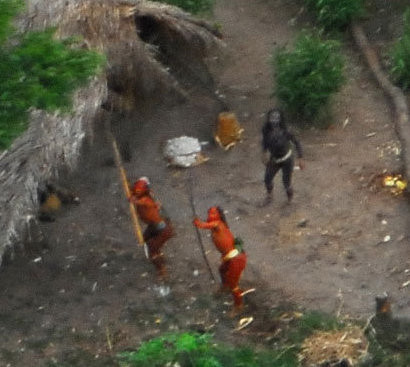
Members of an uncontacted tribe in Acre state of Brazil's western Amazon point their
arrows at a government helicopter flying over their encampment.
The 2008 message of the tribes (photos above) from across Amazônia was simple: GET LOST!!!
But the motif of anger and violence did not play well as the media tended to focus on it rather than on the issues. The massive Belo Monte hydroelectric project was delayed but only temporarily. Now its specter has risen once again.
Recently, the Brazilian government approved the project and will hold an auction for construction bids later this month. It's not yet a "done deal." Already several private firms have stated that the project would not be economical and have withdrawn. But President Luiz Inacio Lula da Silva says Brazil's government will itself build the massive Belo Monte hydroelectric dam if no private firms bid for the project. Let's see.
The conflict has remained as a stand-off for many years but now the march of modern civilization is once again drawing closer to overwhelming the territories of traditional people. And the political flash-point is drawing closer as well. This time there are no Indians brandishing machetes. Instead, a new weapon has appeared. AVATAR 2.0 has arrived as an important ally.
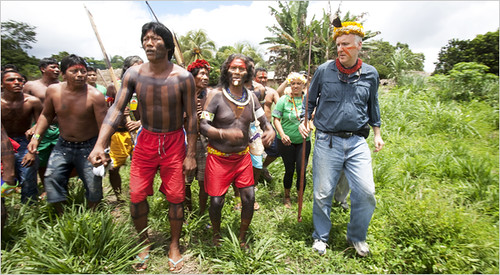
James Cameron backs efforts to halt the building of the Belo Monte dam.
photo: André Vieira for The New York Times
Today's NY Times reports the story and has a marvelous audio slideshow.
AMAZON WATCH would be an excellent place to keep updated.
Here's their recent video:
Indian woman from the Xingu River of the central Amazon valley demonstrating her
opposition to the Belo Monte dam. (June, 2008)
Members of an uncontacted tribe in Acre state of Brazil's western Amazon point their
arrows at a government helicopter flying over their encampment.
The 2008 message of the tribes (photos above) from across Amazônia was simple: GET LOST!!!
But the motif of anger and violence did not play well as the media tended to focus on it rather than on the issues. The massive Belo Monte hydroelectric project was delayed but only temporarily. Now its specter has risen once again.
Recently, the Brazilian government approved the project and will hold an auction for construction bids later this month. It's not yet a "done deal." Already several private firms have stated that the project would not be economical and have withdrawn. But President Luiz Inacio Lula da Silva says Brazil's government will itself build the massive Belo Monte hydroelectric dam if no private firms bid for the project. Let's see.
The conflict has remained as a stand-off for many years but now the march of modern civilization is once again drawing closer to overwhelming the territories of traditional people. And the political flash-point is drawing closer as well. This time there are no Indians brandishing machetes. Instead, a new weapon has appeared. AVATAR 2.0 has arrived as an important ally.
James Cameron backs efforts to halt the building of the Belo Monte dam.
photo: André Vieira for The New York Times
Today's NY Times reports the story and has a marvelous audio slideshow.
AMAZON WATCH would be an excellent place to keep updated.
Here's their recent video:
Colossal Solar Energy Generating Waterfall Tower
for Rio 2016 Olympic Games!

I have no idea about the cost-effectiveness of this spectacular project (or if it is a green-washing of excess) but my first response is to celebrate building such a beautiful monument to alternative energy.
Via Your Solar Link Blog.
This solar energy generating tower is going to be located on the coast of Rio de Janeiro. It is one of the first buildings that are being designed for the 2016 Rio Olympics. This solar energy generating tower looks like an enormous waterfall. The Solar City Tower is designed by Swiss (Zurich-based) company – RAFAA Architecture & Design. It features a large solar system to generate energy during the day and a pumped water storage system to generate energy at night. RAFAA’s goal is that a symbolic tower such as this can serve as a starting point for a global green movement and help make the 2016 Olympic Games more sustainable.

The Solar City Tower is a solar power plant. It is designed to create renewable energy for use in the Olympic Village as well as the city of Rio. A large solar power plant generates energy during the day. Any excess power not used during the day is utilized to pump seawater into a storage tank within the tower. At night, the water is released to power turbines, which will provide nighttime power for the city. A special feature of the building is the urban waterfall. Water is pumped out to create a waterfall over the edges of the building, which Rafael Schmidt of RAFAA says will be “a symbol for the forces of nature.”

Access to the eco-tower is gained through an urban plaza and amphitheater 60 meters above sea level, which can be used for public gatherings. On the ocean side of the 105 meter tower (behind the waterfall) is a cafeteria and shop. An elevator takes visitors up to the top floor where an observation deck offers 360 spectacular views of the ocean and Rio. At level 90.5, there is a retractable bungee platform for daring guests.
for Rio 2016 Olympic Games!
I have no idea about the cost-effectiveness of this spectacular project (or if it is a green-washing of excess) but my first response is to celebrate building such a beautiful monument to alternative energy.
Via Your Solar Link Blog.
This solar energy generating tower is going to be located on the coast of Rio de Janeiro. It is one of the first buildings that are being designed for the 2016 Rio Olympics. This solar energy generating tower looks like an enormous waterfall. The Solar City Tower is designed by Swiss (Zurich-based) company – RAFAA Architecture & Design. It features a large solar system to generate energy during the day and a pumped water storage system to generate energy at night. RAFAA’s goal is that a symbolic tower such as this can serve as a starting point for a global green movement and help make the 2016 Olympic Games more sustainable.
The Solar City Tower is a solar power plant. It is designed to create renewable energy for use in the Olympic Village as well as the city of Rio. A large solar power plant generates energy during the day. Any excess power not used during the day is utilized to pump seawater into a storage tank within the tower. At night, the water is released to power turbines, which will provide nighttime power for the city. A special feature of the building is the urban waterfall. Water is pumped out to create a waterfall over the edges of the building, which Rafael Schmidt of RAFAA says will be “a symbol for the forces of nature.”
Access to the eco-tower is gained through an urban plaza and amphitheater 60 meters above sea level, which can be used for public gatherings. On the ocean side of the 105 meter tower (behind the waterfall) is a cafeteria and shop. An elevator takes visitors up to the top floor where an observation deck offers 360 spectacular views of the ocean and Rio. At level 90.5, there is a retractable bungee platform for daring guests.
Saturday, April 10, 2010
PRIMATE CAPOEIRA
First, some monkeyshines from Brazil's Pantnal
(hat tip to Avi)
Next: some human versions
More about Capoeira.
And here is the rest of it.
First, some monkeyshines from Brazil's Pantnal
(hat tip to Avi)
Next: some human versions
More about Capoeira.
And here is the rest of it.
Friday, April 09, 2010
LET THERE BE LIGHT...
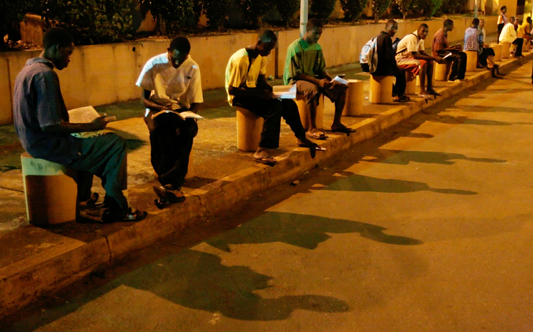
Guinean students study under the lights of the Conakry airport parking lot because they have no light at home.(Rebecca Blackwell/The Associated Press)

The recently completed Burj Khalifa Tower in Dubai, United Arab Emirates
In the latest iteration of the always evolving Dot Earth blog, Andrew Revkin is reframing (slightly) the main question of the 21st Century from "Climate Change" (negative) to "Energy Quest" (more positive). Of course, the two are related because development requires energy and both have huge environmental impacts. This, in turn, raises the question of energy scarcity versus energy gluttony, and whether or not the focus on cheap efficient energy carries us away from seeing that such energy is often used in earth damaging ways.
There are no easy answers but I find it poignant (perhaps also useful) to meditate on the two photos above which surely give iconic views of scarcity versus gluttony. At some point "how much is enough, for whom and where are we going?" must become the central questions.
Below is the grand celebration of development in Dubai. No doubt that it is quite a show. It would seem that the Earth displays its catastrophes spectacularly and its harmonies subtly. In the media-driven world of human perception what might be the grand celebration of life in balance?
Guinean students study under the lights of the Conakry airport parking lot because they have no light at home.(Rebecca Blackwell/The Associated Press)
The recently completed Burj Khalifa Tower in Dubai, United Arab Emirates
In the latest iteration of the always evolving Dot Earth blog, Andrew Revkin is reframing (slightly) the main question of the 21st Century from "Climate Change" (negative) to "Energy Quest" (more positive). Of course, the two are related because development requires energy and both have huge environmental impacts. This, in turn, raises the question of energy scarcity versus energy gluttony, and whether or not the focus on cheap efficient energy carries us away from seeing that such energy is often used in earth damaging ways.
There are no easy answers but I find it poignant (perhaps also useful) to meditate on the two photos above which surely give iconic views of scarcity versus gluttony. At some point "how much is enough, for whom and where are we going?" must become the central questions.
Below is the grand celebration of development in Dubai. No doubt that it is quite a show. It would seem that the Earth displays its catastrophes spectacularly and its harmonies subtly. In the media-driven world of human perception what might be the grand celebration of life in balance?
Thursday, April 08, 2010
THERE'S DANCING IN THE STREETS
In what appears to be an exclusive (yet to appear in the MSM) NatureSong reports The Strike in Puerto Maldonado is over!
Policemen are dancing together with miners in the main square of Puerto Maldonado.
"Viva the national Peruvian police!" the man with the mike shouts and the crowd answers.
Both sides have reached an agreement, in Lima, according to which the Decree would be put on hold for 6 month.
In this time the two sides would sit together and work together on the content of the decree.
Puerto Maldonado is celebrating to the music of the police orchestra.
It's good that violent confrontation has yielded to peaceful dialogue. Now, let's hope that voiceless nature (the rivers don't demonstrate and the forest doesn't vote) will also find its rightful and righteous representation.
[UPDATE: More news here]
In what appears to be an exclusive (yet to appear in the MSM) NatureSong reports The Strike in Puerto Maldonado is over!
Policemen are dancing together with miners in the main square of Puerto Maldonado.
"Viva the national Peruvian police!" the man with the mike shouts and the crowd answers.
Both sides have reached an agreement, in Lima, according to which the Decree would be put on hold for 6 month.
In this time the two sides would sit together and work together on the content of the decree.
Puerto Maldonado is celebrating to the music of the police orchestra.
It's good that violent confrontation has yielded to peaceful dialogue. Now, let's hope that voiceless nature (the rivers don't demonstrate and the forest doesn't vote) will also find its rightful and righteous representation.
[UPDATE: More news here]
Wednesday, April 07, 2010
AND THE ORACLE SAYS...
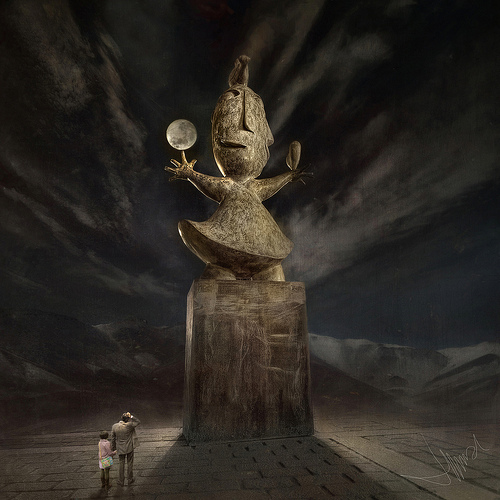
"I do not believe in coincidences" by el silencio
I think the mark of great art is the way it opens a space for many interpretations and yet remains mysterious. In my own imagination, I can give this image all kinds of meanings but at the moment I am thinking about an average person trying to make sense in the raging debate about what is going on with our changing weather and how to evaluate the pronouncements of the oracles climate science.
el silencio has to be my favorite artist at Flickr. I just can't get enough of his images. For a real treat go to the el silencio photostream, click on an image and then on the top button that says "all sizes." There, you can bring up the image at the original size and view it like this.
"I do not believe in coincidences" by el silencio
I think the mark of great art is the way it opens a space for many interpretations and yet remains mysterious. In my own imagination, I can give this image all kinds of meanings but at the moment I am thinking about an average person trying to make sense in the raging debate about what is going on with our changing weather and how to evaluate the pronouncements of the oracles climate science.
el silencio has to be my favorite artist at Flickr. I just can't get enough of his images. For a real treat go to the el silencio photostream, click on an image and then on the top button that says "all sizes." There, you can bring up the image at the original size and view it like this.
FOR THE LOVE OF GO(L)D
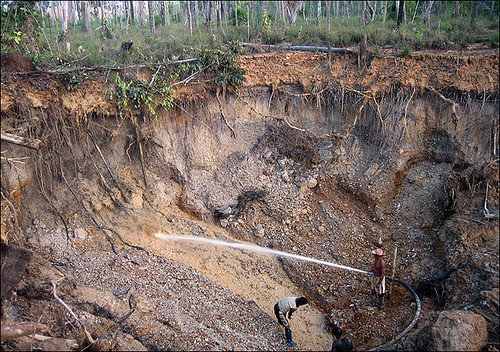
Gold mining in southeast Peru - photo: BBC
As they used to say in my old Josephine County, Oregon home, "Been there. Seen it."
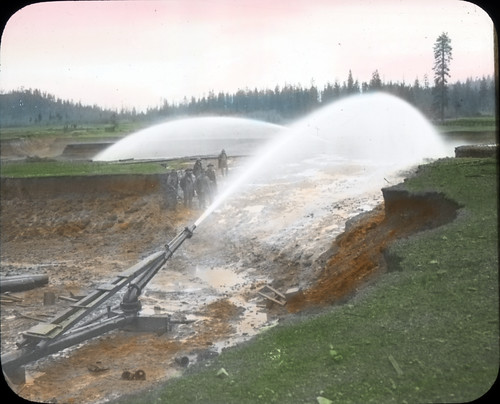
Placer gold mining in Josephine County, Oregon circa 1905-10
Photo: Oregon State University Archives
Nope, I haven't seen it in Peru. That's what they were doing 100 years ago ago in my old Oregon home ground -- a region that is considered to be the center of greatest biodiversity in western North America. They started in the southern Oregon gold rush of the 1860s working largely with indentured Chinese laborers and continued relentlessly until the most of the deposits were washed through the sluices and sieves to capture the precious flakes and nuggets. I didn't see it happen but I saw the land still stripped bare of any topsoil (known in miner jargon as the "overburden") a century later. All for the love of gold.
Nowadays, the drama is repeating here in western Amazônia, in the tri-national region called by the acronym MAP -- Madre de Dios in Peru, Acre in Brazil and Pando in Bolivia -- where the biodiversity of nature's garden is connecting with human aspirations for economic development and a better life. This region used to be considered as the "end of the road" because it literally was. But with modernization and infrastructure development -- bridges, roads, rural electrification, Internet and more -- contact and globalization have set human and wild nature on an ugly collision course. While Acre has been able to make many initiatives toward sustainable development, across the border in much poorer Madre de Dios (Mother of God) it's an often violent confrontation over illegal logging of mahogany and/or "informal mining" in an out-of-control rush to grab valuable resources.
Recently, there have been daily reports of a violent and continuing confrontation between gold miners and the Lima government's plan to regularize "informal" mining which has resulted in a blockade by 6,000 miners of the Panamericana Road. Six deaths have already occurred and there's no end to the violence in sight.
[NEWS FLASH - 7 April, 2010 (08:14): Miners lift strike for 48 hours to enter dialogue.]
Writing daily updates in the blog LivinginPeru, Isabel Guerra reports:
"The Decree 012-2010 includes the suspension of new mining concessions, formalization of all informal miners to make them pay taxes and have environmental licenses, and the creation of a special non-mining area in Madre de Dios, to avoid further damage to the ecosystem.
"Informal mining involves transactions worth US $600 million every year in Peru, produces 20 tons of gold per year in several places in Peru and generates jobs for 40,000 people, but this figure could actually reach 100,000."
Everyone seems to be digging in -- President Alan García says he won't negotiate until the miners end the blockade and violence and "Peru's Prime Minister Javier Velásquez claims that these social protests may be sponsored by businesspeople from Russia, Brazil and Bolivia, who allegedly are extracting gold with big machinery in Madre de Dios, under the disguise of wildcat, informal miners."
Meanwhile, our dear friend Raviv Angel is reporting, in her blog NatureSong a very different picture from her perch in Puerto Maldonado where she hears first hand the stories of the people caught in the chaos and contradictions of poverty, opportunism, prostitution and the struggles for a better life. It reminds her, she says, of her times in Gaza.
Trying to make sense of it all, she writes "When the earth suffers the people suffer."
Many people will die
and not for the sake of the earth
The earth would keep hurting
Small mines would close down
Big mines would open
Money would change hands
The earth would shut her eyes
tolerate more pain
again
People would feel more pain
And keep lying
Some people would tell the miners’ story
Others would sing the voice of the government
Some would say “humanity”
Others would say “environment”
I would plant trees
I wonder what I would do? I would like to tell an inspiring story from my old Oregon home of how awareness and laws changed after the craziness of the Gold Rush to usher in an age of harmony between people and nature. But I can't. Indeed, they are still fighting over the conflict between the 1872 Mining Law and the more recent Wilderness Act. At stake is the dredging for gold of one of the last pristine rivers on the West Coast -- often, for RECREATION!
All I can do is to give you the best picture that I know of what is at stake, of what may be lost forever. That picture would come from the botanist David Campbell who studies the forest in Acre's Juruá watershed and writes in his award-winning Land of Ghosts:
I now have data from a total of 18 hectares. A hectare is an area of only 100 by 100 meters, and 18 hectares [less than 50 acres] is just a mote in the vast Amazon Valley. But that small area seems a universe to me. Its diversity is stunning: more than 20,000 individual trees belonging to about 2,000 species -- three times as many tree species as there are in all of North America. And each tree is an ecosystem unto itself, bearing fungi, lichens, mosses, ferns, aerophytes, orchids, lianas, reptiles, mammals, birds, spiders, scorpions, centipedes, millipedes, mites and uncountable legions of insects. The number of insect species alone -- especially of beetles -- may exceed the combined total of all the other species of plants and animals in the forest.
The Amazon River and its forest are the last continent-sized stretch of untrammeled wilderness on Earth and the greatest expression of her biodiversity. The Amazon Valley, in fact, has more species than have ever existed anywhere at any time during the four-billion-year history of life on Earth. Yet just at this moment of peak biotic eloquence, we know that inevitably most of it will be lost. Over the next several decades Earth will lose hundreds of thousands -- perhaps millions -- of species. Most of this extinction will occur in the tropical forests and especially in Amazonia. In the course of a generation or two, the Amazon rainforest will be destroyed as a wilderness and as a functioning ecosystem. It is an old story, stale by now. Yet the loss of this place, I'm convinced, will be the most egregious event of a generation of atrocities.
A dark vision but I'm afraid it's quite real. Can it be changed? I don't know. But I do know that it is worth trying.
Gold mining in southeast Peru - photo: BBC
As they used to say in my old Josephine County, Oregon home, "Been there. Seen it."
Placer gold mining in Josephine County, Oregon circa 1905-10
Photo: Oregon State University Archives
Nope, I haven't seen it in Peru. That's what they were doing 100 years ago ago in my old Oregon home ground -- a region that is considered to be the center of greatest biodiversity in western North America. They started in the southern Oregon gold rush of the 1860s working largely with indentured Chinese laborers and continued relentlessly until the most of the deposits were washed through the sluices and sieves to capture the precious flakes and nuggets. I didn't see it happen but I saw the land still stripped bare of any topsoil (known in miner jargon as the "overburden") a century later. All for the love of gold.
Nowadays, the drama is repeating here in western Amazônia, in the tri-national region called by the acronym MAP -- Madre de Dios in Peru, Acre in Brazil and Pando in Bolivia -- where the biodiversity of nature's garden is connecting with human aspirations for economic development and a better life. This region used to be considered as the "end of the road" because it literally was. But with modernization and infrastructure development -- bridges, roads, rural electrification, Internet and more -- contact and globalization have set human and wild nature on an ugly collision course. While Acre has been able to make many initiatives toward sustainable development, across the border in much poorer Madre de Dios (Mother of God) it's an often violent confrontation over illegal logging of mahogany and/or "informal mining" in an out-of-control rush to grab valuable resources.
Recently, there have been daily reports of a violent and continuing confrontation between gold miners and the Lima government's plan to regularize "informal" mining which has resulted in a blockade by 6,000 miners of the Panamericana Road. Six deaths have already occurred and there's no end to the violence in sight.
[NEWS FLASH - 7 April, 2010 (08:14): Miners lift strike for 48 hours to enter dialogue.]
Writing daily updates in the blog LivinginPeru, Isabel Guerra reports:
"The Decree 012-2010 includes the suspension of new mining concessions, formalization of all informal miners to make them pay taxes and have environmental licenses, and the creation of a special non-mining area in Madre de Dios, to avoid further damage to the ecosystem.
"Informal mining involves transactions worth US $600 million every year in Peru, produces 20 tons of gold per year in several places in Peru and generates jobs for 40,000 people, but this figure could actually reach 100,000."
Everyone seems to be digging in -- President Alan García says he won't negotiate until the miners end the blockade and violence and "Peru's Prime Minister Javier Velásquez claims that these social protests may be sponsored by businesspeople from Russia, Brazil and Bolivia, who allegedly are extracting gold with big machinery in Madre de Dios, under the disguise of wildcat, informal miners."
Meanwhile, our dear friend Raviv Angel is reporting, in her blog NatureSong a very different picture from her perch in Puerto Maldonado where she hears first hand the stories of the people caught in the chaos and contradictions of poverty, opportunism, prostitution and the struggles for a better life. It reminds her, she says, of her times in Gaza.
Trying to make sense of it all, she writes "When the earth suffers the people suffer."
Many people will die
and not for the sake of the earth
The earth would keep hurting
Small mines would close down
Big mines would open
Money would change hands
The earth would shut her eyes
tolerate more pain
again
People would feel more pain
And keep lying
Some people would tell the miners’ story
Others would sing the voice of the government
Some would say “humanity”
Others would say “environment”
I would plant trees
I wonder what I would do? I would like to tell an inspiring story from my old Oregon home of how awareness and laws changed after the craziness of the Gold Rush to usher in an age of harmony between people and nature. But I can't. Indeed, they are still fighting over the conflict between the 1872 Mining Law and the more recent Wilderness Act. At stake is the dredging for gold of one of the last pristine rivers on the West Coast -- often, for RECREATION!
All I can do is to give you the best picture that I know of what is at stake, of what may be lost forever. That picture would come from the botanist David Campbell who studies the forest in Acre's Juruá watershed and writes in his award-winning Land of Ghosts:
I now have data from a total of 18 hectares. A hectare is an area of only 100 by 100 meters, and 18 hectares [less than 50 acres] is just a mote in the vast Amazon Valley. But that small area seems a universe to me. Its diversity is stunning: more than 20,000 individual trees belonging to about 2,000 species -- three times as many tree species as there are in all of North America. And each tree is an ecosystem unto itself, bearing fungi, lichens, mosses, ferns, aerophytes, orchids, lianas, reptiles, mammals, birds, spiders, scorpions, centipedes, millipedes, mites and uncountable legions of insects. The number of insect species alone -- especially of beetles -- may exceed the combined total of all the other species of plants and animals in the forest.
The Amazon River and its forest are the last continent-sized stretch of untrammeled wilderness on Earth and the greatest expression of her biodiversity. The Amazon Valley, in fact, has more species than have ever existed anywhere at any time during the four-billion-year history of life on Earth. Yet just at this moment of peak biotic eloquence, we know that inevitably most of it will be lost. Over the next several decades Earth will lose hundreds of thousands -- perhaps millions -- of species. Most of this extinction will occur in the tropical forests and especially in Amazonia. In the course of a generation or two, the Amazon rainforest will be destroyed as a wilderness and as a functioning ecosystem. It is an old story, stale by now. Yet the loss of this place, I'm convinced, will be the most egregious event of a generation of atrocities.
A dark vision but I'm afraid it's quite real. Can it be changed? I don't know. But I do know that it is worth trying.
Tuesday, April 06, 2010
THE SILVER OTTER
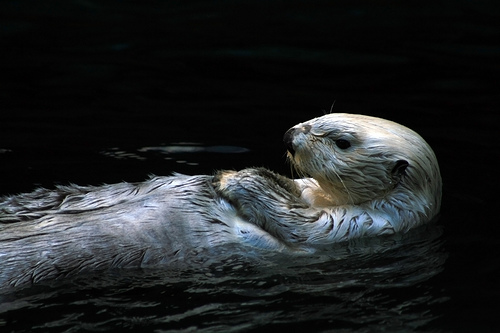
Sliver Otter by Orion Photography
When a friend passed on a traditional teaching story -- The Silver Otter -- I immediately wrote to storyteller Valerie Callahan asking for permission to publish it, mentioning Black Elk's famous statement that "a vision means nothing unless it is shared with the people." She wrote back quickly saying, "I agree both with Black Elk as well as with the prophets who observe that 'a people without a vision soon perish.' I believe the story must have wings to both share its legacy and capture the voices of others who have not yet heard it." INDEED! Could any words be more perfect for VisionShare? So here is the story with a prayer that you, the reader, will continue to give it wings.
As a young girl, my grandfather told me many stories he thought would help explain the world to me. Often long, always colorful, all of his stories – or so he said – included the “signature” phrases of each of the storytellers who had handed down these tales through the generations before him. In this way, the story itself was a kind of family or village history that continuously honored and shaped the wisdom of the past -- so that the village might better embrace the challenges of the future. One of these tales is the story of the Silver Otter. (V.C. - December, 2009)
The Legend of the Silver Otter And the Time of the Great Disruption
Storyteller -- Valerie Callahan
In a far away place and a far off time, there was once a very special silver otter whose great athletic skills far surpassed any of his fellow woodland creatures.
The silver otter lived near a bend in the river, where the waters rushed downward to the lake below.
This was a place of balance and harmony with resources enough for the many different animals who lived there.
And then, with very little warning to those who had ignored the signs...
It began.
The time of the GREAT DISRUPTION!
Life’s rhythms changed. Nothing could be as it had been before.
In a great seizing, the land itself cried out in pain…
And the animals heard the land of their birth cry out to them: “Go from me for I am now the prisoner of chaos!”
The animals were frightened…
How would they get to the safer ground below?
The surging ice, the tumultuous wind, the raging waters…was there safe harbor?
So powerful were the forces of the Great Disruption not even the raven could fly above them.
And so the animals, panicked and separate in their fear, suffered and often perished as they tried to find their way to calmer waters and the lives they had once known.
As his fellow animals struggled, Silver Otter summoned all his strength and unusual skills … and he found a route in, under, and above the raging river to the safer lake below.
“Follow me … over here… I will show you the way!” he said. “Come… go with the forces… like so… up here… under there… across beyond… between those rocks… come, come, there is no time to waste!”
But the animals turned away from Silver Otter, still focused on their own fear… and still fearful for their very survival.
“I will hide here,” said the deer. “I cannot run any farther. Do as you will, Silver Otter, but I must rest now.”
“Silver Otter does not speak to me,” said the Eagle.
“He has nothing I can use,” said the Raven.
“What is he saying? I cannot hear him” called the Beaver.
“It is too late for me…the water is too high” whispered the big cat.
“Why don’t you listen?” shouted Silver Otter. “I can save you! Do as I say or you will surely die. You have no choice. And there is no time to lose!”
But as the Great Disruption claimed more and more of the earth, no one heeded Silver Otter’s call.
Silver Otter was distraught. Deploring the senseless waste around him, he called out to his Great Spirit for help.
And so the Grey Wolf appeared to Silver Otter at the magical moment when the dark of night slowly melts into the hope of morning.
Silver Otter trembled before the Grey Wolf, but was so very thankful Grey Wolf had come.
“I do not understand it,” said Silver Otter. “The animals, they ignore me. They chase their own tails, they rush to their deaths, they freeze in their tracks, they work against each other. Yet, they will not listen to me.“
“Yes,” was the Wolf’s terse reply.
“Well, what is wrong with them? Why can’t they see that I can save them?”
“Because you cannot.”
“But I alone can swim across the great divide. I can take them with me.“
“No,” said the Wolf. “You cannot.”
Silver Otter grew quiet. “I have bridged the gap a hundred times since the Great Disruption began. I know that I can do this.”
“Yes, you are gifted in strength and spirit. And you know the ways of the water,” said the Grey Wolf. “You are not entirely fooled by the chaos which the Great Disruption brings to the land and river. All this is true.”
“But …,” said Grey Wolf, “Neither have you reclaimed the secret that the Great Disruption has stolen away from each of you.”
“The secret?” asked the Silver Otter. “What is the secret? Please tell me quickly so that I may save the animals!”
Grey Wolf growled deep but softly.
“It is not you who will save the animals or calm the Great Disruption that now feeds on the frenzy of fear around us.”
“Is it you, then Grey Wolf, who will do this?” asked the unusually dismayed Silver Otter.
“The morning comes quickly now,” answered Grey Wolf. “I have little time. You must listen carefully.”
And so, Grey Wolf began to explain as best he could. “The Great Disruption can rob us of our free will. We longer choose.”
“The Great Disruption makes the world a random and unpredictable place,” he continued.
“The animals retreat further and further into a darkened space of scarcity and fear…there are far fewer possibilities in this space… fooled by shifting shadows of what used to be, the animals cannot see their real strengths,” said Grey Wolf. “They rely on what they call common sense, when what they need is uncommon wisdom.”
“Common sense is not enough?” asked Silver Otter
“Common sense only works when things are predictable,” answered Grey Wolf. “Uncommon wisdom knows how to harness the forces around us when common sense is confused…Uncommon wisdom weakens the randomness of life. It builds on the mastery of knowing how and when things work as they do.”
Grey Wolf then added, “When we know this, we are not forced to simply endure and accept. We can shape some changes.”
“But we have to move quickly…” said Silver Otter.
“Yes,” Grey Wolf answered. “But not without direction…Work together. Uncommon wisdom is always shared. It is greater than any of you, but comes from all of you… Find the real choices, the real abundance…”
“Abundance?” protested Silver Otter. “The Great Disruption has taken care of that!”
“The Great Disruption has stolen much,” replied Grey Wolf. “But has also revealed other resources you have overlooked. Find them!”
“But,” insisted Silver Otter, “I know I can help get the animals to safer ground, if they would only listen. All the rest of this can happen later.”
“These things must happen first, or you will not succeed,” Grey Wolf answered firmly.
“No one listens to you because they do not trust you. And why should they? Trust is the greatest gift of all. You must first show them you are worthy…”
Grey Wolf looked up at the breaking dawn. “I must go now,” he said. “And you, Silver Otter, have much work to do.”
Silver Otter heard the thunder in the distance and the terrible rushing of the waters above. But he also saw the beauty of the dawn and vowed to act on Grey Wolf’s counsel… or as much of it as he understood.
Making his way through the perilous passage to the higher ground, Silver Otter was surprised to see the spotted coyote on a ledge beneath the waterfall.
The Spotted Coyote had traveled a great way down the steep cliffs with his family, and Silver Otter wondered how he had done this.
The spotted coyotes were not well-known to the other animals. Few had ever talked with them and many thought they wished only to stay among themselves.
“We, too, can jump great distances, Silver Otter,” said the strange coyote. “We can ford the roiling water when we work together. But only up to this point. We do not swim well and cannot go farther. We are not safe here for long.”
“If the beavers were here,” the spotted coyote continued, “they could change the path of the water over there so we might all pass on the other side, don’t you think? But the beavers cannot come down this far.”
Silver Otter now knew what he must do. “Come back with me to talk with Eagle and the others! I understand now…There is a way to do this together. And I would not have thought of it had I not talked to you!”
So Silver Otter gathered the animals. They were amazed Spotted Coyote had come along with him. If Spotted Coyote would join with Silver Otter, they could at least listen to what he had to say.
Eagle listened as Silver Otter told of Spotted Coyote’s plan to dam the river by the ledge and clear the passage to the lake below. But most of the animals could not get to the ledge, and many would not survive there if they could.
“If you can help me down below the wind’s fury, I can fly swift and strong. And so can Raven and the Owl,” said Eagle.
“But even if you get me to the ledge,” said the Beaver, “it is much too dangerous to build a dam. I will fall into the savage waters!”
“If they carry you to the ledge,” said Eagle, “I can hold you under the wind and above the water while you work.”
The animals talked for a while. And then…they began to work together… to take control.
Some animals gathered resources.
Some moved the resources to where they were needed.
Some built new things with the resources.
Some built things that had not been built before to help them travel down to the ledge. They taught others how to do this as well.
Some helped others in ways they had not thought of before.
In all of this, Silver Otter moved swiftly back and forth between the higher ground, the swirling waters, the ledge, and the lake below… helping to coordinate and connect the animals to each other and to their destination.
He learned much from them. And, he helped to share what he had learned among them as well. Together, they found a powerful rhythm to challenge the Great Disruption.
And, in the end, they found their way to the quieter lake shore below.
Silver Otter had never felt so much joy before. As he talked one night at the village feast with Beaver, Eagle, Fox, and Deer, he noticed something wonderful…
Silver Otter, who had always felt so different and so isolated from all the other woodland animals, now felt he belonged to something greater.
And when he looked closely, he noticed he had turned brown. Humbler, happier, he gladly shed most of his silver fur to better harmonize with his woodland home.
#####
The story's lineage through Valerie's grandfather is to the Wabenaki Federation, specifically the Maritime Abenaki. She notes that,"the story was transcribed -- as best as it could be remembered -- from a very early childhood memory and that it has become a symbol of commitment and positive strategic change for an organization called Greater Lynn Senior Services - GLSS in Lynn, MA. Within the GLSS arena, both Grey Wolf and Silver Otter became strong female characters, which makes great sense for us and which adds to the fun of the signature chain." For more information you may contact Valerie at vcvj.cal@gmail.com.
Sliver Otter by Orion Photography
When a friend passed on a traditional teaching story -- The Silver Otter -- I immediately wrote to storyteller Valerie Callahan asking for permission to publish it, mentioning Black Elk's famous statement that "a vision means nothing unless it is shared with the people." She wrote back quickly saying, "I agree both with Black Elk as well as with the prophets who observe that 'a people without a vision soon perish.' I believe the story must have wings to both share its legacy and capture the voices of others who have not yet heard it." INDEED! Could any words be more perfect for VisionShare? So here is the story with a prayer that you, the reader, will continue to give it wings.
As a young girl, my grandfather told me many stories he thought would help explain the world to me. Often long, always colorful, all of his stories – or so he said – included the “signature” phrases of each of the storytellers who had handed down these tales through the generations before him. In this way, the story itself was a kind of family or village history that continuously honored and shaped the wisdom of the past -- so that the village might better embrace the challenges of the future. One of these tales is the story of the Silver Otter. (V.C. - December, 2009)
The Legend of the Silver Otter And the Time of the Great Disruption
Storyteller -- Valerie Callahan
In a far away place and a far off time, there was once a very special silver otter whose great athletic skills far surpassed any of his fellow woodland creatures.
The silver otter lived near a bend in the river, where the waters rushed downward to the lake below.
This was a place of balance and harmony with resources enough for the many different animals who lived there.
And then, with very little warning to those who had ignored the signs...
It began.
The time of the GREAT DISRUPTION!
Life’s rhythms changed. Nothing could be as it had been before.
In a great seizing, the land itself cried out in pain…
And the animals heard the land of their birth cry out to them: “Go from me for I am now the prisoner of chaos!”
The animals were frightened…
How would they get to the safer ground below?
The surging ice, the tumultuous wind, the raging waters…was there safe harbor?
So powerful were the forces of the Great Disruption not even the raven could fly above them.
And so the animals, panicked and separate in their fear, suffered and often perished as they tried to find their way to calmer waters and the lives they had once known.
As his fellow animals struggled, Silver Otter summoned all his strength and unusual skills … and he found a route in, under, and above the raging river to the safer lake below.
“Follow me … over here… I will show you the way!” he said. “Come… go with the forces… like so… up here… under there… across beyond… between those rocks… come, come, there is no time to waste!”
But the animals turned away from Silver Otter, still focused on their own fear… and still fearful for their very survival.
“I will hide here,” said the deer. “I cannot run any farther. Do as you will, Silver Otter, but I must rest now.”
“Silver Otter does not speak to me,” said the Eagle.
“He has nothing I can use,” said the Raven.
“What is he saying? I cannot hear him” called the Beaver.
“It is too late for me…the water is too high” whispered the big cat.
“Why don’t you listen?” shouted Silver Otter. “I can save you! Do as I say or you will surely die. You have no choice. And there is no time to lose!”
But as the Great Disruption claimed more and more of the earth, no one heeded Silver Otter’s call.
Silver Otter was distraught. Deploring the senseless waste around him, he called out to his Great Spirit for help.
And so the Grey Wolf appeared to Silver Otter at the magical moment when the dark of night slowly melts into the hope of morning.
Silver Otter trembled before the Grey Wolf, but was so very thankful Grey Wolf had come.
“I do not understand it,” said Silver Otter. “The animals, they ignore me. They chase their own tails, they rush to their deaths, they freeze in their tracks, they work against each other. Yet, they will not listen to me.“
“Yes,” was the Wolf’s terse reply.
“Well, what is wrong with them? Why can’t they see that I can save them?”
“Because you cannot.”
“But I alone can swim across the great divide. I can take them with me.“
“No,” said the Wolf. “You cannot.”
Silver Otter grew quiet. “I have bridged the gap a hundred times since the Great Disruption began. I know that I can do this.”
“Yes, you are gifted in strength and spirit. And you know the ways of the water,” said the Grey Wolf. “You are not entirely fooled by the chaos which the Great Disruption brings to the land and river. All this is true.”
“But …,” said Grey Wolf, “Neither have you reclaimed the secret that the Great Disruption has stolen away from each of you.”
“The secret?” asked the Silver Otter. “What is the secret? Please tell me quickly so that I may save the animals!”
Grey Wolf growled deep but softly.
“It is not you who will save the animals or calm the Great Disruption that now feeds on the frenzy of fear around us.”
“Is it you, then Grey Wolf, who will do this?” asked the unusually dismayed Silver Otter.
“The morning comes quickly now,” answered Grey Wolf. “I have little time. You must listen carefully.”
And so, Grey Wolf began to explain as best he could. “The Great Disruption can rob us of our free will. We longer choose.”
“The Great Disruption makes the world a random and unpredictable place,” he continued.
“The animals retreat further and further into a darkened space of scarcity and fear…there are far fewer possibilities in this space… fooled by shifting shadows of what used to be, the animals cannot see their real strengths,” said Grey Wolf. “They rely on what they call common sense, when what they need is uncommon wisdom.”
“Common sense is not enough?” asked Silver Otter
“Common sense only works when things are predictable,” answered Grey Wolf. “Uncommon wisdom knows how to harness the forces around us when common sense is confused…Uncommon wisdom weakens the randomness of life. It builds on the mastery of knowing how and when things work as they do.”
Grey Wolf then added, “When we know this, we are not forced to simply endure and accept. We can shape some changes.”
“But we have to move quickly…” said Silver Otter.
“Yes,” Grey Wolf answered. “But not without direction…Work together. Uncommon wisdom is always shared. It is greater than any of you, but comes from all of you… Find the real choices, the real abundance…”
“Abundance?” protested Silver Otter. “The Great Disruption has taken care of that!”
“The Great Disruption has stolen much,” replied Grey Wolf. “But has also revealed other resources you have overlooked. Find them!”
“But,” insisted Silver Otter, “I know I can help get the animals to safer ground, if they would only listen. All the rest of this can happen later.”
“These things must happen first, or you will not succeed,” Grey Wolf answered firmly.
“No one listens to you because they do not trust you. And why should they? Trust is the greatest gift of all. You must first show them you are worthy…”
Grey Wolf looked up at the breaking dawn. “I must go now,” he said. “And you, Silver Otter, have much work to do.”
Silver Otter heard the thunder in the distance and the terrible rushing of the waters above. But he also saw the beauty of the dawn and vowed to act on Grey Wolf’s counsel… or as much of it as he understood.
Making his way through the perilous passage to the higher ground, Silver Otter was surprised to see the spotted coyote on a ledge beneath the waterfall.
The Spotted Coyote had traveled a great way down the steep cliffs with his family, and Silver Otter wondered how he had done this.
The spotted coyotes were not well-known to the other animals. Few had ever talked with them and many thought they wished only to stay among themselves.
“We, too, can jump great distances, Silver Otter,” said the strange coyote. “We can ford the roiling water when we work together. But only up to this point. We do not swim well and cannot go farther. We are not safe here for long.”
“If the beavers were here,” the spotted coyote continued, “they could change the path of the water over there so we might all pass on the other side, don’t you think? But the beavers cannot come down this far.”
Silver Otter now knew what he must do. “Come back with me to talk with Eagle and the others! I understand now…There is a way to do this together. And I would not have thought of it had I not talked to you!”
So Silver Otter gathered the animals. They were amazed Spotted Coyote had come along with him. If Spotted Coyote would join with Silver Otter, they could at least listen to what he had to say.
Eagle listened as Silver Otter told of Spotted Coyote’s plan to dam the river by the ledge and clear the passage to the lake below. But most of the animals could not get to the ledge, and many would not survive there if they could.
“If you can help me down below the wind’s fury, I can fly swift and strong. And so can Raven and the Owl,” said Eagle.
“But even if you get me to the ledge,” said the Beaver, “it is much too dangerous to build a dam. I will fall into the savage waters!”
“If they carry you to the ledge,” said Eagle, “I can hold you under the wind and above the water while you work.”
The animals talked for a while. And then…they began to work together… to take control.
Some animals gathered resources.
Some moved the resources to where they were needed.
Some built new things with the resources.
Some built things that had not been built before to help them travel down to the ledge. They taught others how to do this as well.
Some helped others in ways they had not thought of before.
In all of this, Silver Otter moved swiftly back and forth between the higher ground, the swirling waters, the ledge, and the lake below… helping to coordinate and connect the animals to each other and to their destination.
He learned much from them. And, he helped to share what he had learned among them as well. Together, they found a powerful rhythm to challenge the Great Disruption.
And, in the end, they found their way to the quieter lake shore below.
Silver Otter had never felt so much joy before. As he talked one night at the village feast with Beaver, Eagle, Fox, and Deer, he noticed something wonderful…
Silver Otter, who had always felt so different and so isolated from all the other woodland animals, now felt he belonged to something greater.
And when he looked closely, he noticed he had turned brown. Humbler, happier, he gladly shed most of his silver fur to better harmonize with his woodland home.
#####
The story's lineage through Valerie's grandfather is to the Wabenaki Federation, specifically the Maritime Abenaki. She notes that,"the story was transcribed -- as best as it could be remembered -- from a very early childhood memory and that it has become a symbol of commitment and positive strategic change for an organization called Greater Lynn Senior Services - GLSS in Lynn, MA. Within the GLSS arena, both Grey Wolf and Silver Otter became strong female characters, which makes great sense for us and which adds to the fun of the signature chain." For more information you may contact Valerie at vcvj.cal@gmail.com.
Thursday, April 01, 2010
KAT FOUNTAIN'S AMAZON ADVENTURE
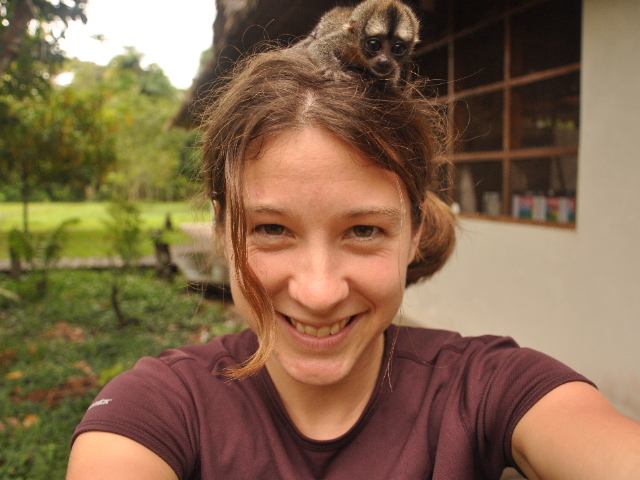
Kat Fountain is a young gonzo gal, surfer chick, monkey maven, peripatetic researcher and jungle adventurer in the Peruvian rainforest. Serious science adventure writing with a flair. I got caught in her blogo-net and felt compelled to go back and read every entry in her must-read blog.
Kat's recent entry says she is leaving the Internet zone to do some work in a cloud forest near Cusco but that she'll return to blogging. Soon, we hope.
Kat Fountain is a young gonzo gal, surfer chick, monkey maven, peripatetic researcher and jungle adventurer in the Peruvian rainforest. Serious science adventure writing with a flair. I got caught in her blogo-net and felt compelled to go back and read every entry in her must-read blog.
Kat's recent entry says she is leaving the Internet zone to do some work in a cloud forest near Cusco but that she'll return to blogging. Soon, we hope.
FOSSIL FOOLS DAY

350.org, the global grassroots climate activist coalition, is not being fooled by the Obama Administration's proposed opening of coastal regions to off-shore oil drilling.
Indeed, they have started a push-back campaign to stop this nonsense.
You can go directly to the fast-growing campaign at Facebook here.
More background here
350.org, the global grassroots climate activist coalition, is not being fooled by the Obama Administration's proposed opening of coastal regions to off-shore oil drilling.
Indeed, they have started a push-back campaign to stop this nonsense.
You can go directly to the fast-growing campaign at Facebook here.
More background here
Subscribe to:
Posts (Atom)


