VISISIONSHARE (blog header)_edited

Friday, May 14, 2010

A MESSAGE FROM CHIEF 
ARVOL LOOKING HORSE

chief arvol looking horse

A Great Urgency
To All World Religious and Spiritual Leaders

My Relatives,

Time has come to speak to the hearts of our Nations and their Leaders. I ask you this from the bottom of my heart, to come together from the Spirit of your Nations in prayer. We, from the heart of Turtle Island, have a great mess age for the World; we are guided to speak from all the White Animals showing their sacred color, which have been signs for us to pray for the sacred life of all things. As I am sending this message to you, many Animal Nations are being threatened, those that swim, those that crawl, those that fly, and the plant Nations, eventually all will be affect from the oil disaster in the Gulf.


The dangers we are faced with at this time are not of spirit. The catastrophe that has happened with the oil spill, which looks like the bleeding of Grandmother Earth, is made by human mistakes, mistakes that we cannot afford to continue to make.

I asked, as Spiritual Leaders, that we join together, united in prayer with the whole of our Global Communities. My concern is these serious issues will continue to worsen, as a domino effect that our Ancestors have warned us of in their Prophecies.

I know in my heart there are millions of people that feel our united prayers for the sake of our Grandmother Earth are long overdue. I believe we as Spiritual people must gather ourselves and focus our thoughts and prayers to allow the healing of the many wounds that have been inflicted on the Earth. As we honor the Cycle of Life, let us call for Prayer circles globally to assist in healing Grandmother Earth (our Unc'l Maka).


We ask for prayers that the oil spill, this bleeding, will stop. That the winds stay calm to assist in the work. Pray for the people to be guided in repairing this mistake, and that we may also seek to live in harmony, as we make the choice to change the destructive path we are on.


As we pray, we will fully understand that we are all connected. And that what we create can have lasting effects on all life.

So let us unite spiritually, All Nations, All Faiths, One Prayer. Along with this immediate effort, I also ask to please remember June 21st, World Peace and Prayer Day/Honoring Sacred Sites day. Whether it is a natural site, a temple, a church, a synagogue or just your own sacred space, let us make a prayer for all life, for good decision making by our Nations, for our children¹s future and well-being, and the generations to come.

Onipikte (that we shall live),

Chief Arvol Looking Horse
19th generation Keeper of the Sacred White Buffalo Calf Pipe
Wolakota Foundation

Wednesday, May 12, 2010

ENVIRONMENTAL WARNING 
COMES TRUE


Yup, I know that this is in the "we told you so" department but the point needs to be hammered over and over again. In October, 2008 Greenpeace posted on YouTube the above infomercial which has turned out to be most prescient. Congress and President Obama clearly were not listening. Did Greenpeace have a crystal ball of prophesy? Certainly not! One does not have to be a rocket scientist to understand that feeding our fossil fuel addiction by drilling miles under the ocean is a disaster waiting to happen -- not often, of course, but of catastrophic impact when it does.


The problem is not limited to off-shore oil drilling...


Where is the change that we have been waiting for?

Tuesday, May 11, 2010

Lessons from the Exxon Valdez spill


EXXON OIL SPILL

–Riki Ott, PhD, has written two books on the Exxon Valdez oil spill impacts on people, communities, and wildlife, including the recently released Not One Drop: Betrayal and Courage in the Wake of the Exxon Valdez Oil Spill. 


Reposted from Reuters, May 1, 2010


I remember the words, “We’ve had the Big One,” with chilling clarity, spoken just over 21 years ago when a fellow fisherman arrived at my door in the early morning and announced that the Exxon Valdez had run aground in Alaska’s Prince William Sound and was gushing oil.

For the small fishing community of Cordova, Alaska, where I lived and worked as a commercial fisherma’am, it was our worst nightmare.

That nightmare is reoccurring now with BP’s deadly rig blowout off the Gulf Coast – with haunting parallels to the Exxon Valdez.

I was not at all surprised when officials reported zero spillage, then projected modest spillage, and then reported spill amounts five times higher than their earlier estimates.

As the spill continues, I imagine that even the newly reported amounts will continue to vastly underestimate the actual spillage.

 Underreporting of spill volumes is common, even though lying about self-reported spill volume is illegal – and a breach of public trust.

Still, penalties are based on spill volume: Exxon likely saved itself several billion dollars by sticking with its low-end estimate of 11 million gallons and scuttling its high-end estimate of 38 million gallons, later validated by independent surveyors.

Sadly, it’s a foregone conclusion that BP’s promise to “do everything we can” to minimize the spill’s impact and stop the oil still hemorrhaging from the well nearly one mile under the sea off Louisiana’s coast will fade as its attention turns to minimizing its liability, including damaged public relations.
BP will likely leverage the billions of dollars it will spend on the cleanup to reduce its fines and lawsuit expenses, despite later recouping a large portion of the cleanup cost from insurers or writing it off as a business expense as Exxon did.

Such tactics saved Exxon billions of dollars in the civil settlement for damages to public lands and wildlife (in which damages were estimated at up to $8 billion; but for which Exxon paid just $900 million) and in the class action lawsuit filed by those whose livelihoods were curtailed by the spill (for which the original jury awarded $5 billion in punitive damages; but which Exxon fought for 20 years until the Supreme Court lessened its burden to just $507 million).

That Supreme Court decision strictly limited corporate liability and essentially removed the ability of future oil spill victims to hold corporations accountable to the people and the law.

A friend in New Orleans is concerned about the oil fumes now engulfing the southern part of town. He says it “smells pretty strong–stronger than standing in a busy mechanics shop, but not as bad as the bus station in Tijuana.”

State health officials are warning people who are sensitive to reduced air quality to stay indoors, but anyone who experiences the classic symptoms of crude oil overexposure–nausea, vomiting, headaches, or cold or flu-like symptoms–should seek medical help.

This is serious: Oil spill cleanups are regulated as hazardous waste cleanups because oil is, in fact, hazardous to health. Breathing oil fumes is extremely harmful.

After the 2002 Prestige oil spill off Galicia, Spain, and the 2007 Hebei Spirit oil spill in South Korea, medical doctors found fishermen and cleanup workers suffered from respiratory problems, central nervous system problems (headaches, nausea, dizziness, etc.), and even genetic damage (South Korea). I have attended two international conferences the past two years to share information with these doctors.

During the Exxon Valdez spill, health problems among cleanup workers became so widespread, so fast, that medical doctors, among others, sounded warnings. Dr. Robert Rigg, former Alaska medical director for Standard Alaska (BP), warned, “It is a known fact that neurologic changes (brain damage), skin disorders (including cancer), liver and kidney damage, cancer of other organ systems, and medical complications–secondary to exposure to working unprotected in (or inadequately protected)–can and will occur to workers exposed to crude oil and other petrochemical by-products. While short-term complaints, i.e., skin irritation, nausea, dizziness, pulmonary symptoms, etc., may be the initial signs of exposure and toxicity, the more serious long-term effects must be prevented.”[1]

Unfortunately, Exxon called the short-term symptoms, “the Valdez Crud,” and dismissed 6,722 cases of respiratory claims from cleanup workers as “colds or flu” using an exemption under OSHA’s hazardous waste cleanup reporting requirements.[2]

Sadly,  sick Exxon cleanup workers were left to suffer and pay their own medical expenses. I know of many who have been disabled by their illnesses – or have died.

I have repeatedly warned Congress in letters and in person to strike that loophole because it exempts the very work-related injuries–chemical induced illnesses–that OSHA is supposedly designed to protect workers from.

Remember the “Katrina Crud” and the “911 Crud?” Standby for the “Gulf Crud” because our federal laws do not adequately protect worker safety or public health from the very real threat of breathing oil vapors, including low levels typically found in our industrial ports, our highways during rush hour traffic, and our urban cities.

Oil is not only harmful to people, it is deadly to wildlife. I am sickened to think of the short-term destruction and long-term devastation that will happen along America’s biologically rich coastal wetlands – a national treasure and a regional source of income.

In Alaska, the killing did not stop in 1989. Twenty-one years later,  buried oil is still contaminating wildlife and Prince William Sound has not returned to pre-spill conditions – nor, honestly, will it. The remnant population of once-plentiful herring no longer supports commercial fisheries and barely sustains the ecosystem.

While local efforts to boom Louisiana’s fragile coasts to keep the oil out will help people feel productive and empowered (and this is important), it is an unfortunate truth that the booms have limited utility and effectiveness. In even mild sea conditions, oil will wash over and under boom. Further, underneath the visible oil slick, there is an invisible cloud of toxic oil dissolved into the water column and this dissolved oil is deadly to shrimp and fish eggs and marine life.

Still, the Gulf spill has one advantage over the Alaska spill – hot weather and the relatively warm ocean will speed the work of bacteria to degrade the Louisiana crude. Even so, the initial toxic hit is likely to harm generations of wildlife, similar to what happened in Prince William Sound.

The oil industry has had over 40 years – since the 1967 Torrey Canyon tanker spill in England – to make good on its promise to cleanup future oil spills. This latest spill highlights the harsh truth that the industry has failed to live up to its promise. It is time for Americans to demand of our leaders accountability and closure of fossil fuel industries – as we transition to new energies.

[1] City of Cordova Fact Sheet, 1989 1[29]: Robert Rigg, MD, Letter to Cordova District Fishermen United, 13 May 1989.

[2] U.S. Dept. of Labor, OSHA 29 CFR Part 1904.5(b)(2)(viii): “Colds and flu will not be considered work-related.”

Monday, May 10, 2010

RIGHT TO LIFE


Via Mongabay

A joint report released today by the Convention on Biological Diversity (CBD) and the UN Environment Program (UNEP) finds that our natural support systems are on the verge of collapsing unless radical changes are made to preserve the world's biodiversity. Executive Secretary of the Convention on Biological Diversity, Ahmed Djoghlaf, called the bleak report "a wake-up call for humanity."
...the report warns that several ecosystems are heading toward tipping points from which they may never recover. Due to a combination of climate change, deforestation, and fires, the Amazon rainforest may change irrevocably; while coral reefs are being pounded by overfishing, warmer waters, and ocean acidification; finally freshwater ecosystems like lakes and rivers are losing biodiversity and abundance due to nutrient runoff.

"Business as usual is no longer an option if we are to avoid irreversible damage to the life-support systems of our planet..."

In spite of the report, business continues as usual worldwide with, for example, New Zealand attempting to push through a plan to allow mining in protected areas; US congress proposing to give 85,000 acres of old-growth temperate rainforest to a logging company in Alaska; Brazil moving ahead on its controversial Belo Monte dam that would flood 500 square miles of rainforest; and Convention on International Trade in Endangered Species (CITES) failing to protect a single marine species in its most recent meeting.

"Humanity has fabricated the illusion that somehow we can get by without biodiversity or that it is somehow peripheral to our contemporary world: the truth is we need it more than ever on a planet of six billion heading to over nine billion people by 2050..."


FOR THE DEVELOPING WORLD 
WHICH PROBLEM COMES FIRST: 
POVERTY OR ENVIRONMENT?

I guess that my "conservation bible" quote on this question comes from the American naturalist Aldo Leopold who held that
We abuse land because we regard it as a commodity belonging to us. When we see land as a community to which we belong, we may begin to use it with love and respect.
But one of my Brazilian friends keeps accusing me of asking that the poor of Brazil sacrifice their economic development for the benefit of the rich. Basically he argues that my North American capitalist view causes me to put the environment first. Generally, this triggers a vigorous but truly tedious and exhausting dialectical debate between us in which I end up hoping only for some expression that might transcend the old-school ideological over-simplifications. I believe it comes from activist, politician and Nobel laureate Wangari Maathai:
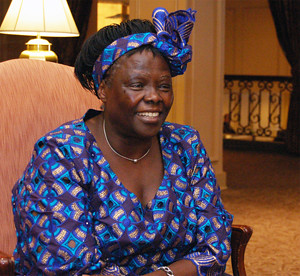
Wangari Maathai

About a year ago, she was interviewed by Sarah Kuck and Julia Levitt of Worldchanging:

Julia Levitt: In The Challenge for Africa, you argue that of all of the UN Millennium Development Goals for 2015, it's the seventh -- environmental sustainability -- that is most important. How is a healthy environment the keystone for all of these economic and social goals?

Wangari Maathai: The way I look at it, we tend to put the environment last because we think the first thing we have to do is eliminate poverty and send children to school and provide health. But how are you going to do that? In Kenya, one of our biggest exports is coffee. Where do you grow coffee? You grow coffee in the land. To be able to grow coffee you need rain, you need special kinds of soils that are found on hillsides, and that means you have to protect that land from soil erosion so you don't lose the soil. You also want to make sure that when the rains come you're going to be able to hold that water and have it go into the ground so that the streams and the rivers keep flowing and the ground is relatively humid for these plants. For the rains and the rivers you need forests and you need to make sure these your forests are all protected, that there is no logging, that there is no charcoal burning and all the activities that destroy the forest. All this really needs to be done so that you can be able to grow good coffee, so that you can have an income, so that you can send your children to school, so that you can buy medicine, so that you can take them to hospitals, so that you can care for the women, especially mothers.

We see that the environment is something to exploit, because we see the environment in terms of minerals for example, or forests, or even raw materials that we produce on our land, or even land itself. We see it in terms of what we can exploit rather than the medium in which all of these activities have to take place. But you can’t reduce poverty in a vacuum. You are doing it in an environment.

JL: In your book, you argue that it's most important for African people to develop solutions for their own needs instead of relying on aid from abroad. How do you envision a healthy exchange between Global North and Global South?

WM: I hope that it doesn't come out in the book that I’m saying that Africans don't need any help. What I am trying to say is that they need to learn to rely on themselves and to learn from other people, and when you learn something from other people, then you keep moving onward for yourself.

For example, they have land. The government of Qatar wants to lease the Tana River delta, which is in Kenya, from the Kenyan government, so that they can produce food there. People in Kenya need food. We have people who have studied agriculture. Why is it that if we really need food, we cannot go into the delta and develop our own food? Why do we have to have people come from afar to come and grow food for us, or to grow food to sell to us? It is partly because we are almost becoming used to people doing things for us. Like somebody else is going to solve that problem for us. And that to me is very disempowering system. And that system eventually can make you destroy yourself completely, because you are so dependent on others. Nobody in the world is completely dependent on another person, but we are all interdependent.

I was particularly talking with respect to aid, because that to me is one area that can make people so dependent, and unfortunately, that dependency starts with the government. It goes to local authorities and even to members of Parliament so that individual citizens almost become people who want to sit and wait for their member of Parliament to come and solve the problem. Now that won't take you anywhere. And if you follow it, you will see that it feeds corruption in the country.

JL: You write that African nations are being left behind in the global trend toward renewable energy. Do you have a vision for how African people and governments can work to bring renewable energy industries to African nations?

WM: We have been trying to follow the same development, often that we have learned from the industrialized world. Yet now the industrialized world is moving away from fossil fuels and moving towards renewable sources of energy. And because we have not invested so much into education, we don’t have the technology and sometimes we don't even have the capital to buy this technology. But obviously the world is moving away from high carbon energy to low carbon energy, and eventually moving away toward renewable energy. So it is in the interest of Africa to move towards that, because that's where the world is moving.

Unfortunately, I don’t believe she’s ready to shift -- and she needs to shift. So she needs to get the technology and she can only get that technology from the developed world. So the developed world should be willing to help her and support her and make this energy affordable. Because if Africa is left behind, she is going to continue pumping greenhouse gases into the atmosphere, especially carbon. She’s going to continue logging the forests, she’s going to continue burning charcoal, she is going to continue practicing agricultural activities that destroy the environment, and sooner or later Africa's problem will become a global problem.

That is why it is in the interest of the developed world to help her, and it is one of the reasons why I say we all need to work together to save the Congo forest, because if we don’t save the Congo forest, the Amazon forest and the southeast Asia forest, if those forests release the carbon they are trapping at the moment, much of what you will be doing in the North will be negated by the amount of carbon released into the atmosphere. So this issue of carbon is one area where we really need to work together and if people don’t have the technology they need, that technology needs to be made available and affordable.

Sarah Kuck: In the documentary Taking Root, you said that after you went to America for university, it was very hard to re-adjust to the level of women’s rights in Kenya. Can you talk about how things have changed for African women since the ’60s and what struggles women are still encountering?

WM: Things have changed tremendously. Most parents want to send their children to school, including girls, and usually poverty is the big blockade that makes them not do that. Human rights have also greatly improved. There are laws that allow women to own property, to buy property and to inherit equally as men. But the problem that we have seen since that time is that tradition sometimes excludes the girl child from inheriting; or single women may not want to be perceived as pursuing too much property. The law has come a long way in favor of the woman, but it is the tradition, the attitudes, that we often have to fight.

SK: What kind of things are happening that are changing peoples opinion about traditional women's rights and women's roles?

WM: I have seen a lot of men, for example, who will make a will and include their daughters whether they are married or not. And perhaps the greatest change of attitude is that today, at least in Kenya, if you don’t send your child to school -- unless it's a matter of poverty or religion, and it is not that there no schools -- then people wonder, "why the hell don’t you send your children to school?" Now that's a very big jump from when I was going to school and educating girls was an exception to the rule.

People are dynamic. They change, and soon as there are enough of you, things change [for a whole society]. Education of course is a very empowering experience, so many people who went to school also managed to improve their quality of life much faster because they could get a job, they could get money, and with money you could buy things that you cannot buy if you don’t have money. So once people see that you improve you life if you are educated, then education becomes a valuable tool and people want it.

SK: Powerful corporations and individuals would like to come into Africa and help with food and farming initiatives. Do you see these as positive, or are they hurting local farmers?

WM: At the moment, both private companies and governments have proposed to come and lease land in Africa. For example, the government of Qatar, as I mentioned, has proposed to come and lease Kenya's Tana River delta in order to farm there. What I am not sure of is, has an environmental impact assessment been made to ensure that exploiting this delta for agricultural activities is the best way we can use the delta?

We must be concerned about the long-term impact of agricultural activities in the delta. That question I feel is very important when you consider, for example, what America did in the Gulf, and a lot of that coastal exploitation, at a time where we did not know enough about how to manage these seaside land masses.

Today the American government has spent a lot of money trying to reclaim, for example, the Everglades, and to allow the natural vegetation at the coastal areas to be restored because that was part of the vegetation that actually protected the hinterlands. After Hurricane Katrina, many people said that the levees were not as effective as the natural vegetation that had been removed at the coast. So that means as we develop these seaside land masses, we need to have enough knowledge to not regret in the future. We know that the US government is literally buying these lands back to allow them to be rehabilitated. Why would anyone want to repeat the same mistake in Kenya at this time? And I’m not quite sure that the government of Qatar is ignorant about that and I’m not quite sure that the Kenyan government is ignorant about that, but between the two of them, unless they are going to be questioned, they are interested in making profits now.

I’m sure the government of Qatar is not coming in to grow food for the people of Kenya; it's coming to grow food to sell. If it can also sell to the people of Kenya, well, then good. I think that the moves can be helpful, but I think that the history that Africa knows, as I say in my book, has been a history of exploitation.

There are certain areas where foreign investors can help the local people to generate wealth, and improve their quality of life. Some companies, for example, Del Monte, which produces pineapples in Kenya, pay a huge amount of taxes, I am sure, to the Kenyan government, and they do create jobs for thousands of locals. But there has to be an understanding that you can’t just go there to exploit, and governments need to be interested in protecting their people from such exploitation. An individual citizen cannot protect himself from the powers of large corporations or external governments. It is the responsibility of the government to protect its citizens.

SK: Do you feel that it is an appropriate solution for farming in Africa to start using genetically modified crops that might produce a larger quantity of food?

WM: Maybe instead of answering that question directly, because there are so many pros and cons of genetically engineered food, let me use an example.

Nile perch is a fish that was introduced into Lake Victoria. The reason that fish was introduced into Lake Victoria was because it was decided that the people living near the lake needed more proteins than they were getting. Now, the people around the lake were used to eating a very small fish that was prolific in the lake, and they would fish with very simple nets and very simple boats. Now when Nile perch was introduced, I don’t think enough research was done; maybe it was done, maybe it was not. But Nile perch is a huge fish. So it ate all the little fish, and it grew into a monster which the local people could not fish with their little boats and their little nets.

So now we have allowed people to come, not local people, with these huge boats which can catch this fish, process them, put the meat in freezers and directly export them to Europe or other parts of the world. And the bones are processed by the same boats into chicken feed, which is then sold to the multi-national corporations that produce chicken in large number. So the question I would ask then is, where were the local people helped?

I think some of these solutions are prepared in an office without a full understanding of the local situation...Or maybe there was never the intention to help the people anyway. So GMOs, who knows? Maybe GMOs will come, they will get maize that produces double. But who knows what else may happen to the maize?

As a scientist I cannot say we don’t want to hear anything about GMOs, because these are advances in science. But I think its also important, especially when you are dealing with food, to be cautious, and I think this is one area where the is a need for legal regulations to make sure that companies -- because at the moment, companies are the ones that have this technology -- will not use this technology in a way that could adversely affect the people.

SK: Are there ways that African farmers can work with international corporations for mutual benefit, or do you think that exploitation is always the end result?

WM: First of all, farmers should work with universities and research institutions in the country, and hopefully with the government. One of the reasons why I’ve written The Challenge for Africa is to save it. Surely there are so many problems we can solve in Africa, but first and foremost, we need a government that feels responsible to protect their own people from the exploitations, from the misuse, from the mistreatment that they can easily get. There is no reason why a company like Monsanto, for example, that is pushing GMOs, cannot go to Kenya, partner with the university, partner with the research institutions, and try to promote – in a responsible way — advanced techniques to help farmers. But this should be done in such a way that the farmers’ livelihoods are not undermined because the government is irresponsible or careless, or because it is compromised.

Monsanto will not come empty-handed. Monsanto will come with a big bag of money. And because these governments are poor, when they are shown money for their research institutions, for their universities, for their professors, they are very quick to say yes, and I can tell you that when Monsanto came to Kenya, they were able to be given permission to do research in one of our research institutions, and yet there was not a single law to control such research. They said laws will be created. Why would you want to start the research before laws are created? One should be creating laws so that those scientists are regulated, they are controlled, they are guided by a legal mechanism that will ensure that they remain responsible and accountable to the people for whom they are doing research. I think maybe as we speak, the rules have now been drafted. But it has been more than three years now since that research was started. Those are the kind of steps that make me a little bit nervous because it’s so easy to twist the arms of the government with money.

SK: For the African people whom you know, does the desire and the need for quality and quantity of food supply trump things like environmental safety or longevity for the soil?

WM: Quite often when you help poor people, they don't think about the environment. They think about survival. One of the reasons why we started the Green Belt Movement is to work with these ordinary peasant farmers so as to educate them that, despite the fact that they are poor, it is in their interest to protect the soil that they have, to protect the forest they have, to protect the land that they have, because if they don't do it, things can be only worse tomorrow for them for them and for their children.

Photo credit: Sean Conroe.

OBAMA STILL TOO COZY WITH ENERGY EXPLOITERS

obama_oil_large_obamaprompter


The first signs that President Obama was going to play along with the established energy game came early in the election campaign when he cozied up to Iowa's corn ethanol interests. Little has happened since to give comfort to those who have been hoping that he might begin to break the stranglehold over energy policy that agricultural, mining and oil interests exercised during the Bush years.

The first big policy marker came before his inauguration when then President-elect Obama signaled that he would appointed Ken Salazar as Secretary of Interior drawing praises from agriculture and mining interests and gasps from environmentalists.

More recently the Obama-Salazar team was responsible for a very weak "compromise" on the devastating practice of mountaintop coal mining. And now no less of a liberal supporter than Paul Krugman, analyzing how the Bush legacy contributed to the Deepwater Horizon disaster, is joining the chorus of criticism of Obama for his refusal to break with the policies of the Bush era.

"...it’s worth noting that environmentalists were bitterly disappointed when Mr. Obama chose Ken Salazar as secretary of the interior. They feared that he would be too friendly to mineral and agricultural interests, that his appointment meant that there wouldn’t be a sharp break with Bush-era policies — and in this one instance at least, they seem to have been right."

OK, I know that I'm sounding like a broken record but many of us were hoping that Obama was going to be a force for change.


Friday, May 07, 2010

SOBERING


[UPDATE - May 13, 2010: Expert views are pushing toward the higher leakage estimates.]

The above counter, put together by PBS NEWSHOUR offers a sliding estimate because
"nobody knows for certain how much oil has leaked into the Gulf of Mexico since last month's oil rig explosion. What we do have are estimates -- from the National Oceanic and Atmospheric Administration, from outside experts, from British Petroleum -- of how fast crude is flowing out of two remaining leaks."

But, in my view, that's not the most sobering report. Writing in his NY Times Dot Earth blog, Andrew Revkin says:


"To my mind, an end to exploration and development of oil resources in the seas, including United States waters, is untenable politically. There is no way President Obama will be able to close a deal on an energy (and climate) bill without such a provision, even with the Gulf mess.


But there are several teachable moments at hand that, so far, President Obama hasn’t sought to embrace. One is that it is a patriotic duty to use oil more sparingly, that the price at the pump does not come close to reflecting the real costs, that extractive industries have been insufficiently policed.


Another is that the Gulf disaster offers the country the opportunity to embrace its oil habit (for the time being) and thus fully accept the responsibilities that come with it. Kind of like the first steps in a 12-step program. “I am an alcoholic.” Big hug."

I don't know whether to celebrate the honesty of these words or despair of their truth.

There's more discussion at Oil Now and in the Long Haul.

[May 10, 2010: More debate on prospects for an energy bill here.]

AYAHAUSCA VISION

ayahuasca_vision
by Paulo Jales - Brazil- 2010  - Click for large size.

From John Tierney's recent NY Times article "Hallucinogens Have Doctors Tuning In Again" to Derek Beres reporting in the Huffington Post on "The Rekindling of the Psychedelic Age" there is an emerging serious scientific interest in the more profound aspects of the use of psychoactive substances.


The soon-to-be released film documentary The Spirit Molecule which portrays the seminal research of Dr Rick Strassman has been in preparation for several years.


July 20, 2009 — THE SPIRIT MOLECULE weaves an account of Dr. Rick Strassman's groundbreaking DMT research through a multifaceted approach to this intriguing hallucinogen found in the human brain and hundreds of plants. Utilizing interviews with a variety of experts to explain their thoughts and experiences with DMT within their respective fields, and discussions with Strassman's research volunteers brings to life the awesome effects of this compound, and far-reaching theories regarding its role in human consciousness .


Several themes explored include possible roles for endogenous DMT; its theoretical role in near-death and birth experiences, alien-abduction experiences; and the uncanny similarities in Biblical prophetic texts describing DMT-like experiences. Our expert contributors offer a comprehensive collection of information, opinions, and speculation about indigenous use of DMT, the history and future of psychedelic research, and current DMT research. All this, to help us understand the nature of the DMT experience, and its role in human society and evolution.


The subtle combination of science, spirituality, and philosophy within the films approach sheds light on an array of ideas that could considerably alter the way humans understand the universe and their relationship to it.

More information on the documentary The Spirit Molecule.


Wednesday, May 05, 2010

HONEY BEE CATASTROPHE MAY 
SHRINK WORLD FOOD SUPPLY

Honey Bees

First, we destroy native biodiversity in order to create mono-crop plantations. Then we massively apply pesticides and herbicides to defend the plantations against insect and weed attack. Next, we genetically engineer crops to handle the chemicals. Now we need roundup-resistant super bees. Reductionist science still thinks that you can work on the pieces without producing a negative effect on the whole. Or, perhaps it is well-understood and they are in the self-fulfilling profit-making process of "solving" (endlessly) the problems that they have created.

[UPDATE May 6, 2010: Making things even more challenging, there's an attack of superweeds that are roundup-resistant. What to do about them is debated in the NY Times here. Driving the concerns about chemical-based agriculture home, there are New Alarm Bells about Chemicals and Cancer ]

There's an important series of articles in the Guardian triggered by the possibility the world may be on the brink of biological disaster after news that a third of US bee colonies did not survive the winter... AGAIN!

Fears for crops as shock figures from America show scale of bee catastrophe

Last flight of the honeybee?

Why the decline in bees matters (in 10 photos)

The bees are yet another reason why we must understand that an agricultural revolution is necessary to protect the biodiversity that is nature's insurance policy against catastrophe. Mongabay has an interview with Dr. Ivette Perfecto exploring a new paradigm for combining agroecology farming practices with food sovereignty politics to create a better, more sustainable world.


TUFI RACHID AMIN
In Memorium


Senhor Tufi Rachid Amin who long-suffered a chronic kidney disease has passed from among us, leaving behind a trail filled with happiness, joy, friendship and healing. The story of his life and times (with special explanations of his healing hymns) is at Cadernos de Hinário (in Portuguese).

Words are limited always in their capacity for describing a great soul. Perhaps the videos that follow can give a bit more flavor to the story of the dear friend who we miss and celebrate.

From his friendly smile to his forró singing to his healing hymns, Tufi Rachid Amin transmitted love and joy and his personal sensibility of "I AM HAPPY" which is the title of his collection of Santo Daime hymns.


Tuesday, May 04, 2010

WILL OUR SINKING ENERGY POLICY BEACH FUTURE PLANS?


Amazing photos via AMERICAblog

The slideshow above documents the current Deepwater-Horizon disaster off the Louisiana coast in the Gulf of Mexico but it is "our" collective energy policy that is being challenged. Currently there are many offshore initiatives, especially in Africa and South America. The energy crisis is global and so is the drive for resource exploitation and economic development.

F
or example, offshore oil drilling has a big role in Brazil's future.  The subsalt oil discovery off the coast of Rio de Janeiro promises to make Brazil a leading global petrol player. So much so that President Luiz Inacio Lula da Silva declared, "God is Brazilian". Brazil is preparing in many ways for its new global role.

It's not surprising that lots of energy is going into polishing Rio's image as it prepares to host the 2014 World Cup soccer and the 2016 Olympic Games. Clearly, Brazil wants to display itself as model of a world-leading developing economy and society. Officials are even trying to change deep-rooted Carioca cultural patterns.

"Recently, in an effort to clean-up Rio's 85-kilometer (53-mile) white-sand coastline, State Governor Sergio Cabral and Rio Mayor Eduardo Paes began an ambitious campaign. The so-called shock and order initiative, modeled after former New York Mayor Rudolph Giuliani’s zero-tolerance campaign in the 1990s, is also cracking down on beloved beach traditions.

"There’s no more playing soccer and paddleball by the water from 8 a.m. to 5 p.m. Eating grilled shrimp and fresh fruit on the sand is banned because of potential food poisoning. The metal kegs that vendors use to dispense a local iced tea called mate are inspected and the tea itself is tested. Even Brazil’s national drink, a refreshing mix of rum with lime and sugar called the caipirinha, has been booted from the beach for being unsanitary."

I guess it's possible to pass a radical ban on futebol, caipirinha and matte but how might one ban an oil spill? I know this is an "inconvenient thought" but off-shore oil problems have already occurred.


On March 20, 2001 the world's then-largest oil rig sank off the Brazilian coast following an explosion that killed 11 workers. I know that the response will be to say "that's all in the past" and that new technology has "made it safe now."

It's instructive to look at what was being written about US off-shore drilling only a few years ago on the pages of the NY Times:

"Offshore drilling has made a photogenic enemy for environmentalists since the famous spill off Santa Barbara in 1969, but its risks have been greatly exaggerated. During the debate over allowing offshore drilling in 1984, the Times editorialized in support of the drilling and offered this response to the opponents:

"Why risk populated or ecologically fragile coasts, they say, when oil is available elsewhere? There surely is some risk of damage. But the technology of containing spills and vigor of regulation have come a long way since Santa Barbara. No serious spill has marred the harvesting of four billion barrels from 12,000 drilling rigs in American waters since 1970. Statistically, tankers bearing imported oil now pose a much greater environmental danger.
"Since then the risks have shrunk further. A 2003 report from the National Research Council noted that only 1 percent of oil that entered U.S. waters during the 1990s came from extraction operations (like the offshore platforms in the Gulf of Mexico)."

Clearly, recent events have changed that picture dramatically.

In the report quoted above, NY Times science blogger John Tierney suggests that the shoreline states and the local people who would be effected by an oil spill should have the final word about off-shore drilling.

In California which has been suffering from an incredible budget deficit there had been a proposal to reopen off-shore drilling in order to generate new tax revenues but Governor Arnold Schwarzenegger has withdrawn his support saying that images from the oil spill had changed his mind about the safety of oil platforms in the Pacific Ocean.

I wonder what the Cariocas would say?

Monday, May 03, 2010

HOW THE HERMIT THRUSH 
GOT ITS SONG

Hermit Thrush
Photo by mnlamberson


Across my many years of summering on Bald Mountain nothing delighted me more than listening to the song of the Hermit Thrush. I never got to see one singing nor was I able to pin down its location. Indeed, the sound was so lovely that I sometimes suspected the song might be coming from another spiritual realm. Now, thanks to an Iroquois legend, the hidden origins of its song are revealed:


Long ago the birds had no song. Only man could sing. Each day man greeted the rising sun with a song. The birds, as they flew by, listened to the beautiful song and they wished they too could sing. One day the Creator visited the earth.

The Creator walked around on the earth looking at all the things he had created. He noticed, though, that there was a great silence. Something was missing.

As the Creator thought about this, the sun sank behind the western hills. Then he heard the distant sound of a drum followed by the chanting of the sunset song. The sounds pleased the Creator.

When the Creator looked around, he noticed that the birds were also listening to the singing. "That's what's missing!" said the Creator. "Birds should also have songs."

The next day the Creator called all the birds to the great council. The birds came from far away.The sky filled with flying birds and the trees and bushes bent under the weight of so many birds.

The Creator sat on the council rock. The birds perched and became quiet. The Creator spoke.

"Would the birds like to have songs and be able to sing as the people sing?" With one voice, the birds replied, "Yes! Yes!"

The Creator spoke to them. "At tomorrow's dawn, fly as high in the sky as you can. When you can fly no higher, it is there where you will find your song. The bird who flies the highest will find the most beautiful song."

The next morning, all the Creator's birds gathered upon the land. Excitement spread throughout the birds. One small brown thrush was not excited. He was perched next to a great eagle. He looked at the strength of the eagle and thought to himself, "What chance do I have of reaching the most beautiful song? This eagle is so great. I will never be able to compete with a bird such as he."

The eagle, eager for daybreak, took no notice of the small brown thrush near him. The thrush had an idea. The thrush flew to the eagle's head and quickly hid beneath his feathers. The eagle stretched his wings. "With my great wings, I will surely fly to the most beautiful song."

At that moment, the first break of dawn appeared. With a great roar of wings, the birds took off. The morning sky remained dark as so many birds flew up higher and higher.

The first bird found his song. He had flown so hard you could hear a hum coming from his wings. The hummingbird song plainly calls, "Wait, wait for me." Next the cowbird tires, and as he flies down to the earth, he sees other birds weaken and find their songs.

The sky began to darken once again. As the sun went down behind the horizon, only the Eagle, the Hawk, the Owl, the Buzzard, and the Loon flew higher.

As daybreak came the next day, only Eagle, the chief of all birds, was left. He flew steady and strong until the sun was halfway in the sky. He looked and saw he was the only bird left in the sky. He began triumphantly soaring to the earth. The thrush awoke from his sound sleep at the back of eagle's head. He hopped off the eagle's head and began flying upward. The eagle saw the thrush begin his journey, but was exhausted. The eagle could do nothing more than stare at him in anger.

The little thrush flew higher and higher. He soon came to a hole in the sky. Entering the hole, he heard a beautiful song coming from the Spirit World. He stayed and learned the song. When he had learned it perfectly, he took leave of that place and returned anxiously to earth. He could not wait to share this most beautiful song with the others.

As he came closer to earth, he could see council rock, and he could see the great eagle, Stagwia, waiting for him. All the other birds waited in silence for thrush's arrival upon the earth.

The thrush, nearing the earth, no longer felt proud of his song. He began to feel ashamed that he cheated to find this song. He feared Stagwia, for he was the one thrush cheated out of the song. He flew in silence to the deep woods. He hid in shame under the branches of the largest tree. He could not proudly share his song.He was so ashamed that he wanted no one to see him.

There you will find him even today. The Hermit Thrush never comes out into the open because he is still ashamed that he cheated. Sometimes, he can't help himself, though, and he must sing his beautiful song. When he does this, the other birds stop singing because they know the song of the Hermit Thrush is from the Spirit World. That is why the Hermit Thrush is so shy and that is why his song is the most beautiful song of all the birds.

Listen to the Song of the Hermit Thrush


DISMAYLAND

Dismayland-Jeff-Gilette-1-550x542

The dream of a trip to Disneyland is common among Brazilian children. Often reality is much harsher. Artist Jeff Gilette offers a set of graphic illustrations.

Sunday, May 02, 2010

A BAG OF AMAZON WATER VAPOR FROM
THE ATLANTIC OCEAN AND GOING BACK

plant evapotranspiration in Rio Branco

In a process called evapotranspiration, water vapor is released into the air by the vegetation of the Amazon forest which supplies about three-quarters of its own rainfall. In early April we tested for this process in front of our house in Rio Branco, the capital of Acre, Brazil's western-most Amazonian state. The water seen above arrives from the Atlantic Ocean 3,000 kilometers to the east and will begin its slow and meandering return only at the onset of the rainy season next October. It took only about two hours for the accumulation of condensed water shown above.

Saturday, May 01, 2010

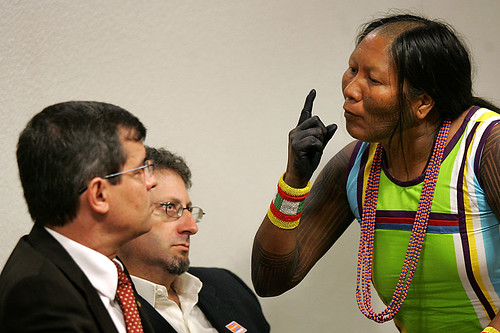
BELO MONTE IS NOT A DONE DEAL

APTOPIX Brazil Dam Protest
Tuira Kayapo, leader of the indigenous Kayapo tribe, speaks to Aloysio Guapindaia,
director of the National Indian Foundation, FUNAI. (AP Photo/Eraldo Peres)


Yes, indeed! It's a squirmy deal at best, put together hastily in the final moments before a politically insane auction during global Earth Week celebrations.

International Rivers, the global NGO that has filled a key role in disseminating the truth about Belo Monte gives the latest UPDATE

Belo Monte Dam is by no means an inevitability, despite what the Brazilian government and the companies promoting the dam would like you to believe. Legal actions, protests and occupations by indigenous groups, and a growing international campaign could derail the project. Let's recap the events of the last couple of weeks.

After several last-minute legal wranglings, the auction went forward on April 20, 2010, and the dam contract was awarded to a consortium calling itself Norte Energia (North Energy), led by CHESF, an Electrobras subsidiary. The consortium bid to supply power to the grid at a cost of R$77.97 per MWh, well below the government-set price ceiling of R$83 per MWh, a low price which was already scaring away investment. Very soon after the auction, two companies threatened to pull out of the consortium, citing lack of profitability. The consortium itself is in a state of disarray, with some companies pulling out and others from the losing consortium potentially joining in.


Indeed, the lack of economic viability of the project has been an ongoing theme the past couple of weeks. Brazil's pre-eminent national newspaper, O Globo, published an editorial on April 20 entitled "Belo Monte is a bad investment for Brazil". O Globo cites the fact that the winners of the auction will get an unprecedented 30-year loan from BNDES, the Brazilian National Development Bank, with an interest rate of just 4%, less than what the government will be selling bonds for to finance the deal! Because of the lack of private investment, to finance the loan BNDES is drawing from the Workers' Support Fund (Fundo de Amparo ao Trabalhador) and from public pension funds- funds that are supposed to guarantee job security, health, and education provisions, not subsidize the energy consumption of electro-intensive industries! In addition, the government announced tax breaks of 75% for investors in the auction, while around half of the shares in the project will be owned by state-owned enterprises, which generally operate with a minimal return on investment.

Next, a former director of ANEEL, the national electrical regulatory agency, said on April 27 that the government would be "creating a monster" if they go ahead with Belo Monte. Besides the social and environmental problems, the project would threaten energy security because of the large seasonal variations in power production (the dam is expected to generate as little as 1000 MW during the dry season). Afonso Henriques Moreira Santos said that "Belo Monte is not essential for energy security." Indeed he argued that dams in the Amazon are not a good solution for Brazil's energy needs because of the long transmission lines that need to be built to bring the energy to population centers. "Large transmission lines are very fragile," he said.

And as if to reinforce the point that this is a lousy investment for Brazilians, José Ailton de Lima, the president of the winning consortium Norte Energia, said the final price of the project will be somewhere between R$19 billion (US$10.85 billion) and R$30 billion (US$17.13 billion). The higher price is what private construction contractors have thought it will actually cost all along. Such skyrocketing costs can only be absorbed by the huge public subsidies being offered by the government.

Meanwhile, opposition is mounting internally and externally. In Brazil, the Senate is investigating claims that ANEEL held the project auction illegally by ignoring a third restraining order placed on the auction by federal Judge Antonio Carlos Campelo. Reports show that the third order to cancel the auction was issued by 1pm, yet the auction still went forward at 1:20pm behind closed doors. A regional appellate judge overturned the third order, buckling to direct pressure from the government. By pushing Belo Monte through at any cost, the Lula government is making a mockery of Brazil's rule of law.

Abroad, the auction date was marked by massive protests around Brazil and people calling in to Embassies around the world to express their opposition to the project. Soon after, indigenous people from the Big Bend of the Xingu announced that they would be establishing a protest village on Pimental Island, the site where dam construction will take place, in order to block construction. They are planning this village as I write.

In solidarity, the Kayapo Indians from the Xingu National Park have been blocking a major road and river crossing in Mato Grosso state for the past week to protest the government's decision to build the dam. Kayapo leader Megaron Txukarramae released a statement reaffirming his people's intention to resist dam construction, calling President Lula "enemy number one", and stating that "if Lula wants to do away with us as he has been indicating, the whole world will know that we will die fighting for our rights." Heavy words from a warrior tribe.

And just last Wednesday our friends at Amazon Watch organized a protest in front of the Brazilian mission to the United Nations in New York with indigenous people around the world and actress Sigourney Weaver to express opposition to Belo Monte Dam.

Legal actions, protests, a mounting campaign: it ain't over until the fat lady sings, and that fat lady will not be singing for a while.