VISISIONSHARE (blog header)_edited

Sunday, September 06, 2009

THIS IS A HOAX

clear-cut robot
FOREST EATING ROBOT

Unfortunately, reality has been far worst than the hoax, at least in Amazônia.


The inexorable march of 20th Century-style extractive agriculture and development into the interior of Brazil is threatening to block the vision of achieving a new era of harmony between conservation and development in Amazônia.

There are lots of instances of the Brazilian Ministry of Environment being sabotaged in Congress or on the ground by the more powerful constituencies of the ministries of Agriculture, Energy and Transportation. Indeed, Minister Carlos Minc has faced many obstacles and has already announced his intention to resign. Previously, his world-renown predecessor Marina Silva resigned citing, “the increasing resistance in central parts of government and the society”.

But the past need not be prologue. As the NY Times headline put it, A Child of the Amazon is Shaking Up Brazilian Politics. Marina Silva is weighing her return to the center stage and the pundits are either promising a new Obama or fearing that she will upset the delicate and always uncertain era of Worker Party governance.

As the political controversy grows more intense and as personalities and promises grab the headlines it is important keep in view exactly what has been happening on the ground.


Photos of Mato Grosso and Para by Leonardo F. Freitas.

Today, we are all global citizens -- in Brazil and in the world -- and we can't just look on passively as the future of the Amazon forest and planetary life as we have known it is threatened. Indeed, environmentalism and sustainability are not spectator sports.

The great Samaúma is now calling ALL of us -- the big guys at the World Bank and the folks on the ground alike. This is a time not for building endless "infrastructure improvements" but for building true bridges between people and nature.


We hope and pray that Marina will be able to help us heed the call, halt the devastation and return to a balance between people and nature.
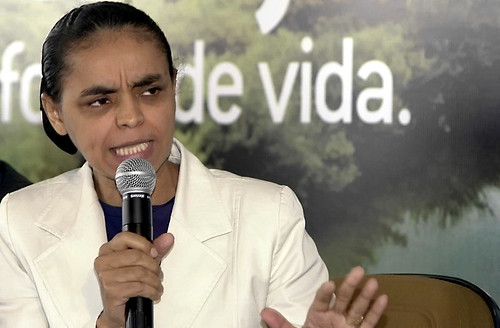
Marina Silva


SUFI MUSIC FOR A SUNDAY MORNING


Beautiful!


The Hang Drum is a pretty special percussion instrument with lots of tones. It is newly arrived from Switzerland onto the global music scene. There are thousands of examples at YouTube.

Here it lands in the hands of Modou, a young Sufi-Jazz musician, who uses it as a master key to many doors, opening new dimensions within us and the world of music.


Saturday, September 05, 2009

INSPIRING WEEKEND ENTERTAINMENT

Tired of TV? Natasha Tsakos really jumps out of the box.


If you are interested in TED talks, they are all listed in this convenient spreadsheet.

via Biongboing


THE SOPHIE PRIZE

Marina Silva

Marina Silva for President


The Sophie prize 2009

Awarded to Marina Silva

Senator and former Minister of the Environment, Brazil

This year’s Sophie Prize winner grew up in poverty in one of the world’s most isolated areas and was illiterate until her teens. She has since, as activist, senator and minister, been dedicated to securing the largest and richest ecosystem on earth: the Amazon rainforest. Her efforts and courage - and her achievements – are without comparison.

Marina Silva (born 1958) was Minister of the Environment in Brazil from 2003 to 2008. During this period she reduced deforestation in the Amazon to historically low levels - by 60% from 2004 to 2007. Silva used drastic measures and clamped down on all illegal activity in the forest. Hundreds who did not obey the law were imprisoned. While protecting the rainforest, she also balanced the concerns of indigenous peoples’ traditional farming societies.

Brazil’s rainforest absorbs massive amounts of CO2. Rainforest conservation is crucial to limit the greenhouse effect and dramatic climate changes. Conservation of biodiversity and preservation of areas for local and indigenous peoples is also of great importance.

Marina Silva grew up as one of 12 siblings in a poor rubber tapper family in the province of Acre, Western Brazil. Totally dependent of the rubber plantation, the family practically lived as slaves. 16 years old (in 1974) she contracted hepatitis and was sent to Rio Branco for treatment. She was illiterate, but with a dream of studying and becoming a nun.

She worked as a maid, learned to read, was enrolled at a public school, stood for exams and started history studies. Along the way she was inspired by liberation theology and the ideas of the environmental activist Chico Mendes (murdered by cattle ranchers in 1988). She became politically active, and an ardent proponent of negotiation, non-violence, and innovative solutions. She saw many of her fellow activists murdered. Still, she did not give in, however, convinced that civilization must be based on sustainability.

In 1994 she was elected senator to Brazil’s national assembly, the first from a rubber tapper family. President Lula appointed her Minister of the Environment in 2003. She faced enormous challenges. The ministry was weak and isolated, and deforestation in the Amazon was accelerating. Vested economic interest, sometimes criminal, were fiercely opposed and willing to go far to stop conservation.

Despite this, Silva managed to forge alliances and to use laws and institutions to turn things around. Huge areas were conserved, more than 700 people were arrested for illegal activities in the forest, over 1.500 companies were closed down and equipment, properties and illegal timber were confiscated. These measures were effective. During Silva’s last three years in government, deforestation was reduced to the second lowest level in 20 years. As a result to this, the earth avoided emissions of 520 million tons of CO2, or ten times Norway’s annual emissions.

Another result of Marina Silva’s efforts is The Amazon Fund, established to prevent greenhouse gas emissions through rainforest conservation. The Fund is financed by national and international contributions.

Marina Silva resigned as Minister of the Environment, citing “the increasing resistance in central parts of government and the society”. The resistance became to massive after she made the government adopt a new set of measures to prevent the deforestation that was now increasing again. Silva continues her struggle from her place in the national assembly and still has great influence on environmental policy in Brazil.

Mahatma Gandhi said: “Never underestimate the individuals ability to change the world”. Marina Silva confirms Ghandi’s words.

Marina Silva is awarded the Sophie Prize based on her courage, her creativity and her ability to forge alliances, but first and foremost for her battle to conserve the Amazon rainforest. Her effort to secure a sustainable management of the earth we live on is an inspiration to us all.

More about the Sophie prize here.


LAUGH YOUR WAY TO SUSTAINABILITY

Eco-Worriers: Episode 1 from Daf Palfrey on Vimeo.


Go to the full story and more at treehugger.


Friday, September 04, 2009

SOME MORE GOOD NEWS

It's nice to go into the weekend with a few positive reports recently posted at our favorite rainforest website, Mongabay.com.

Amazon deforestation to fall 30% in 2009

(09/02/2009) Deforestation in the Brazilian Amazon is likely to fall between 8,500 square kilometers (3,088 square miles) and 9,000 sq km (3,474 sq mi) for the 12 months ended July 31, 2009, a reduction of 29-37 percent from last year, reports Brazil's Environment Minister Carlos Minc. If the estimate is confirmed by high resolution satellite data to be published later this year, the rate of forest loss for 2008-2009 would be the lowest since annual record-keeping began in the 1980s.


Germany to pay Ecuador $650 million to forgo oil drilling, protect rainforest reserve

(09/03/2009) Germany has apparently agreed to fund a significant portion of Ecuador's scheme to leave Amazon rainforest oil reserves in the ground, according to Business Green.


WHERE IS HEAVEN, ANYWAY?

OK, perhaps it is time to lighten up a bit from all this deep spiritual and political talk. There's no better way to do that than with some classic Indian humor. So here's a story.

St_Peter's_Square,_Vatican_City_-_April_2007
Vatican City Photo by David Iliff

Once there was a young Native American traveling Europe. He was interested in learning something about the roots of European religion and spirituality so he had visited many of the great cathedrals and shrines. He saved a visit to the Vatican for his last stop.

He arrived to its great plaza on a non-festival day and the courtyard was nearly empty. He wandered around a bit scanning the great edifice that he had heard so much about and looked up at the balcony where the Pope sometimes appeared to address the faithful. But the door was closed.

Thinking that no one was home, he struck up a conversation with a guard saying, "I guess I came on the wrong day. It looks like no one is home." The guard responded, "Oh, the Holy Father is there. He's taking advantage of the quite day to catch up on some of his office work."

Then Indian said, "Well, if he is not too busy, do you think that I might visit him? You know, have an 'audience' or something like that?" The guard looked at him skeptically and said, "Wait here and I'll go ask." Soon he returned and said, "This is most unusual but he said that I should bring you up to his office."

At the office, the Indian exchanged pleasantries and the stood in awe of the great room with all of its fancy appointments, it was decorated with some of the world's greatest art and craftsmanship. When his gaze turned to a bookcase wall, he was surprised to see that the shelves were lined not with books but with telephones, one after another.

He asked, "Pope, what are those phones for?" The Pope responded, "Oh that's how I stay in touch with the Church's spiritual empire. Each phone is a direct line to the Bishop of an Archdiocese. That's Santiago, Chile over there, and Paris is here. This one is for Los Angeles."

As the Indian surveyed this central communications network, his gaze stopped at a single ornate telephone finely crafted all in gold. He asked. What's that one for?" The Pope responded, "Oh, that's my direct line to Our Heavenly Father, to God." The Indian became very excited and asked if he might talk with God. The Pope answered, "Sure, go ahead. He is having sort of a free day like me. Nothing much is happening."

The Indian had a marvelous conversation lasting nearly 45 minutes. When it was over, he was truly radiant. He thanked the Pope profusely and said that he didn't want to impose on the Pope anymore and turned to leave. The Pope halted him, saying, "Wait. That was an expensive long-distance call. The bill comes to $657. We're on a tight budget this month with lots of unexpected expenses. Can you pay the bill?"

The Indian said that it would take most of his remaining money but since he was leaving for the States in the morning it was OK and certainly worth it. He then says, "Pope, if you ever get near to South Dakota please come visit" and he scribbles directions to his home on the Reservation.

Well, it so happens that the Pope is soon in Minneapolis for a conference of bishops. He has a free day when he arrives, looks at a map and sees that South Dakota and the Reservation are nearby. He summons his driver and says, "Let's go find that Indian."

They locate the Indian's home in a classic shantytown. Clapboard structures and yards full of junk cars, chickens, cats and dogs everywhere amidst incredible poverty. The Indian, totally shocked to see the Pope, invites him into his humble home which is a big mess. The Pope surveys the situation and sees a small table that is immaculate. On it sits a cell phone that is all decorated, Indian-style with fancy beadwork. The Indian explains that it is his direct line to Great Spirit.

The Pope asks if he might talk with Great Spirit, noting that it would be a fine culture and spiritual exchange for the Indian's conversation with God. The Indian is thrilled with the Pope's request and hands him the phone.

The Pope has a marvelous conversation, similarly lasting about 45 minutes. When it ends the Pope is radiant. He pulls out his wallet and says that he knows how expensive cell phone calls are. He wants to pay the bill.

The Indian says, "Forget it Pope. It's no big deal. Out here talking to Great Spirit is a local call."


THE ONENESS OF SPIRIT

Sometimes, when I am writing in front of my Fortaleza window unto the forest, the view seems to turn suddenly inward and I travel in reverie into the realms of my heart. It happened again recently. I had just finished reviewing my recent post about Sophie's fardamento when the memories of my own initiation over 11 years ago became very much alive.


Back then in Oregon I had not been looking for a new spiritual path as I was already walking the very strong and satisfying Red Road of the North American Indians. Yet, somehow, I was drawn into experiencing a Santo Daime ceremony where I met, for the first time outside of the realm of dreams, A Rainha da Floresta (The Queen of the Forest). I knew instantly that I had found a complimentary path. At least, I truly wanted the path to be complimentary, but harmony wasn't so easy for me to achieve.

Indeed, as time passed and I began to experience the inner call toward initiation, a terrible conflict arose within me. I simply could not make peace between the Doctrine of Jesus that I was receiving in the hymns and the history of horrors that have been perpetrated onto native peoples with the sanction and support of the official Church. [1]

The contradiction was simply impossible for me to resolve, so I did what is recommended -- I asked the Teacher. I attended a concentração ritual where I confessed my painful confusion and begged to the Spirit of the Daime for a teaching. Then I drank the Daime, recited the opening prayers and sang the opening hymns.

When the time for silent meditation arrived, I closed my eyes and was instantly transported into miração (the visionary state of Santo Daime). I found myself alone, sitting in a Native American sweatlodge and peering into the darkest darkness that I have ever seen. Then, a vision appeared within the vision that put total faith into my heart.

When the vision ended, I opened my eyes to reorient myself in the room. I started to turn to look at the altar on the central table but a voice from within screamed, "DO NOT LOOK AT THE ALTAR!" I shrunk back and whispered, "why not?" The voice answered, "We put something in your heart. Don't look at altars any more. Just look and listen with your heart."

That resolved all my confusion and I decided that Santo Daime would be my path along with my Native American ways. Since then I have never experienced any contradiction between Santo Daime and any other spiritual path. The lesson for me has been that each Path of Heart is part of the One.

But, as I have mentioned often, living in one's heart can be difficult. Indeed, I remember a Native American Church peyote ceremony that I attended. It was really hard for me. I spent most of my time throwing up (in Peyote circles that's called "getting well") and I recall only one thing -- somewhere in the ritual the very humble Roadman Ken Littlefish asked, rhetorically, "Why do we put ourselves through such ordeals?" He paused, turned inward and with tears in his eyes and a broken voice said, "Because the result is just… is just so sweet."

The language of the heart begs for prayer and poetry and music. To express it a bit, I have put together a loop of 3 recordings that I use as a meditation.


It begins with Saturnino, Luzirene and friends singing Padrinho Alfredo's hymn, # 157 of the Hinario, "O Cruzeirinho":

"The Angel of God"

Angel of God protect us
With Your holy blue mantle
From east to west, from north to south
Viva the star of the blue
Which makes the stars of heaven shine
Of the Archangel Raphael

This globe turns perfectly
With diverse displays of color
It's God in everything, it's the fruit, the flower
Life of my creator
That causes budding with all vigor
Life of the King of Love


Next comes Carioca's instrumental version of the same hymn, carrying the listener first into the starry firmament and then back to earth at the shore of a great water where I can see the Morning Star yielding to the light of the Dawn.

Finally, looking into the rising sun, I can imagine being there hearing the universal prayer of the great Lakota Holy Man Black Elk as recited by his biographer and voice to the world, John Neihardt.

Again, I must caution the reader that I have no special authority for interpreting the Doctrine of Santo Daime or Native American ways. My view here is one of a single pilgrim of the heart. It is a view that, for me at least, holds much sweetness. I hope that it might bring something heartfelt to you as well.

~~~~~~~~~~~~~~~~~~~~~~~~~~~~

Endnote [1]: Sadly, I must report that the Papal Bull that authorized the taking of native lands has never been rescinded. After the return of Columbus, in 1493 Pope Alexander VI issued a declaration sanctifying the conquest of people who were non-Christian and therefore “barbarous,” unworthy to own the land where they had been living for thousands of years. Known as the “Inter Caetera bull,” this document inspired England’s King Henry VII to issue his own royal charter of “Discovery” in 1496, and set the precedent for the domination of indigenous people worldwide under the vast empires of European nations who could now claim that their theft of land from native inhabitants was the will of God.

Our Grandma Aggie and the International Council of 13 Indigenous Grandmothers are among the many indigenous groups and supporters attempting to correct the 500 year old mistake that set the stage for the oppression of native people around the world.

There will be a Gala Benefit for the Grandmothers next month in San Francisco.


Thursday, September 03, 2009

ARE WE WHAT WE EAT?

Warning: this video is horrible.


But does it mean that we all must become vegans? Personally, I don't think so, and my reason comes from a Ram Dass story about his guru Sri Neem Karoli Baba...

It seems that once when they were all hanging out in India, a group of Americans-in-training-to-be-yogis became very concerned about the food that what being passed around the ashram because it was full of white sugar and white flour and other non-whole foods. They demanded a teaching from the guru about food.

He didn't like to teach, never wrote anything and rarely gave sermons. Reluctantly, he offered the teaching, saying,

"Eat food that has been prepared with love and don't eat poison. End of teaching."

For me, that's the reason to avoid ALL industrial foods. They contain no love and are loaded with poison. I don't believe it's about killing animals as much as how we relate to all life from birth to death. That's what determines who and what we are.

Here is the full explanation of the video:

Hatchery Horrors: Video Shows No Mercy for Baby Chicks

by Christine Lepisto,
Berlin on 09. 2.09

For two weeks, a Mercy for Animals investigator operated a hidden camera secretly inside of one of America's largest hatcheries. In a calm voice, the narrator describes the scenes playing in the video. The video captures the horror of the post-industrial food chain, where live animals flutter in panic along assembly line operations that proceed with deliberate calmness and unmerciful purpose. Many of the chicks in the image above, excerpted from the video, are heading towards a gruesome death by being ground up while still alive.

Cute, fluffy chicks bounce roughly along assembly lines. 150,000 male chicks per day are sorted out by operators known as "sexers" and tossed aside to be ground alive because they cannot produce eggs and will not grow fast enough for meat. Death by being ground alive is merciful in contrast: chicks that get caught in the machinery, slip through, or accidentally end up in the wrong place at the wrong time suffer terribly before dying. Females that make it through sorting face a life in confined, factory farm conditions.

On the
Mercy for Animals website, a consumer right-to-know label is proposed:

Citing the troubling findings of this investigation, Mercy For Animals is calling on the nation's 50 largest grocery chains to require that all eggs sold in their stores bear a label reading, "Warning: Male chicks are ground-up alive by the egg industry."

More on Animal Cruelty:

Hatchery Horrors, Mercy for Animals
Heroes Star Tries to Stop Dolphin Hunt in Japan
So What Does the Inside of a Factory Farm Look Like Anyway? (Slideshow)
Animal Visuals Gives Bird's Eye View of Factory Farm Cage
The Meatrix


WOW! RIGHT ON DOUGLAS!


Boy, as an artist and storyteller, I really resonnate with this.


9/11 Ad for WWF Causes Tsunami of Criticism

Can you believe this?


Go to original at Advertising Age

An obscure ad that ran once in a small Sao Paulo newspaper months ago has come back to haunt DDB Brasil and its conservation client, the WWF in Brazil, in the latest example of the internet exposing a local ad to global condemnation.

Sergio Valente, president of DDB Brasil, said the ad was presented to the WWF in Brazil in December 2008 and approved; it then ran once in a small local paper.

"When I saw it, I said, 'Stop running that ad,'" Mr. Valente said.

'Worst Person in the World'

Running an ad once is often a tactic to make it awards-show-eligible, and "Tsunami" somehow ended up among a bunch of the agency's submissions to this year's One Show in New York. Mr. Valente said that an American blogger apparently unearthed the ad in the One Show's online archive and posted it on his blog.

The ad ricocheted around the blogosphere, garnering horrified and often vicious posts, tweets and comments, and it landed the agency on Keith Olbermann's MSNBC show as the villain of his "Worst Person in the World" segment.


After the WWF appeared to initially deny approving the ad, DDB Brasil and the WWF hammered out a statement posted in Portuguese on both groups' Brazilian websites Wednesday afternoon apologizing for the ad and attributing it to "the inexperience of some professionals on both sides, and not bad faith or disrespect toward American suffering."

The statement continued, "WWF-Brasil and DDB Brasil reaffirm that the ad never should have been created, approved or run. They deeply regret that this happened, and apologize to everyone who has been offended."

DDB Brasil has been the WWF's local agency in Brazil for the past three years and has won numerous creative awards for its work for the conservation group. The agency was also named Agency of the Year at the Cannes Lions International Advertising Festival in June for winning more Lions than any other agency.

In a separate mishap in a bad week for DDB Brasil, "Tsunami" accidentally ended up in a folder for work to be sent to journalists by the agency's public-relations department and was mistakenly sent to Ad Age sibling Creativity this week as though it were a new print ad. It was described in the e-mail as "a great campaign."

A DDB Brasil spokesperson in Sao Paulo said a video version of the ad being circulated on the internet was not done or authorized by the agency or the client. She said DDB execs first saw the video, which features slightly different copy, on the internet and don't know who created it.


Read the very interesting comments at Advertising Age

My take on how these things happen is that, along with Rushkoff, I believe that top-down movements are a thing of the past. The 21st Century is going to be about networks and communities of conversation and action and not about cleverness produced either in think tanks or advertising firms.

SIMPLICITY IS THE HIGHEST FORM OF SOPHISTICATION

Do you ever wonder how God or No-God keeps expanding and perfecting the performance of life? Here's a great essay about it.


by Jim Manzi

Jerry Coyne has a fairly scathing review of Robert Wright’s book Evolution of God in The New Republic. Here’s how the review begins:

Over its history, science has delivered two crippling blows to humanity’s self-image. The first was Galileo’s announcement, in 1632, that our Earth was just another planet and not, as Scripture implied, the center of the universe. The second—and more severe—landed in 1859, when Charles Darwin published On the Origin of Species, demolishing, in 545 pages of closely reasoned prose, the comforting notion that we are unique among all species—the supreme object of God’s creation, and the only creature whose earthly travails could be cashed in for a comfortable afterlife.

But there are some for whom the true evolutionary tale of human life is not sufficiently inspiring or flattering. After all, the tale seems to hold no moral other than this: like all species, we are the result of a purely natural and material process. While many religious people have been persuaded by Darwin’s overwhelming evidence, there still remains a need to find greater meaning behind it all—to see our world as part of an unfolding and divinely scripted plan.

And so the faithful—the ones who care about science at all—have tweaked the theory of evolution to bring it into line with their needs, to make it more congenial. Although life may indeed have evolved, they say, the process was really masterminded by God, whose ultimate goal was to evolve a species, our species, that is able to apprehend and therefore to admire its creator.

Coyne is an eminent evolutionary biologist, but here makes an enormous claim about the philosophical implications of science: that evolution through natural selection demonstrates that there is no divine plan for the universe. I think this claim is, in fact, a gigantic leap of faith unsupported by any scientific findings. Let me try to explain why.

I’ll need to begin by considering evolution at a reasonably concrete level. It’s very helpful to look at a representation of the core algorithmic processes that comprise evolution through natural selection, but abstract away, for the moment, many of its biochemical complexities. Genetic Algorithms (GAs) are computer-software implementations of the same kind of information algorithm that takes place in the biological process of evolution through natural selection. Today, GAs are a widely deployed software engineering tool used to solve such prosaic problems as optimally scheduling trucks on a delivery route or identifying the best combination of process-control settings to get maximum output from a factory.

Consider the example of a chemical plant with a control panel that has 100 on/off switches used to regulate the manufacturing process. You are given the task of finding the combination of switch settings that will generate the highest total output for the plant. How would you solve the problem? One obvious approach would be to run the plant briefly with each possible combination of switch settings and select the best one. Unfortunately, even in this very simplified example there are 2^100 possible combinations. This is a surprisingly gigantic number — much larger, for instance, than the number of grains of sand on Earth. We could spend a million lifetimes trying various combinations of switches and never get to most of the possible combinations.

But there’s a trick that can help us. Once we start to try combinations, we might begin to notice patterns like “when switches 17 and 84 are set to ‘on,’ production tends to increase when I put switch 53 to the ‘off’ position.” Such insights could help us to narrow down our search, and get to the answer faster. This might not seem to be much help in the face of such an enormous number of possibilities, but the power of these rules is also surprising.

To illustrate this, think of a simple game: I pick a random whole number between one and a billion, and you try to guess it. If the only thing I tell you when you make each guess is whether you are right or wrong, you would have very little chance of guessing my number even if I let you guess non-stop for a year. If, however, I tell you whether each guess is high or low, there is a procedure that will get the exact answer within about 30 guesses. You should always guess 500 million first. For all subsequent guesses, you should always pick the mid-point of the remaining possibilities. If, for example, the response to your opening guess of 500 million is that you are too high, your next guess should be the mid-point of the remaining possibilities, or 250 million. If the response to this second guess is “too low,” then your next guess should be the mid-point of 250 million and 500 million, or 375 million, and so on. You can find my number within about a minute.

A Genetic Algorithm works on roughly the same principle. To return to our problem of the 2^100 possible combinations of switch settings, we can use a GA as an automated procedure to sort through the vast “search space” of possibilities — and thus home in quickly on the best one. This procedure has the same three elements as our procedure for guessing the number: a starting guess, a feedback measurement that gives some indication of how good any guess is, and an iterative method that exploits this feedback to improve subsequent guesses.

In order to establish the initial guess for the GA, imagine writing a vertical column of 100 zeroes and ones on a piece of paper. If we agree to let one=“turn the switch on” and zero=“turn the switch off,” this could be used as a set of instructions for operating the chemical plant. The first of the hundred would tell us whether switch 1 should be on or off, the second would tell us what to do with switch 2, and so on all the way down to the 100th switch

This is a pretty obvious analogy to what happens with biological organisms and their genetic codes — and therefore, in a GA, we refer to this list as a “genome.” The mapping of genome to physical manifestation is termed the genotype-phenotype map.

Our goal, then, is to find the genome that will lead the plant to run at maximum output. The algorithm creates an initial bunch of guesses — genomes — by randomly generating, say, 1,000 strings of 100 zeros and ones. We then do 1,000 sequential production runs at the factory, by setting the switches in the plant to the combination of settings indicated by each genome and measuring the output of the plant for each; this measured output is termed the “fitness value.” (Typically, in fact, we construct a software-based simulation of the factory that allows us to run such tests more rapidly.) Next, the program selects the 500 of the 1,000 organisms that have the lowest fitness values and eliminates them. This is the feedback measurement in our algorithm — and it is directly analogous to the competition for survival of biological entities.

Next comes the algorithmic process for generating new guesses, which has two major components: crossover and mutation. These components are directly modeled on the biological process of reproduction. First, the 500 surviving organisms are randomly paired off into 250 pairs of mates. The GA then proceeds through these pairs of organisms one at a time. For each pair it flips a coin. If the coin comes up heads, then organism A “reproduces” with organism B by simply creating one additional copy of each; this is called direct replication. If it comes up tails, then organism A reproduces with organism B via “crossover”: The program selects a random “crossover point,” say at the 34th of the 100 positions, and then creates one offspring that has the string of zeroes and ones from organism A up to the crossover point and those from organism B after the crossover point, and an additional offspring that has the string of zeroes and ones from organism B up to the crossover point and those from organism A after the crossover point. The 500 resulting offspring are added to the population of 500 surviving parents to create a new population of 1,000 organisms. Finally, a soupçon of mutation is added by randomly flipping roughly every 10,000th digit from zero to one or vice versa.

The new generation is now complete. Fitness is evaluated for each; the bottom 500 are eliminated, and the surviving 500 reproduce through the same process of direct replication, crossover, and mutation to create the subsequent generation. This cycle is repeated over and over again through many generations. The average fitness value of the population moves upward through these iterations, and the algorithm, in fits and starts, closes in on the best solution.

This seems like a laborious process — but it works: it helps us get the factory to very high output much faster than we could otherwise. Computer scientists were inspired to do it this way because they observed the same three fundamental algorithmic operators — selection, crossover, and mutation — accomplish a similar task in the natural world. Notice that the method searches a space of possible solutions far more rapidly than random search, but it neither requires nor generates beliefs about the causal relationship between patterns within the genome and fitness beyond the raw observation of the survival or death of individual organisms. This is what makes the approach applicable to such a vast range of phenomena. That such a comparatively simple concept can explain so much about the way nature works is what makes genetic evolution a scientific paradigm of stupendous beauty and power. As Leonardo put it, simplicity is the highest form of sophistication.

We can make two simple observations about the properties of this GA. First, our factory evolution process did not begin ex nihilo. It required pre-existing building blocks in the form of the initial population and the rules of the algorithm. Second, one of the 2^100 possible combinations of switch settings will produce the highest output. With enough time, the algorithm will always converge on this one answer. The algorithm is therefore the opposite of goalless: it is, rather, a device designed to tend toward a specific needle in a haystack — the single best potential result.

These two observations are highly relevant to our consideration of the philosophical problems of creation (first cause) and purpose (final cause).

It is obvious from the factory analogy that evolution does not eliminate the problem of ultimate origins. Physical genomes are composed of parts, which in turn are assembled from other subsidiary components according to physical laws. We could, in theory, push this construction process back through components and sub-components all the way to the smallest sub-atomic particles currently known, but we would still have to address the problem of original creation. Even if we argue that, as per the GA which spontaneously generates the initial population, that prior physical processes created matter, we are still left with the more profound question of the origin of the rules of the physical process themselves.

This, of course, is a very old question that far pre-dates modern science. A scientific theory is a falsifiable rule that relates cause to effect. If you push the chain of causality back far enough, you either find yourself more or less right back where Aristotle was more than 2,000 years ago in stating his view that any conception of any chain of cause-and-effect must ultimately begin with an Uncaused Cause, or just accept the problem of infinite regress. No matter how far science advances, an explanation of ultimate origins seems always to remain a non-scientific question.

Now consider the relationship of the second observation to the problem of final cause. The factory GA, as we saw, had a goal. Evolution in nature is more complicated — but the complications don’t mean that the process is goalless, just that determining this goal would be so incomprehensibly hard that in practice it falls into the realm of philosophy rather than science. Science can not tell us whether or not evolution through natural selection has some final cause or not; if we believe, for some non-scientific reason, that evolution has a goal, then science can not, as of now, tell what that goal might be.

One important complication is that evolution in nature proceeds against a more complex fitness function than “see how much output this factory creates.” The natural fitness landscape is defined by survival and reproduction, and it is constantly changing as the environment changes — for example, as new species arise or the climate becomes colder. It is prohibitively difficult to calculate the result of this process, but it is, in principle, calculable; the fitness landscape, after all, is only the product of the interaction of other physical processes.

A second major complication is that genetic strings in nature have complex structures and can evolve to some arbitrary length, unlike our factory example, where the genome had a single string with a fixed length of 100 positions. But, even in nature, the genome must always have finite dimension, as regulated by physical laws; and therefore the total number of potential combinations of genetic components remains finite. It is often said, correctly, that the number of possible genetic combinations is “all but infinite”; but of course this is just a very loaded way of saying “finite.”

The combination of a constantly changing fitness landscape and an extraordinarily large number of possible genomes means that scientists appropriately proceed as if evolution were goalless, but from a philosophical perspective a goal may remain present in principle.

But what about the random elements of evolution – how can randomness possibly comport with a goal? First, note that in the factory example, this did not impact the goal, merely the path taken to the goal. Further, it’s especially important that we be clear about our terms on this subject, since a lot of philosophical baggage can get swept into the term “random”. It is often used loosely in discussions of evolution to imply senselessness, a basic lack of understandability, in occurrences. But in fact, even the “random” elements of evolution that influence the path it takes toward its goal — for example, mutation and crossover — are really pseudo-random. For example, if a specific mutation is caused by radiation hitting a nucleotide, both the radiation and its effect on the nucleotide are governed by normal physical laws. Human uncertainty in describing evolution, which as a practical matter we refer to as randomness, is reducible entirely to the impracticality of building a model that comprehensively considers things such as the idiosyncratic path of every photon in the universe compounded by the quantum-mechanistic uncertainty present in fundamental physical laws that govern the motion of such particles. So, said more precisely, the evolutionary process does not add any incremental randomness to outcomes beyond what is already present in other physical laws, simply such great complexity that scientists are well-advised to treat it as if it were goalless. We currently lack the capability to compute either the goal or the path of evolution, but that is a comment about our limitations as observers, not about the process itself.

The theory of evolution, then, has not eliminated the problems of ultimate origins and ultimate purpose with respect to the development of organisms; it has ignored them. These problems are defined as non-scientific questions, not because we don’t care about the answers, but because attempting to solve them would impede practical progress. Accepting evolution, therefore, requires neither the denial of a Creator nor the loss of the idea of ultimate purpose. It resolves neither issue for us one way or the other. The field of philosophical speculation that does not contradict any valid scientific findings is much wider open to Wright than Coyne is willing to accept.

Orginally at The Daily Dish


Wednesday, September 02, 2009

SOME GOOD NEWS FROM PERU


New Amazonian reserve saves over a million acres in Peru
Jeremy Hance
mongabay.com
August 30, 2009


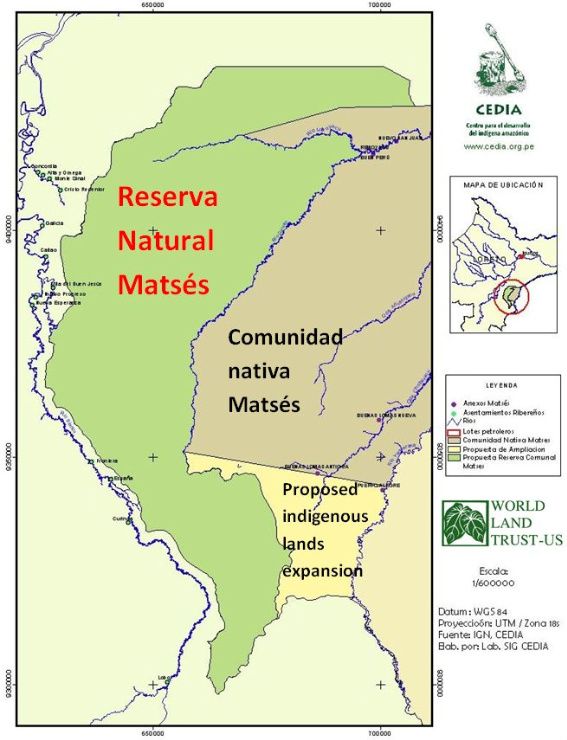
On August 27th Peru's Ministry of the Environment approved the creation of the Matses National Reserve to protect the region's biodiversity, ensure its natural resources, and preserve the home of the Matses indigenous peoples (known as the Mayorunas in Brazil). The park is 1,039,390 acres (or 420,626 hectares) of lowland Amazonian rainforest in eastern Peru.

The park is the culmination of over a decade of work by the local non-profit CEDIA(the Center for the Development of the Indigenous Amazonians) funded in large part by the World Land Trust-US.

"Like so many other remote indigenous peoples, [the Matses] have been forced to defend their homelands from logging and oil companies in a bid to preserve their ancient way of life and protect the amazing Amazon rainforest… These short-sighted commercial activities have worked against indigenous peoples and conservationists to prevent this critical protected area from being established," a press release by the World Land Trust-US stated.

Long unknown to the world, the Matses people were first contacted in 1969 by Christian Missionaries. The indigenous group has since remained in nearly complete isolation, retaining their traditions and living through sustainable hunting and fishing. The preserve protects the Galvez and Yaquerana Rivers, which the Matses people depend on for fishing. The group is eminently skilled with the bow and the arrow—their unique arrows measure two meters in length—which they use for hunting. The Matses group are also known as the 'cat people', because of distinct facial tattoos and piercings worn by the women which resemble the whiskers of a cat.


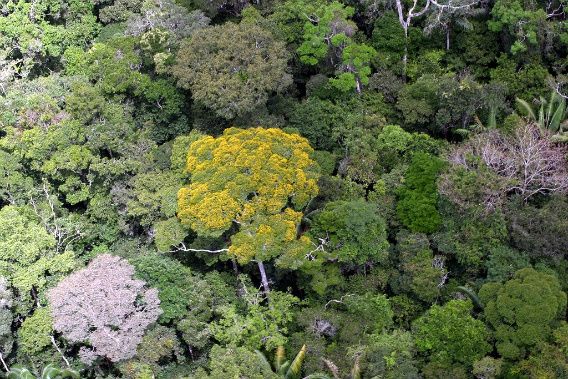
View of rainforest in the new Matses National Reserve. Photo courtesy of the World Land Trust-US.


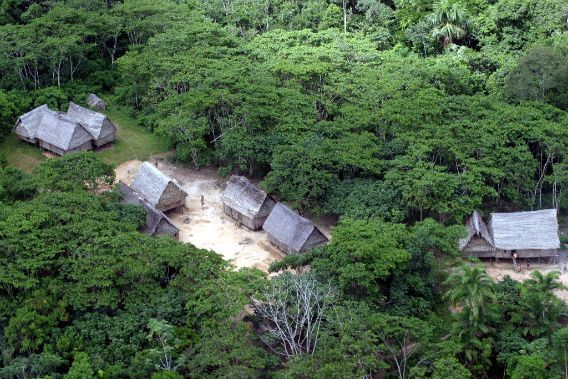
Remote Matses village. Photo courtesy of The World Land Trust-US.


Map of the new reserve. Map courtesy of The World Land Trust-US.


Tuesday, September 01, 2009

HERE WE GO AGAIN... and AGAIN...

US Government to Appeal Oregon Daime Ruling

By Matthew Meyer

Special to bialabate.net

On August 21st, 2009, the Department of Justice formally notified the United States Court of Appeals for the Ninth Circuit that it would appeal Judge Owen M. Panner’s March 18 ruling granting a permanent injunction to the Ashland, Oregon-based Church of the Holy Light of the Queen to import and use Daime tea (ayahuasca) in its religious rituals.

The government had already asked Judge Panner, following the decision, to amend it, arguing that the exemptions to the Controlled Substances Act that Panner set forth “swept too broadly, mistakenly enjoining the enforcement of numerous regulations that were not challenged in the Complaint and that have not been held to pose any burden on Plaintiffs’ exercise of religion.”

The government’s position in this case has lately resembled the stance it has taken in the O Centro case involving the União do Vegetal, where the government, having apparently lost the substantial points about the dangers ayahuasca use by the UDV might pose to its members and to society, has resorted to stonewalling by refusing to agree to a permanent, workable arrangement in negotiations with the UDV outside the court. Instead, the government has argued that the UDV must prove the same case for each and every DEA regulation that places an unreasonable burden on its religious practice. (These regulations include keeping track of the precise dose of the controlled substance—which is this case would be small amounts of DMT in the ayahuasca—given to each individual.)

A blanket or wide-sweeping exception to the CSA, the government told Panner, would mean that “the DEA’s ability to enforce the [Controlled Substances Act] through the closed regulatory system…would be seriously inhibited.”

Judge Panner denied the government’s request in a document dated June 23rd, 2009, saying that the government “has already lost its battle for a closed regulatory system.” He pointed to the Supreme Court’s unanimous decision in O Centro, which characterized the government’s position, having failed to demonstrate harm from ayahuasca use, as saying that “If I make an exception for you, I’ll have to make one for everybody.” But judicial exceptions to laws on a case-by-case basis is exactly what the Religious Freedom Restoration Act requires, Judge Panner noted. And the Supreme Court decision made it clear that the Controlled Substances Act was not beyond the reach of RFRA.

Concluding the legal justification of his decision, Judge Panner declared that he found “that this court’s authority under RFRA to create exceptions to the Controlled Substances Act necessarily includes the authority to create exceptions to the DEA regulations that implement the Act.”

Judge Panner went further, however, chiding the government for its extremely inflexible approach to the Oregon case (and, one imagines, for its similar approach in the UDV’s case in New Mexico, especially given that some of the same government lawyers are working both cases). “Many of the issues the government raises in its motion,” he noted, “could have been resolved through discussions with [the UDV].”

The government’s appeal was not surprising if you consider that it has continued to appeal both ayahuasca cases despite never getting any court, at the district, circuit, and Supreme Court levels to agree with its central arguments.

On the other hand, as Jonathan Goldman, the leader of the Church of the Holy Light of the Queen noted in a recent podcast interview with Martin Ball of the Entheogenic Evolution, the government surely knows that it is raising the stakes in appealing this decision. Because the Ninth Circuit covers all of California, Oregon, Washington, and Hawaii, among other western states, losing an appeal at that level would expand the reach of the precedent set by the case to areas with numerous similar ayahuasca-using churches.

Although it seems likely that the government will continue to argue that all DEA regulations may legally be applied to the Church of the Holy Light of the Queen, we won’t know their precise arguments until the government’s first brief, due to the court December 7th, is available.


Turning charcoal into Carbon Gold


A chocolate maker and music promoter aim to create a £1bn biochar industry, in a controversial effort to fight climate change.

David Adam, environment correspondent
guardian.co.uk, Thursday 27 August 2009


Go to original article and comments

In a patch of woodland on the outskirts of Hastings, on the English south coast, a group of men huddle around a brick laboratory as smoke curls from its two chimneys. The men are trying, with some chemical trickery, to bring a lucrative piece of South America to Sussex, to spark what they believe could be a £1bn industry in Britain.

The business is controversial. Some maintain it should be outlawed, and others say that only full-scale legalisation would control the risks. Until the fuss dies down, the men have decided to bury the powder they make in a nearby field.

Craig Sams, a millionaire chocolate maker, and Dan Morrell, a former music promoter and entrepreneur, are producing charcoal, and their aim is to get rich by selling it to tackle global warming.

Together Sams and Morrell make Carbon Gold, a company they have set up to exploit the growing interest in green solutions to climate change. The brick laboratory is, they claim, Britain's first dedicated facility to produce biochar, which is what you call charcoal when you are selling it as a solution to global warming.

Their idea is a low-tech take on the futuristic concept of carbon capture and storage. Carbon, in the form of wood from trees and agricultural waste, can be turned to
charcoal and buried in the ground, so storing it away from the atmosphere. If enough carbon can be buried in this way, then it could bolster so-far feeble global attempts to address climate change through cuts greenhouse gas emissions.

Making and burying biochar to help reduce carbon levels in the atmosphere has some heavy green backing, including scientist and author James Lovelock and Jim Hansen of Nasa. The journal Nature Reports Climate Change said that biochar "could be the closest contender yet for a silver-bullet solution to climate change".

But it also has some high profile critics. Writing in this newspaper in March, George Monbiot said: "The idea that biochar is a universal solution that can be safely deployed on a vast scale is as misguided as Mao Zedong's Great Leap Backwards." He added: "According to the magical thinkers who promote it, the new miracle stops climate breakdown, replaces gas and petroleum, improves the fertility of the soil, reduces deforestation, cuts labour, creates employment, prevents respiratory disease and ensures that when you drop your toast it always lands butter side up."

Good idea or bad, if Sams and Morrell have their way, green consumers who want to offset the damaging emissions from their flights or cars will soon be able to pay Carbon Gold to make biochar on their behalf. Within weeks, the company expects to be approved by the offset industry's unofficial watchdog. Bigger markets could follow: the firm is among those lobbying for biochar credits to be included in the UN's clean development mechanism - a global carbon trading scheme used by countries such as Britain to meet ambitious carbon targets. A decision could be made as soon as December, at key climate talks in Copenhagen.

Morrell, who founded Future Forests, which later became the Carbon Neutral Company, said: "Biochar is the only technology that enables us to take invisible carbon dioxide out of the atmosphere, transform it into black lumps of pure carbon and, by ploughing it into the soil, prevent it from going back into the atmosphere."

He added: "We don't want to clear-cut woodland and turn it to dust. That's slightly alarmist. We're not saying this is the answer to global warming, but I don't see why it can't be one of a suite of solutions."

The duo's biochar facility runs on wood from surrounding trees, part of a woodland owned by Sams. By lighting a fire in a chamber beneath and fiddling with the way air flows through the device, the team says it can convert about a third of the carbon locked in the wood to charcoal in 24 hours. The wood part burns and is part baked, in a process called pyrolysis.

Biochar is not emissions free - the rest of the carbon from the wood goes up in smoke, but Morrell says it is better for the climate than burning or leaving it to rot, which can produce methane. He says their primary targets are large agricultural sites such as vineyards and olive producers, which have large amounts of waste cuttings.

Under Carbon Gold's business model, the firm would supply the technology to farmers and others, and take a cut of the valuable carbon credits generated by each tonne of carbon they store. It is already working on a similar project in Belize.

"It's almost like a franchise," says Sams, a founder of Green and Black's chocolate and former chair of the Soil Association. "It's the same principle as McDonalds," he adds, then wishes he hadn't.

Morrell's answer to the critics of biochar is a rule book produced by the company that is currently being considered by the Voluntary Carbon Standard, which regulates carbon offsets. Morrell says it includes safeguards to make sure wood and other feedstocks used are sustainable, as well as to preserve biodiversity and to give work to local people. "Of course it will be easier to just clear cut forest, but we think we can set the bar high enough to keep those people out."

There could be other benefits too, he says. Biochar could help make more soil productive, because it offers a surface for bugs to thrive. Charcoal mixed into the ground by Indian tribes centuries ago is often credited for the acclaimed rich and dark terra preta soils of the Amazon basin. If benefits can be proven, and Carbon Gold says local soil scientists are investigating, then biochar could perhaps claim extra carbon credits based on reduced fertiliser use. Sams is already experimenting with charcoal sprayed and ploughed onto a field next to the Sussex woodland.

Mike Childs, climate campaigner with Friends of the Earth, said: "The problems with biochar are largely the same as biofuel. If you manage it properly then making limited amounts is OK, sensible and useful. But there is massive pressure on forests for land and protecting ecosystems, and the potential to produce lots [of biochar] comes up against those pressures. In the short term it is not the answer to climate change."