

Saturday, October 31, 2009


EXACTLY AS I FEEL
One of Ken Robinson's many great lines about how schools are: "Don't share answers with anyone, that's cheating." Outside of schools, that's called collaboration. He notes that kids start school with the vast majority showing signs of incredible creativity but by the end of high school only 10 percent manifest the standard measures of creativity. Why?
FEAR OF MAKING A MISTAKE.
How did I ever miss this guy? Thanks to treehugger for putting Robinson back into our view.
One of Ken Robinson's many great lines about how schools are: "Don't share answers with anyone, that's cheating." Outside of schools, that's called collaboration. He notes that kids start school with the vast majority showing signs of incredible creativity but by the end of high school only 10 percent manifest the standard measures of creativity. Why?
FEAR OF MAKING A MISTAKE.
How did I ever miss this guy? Thanks to treehugger for putting Robinson back into our view.
SPEAKING TRUTH AND POWER
Indeed! Politics can get pretty weird everywhere but US does seem to have a field day with self-righteousness. Jon Stewart nails it and ends with barbs of brilliant balance.
What's the answer? Surely the blogosphere will be part of it. Since the BIG STORY was never really the news, maybe we need to start constructing our realities out of lots of little stories. And THAT could be news.
| The Daily Show With Jon Stewart | Mon - Thurs 11p / 10c | |||
| For Fox Sake! | ||||
| ||||
Indeed! Politics can get pretty weird everywhere but US does seem to have a field day with self-righteousness. Jon Stewart nails it and ends with barbs of brilliant balance.
What's the answer? Surely the blogosphere will be part of it. Since the BIG STORY was never really the news, maybe we need to start constructing our realities out of lots of little stories. And THAT could be news.
Friday, October 30, 2009
Saturday, October 24, 2009
350 DAY OF ACTION
Last month, in preparation for today's day of actions around the globe, school children in Hawaii expressed their feelings in art.
The inspiration for the day of international events came from the global network at 350.org. They report that "TODAY, 24 October 2009, people in 181 countries came together for the most widespread day of environmental action in the planet's history. At over 5200 events around the world, people gathered to call for strong action and bold leadership on the climate crisis." They've got a great slideshow and lots of ideas for how to keep the movement building at 350.org.
Andrew Revkin has a running story at the NY Times on today's events and lots of comments at his dotearth blog.
Here are the featured photos at flickr.
The photos are pouring in from around the world. You can keep track of them at the global collection at flickr or at 350.org.
[update 25 october: Thanks to the links in Revkin's NY Times coverage, I just found the Greenpeace "put your nude body on the line" youtube clip (below) from a few years ago.]
Last month, in preparation for today's day of actions around the globe, school children in Hawaii expressed their feelings in art.
The inspiration for the day of international events came from the global network at 350.org. They report that "TODAY, 24 October 2009, people in 181 countries came together for the most widespread day of environmental action in the planet's history. At over 5200 events around the world, people gathered to call for strong action and bold leadership on the climate crisis." They've got a great slideshow and lots of ideas for how to keep the movement building at 350.org.
Andrew Revkin has a running story at the NY Times on today's events and lots of comments at his dotearth blog.
Here are the featured photos at flickr.
The photos are pouring in from around the world. You can keep track of them at the global collection at flickr or at 350.org.
[update 25 october: Thanks to the links in Revkin's NY Times coverage, I just found the Greenpeace "put your nude body on the line" youtube clip (below) from a few years ago.]
Sunday, October 18, 2009
IS THE BEST ANSWER,
"I DON'T KNOW?"
I was just having this conversation with my email friend Phylis when I discovered that Sullivan had re-posted a sensibility from Rev. Tom Honey that I can truly relate to.
"When I stood up to speak to my people about God and the tsunami, I had no answers to offer them. No neat packages of faith with Bible references to prove them. Only doubts and questions and uncertainty. I had some suggestions to make - possible new ways of thinking about God. Ways that might allow us to go on, down a new and uncharted road. But in the end the only thing I could say for sure was I don't know, and that might just be the most profoundly religious statement of all."
"I DON'T KNOW?"
I was just having this conversation with my email friend Phylis when I discovered that Sullivan had re-posted a sensibility from Rev. Tom Honey that I can truly relate to.
"When I stood up to speak to my people about God and the tsunami, I had no answers to offer them. No neat packages of faith with Bible references to prove them. Only doubts and questions and uncertainty. I had some suggestions to make - possible new ways of thinking about God. Ways that might allow us to go on, down a new and uncharted road. But in the end the only thing I could say for sure was I don't know, and that might just be the most profoundly religious statement of all."
A GOOD DREAM FROM BONO

NY Times Graphic by Alan Dye
Bono has a good dream.
Via NY Times
Rebranding America
By BONO
A FEW years ago, I accepted a Golden Globe award by barking out an expletive.
One imagines President Obama did the same when he heard about his Nobel, and not out of excitement.
When Mr. Obama takes the stage at Oslo City Hall this December, he won’t be the first sitting president to receive the peace prize, but he might be the most controversial. There’s a sense in some quarters of these not-so-United States that Norway, Europe and the World haven’t a clue about the real President Obama; instead, they fixate on a fantasy version of the president, a projection of what they hope and wish he is, and what they wish America to be.
Well, I happen to be European, and I can project with the best of them. So here’s why I think the virtual Obama is the real Obama, and why I think the man might deserve the hype. It starts with a quotation from a speech he gave at the United Nations last month:
“We will support the Millennium Development Goals, and approach next year’s summit with a global plan to make them a reality. And we will set our sights on the eradication of extreme poverty in our time.”
They’re not my words, they’re your president’s. If they’re not familiar, it’s because they didn’t make many headlines. But for me, these 36 words are why I believe Mr. Obama could well be a force for peace and prosperity — if the words signal action.
The millennium goals, for those of you who don’t know, are a persistent nag of a noble, global compact. They’re a set of commitments we all made nine years ago whose goal is to halve extreme poverty by 2015. Barack Obama wasn’t there in 2000, but he’s there now. Indeed he’s gone further — all the way, in fact. Halve it, he says, then end it.
Many have spoken about the need for a rebranding of America. Rebrand, restart, reboot. In my view these 36 words, alongside the administration’s approach to fighting nuclear proliferation and climate change, improving relations in the Middle East and, by the way, creating jobs and providing health care at home, are rebranding in action.
These new steps — and those 36 words — remind the world that America is not just a country but an idea, a great idea about opportunity for all and responsibility to your fellow man.
All right ... I don’t speak for the rest of the world. Sometimes I think I do — but as my bandmates will quickly (and loudly) point out, I don’t even speak for one small group of four musicians. But I will venture to say that in the farthest corners of the globe, the president’s words are more than a pop song people want to hear on the radio. They are lifelines.
In dangerous, clangorous times, the idea of America rings like a bell (see King, M. L., Jr., and Dylan, Bob). It hits a high note and sustains it without wearing on your nerves. (If only we all could.) This was the melody line of the Marshall Plan and it’s resonating again. Why? Because the world sees that America might just hold the keys to solving the three greatest threats we face on this planet: extreme poverty, extreme ideology and extreme climate change. The world senses that America, with renewed global support, might be better placed to defeat this axis of extremism with a new model of foreign policy.
It is a strangely unsettling feeling to realize that the largest Navy, the fastest Air Force, the fittest strike force, cannot fully protect us from the ghost that is terrorism .... Asymmetry is the key word from Kabul to Gaza .... Might is not right.
I think back to a phone call I got a couple of years ago from Gen. James Jones. At the time, he was retiring from the top job at NATO; the idea of a President Obama was a wild flight of the imagination.
General Jones was curious about the work many of us were doing in economic development, and how smarter aid — embodied in initiatives like President George W. Bush’s Emergency Program for AIDS Relief and the Millennium Challenge Corporation — was beginning to save lives and change the game for many countries. Remember, this was a moment when America couldn’t get its cigarette lighted in polite European nations like Norway; but even then, in the developing world, the United States was still seen as a positive, even transformative, presence.
The general and I also found ourselves talking about what can happen when the three extremes — poverty, ideology and climate — come together. We found ourselves discussing the stretch of land that runs across the continent of Africa, just along the creeping sands of the Sahara — an area that includes Sudan and northern Nigeria. He also agreed that many people didn’t see that the Horn of Africa — the troubled region that encompasses Somalia and Ethiopia — is a classic case of the three extremes becoming an unholy trinity (I’m paraphrasing) and threatening peace and stability around the world.
The military man also offered me an equation. Stability = security + development.
In an asymmetrical war, he said, the emphasis had to be on making American foreign policy conform to that formula.
Enter Barack Obama.
If that last line still seems like a joke to you ... it may not for long.
Mr. Obama has put together a team of people who believe in this equation. That includes the general himself, now at the National Security Council; the vice president, a former chairman of the Senate Foreign Relations Committee; the Republican defense secretary; and a secretary of state, someone with a long record of championing the cause of women and girls living in poverty, who is now determined to revolutionize health and agriculture for the world’s poor. And it looks like the bipartisan coalition in Congress that accomplished so much in global development over the past eight years is still holding amid rancor on pretty much everything else. From a development perspective, you couldn’t dream up a better dream team to pursue peace in this way, to rebrand America.
The president said that he considered the peace prize a call to action. And in the fight against extreme poverty, it’s action, not intentions, that counts. That stirring sentence he uttered last month will ring hollow unless he returns to next year’s United Nations summit meeting with a meaningful, inclusive plan, one that gets results for the billion or more people living on less than $1 a day. Difficult. Very difficult. But doable.
The Nobel Peace Prize is the rest of the world saying, “Don’t blow it.”
But that’s not just directed at Mr. Obama. It’s directed at all of us. What the president promised was a “global plan,” not an American plan. The same is true on all the other issues that the Nobel committee cited, from nuclear disarmament to climate change — none of these things will yield to unilateral approaches. They’ll take international cooperation and American leadership.
The president has set himself, and the rest of us, no small task.
That’s why America shouldn’t turn up its national nose at popularity contests. In the same week that Mr. Obama won the Nobel, the United States was ranked as the most admired country in the world, leapfrogging from seventh to the top of the Nation Brands Index survey — the biggest jump any country has ever made. Like the Nobel, this can be written off as meaningless ... a measure of Mr. Obama’s celebrity (and we know what people think of celebrities).
But an America that’s tired of being the world’s policeman, and is too pinched to be the world’s philanthropist, could still be the world’s partner. And you can’t do that without being, well, loved. Here come the letters to the editor, but let me just say it: Americans are like singers — we just a little bit, kind of like to be loved. The British want to be admired; the Russians, feared; the French, envied. (The Irish, we just want to be listened to.) But the idea of America, from the very start, was supposed to be contagious enough to sweep up and enthrall the world.
And it is. The world wants to believe in America again because the world needs to believe in America again. We need your ideas — your idea — at a time when the rest of the world is running out of them.
NY Times Graphic by Alan Dye
Bono has a good dream.
Via NY Times
Rebranding America
By BONO
A FEW years ago, I accepted a Golden Globe award by barking out an expletive.
One imagines President Obama did the same when he heard about his Nobel, and not out of excitement.
When Mr. Obama takes the stage at Oslo City Hall this December, he won’t be the first sitting president to receive the peace prize, but he might be the most controversial. There’s a sense in some quarters of these not-so-United States that Norway, Europe and the World haven’t a clue about the real President Obama; instead, they fixate on a fantasy version of the president, a projection of what they hope and wish he is, and what they wish America to be.
Well, I happen to be European, and I can project with the best of them. So here’s why I think the virtual Obama is the real Obama, and why I think the man might deserve the hype. It starts with a quotation from a speech he gave at the United Nations last month:
“We will support the Millennium Development Goals, and approach next year’s summit with a global plan to make them a reality. And we will set our sights on the eradication of extreme poverty in our time.”
They’re not my words, they’re your president’s. If they’re not familiar, it’s because they didn’t make many headlines. But for me, these 36 words are why I believe Mr. Obama could well be a force for peace and prosperity — if the words signal action.
The millennium goals, for those of you who don’t know, are a persistent nag of a noble, global compact. They’re a set of commitments we all made nine years ago whose goal is to halve extreme poverty by 2015. Barack Obama wasn’t there in 2000, but he’s there now. Indeed he’s gone further — all the way, in fact. Halve it, he says, then end it.
Many have spoken about the need for a rebranding of America. Rebrand, restart, reboot. In my view these 36 words, alongside the administration’s approach to fighting nuclear proliferation and climate change, improving relations in the Middle East and, by the way, creating jobs and providing health care at home, are rebranding in action.
These new steps — and those 36 words — remind the world that America is not just a country but an idea, a great idea about opportunity for all and responsibility to your fellow man.
All right ... I don’t speak for the rest of the world. Sometimes I think I do — but as my bandmates will quickly (and loudly) point out, I don’t even speak for one small group of four musicians. But I will venture to say that in the farthest corners of the globe, the president’s words are more than a pop song people want to hear on the radio. They are lifelines.
In dangerous, clangorous times, the idea of America rings like a bell (see King, M. L., Jr., and Dylan, Bob). It hits a high note and sustains it without wearing on your nerves. (If only we all could.) This was the melody line of the Marshall Plan and it’s resonating again. Why? Because the world sees that America might just hold the keys to solving the three greatest threats we face on this planet: extreme poverty, extreme ideology and extreme climate change. The world senses that America, with renewed global support, might be better placed to defeat this axis of extremism with a new model of foreign policy.
It is a strangely unsettling feeling to realize that the largest Navy, the fastest Air Force, the fittest strike force, cannot fully protect us from the ghost that is terrorism .... Asymmetry is the key word from Kabul to Gaza .... Might is not right.
I think back to a phone call I got a couple of years ago from Gen. James Jones. At the time, he was retiring from the top job at NATO; the idea of a President Obama was a wild flight of the imagination.
General Jones was curious about the work many of us were doing in economic development, and how smarter aid — embodied in initiatives like President George W. Bush’s Emergency Program for AIDS Relief and the Millennium Challenge Corporation — was beginning to save lives and change the game for many countries. Remember, this was a moment when America couldn’t get its cigarette lighted in polite European nations like Norway; but even then, in the developing world, the United States was still seen as a positive, even transformative, presence.
The general and I also found ourselves talking about what can happen when the three extremes — poverty, ideology and climate — come together. We found ourselves discussing the stretch of land that runs across the continent of Africa, just along the creeping sands of the Sahara — an area that includes Sudan and northern Nigeria. He also agreed that many people didn’t see that the Horn of Africa — the troubled region that encompasses Somalia and Ethiopia — is a classic case of the three extremes becoming an unholy trinity (I’m paraphrasing) and threatening peace and stability around the world.
The military man also offered me an equation. Stability = security + development.
In an asymmetrical war, he said, the emphasis had to be on making American foreign policy conform to that formula.
Enter Barack Obama.
If that last line still seems like a joke to you ... it may not for long.
Mr. Obama has put together a team of people who believe in this equation. That includes the general himself, now at the National Security Council; the vice president, a former chairman of the Senate Foreign Relations Committee; the Republican defense secretary; and a secretary of state, someone with a long record of championing the cause of women and girls living in poverty, who is now determined to revolutionize health and agriculture for the world’s poor. And it looks like the bipartisan coalition in Congress that accomplished so much in global development over the past eight years is still holding amid rancor on pretty much everything else. From a development perspective, you couldn’t dream up a better dream team to pursue peace in this way, to rebrand America.
The president said that he considered the peace prize a call to action. And in the fight against extreme poverty, it’s action, not intentions, that counts. That stirring sentence he uttered last month will ring hollow unless he returns to next year’s United Nations summit meeting with a meaningful, inclusive plan, one that gets results for the billion or more people living on less than $1 a day. Difficult. Very difficult. But doable.
The Nobel Peace Prize is the rest of the world saying, “Don’t blow it.”
But that’s not just directed at Mr. Obama. It’s directed at all of us. What the president promised was a “global plan,” not an American plan. The same is true on all the other issues that the Nobel committee cited, from nuclear disarmament to climate change — none of these things will yield to unilateral approaches. They’ll take international cooperation and American leadership.
The president has set himself, and the rest of us, no small task.
That’s why America shouldn’t turn up its national nose at popularity contests. In the same week that Mr. Obama won the Nobel, the United States was ranked as the most admired country in the world, leapfrogging from seventh to the top of the Nation Brands Index survey — the biggest jump any country has ever made. Like the Nobel, this can be written off as meaningless ... a measure of Mr. Obama’s celebrity (and we know what people think of celebrities).
But an America that’s tired of being the world’s policeman, and is too pinched to be the world’s philanthropist, could still be the world’s partner. And you can’t do that without being, well, loved. Here come the letters to the editor, but let me just say it: Americans are like singers — we just a little bit, kind of like to be loved. The British want to be admired; the Russians, feared; the French, envied. (The Irish, we just want to be listened to.) But the idea of America, from the very start, was supposed to be contagious enough to sweep up and enthrall the world.
And it is. The world wants to believe in America again because the world needs to believe in America again. We need your ideas — your idea — at a time when the rest of the world is running out of them.
PEACE IS EVERY STEP
(re-posted from May 14, 2009)

Last weekend, at the time of the full moon, the Vesak festivals around the world celebrated the birth, enlightenment and the passing away of Gautama Buddha. I wanted to honor the time with the photo above, which is of a statue of some deity in the Chicago Art Institute seeming (to me at least) to be stepping out of the illusion, and out of the path of endless suffering (maybe even signaling, "no, don't go there").
(re-posted from May 14, 2009)
Last weekend, at the time of the full moon, the Vesak festivals around the world celebrated the birth, enlightenment and the passing away of Gautama Buddha. I wanted to honor the time with the photo above, which is of a statue of some deity in the Chicago Art Institute seeming (to me at least) to be stepping out of the illusion, and out of the path of endless suffering (maybe even signaling, "no, don't go there").
Saturday, October 17, 2009
SANTO DAIME USA UPDATE
A few days ago we posted the call for prayers issued by Jonathan Goldman in support of attorney Roy Haber's mission to Washington DC to discuss the government's intention to continue to appeal against the freedom of the Santo Daime religion in the US.
Here's Jon's update about what transpired and what needs to be done now:
Dear Brothers and Sisters,
I want to thank you all from the bottom of my heart for the response to our request for prayers. We had people literally all over the world lending heart and prayer to Roy's efforts in Washington. What I want to ask you to do now is to keep it up. We have been promised a clear response to our requests in two weeks. The people who Roy met with were simultaneously listening to what he said and also strongly representing a dug-in, unfair and unnecessary position that we simply cannot agree to. Those folks will report to their higher ups, and there exist a number of possibilities as to how things will proceed from here. The baseline is, we are free and there is no likely outcome, no matter how things proceed, that would find that freedom removed form us. Some possibilities are longer , more complicated, and way more expensive than others. The details are in process, and we quite truly don't know what the government's response will be. Until we do, light sent to the Justice officials, and daily gratitude for the Santo Daime and its path are in order for us all. We remain hopeful and grateful for the gift of brilliant and dedicated representatives of our interest, and committed to fortifying our union to receive the next level of blessing that will come as this process plays out. I'll keep you updated.
In the Light of Freedom
Jonathan Goldman
Santo Daime
Ashland, Oregon
A few days ago we posted the call for prayers issued by Jonathan Goldman in support of attorney Roy Haber's mission to Washington DC to discuss the government's intention to continue to appeal against the freedom of the Santo Daime religion in the US.
Here's Jon's update about what transpired and what needs to be done now:
Dear Brothers and Sisters,
I want to thank you all from the bottom of my heart for the response to our request for prayers. We had people literally all over the world lending heart and prayer to Roy's efforts in Washington. What I want to ask you to do now is to keep it up. We have been promised a clear response to our requests in two weeks. The people who Roy met with were simultaneously listening to what he said and also strongly representing a dug-in, unfair and unnecessary position that we simply cannot agree to. Those folks will report to their higher ups, and there exist a number of possibilities as to how things will proceed from here. The baseline is, we are free and there is no likely outcome, no matter how things proceed, that would find that freedom removed form us. Some possibilities are longer , more complicated, and way more expensive than others. The details are in process, and we quite truly don't know what the government's response will be. Until we do, light sent to the Justice officials, and daily gratitude for the Santo Daime and its path are in order for us all. We remain hopeful and grateful for the gift of brilliant and dedicated representatives of our interest, and committed to fortifying our union to receive the next level of blessing that will come as this process plays out. I'll keep you updated.
In the Light of Freedom
Jonathan Goldman
Santo Daime
Ashland, Oregon
MALDIVES GOVERNMENT MEETS UNDERWATER
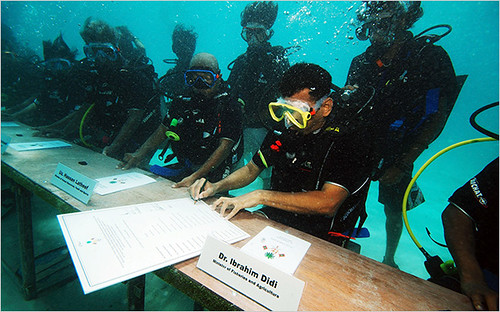
Photo - Agence France-Presse — Getty Images
Recently, the island nation of Maldives, affirmed its commitment to biochar as an important means of meeting the country's goal to be "Zero Carbon" by 2020. Now they are meeting underwater to highlight the desperate challenge that this climate change frontline state is facing.
via NY Times
Maldives Government Dives for Climate Change
GIRIFUSHI, Maldives (AP) -- Members of the Maldives' Cabinet donned scuba gear and used hand signals Saturday at an underwater meeting staged to highlight the threat of global warming to the lowest-lying nation on earth.
President Mohammed Nasheed and 13 other government officials submerged and took their seats at a table on the sea floor -- 20 feet (6 meters) below the surface of a lagoon off Girifushi, an island usually used for military training.
With a backdrop of coral, the meeting was a bid to draw attention to fears that rising sea levels caused by the melting of polar ice caps could swamp this Indian Ocean archipelago within a century. Its islands average 7 feet (2.1 meters) above sea level.
''What we are trying to make people realize is that the Maldives is a frontline state. This is not merely an issue for the Maldives but for the world,'' Nasheed said.
As bubbles floated up from their face masks, the president, vice president, Cabinet secretary and 11 ministers signed a document calling on all countries to cut their carbon dioxide emissions.
The issue has taken on urgency ahead of a major U.N. climate change conference scheduled for December in Copenhagen. At that meeting countries will negotiate a successor to the Kyoto Protocol with aims to cut the emission of greenhouse gases such as carbon dioxide that scientists blame for causing global warming by trapping heat in the atmosphere.
Wealthy nations want broad emissions cuts from all countries, while poorer ones say industrialized countries should carry most of the burden.
Dozens of Maldives soldiers guarded the event Saturday, but the only intruders were groupers and other fish.
Nasheed had already announced plans for a fund to buy a new homeland for his people if the 1,192 low-lying coral islands are submerged. He has promised to make the Maldives, with a population of 350,000, the world's first carbon-neutral nation within a decade.
''We have to get the message across by being more imaginative, more creative and so this is what we are doing,'' he said in an interview on a boat en route to the dive site.
Nasheed, who has emerged as a key, and colorful, voice on climate change, is a certified diver, but the others had to take diving lessons in recent weeks.
Three ministers missed the underwater meeting because two were not given medical permission and another was abroad.
Photo - Agence France-Presse — Getty Images
Recently, the island nation of Maldives, affirmed its commitment to biochar as an important means of meeting the country's goal to be "Zero Carbon" by 2020. Now they are meeting underwater to highlight the desperate challenge that this climate change frontline state is facing.
via NY Times
Maldives Government Dives for Climate Change
GIRIFUSHI, Maldives (AP) -- Members of the Maldives' Cabinet donned scuba gear and used hand signals Saturday at an underwater meeting staged to highlight the threat of global warming to the lowest-lying nation on earth.
President Mohammed Nasheed and 13 other government officials submerged and took their seats at a table on the sea floor -- 20 feet (6 meters) below the surface of a lagoon off Girifushi, an island usually used for military training.
With a backdrop of coral, the meeting was a bid to draw attention to fears that rising sea levels caused by the melting of polar ice caps could swamp this Indian Ocean archipelago within a century. Its islands average 7 feet (2.1 meters) above sea level.
''What we are trying to make people realize is that the Maldives is a frontline state. This is not merely an issue for the Maldives but for the world,'' Nasheed said.
As bubbles floated up from their face masks, the president, vice president, Cabinet secretary and 11 ministers signed a document calling on all countries to cut their carbon dioxide emissions.
The issue has taken on urgency ahead of a major U.N. climate change conference scheduled for December in Copenhagen. At that meeting countries will negotiate a successor to the Kyoto Protocol with aims to cut the emission of greenhouse gases such as carbon dioxide that scientists blame for causing global warming by trapping heat in the atmosphere.
Wealthy nations want broad emissions cuts from all countries, while poorer ones say industrialized countries should carry most of the burden.
Dozens of Maldives soldiers guarded the event Saturday, but the only intruders were groupers and other fish.
Nasheed had already announced plans for a fund to buy a new homeland for his people if the 1,192 low-lying coral islands are submerged. He has promised to make the Maldives, with a population of 350,000, the world's first carbon-neutral nation within a decade.
''We have to get the message across by being more imaginative, more creative and so this is what we are doing,'' he said in an interview on a boat en route to the dive site.
Nasheed, who has emerged as a key, and colorful, voice on climate change, is a certified diver, but the others had to take diving lessons in recent weeks.
Three ministers missed the underwater meeting because two were not given medical permission and another was abroad.
Friday, October 16, 2009
AN ORDINARY ISRAEL
 [Once again, I find myself in deep agreement with Roger Cohen. As the 21st Century squeezes all of us more and more together, clinging to the formulas of past pains no longer serve us well. The modern challenge is that, as everything becomes global, long standing prejudices and presumptions of specialness and separateness must yield to here-and-now questions of justice and equity, and of living together in peace. ]
via NY Times
An Ordinary Israel
By ROGER COHEN
NEW YORK — Is Israel just a nation among nations? On one level, it is indeed an ordinary place. People curse the traffic, follow their stocks, Blackberry, go to the beach and pay their mortgages. Stroll around in the prosperous North Tel Aviv suburbs and you find yourself California dreaming.
On another, it’s not. More than 60 years after the creation of the modern state, Israel has no established borders, no constitution, no peace. Born from exceptional horror, the Holocaust, it has found normality elusive.
The anxiety of the diaspora Jews has ceded not to tranquility but to another anxiety. The escape from walls has birthed new walls. The annihilation psychosis has not disappeared but taken new form.
For all Israel’s successes — it is the most open, creative and dynamic society in the region — this is a gnawing failure. Can anything be done about it?
Perhaps a good place to start that inquiry is by noting that Israel does not see itself as normal. Rather it lives in a perpetual state of exceptionalism.
I understand this: Israel is a small country whose neighbors are enemies or cold bystanders. But I worry when Israel makes a fetish of its exceptional status. It needs to deal with the world as it is, however discomfiting, not the world of yesterday.
The Holocaust represented a quintessence of evil. But it happened 65 years ago. Its perpetrators are dead or dying. A Holocaust prism may be distorting. History illuminates — and blinds.
These reflections stirred on reviewing Prime Minister Benjamin Netanyahu’s speech to the U.N. last month. The first 30 paragraphs were devoted to an inflammatory conflation of Nazi Germany (the word “Nazi” appears five times), modern Iran, Al Qaeda (a Sunni ideology foreign to Shiite Iran) and global terrorism, with lonely and exceptional Israel standing up against them all.
Here’s Netanyahu’s summary of the struggle of our age: “It pits civilization against barbarism, the 21st century against the 9th century, those who sanctify life against those who glorify death.”
That’s facile, resonant — and unhelpful. Sure, it’s an outlook that Iranian President Mahmoud Ahmadinejad’s unacceptable Holocaust denial and threats comfort. (Several Iranian leaders have also spoken of accepting any deal on Israel that the Palestinians agree to.)
There’s another way of looking at the ongoing struggle in the Middle East — less dramatic and more accurate.
That is to see it as a fight for a different balance of power — and possibly greater stability — between a nuclear-armed Israel (an estimated 80 to 200 never-acknowledged weapons), a proud but uneasy Iran and an increasingly sophisticated and aware (if repressed) Arab world.
Some of Israel’s enemies contest its very existence, however powerless they are to end it. But the death-cult terrorists-versus-reasonable-Israelis paradigm falls short. There are various civilizations in the Middle East, whose attitudes toward religion and modernism vary, but who all quest for some accommodation between them.
One casualty of this view, of course, is Israeli exceptionalism. The Jewish state becomes more like any other nation fighting for influence and treasure. I think President Obama, himself talking down American exceptionalism, is trying to nudge Israel toward a more prosaic, realistic self-image.
Hence the U.S. abstention last month at a U.N. nuclear assembly vote calling on all states in the Middle East to “accede to the Treaty on the Non-Proliferation of Nuclear weapons” (N.P.T.) and create a nuclear-weapon-free Middle East — an idea Obama administration officials have supported in line with a nuclear disarmament agenda.
A shift is perceptible in the decades-old tacit American endorsement of Israel’s undeclared nuclear arsenal. This is logical. To deal effectively with the nuclear program of Iran, an N.P.T. member, while ignoring the nuclear status of non-N.P.T. Israel is to invite accusations of double standards. President Obama doesn’t like them.
I’d say there’s a tenable case for Israel ending its nuclear exceptionalism, coming clean on its arsenal and joining the N.P.T. as part of any U.S.-endorsed regional security arrangement that stops Iran short of weaponization.
It’s also worth noting the sensible tone of Defense Secretary Robert Gates — in flagrant contrast to Netanyahu. “The only way you end up not having a nuclear capable Iran is for the Iranian government to decide that their security is diminished by having those weapons as opposed to strengthened,” Gates says.
In other words, as I’ve long argued, Iran makes rational decisions. Rather than invoking the Holocaust — a distraction — Israel should view Iran coolly, understand the hesitancy of Tehran’s nuclear brinksmanship, and see how it can gain from U.S.-led diplomacy.
Cut the posturing and deal with reality. This can be painful — as with Justice Richard Goldstone’s recent U.N. report finding that both Israeli forces and Palestinian militants committed possible crimes against humanity during Israel’s military operations in Gaza.
But it’s also instructive. Goldstone is a measured man — I’ve known him a long time. The Israeli response to his findings strikes me as an example of the blinding effect of exceptionalism unbound. Ordinary nations have failings.
The Middle East has changed. So must Israel. “Never again” is a necessary but altogether inadequate way of dealing with the modern world.
[Once again, I find myself in deep agreement with Roger Cohen. As the 21st Century squeezes all of us more and more together, clinging to the formulas of past pains no longer serve us well. The modern challenge is that, as everything becomes global, long standing prejudices and presumptions of specialness and separateness must yield to here-and-now questions of justice and equity, and of living together in peace. ]via NY Times
An Ordinary Israel
By ROGER COHEN
NEW YORK — Is Israel just a nation among nations? On one level, it is indeed an ordinary place. People curse the traffic, follow their stocks, Blackberry, go to the beach and pay their mortgages. Stroll around in the prosperous North Tel Aviv suburbs and you find yourself California dreaming.
On another, it’s not. More than 60 years after the creation of the modern state, Israel has no established borders, no constitution, no peace. Born from exceptional horror, the Holocaust, it has found normality elusive.
The anxiety of the diaspora Jews has ceded not to tranquility but to another anxiety. The escape from walls has birthed new walls. The annihilation psychosis has not disappeared but taken new form.
For all Israel’s successes — it is the most open, creative and dynamic society in the region — this is a gnawing failure. Can anything be done about it?
Perhaps a good place to start that inquiry is by noting that Israel does not see itself as normal. Rather it lives in a perpetual state of exceptionalism.
I understand this: Israel is a small country whose neighbors are enemies or cold bystanders. But I worry when Israel makes a fetish of its exceptional status. It needs to deal with the world as it is, however discomfiting, not the world of yesterday.
The Holocaust represented a quintessence of evil. But it happened 65 years ago. Its perpetrators are dead or dying. A Holocaust prism may be distorting. History illuminates — and blinds.
These reflections stirred on reviewing Prime Minister Benjamin Netanyahu’s speech to the U.N. last month. The first 30 paragraphs were devoted to an inflammatory conflation of Nazi Germany (the word “Nazi” appears five times), modern Iran, Al Qaeda (a Sunni ideology foreign to Shiite Iran) and global terrorism, with lonely and exceptional Israel standing up against them all.
Here’s Netanyahu’s summary of the struggle of our age: “It pits civilization against barbarism, the 21st century against the 9th century, those who sanctify life against those who glorify death.”
That’s facile, resonant — and unhelpful. Sure, it’s an outlook that Iranian President Mahmoud Ahmadinejad’s unacceptable Holocaust denial and threats comfort. (Several Iranian leaders have also spoken of accepting any deal on Israel that the Palestinians agree to.)
There’s another way of looking at the ongoing struggle in the Middle East — less dramatic and more accurate.
That is to see it as a fight for a different balance of power — and possibly greater stability — between a nuclear-armed Israel (an estimated 80 to 200 never-acknowledged weapons), a proud but uneasy Iran and an increasingly sophisticated and aware (if repressed) Arab world.
Some of Israel’s enemies contest its very existence, however powerless they are to end it. But the death-cult terrorists-versus-reasonable-Israelis paradigm falls short. There are various civilizations in the Middle East, whose attitudes toward religion and modernism vary, but who all quest for some accommodation between them.
One casualty of this view, of course, is Israeli exceptionalism. The Jewish state becomes more like any other nation fighting for influence and treasure. I think President Obama, himself talking down American exceptionalism, is trying to nudge Israel toward a more prosaic, realistic self-image.
Hence the U.S. abstention last month at a U.N. nuclear assembly vote calling on all states in the Middle East to “accede to the Treaty on the Non-Proliferation of Nuclear weapons” (N.P.T.) and create a nuclear-weapon-free Middle East — an idea Obama administration officials have supported in line with a nuclear disarmament agenda.
A shift is perceptible in the decades-old tacit American endorsement of Israel’s undeclared nuclear arsenal. This is logical. To deal effectively with the nuclear program of Iran, an N.P.T. member, while ignoring the nuclear status of non-N.P.T. Israel is to invite accusations of double standards. President Obama doesn’t like them.
I’d say there’s a tenable case for Israel ending its nuclear exceptionalism, coming clean on its arsenal and joining the N.P.T. as part of any U.S.-endorsed regional security arrangement that stops Iran short of weaponization.
It’s also worth noting the sensible tone of Defense Secretary Robert Gates — in flagrant contrast to Netanyahu. “The only way you end up not having a nuclear capable Iran is for the Iranian government to decide that their security is diminished by having those weapons as opposed to strengthened,” Gates says.
In other words, as I’ve long argued, Iran makes rational decisions. Rather than invoking the Holocaust — a distraction — Israel should view Iran coolly, understand the hesitancy of Tehran’s nuclear brinksmanship, and see how it can gain from U.S.-led diplomacy.
Cut the posturing and deal with reality. This can be painful — as with Justice Richard Goldstone’s recent U.N. report finding that both Israeli forces and Palestinian militants committed possible crimes against humanity during Israel’s military operations in Gaza.
But it’s also instructive. Goldstone is a measured man — I’ve known him a long time. The Israeli response to his findings strikes me as an example of the blinding effect of exceptionalism unbound. Ordinary nations have failings.
The Middle East has changed. So must Israel. “Never again” is a necessary but altogether inadequate way of dealing with the modern world.
Wednesday, October 14, 2009
SANTO DAIME CHALLENGED IN THE US
Despite expectations that the US Department of Justice might be more enlightened under Obama than it was under Bush, and despite a series of court challenges where the Santo Daime has been found in every instance to be an authentic religion deserving the full rights of religious freedom, and despite countless studies demonstrating the religious and therapeutic properties of the church's sacramental tea, the government continues to view it as a drug and has announced its intention to appeal the court victory that recently set Santo Daime free in Oregon.
The US Santo Daime lawyer Roy Haber will be meeting with officials in the Department of Justice in Washington D.C on Thursday October 15, 2009 to discuss the government's ill-advised intention to appeal the recent judicial ruling that declared Santo Daime as a free and fully legal religion in Oregon.
Jonathan Goldman who leads the Santo Daime church in Ashland, Oregon has sent out an alert saying:
"I am asking all brothers and sisters in the whole world to focus your prayer during the hour of 1 to 2 PM EST on Thursday. ... However you feel to join us - from your church, home, your work, your forest, your mountain top - I am positive that all of our prayers will be woven together by our guides and delivered to that conference room in Washington."
TV Interview with Jonathan Goldman
Jonathan also has a podcast with an in-depth discussion of Santo Daime's legal struggle in the US.
There's an excellent collection of documents here.
US District Judge Owen Panner's full ruling is at GREAT NEWS: Santo Daime is free.)
Despite expectations that the US Department of Justice might be more enlightened under Obama than it was under Bush, and despite a series of court challenges where the Santo Daime has been found in every instance to be an authentic religion deserving the full rights of religious freedom, and despite countless studies demonstrating the religious and therapeutic properties of the church's sacramental tea, the government continues to view it as a drug and has announced its intention to appeal the court victory that recently set Santo Daime free in Oregon.
The US Santo Daime lawyer Roy Haber will be meeting with officials in the Department of Justice in Washington D.C on Thursday October 15, 2009 to discuss the government's ill-advised intention to appeal the recent judicial ruling that declared Santo Daime as a free and fully legal religion in Oregon.
Jonathan Goldman who leads the Santo Daime church in Ashland, Oregon has sent out an alert saying:
"I am asking all brothers and sisters in the whole world to focus your prayer during the hour of 1 to 2 PM EST on Thursday. ... However you feel to join us - from your church, home, your work, your forest, your mountain top - I am positive that all of our prayers will be woven together by our guides and delivered to that conference room in Washington."
TV Interview with Jonathan Goldman
Jonathan also has a podcast with an in-depth discussion of Santo Daime's legal struggle in the US.
There's an excellent collection of documents here.
US District Judge Owen Panner's full ruling is at GREAT NEWS: Santo Daime is free.)
BEAUTY AND KNOWLEDGE
"BELEZA E SABER: plummária indígena" -- BEAUTY AND KNOWLEDGE: indigenous plumage -- is a wonderful exhibit of Brazilian Indian regalia currently showing in São Paulo. I was really challenged as a photographer because of all of the reflections and lights of the city setting. The result was what Brazilians call a mistura, in this case producing what might be called a Paulista Plumage. I hope you like the result.
"BELEZA E SABER: plummária indígena" -- BEAUTY AND KNOWLEDGE: indigenous plumage -- is a wonderful exhibit of Brazilian Indian regalia currently showing in São Paulo. I was really challenged as a photographer because of all of the reflections and lights of the city setting. The result was what Brazilians call a mistura, in this case producing what might be called a Paulista Plumage. I hope you like the result.
Friday, October 09, 2009
PARABÉNS
That's the way we say "CONGRATULATIONS" in Brazil. The ovations and praises are for Petra Costa and her colleagues who have given us a tender tale of love nurtured and seasoned across more than 60 years by Gabriel and Vera. OLHOS DE RESSACA (Undertow Eyes) has won the "Best Short Film" award in Rio's Film Festival.
Directed by Petra Costa, Ava Rocha Montage, Eryk Rocha Photography, and Edson Secco Audio Design
Vera and Gabriel have been married for sixty years. In "Undertow Eyes" they wander about their own history: the first flirtations, the birth of children, life and aging. In this recollection, archival footage of family mingle with images of the present, weaving an emotional and dreamlike universe that is both delicate and delicious.
20 minutes of viewing left me more than satisfied. It filled my heart with a warm glow. Watch for it as it makes its way to the States and Abroad.
That's the way we say "CONGRATULATIONS" in Brazil. The ovations and praises are for Petra Costa and her colleagues who have given us a tender tale of love nurtured and seasoned across more than 60 years by Gabriel and Vera. OLHOS DE RESSACA (Undertow Eyes) has won the "Best Short Film" award in Rio's Film Festival.
Directed by Petra Costa, Ava Rocha Montage, Eryk Rocha Photography, and Edson Secco Audio Design
Vera and Gabriel have been married for sixty years. In "Undertow Eyes" they wander about their own history: the first flirtations, the birth of children, life and aging. In this recollection, archival footage of family mingle with images of the present, weaving an emotional and dreamlike universe that is both delicate and delicious.
20 minutes of viewing left me more than satisfied. It filled my heart with a warm glow. Watch for it as it makes its way to the States and Abroad.
Subscribe to:
Posts (Atom)


