SANTO DAIME FESTIVAL IN BRASILIA: Connecting the City and the Forest
Brazil's national capital, Brasilia, is located in the great cerrado grassland of the central plateau or high plane (planalto) which is an ecological interior zone between the mountains of southeastern Brazil and the Amazon basin forest. As in Brazil in general, its capital is where many cultural and spiritual traditions meet and mix.
In the ceremonies of Santo Daime one can feel as if in a celestial bus station with lines to many cultures and places. Africa, Europe, Amazônia, forge new mixtures of the Old and the New. In this personal interior zone, the rituals of Santo Daime offer a profound celebration of the universality of Spirit -- many paths and many people.
Last week in Brasilia a Santo Daime festival of spiritual works began by celebrating the birthday of Céu do Planalto and inauguration of its new church with the singing of Padrinho Alfredo's, "O Cruzeirinho". In two subsequent seesions the festival continued with the singing of Padrinho Fernando's hinario, "Na Força do Padrinho Sebastião" and Padrinho Alfredo's hinario, "Nova Era" at Céu do Planalto and then ending at Divina Luz with Madrinha Conceição's hinario, "Forças Verdadeiras" and selections from Padrinho Sebastião's hinario, "Nova Jerusalém".
Truly, it seemed as if the Orixás from Africa, Caboclos from Amazônia, Christian Celestial Beings and the expanding family of Juramidam were journeying together in a great celebration.
Here are some of the videos...
Hymns from Padrinho Fernando's Na Força do Padrinho Sebastião sung at Ceu do Planato:
Hymns from Padrinho Alfredo's Nova Era sung at Ceu do Planalto:
Hymns from Madrinha Conceição's Forças Verdadeiras sung at Divina Luz:
Hymns from Padrinho Sebastião's Nova Jerusalém sung at Divina Luz:
I have posted many more videos from this festival (and others) at youtube. Click here to view them.

Saturday, April 25, 2009


Friday, April 24, 2009
AND THE PURSUIT OF HAPPINESS
And the Pursuit of Happiness is a wonderfully playful blog on the New York Times site. It combines beautiful illustrations with quirky insight to discuss the many facets of American Democracy. From wondering whether Abraham Lincoln would enjoy Frida Kahlo to the subtle change in the Constitution from “the pursuit of property” to “the pursuit of happiness”.
Very americano and delightful too!
THE TRUTH WILL SET US FREE -- I HOPE!
Some of the most no-nonsense probing and pointed commentary is being provided by one of the world's leading bloggers -- Andrew Sullivan.
Some of the most no-nonsense probing and pointed commentary is being provided by one of the world's leading bloggers -- Andrew Sullivan.
Cliff May: We Have To Torture Muslims: I guess the jaw can drop some more.
The Right vs Left Canard: The mainstream media are too cowardly to report the truth.
The Right Vs The Geneva Conventions: Unless we prosecute, America and torture will become synonymous.
Churchill vs Cheney: Torture is the weapon of cowards and bullies and monsters.
The Torture And The Iraq War: Cheney used the former to obtain the latter.
Thursday, April 23, 2009
HANDS OF LOVE
As long as you are kind and there is love in your heart / A thousand hands will naturally come to your aid / As long as you are kind and there is love in your heart / You will reach out with a thousand hands to help others
.Guan Yin is the bodhisattva of compassion, revered by Buddhists as the Goddess of Mercy. Her name is short for Guan Shi Yin. Guan means to observe, watch, or monitor; Shi means the world; Yin means sounds, specifically sounds of those who suffer. Thus, Guan Yin is a compassionate being who watches for, and responds to, the people in the world who cry out for help.
ceudoplanalto26@daime.brasilia
The Santo Daime community of Ceu do Planalto has a new church and a marvelous festival has begun in Brasilia. It began on 21 April with the singing of the O Cruzeirinho hymns of Padrinho Alfredo.
Here's are some pics...
And a few videos...
VIVA SANTO DAIME!
VIVA PADRINHO ALFREDO!
VIVA CEU DO PLANALTO!
VIVA PADRINHO FERNANDO!
VIVA MADRINHA CLARICE!
PARABÉNS PARA TODOS!
Wednesday, April 22, 2009
NEWSWEEK LOVES LULA
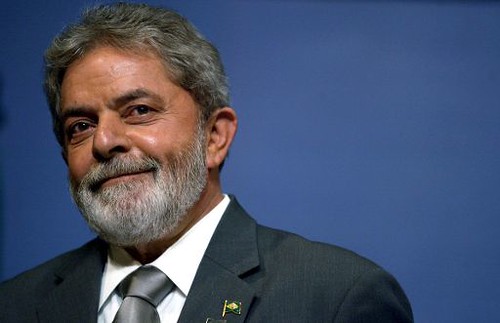
Lula's secret seems to be making cordiality rather than conflict and welcome rather than war.
The Crafty Superpower
By turns charming and cagey, cool to America and close to Obama, Lula is building a unique regional giant.
Mac Margolis
NEWSWEEK
From the magazine issue dated Apr 27, 2009
Go to Orginal
Brazilian President Luiz Inácio Lula da Silva is on a roll. In recent weeks he's shared a dais with Gordon Brown and Nicolas Sarkozy, and drew effusive praise ("My man!") from Barack Obama at the G20 summit in London. He even had a photo op with Queen Elizabeth II. The former machine-tool worker, who spent decades picketing "savage capitalism," is now the toast of bankers and boardrooms. "Don't you think it's chic that we are now lending the IMF money?" he joked at a press conference.
Not so long ago, such scenes would have been improbable. With Brazil's tender democracy, clawing poverty and an accident-prone economy, the country's leaders were more likely to be queuing for a bailout than standing toe-to-toe with rainmakers on the international stage. After decades of false steps, Brazil has become a solid free-market democracy, a rare island of stability in a region of turmoil and governed by the rule of law instead of the whims of autocrats. Now Brazil is asserting itself as never before, but in a way that is markedly different from other big global players. Over the past decade, Brazil has emerged as a unique regional powerhouse. Relying on the cover of America's security umbrella, and a hemisphere with no credible enemies, Brazil has been free to leverage its vast economic size advantage within South America to befriend, sway or co-opt neighbors, while managing to contain its most troublesome regional rival, Venezuela. Lula presides over a crafty superpower unlike any other emerging giant.
The Chinese police the Taiwan Strait, and Moscow never relinquished the Soviet sphere of influence in the Caucasus. India's security duties stretch from the Pakistani border to the Persian Gulf, and Washington casts a long shadow from pole to pole. Yet Brazil has asserted its international ambitions without rattling a saber. When tempers flare between neighbors—as when Ecuador and Peru nearly went to war in the 1990s, and after Colombia bombed guerrilla camps in the Ecuadoran jungle last year—diplomats and lawyers are dispatched to the hot zones rather than flotillas or tanks. And when U.N. peacekeepers clashed with street gangs in Haiti, the Brazilians called not for a troop surge, but for footballers Ronaldinho, Robinho and Ronaldo, who played a friendly in the war zone. Now Haitian youths do battle with cleats, not Kalashnikovs.
The Brazilians have also become a more assertive voice for the emerging markets in international affairs. They rallied the major developing nations to challenge the rich world's agricultural subsidies, forming a group now known as the G5. At Brasília's prodding, the ambassadors of Brazil, China, India and Russia now meet monthly in Washington to coordinate a common BRIC policy strategy, often to counter U.S. positions. Pushing its "south-south" agenda, the Lula government has opened 35 embassies since taking office in 2003, most of them in Africa and the Caribbean. Brazil also leads a widely acclaimed peacekeeping mission in Haiti, one of the hemisphere's biggest basket cases.
Brazil can do all this in large part because it has no credible state enemies with which to contend, and is therefore unshackled from many of the responsibilities of power, like patrolling sea lanes. Moreover, the United States has always been the peacemaker of last resort in the region, so while emerging nations in many global trouble zones must pump precious wealth into defense, Brazil's military expenditures have remained stagnant at about 1.5 percent of GDP, a quarter of China's defense spending and about 60 percent of India's and Russia's. "Brazil doesn't have the ambition to be a military power," says Amaury de Souza, a Brazilian political analyst. "What we have is economic strength, a history of defending our interests and a complex and compelling culture."
For years, Brazilians have wanted a larger role in world affairs, and the world has refused. Despite its war efforts—Brazil was the only Latin country to send troops to Europe during World War II—it had no seat at the postwar negotiating table. Brazil's international standing finally won an upgrade in the mid-1990s, when the reform-minded administration of Fernando Henrique Cardoso stopped inflation, opened the country to trade and normalized tattered relations with the world financial community. Cardoso parlayed the young democracy's new bona fides into a more assertive role abroad. He argued for a seat on the U.N. Security Council, jump-started the Mercosur free-trade zone for South America and rallied the larger developing nations under the banner of free trade.
But no government has been as determined as Lula's in extending Brazil's international footprint. Though he began his political career on the left, Lula surprised foreign and national investors alike by preserving Cardoso's market-friendly policies at home, much to the frustration of his militant Workers' Party allies. For the left, he offered a pumped-up foreign policy. "Lula put Cardoso's foreign policy on steroids," says Donna Hrinak, a former U.S. ambassador to a number of Latin countries.
Lula has doubled the number of departments in the Foreign Ministry and embarked on a breathless international itinerary, visiting 45 countries and spending nearly one of every five months in office abroad just since 2007. "Aero-Lula," the local press has dubbed him. The explicit purpose of all this diplomacy has been to boost relations with other developing countries. But Lula's increased visibility has also helped force the richest nations to lower trade barriers. In two major cases in 2004, the WTO ruled in favor of Brazil, ordering the U.S. to drop subsidies to cotton farmers, and told Europe to end its protection of the sugar-beet industry. In keeping with Lula's staunch support for free trade, Brazil also sided with the U.S. at the recent Doha trade talks over the developing world's own protectionist barriers. In a recent report warning of rising protectionism in developing nations, the World Bank praised Brazilians for resisting pressures to close down its own borders.
At least part of these efforts spring from Brazil's undeclared strategy to blunt U.S. influence in the region and dispel expectations that it play a proxy role for Washington. In fact, while U.S. officials wax diplomatic over their new "global partner," Brasília has been mostly silent as Venezuelan strongman Hugo Chávez threatens foreign companies, intimidates the opposition and bullies its courts and Congress. "No one can claim that democracy doesn't exist in Venezuela" is Lula's canned defense of companheiro Chávez. Citing the catchall rule of sovereignty, Brazil also roundly condemned Colombia, the U.S.'s closest ally in the region, for attacking a guerrilla encampment in the Ecuadoran jungle last year, and routinely abstains on U.N. resolutions condemning human-rights violations in Cuba.
But Lula has hardly thrown in with the Bolivarian revolution. Instead, he has controlled the region by co-opting his neighbors with trade, turning the whole continent into a captive market for Brazilian goods. Ultimately, Brazil's power derives not from guns but from its immense store of natural resources, including oil and gas, metals, soybeans and beef—and it has become a key supplier of markets in Asia and closer to home. Brazil now enjoys a trade surplus with every country in the region, including a $1 billion surplus with Venezuela. "Turning natural resources into value-added goods has helped Brazil punch above its weight," says David Rothkopf, a former U.S. Commerce Department official.
For instance, Lula has curbed two grandiose initiatives from Chávez's playbook, a regional development bank (Banco del Sur) and a joint Brazilian-Venezuelan oil refinery, by quietly never getting around to allocating money to help. He also chided Chávez for his lavish spending on modern weapons even though Venezuela's economy is so weak it has become utterly dependent on Brazil for basic consumer goods. "Christ, what do you want these weapons for?" Lula reportedly berated Chávez in a recent visit. "You can't even get milk for your coffee in the hotels." Brazil's Congress will probably end up approving Venezuela's entry into Mercosur in the coming weeks, not as an endorsement of Chávez's imperial designs but as a way to contain him through the trading bloc's treaty obligations, such as respect for democracy and property protection.
This might be risky politics. But the smart money is on the Brazilians. With no manual for becoming a global power, Lula's Brazil seems to be writing one of its own.
EARTH DAY - 2009
I gotta admit that I'm pretty tired of listening to all the annual green-spins of Earth Day. The harsh fact is that the legacy of past industrial output is still flowing into the present atmosphere and the emissions are still rising.

The graph shows recent monthly mean carbon dioxide measured at the Mauna Loa Observatory, Hawaii (recent months are preliminary data).
The National Oceanic and Atmospheric Administration is reporting that the concentrations of carbon dioxide and methane, the two most important greenhouse gases released through human activities, rose in 2008.
Andrew Revkin has the full story at DOT EARTH.
Pieter Tans of the agency’s Earth System Research Laboratory in Boulder, Colo., said, "Think of the atmosphere and oceans taking in greenhouse gases as a bathtub filling with more water than the drain can empty, and the drain is very slow."
So, what's the solution -- the game-changer that will open the drain?
Readers of this blog know that I believe the paradigm-shifter will be terra preta's modern incarnation as biochar. If you don't know about biochar, here's an excellent summary article by Thomas Blakeslee.
I truly believe that -- as a result of the exigencies imposed by climate change -- the ancient wisdom of Terra Preta de Indio, translated into the modern processes of pyrolysis, will be the game-changer. The technological shift will be to transform the wastes and depletions of the Industrial Age into healing reciprocities and renewals of an emerging Anthropocene Age of human-and-nature sustainability.
But there must be a foundation story -- a cultural and spiritual narrative to guide the evolving consciousness toward healing the relationship between people and nature. Last year I posted a possible storyline and the icon that I believe may guide the transition.

Here's is a round-up of a broad range of materials posted at VISIONSHARE. Please consider terra preta and tell the story.
We have something glorious and precious to care for and enjoy.

I gotta admit that I'm pretty tired of listening to all the annual green-spins of Earth Day. The harsh fact is that the legacy of past industrial output is still flowing into the present atmosphere and the emissions are still rising.
The graph shows recent monthly mean carbon dioxide measured at the Mauna Loa Observatory, Hawaii (recent months are preliminary data).
The National Oceanic and Atmospheric Administration is reporting that the concentrations of carbon dioxide and methane, the two most important greenhouse gases released through human activities, rose in 2008.
Andrew Revkin has the full story at DOT EARTH.
Pieter Tans of the agency’s Earth System Research Laboratory in Boulder, Colo., said, "Think of the atmosphere and oceans taking in greenhouse gases as a bathtub filling with more water than the drain can empty, and the drain is very slow."
So, what's the solution -- the game-changer that will open the drain?
Readers of this blog know that I believe the paradigm-shifter will be terra preta's modern incarnation as biochar. If you don't know about biochar, here's an excellent summary article by Thomas Blakeslee.
I truly believe that -- as a result of the exigencies imposed by climate change -- the ancient wisdom of Terra Preta de Indio, translated into the modern processes of pyrolysis, will be the game-changer. The technological shift will be to transform the wastes and depletions of the Industrial Age into healing reciprocities and renewals of an emerging Anthropocene Age of human-and-nature sustainability.
But there must be a foundation story -- a cultural and spiritual narrative to guide the evolving consciousness toward healing the relationship between people and nature. Last year I posted a possible storyline and the icon that I believe may guide the transition.
Here's is a round-up of a broad range of materials posted at VISIONSHARE. Please consider terra preta and tell the story.
We have something glorious and precious to care for and enjoy.
Tuesday, April 21, 2009
HOW TO BEST PRESERVE FORESTS AND ADDRESS CLIMATE CHANGE?
Climate negotiators widely agree that, unlike in the Kyoto Protocol, incentives for forest preservation must be included in the new agreement. The reason is simple: healthy forests absorb carbon dioxide. Cutting and burning forests, however, contributes about 18 percent of annual human-caused greenhouse gas emissions - a larger share than all the world's vehicles combined.
Yet it remains unclear how REDD will be integrated into the final emissions-mitigating mechanism - or whether it will be included at all. Among tropical countries, leaders are falling into two camps. A coalition of nations led by Papua New Guinea and Costa Rica is calling for the inclusion of REDD in a global cap-and-trade system. Under such an approach, industrialized countries would finance REDD projects, mainly in developing countries, to compensate for their own emissions.
The opposition, led by Brazil, advocates that industrialized nations should instead support REDD with direct public funding, akin to international aid. Bolivian President Evo Morales wrote last year that he supports such an approach. Read Ben Block's full story at Worldchanging.
Mongabay reports that a business survey finds high levels of support for using carbon offsets for avoided deforestation projects.
PICTURES SPEAK LOUDER THAN WORDS
Daniel Beltrá, who has freelanced with Greenpeace since 1990, is the winner of The Prince’s Rainforests Project Award at this year’s Sony World Photography Gala Ceremony in Cannes.
Check out his galleries here
Daniel Beltrá, who has freelanced with Greenpeace since 1990, is the winner of The Prince’s Rainforests Project Award at this year’s Sony World Photography Gala Ceremony in Cannes.
Check out his galleries here
Sunday, April 19, 2009
THE MUSICAL DOCTRINE OF SANTO DAIME: "The hymns are currents."
Much has been written and posted on the Internet about the musical doctrine of the Santo Daime religion. The anthropologist Edward McCrae, building on the work of Fernando Couto, has developed the notion of Santo Daime as "collective shamanism", Jose Murilo has offered a penetrating analysis of this in the context of developing urban Santo Daime communities and I've posted previously on spread of the musical doctrine here and here.
A key to understanding the spiritual works of Santo Daime is to focus on how the hymns are employed in a ritual setting. But, try as we might, it remains very difficult to stuff such a profound spiritual process into words and concepts. The realization of and the transformative power of the Doctrine of Santo Daime is located in its full mind-and-body musical performance.
Let's begin with the making of the sacrament. The objective is to forge hard work into a collective ritual of harmony, strength and joy. Here is how the process works in the forest roots community of Vila Fortaleza in rural Acre, Brazil. The hymns are from the hinario of Germano Guilhereme. The ritual is a batação where the jugube vines are pounded into fibers for cooking with the leaves of rainha.
The mallets and music are governed by Saturnino's maracá and the goal is to align with its high level of discipline in order to integrate the energies of work, celebration and union into a tightly performed ritual. If you listen carefully to the whole thing, you can feel the struggle to get it right -- a true batalha espiritual that rises, falls and amplifies as it channels energy into the sacramental tea.
The next video comes from the 2009 New Horizon celebration where the Daime hymns of Mestre Conselheiro Luiz Mendes were performed in an all-night ritual of welcoming in the New Year.
A few nights later Senhor Tufi Rashid Amin, who maintains one of the Alto Santo centers in Rio Branco and is a great friend of the Luiz Mendes family, arrived with his full family to present his hymns -- called Sou Feliz (I Am Happy) -- with incredible gusto and joy in celebration of the 69th birthday of Padrinho Luiz Mendes.
I really can't add any words to this -- the meaning is inside the energy current of the performance -- but I do recall the words of a Native American spiritual leader I once knew in Oregon. At the start of a ritual he would say,
"No one here is a medicine person but the Creator has given each of us a little piece of His Medicine. If we put those pieces together well in ritual, we get as close to God as human beings can get."
That's what I think the Work is in the Doctrine of the Santo Daime. It's a process of putting our pieces back together and perfecting the individual and collective performance of being all that human beings might be. And, with the Master in front, there is always a New Horizon.
Saturday, April 18, 2009
THE WEIRD RIGHT
Been reading about tea parties? That's just a start. Now the weird right is conflating Earth Day (they call it radical environmentalism?) with The Gay and Lesbian "Day of Silence" which seeks to halt harrassment in the schools and educate kids toward tolerance.
Here's a video that I picked up at Andrew Sullivan's Daily Dish.
Like I said, "WEIRD!"
[Update 19 April: Frank Rich calls it The Bigots’ Last Hurrah and provides a good overview of the weirdness.]
Consumption, Not Population Is Our Main Environmental Threat

Another great photo by Peter Menzel. Check out his galleries.
Fred Pearce writes that
"It's overconsumption, not population growth, that is the fundamental problem: By almost any measure, a small portion of the world's people — those in the affluent, developed world — use up most of the Earth's resources and produce most of its greenhouse gas emissions."
Go to original article
13 Apr 2009: Yale Environment 360
Consumption Dwarfs Population
As Main Environmental Threat
by Fred Pearce
It’s the great taboo, I hear many environmentalists say. Population growth is the driving force behind our wrecking of the planet, but we are afraid to discuss it.
It sounds like a no-brainer. More people must inevitably be bad for the environment, taking more resources and causing more pollution, driving the planet ever farther beyond its carrying capacity. But hold on. This is a terribly convenient argument — “over-consumers” in rich countries can blame “over-breeders” in distant lands for the state of the planet. But what are the facts?
The world’s population quadrupled to six billion people during the 20th century. It is still rising and may reach 9 billion by 2050. Yet for at least the past century, rising per-capita incomes have outstripped the rising head count several times over. And while incomes don’t translate precisely into increased resource use and pollution, the correlation is distressingly strong.
Moreover, most of the extra consumption has been in rich countries that have long since given up adding substantial numbers to their population.
By almost any measure, a small proportion of the world’s people take the majority of the world’s resources and produce the majority of its pollution. Take carbon dioxide emissions — a measure of our impact on climate but also a surrogate for fossil fuel consumption. Stephen Pacala, director of the Princeton Environment Institute, calculates that the world’s richest half-billion people — that’s about 7 percent of the global population — are responsible for 50 percent of the world’s carbon dioxide emissions. Meanwhile the poorest 50 percent are responsible for just 7 percent of emissions.
Although overconsumption has a profound effect on greenhouse gas emissions, the impacts of our high standard of living extend beyond turning up the temperature of the planet. For a wider perspective of humanity’s effects on the planet's life support systems, the best available measure is the “ecological footprint,” which estimates the area of land required to provide each of us with food, clothing, and other resources, as well as to soak up our pollution. This analysis has its methodological problems, but its comparisons between nations are firm enough to be useful.
They show that sustaining the lifestyle of the average American takes 9.5 hectares, while Australians and Canadians require 7.8 and 7.1 hectares respectively; Britons, 5.3 hectares; Germans, 4.2; and the Japanese, 4.9. The world average is 2.7 hectares. China is still below that figure at 2.1, while India and most of Africa (where the majority of future world population growth will take place) are at or below 1.0.
The United States always gets singled out. But for good reason: It is the world’s largest consumer. Americans take the greatest share of most of the world’s major commodities: corn, coffee, copper, lead, zinc, aluminum, rubber, oil seeds, oil, and natural gas. For many others, Americans are the largest per-capita consumers. In “super-size-me” land, Americans gobble up more than 120 kilograms of meat a year per person, compared to just 6 kilos in India, for instance.
I do not deny that fast-rising populations can create serious local environmental crises through overgrazing, destructive farming and fishing, and deforestation. My argument here is that viewed at the global scale, it is overconsumption that has been driving humanity’s impacts on the planet’s vital life-support systems during at least the past century. But what of the future?
We cannot be sure how the global economic downturn will play out. But let us assume that Jeffrey Sachs, in his book Common Wealth, is right to predict a 600 percent increase in global economic output by 2050. Most projections put world population then at no more than 40 percent above today’s level, so its contribution to future growth in economic activity will be small.
Of course, economic activity is not the same as ecological impact. So let’s go back to carbon dioxide emissions. Virtually all of the extra 2 billion or so people expected on this planet in the coming 40 years will be in the poor half of the world. They will raise the population of the poor world from approaching 3.5 billion to about 5.5 billion, making them the poor two-thirds.
Sounds nasty, but based on Pacala’s calculations — and if we assume for the purposes of the argument that per-capita emissions in every country stay roughly the same as today — those extra two billion people would raise the share of emissions contributed by the poor world from 7 percent to 11 percent.
Look at it another way. Just five countries are likely to produce most of the world’s population growth in the coming decades: India, China, Pakistan, Nigeria, and Ethiopia. The carbon emissions of one American today are equivalent to those of around four Chinese, 20 Indians, 30 Pakistanis, 40 Nigerians, or 250 Ethiopians.
Even if we could today achieve zero population growth, that would barely touch the climate problem — where we need to cut emissions by 50 to 80 percent by mid-century. Given existing income inequalities, it is inescapable that overconsumption by the rich few is the key problem, rather than overpopulation of the poor many.
But, you ask, what about future generations? All those big families in Africa begetting yet-bigger families. They may not consume much today, but they soon will.
Well, first let’s be clear about the scale of the difference involved. A woman in rural Ethiopia can have ten children and her family will still do less damage, and consume fewer resources, than the family of the average soccer mom in Minnesota or Munich. In the unlikely event that her ten children live to adulthood and have ten children of their own, the entire clan of more than a hundred will still be emitting less carbon dioxide than you or I.
And second, it won’t happen. Wherever most kids survive to adulthood, women stop having so many. That is the main reason why the number of children born to an average woman around the world has been in decline for half a century now. After peaking at between 5 and 6 per woman, it is now down to 2.6.
This is getting close to the “replacement fertility level” which, after allowing for a natural excess of boys born and women who don’t reach adulthood, is about 2.3. The UN expects global fertility to fall to 1.85 children per woman by mid-century. While a demographic “bulge” of women of child-bearing age keeps the world’s population rising for now, continuing declines in fertility will cause the world’s population to stabilize by mid-century and then probably to begin falling.
Far from ballooning, each generation will be smaller than the last. So the ecological footprint of future generations could diminish. That means we can have a shot at estimating the long-term impact of children from different countries down the generations.
The best analysis of this phenomenon I have seen is by Paul Murtaugh, a statistician at Oregon State University. He recently calculated the climatic "intergenerational legacy" of today’s children. He assumed current per-capita emissions and UN fertility projections. He found that an extra child in the United States today will, down the generations, produce an eventual carbon footprint seven times that of an extra Chinese child, 46 times that of a Pakistan child, 55 times that of an Indian child, and 86 times that of a Nigerian child.
Of course those assumptions may not pan out. I have some confidence in the population projections, but per-capita emissions of carbon dioxide will likely rise in poor countries for some time yet, even in optimistic scenarios. But that is an issue of consumption, not population.
In any event, it strikes me as the height of hubris to downgrade the culpability of the rich world’s environmental footprint because generations of poor people not yet born might one day get to be as rich and destructive as us. Overpopulation is not driving environmental destruction at the global level; overconsumption is. Every time we talk about too many babies in Africa or India, we are denying that simple fact.
At root this is an ethical issue. Back in 1974, the famous environmental scientist Garret Hardin proposed something he called “lifeboat ethics”. In the modern, resource-constrained world, he said, “each rich nation can be seen as a lifeboat full of comparatively rich people. In the ocean outside each lifeboat swim the poor of the world, who would like to get in.” But there were, he said, not enough places to go around. If any were let on board, there would be chaos and all would drown. The people in the lifeboat had a duty to their species to be selfish – to keep the poor out.
Hardin’s metaphor had a certain ruthless logic. What he omitted to mention was that each of the people in the lifeboat was occupying ten places, whereas the people in the water only wanted one each. I think that changes the argument somewhat.
* * * * *
Gary Peters strongly objects, "Nothing in human nature bodes well for cutting consumption levels in the short run — people want more, whether they need it or not, and billions on Earth really do need more."
Fred Pearce has done us no favors by downplaying population numbers and growth then pretending that only overconsumption by a small minority is the real force behind the growth in greenhouse gases and climate change.
As Paul Ehrlich and others have noted for decades, human impact on the environment is multiplicative. In his I = PAT equation he gave weightings to population, affluence, and technology as they impact the environment. From a climate change perspective we could rewrite this in different ways, but it would be moronic to leave population out of the equation.
Let's start with this rewrite. GGE = PCF That is greenhouse gas emissions (GGE) = population (P), per capita consumption (C), and energy produced from fossil fuels (F). We could diddle with this, but it contains the basics. Now let's consider Fred's notion that population doesn't matter, a view held by many economists among others, but a view held by no ecologist that I can name.
Greenhouse gas emissions are going to continue to grow so long as any one of these three variables continue to grow, P, C, or F. P continues to grow at about 80 million per year and has increased from 1.6 billion in 1900 to 6.8 billion today. C continues to grow virtually everywhere where that is possible because few if any people anywhere are "satisfied" with their current levels of consumption. Barring disaster, then, C will continue to grow as well. With both P and C growing, reductions in GGE will have to come from sharp reductions in F, fossil fuel usage.
That may happen, but not soon enough to keep the Earth's atmosphere from having a CO2 level in perhaps the 500-600 ppm range (or more), up from close to 390 ppm today and perhaps twice the 270 ppm that prevailed at the beginning of the industrial era.
Because their supplies are finite, fossil fuels sooner or later will face declining production, probably with concomitant rising prices, and GGE will finally level off, then drop.
Is that enough? Not if the vast majority of climatologists, including those at the IPCC, are right, or even close. Because much of the increase in productivity that has allowed rapid population and consumption growth to occur over the last century has come directly from our discovery and use of fossil fuels, we should expect productivity declines to set in as fossil fuels become scarcer unless we can truly replace them at a sufficient scale, which right now looks unlikely.
Nothing in human nature bodes well for cutting consumption levels in the short run — people want more, whether they need it or not, and billions on Earth really do need more. However, as the EROEI for fossil fuels, first for oil and natural gas, then for coal, falls, the likelihood of production decreases will rise. At that point, with ever more people, we will start to see declines in the standard of living. By then, cutting people may no longer be an option, so population declines will set in, mainly in poor countries.
Would it not be much easier to start now to curtail future population growth, so that if production declines do set in we could decrease consumption growth and not cut population numbers? As Kenneth Boulding observed several decades ago, "Anyone who believes that exponential growth can go on forever in a finite world is either a madman or an economist." We cannnot pretend that population growth is not part of the problem, though I would be happy to admit that the additional 3 million plus added to the U.S. population each year is more problematic for the environment than 3 million additional people in Bangladesh or Sub-Saharan Africa, but that is not the whole point, Fred. More people are going to provide more environmental stress, no matter where they are born or where they subsequently move to.
(Comment posted by Gary Peters on 17 Apr 2009)
Go to original article for more discussion
And Andrew Revkin's Dot.Earth exploration of The Endless Pursuit of Unnecessary Things is a must read.
My personal strongly-held non-scientific speculation is that, while it is absolutely true that both population and consumption are problematic, it is consumption that drives destruction. As development and improved quality of life delivers the impoverished from wretchedly oppressive conditions, it also increases the cumulative ecological footprint. The riddle of combining sustainability and social justice has yet to be solved. This is THE work of the 21st Century.
Friday, April 17, 2009
HEADS UP

The ostrich is taking its head out of the sand.
E.P.A. to Clear the Way for Regulation of Warming Gases
The denial days of the Bush Administration are ending. FINALLY, the US is preparing to confront the reality of green house gases. This begins a long process which will undoubtedly include much controversy and many pitfalls but, as with Iran and Cuba and Immigration and Family Planning Assistance and Torture Memos and more, the Obama Administration is opening the door to change.
How welcome it is to receive some whiffs of fresh air into the stuffy old white-no-longer-house!
Here's more about the EPA decision from Bloomberg
THE GREAT BIOCHAR DEBATE (con't)
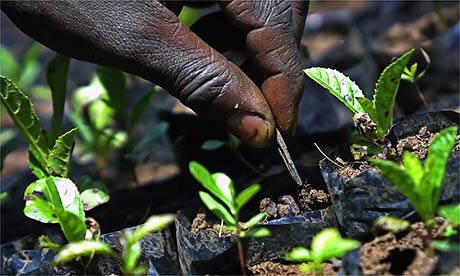
Peter Read says, The emissions reductions gospel is failing – we need something more. NGOs who oppose geo-engineering are running the risk of climatic catastrophe.
by Peter Read in the Guardian.UK
Go to Original Article
[Note: My thoughts (submitted as a comment) are:
Peter,
I agree that tree plantations for charcoal feedstock is an excellent idea with one IMPORTANT caveat — there must be a firm incontrovertible rule against cutting natural forests for feedstock and/or triggering land use changes that result in increased deforestation. If this is not done, the sequestration gains of biochar will be negated by losses in the natural forest carbon sink.
Geo-engineering is a scary term because because it often focuses on single variable in reductionist and non-holistic ways. This might be corrected if the the grand schemers were to demonstrate how they are going to preserve natural ecosystem services such as those provided by remnant standing forests.]
[NOTE: This post with the comment has been syndicated at re:char which is a great site for keeping up with biochar developments. So, check it out.]
Planting trees for a carbon offset project in Kenya. Growing trees is one way of stocking carbon out of the linked ocean-atmosphere system. Photograph: Tony Karumba/AFP/Getty
Peter Read says, The emissions reductions gospel is failing – we need something more. NGOs who oppose geo-engineering are running the risk of climatic catastrophe.
by Peter Read in the Guardian.UK
Go to Original Article
Interviewed last week, John Holdren, President Obama's chief scientific adviser, said that drastic measures should not be "off the table" in discussions on how best to tackle climate change and that geo-engineering could not be ruled out. Making clear these were his personal views, he said: "It's got to be looked at. We don't have the luxury of taking any approach off the table."
He's right. We don't have that luxury – not only because the Kyoto protocol's first phase, running to 2012, is manifestly failing, but because the emissions reduction approach that it embodies cannot succeed. It is manifestly failing because emissions are going ahead faster than even the worst scenarios considered by the IPCC, which provides scientific assessments to the UN Climate Convention and because many rich countries are on course to fall short of their emissions reductions commitments.
Research since the IPCC's last assessment reveals that the threat of climatic disaster is more serious than previously supposed. Several threats exist but the most imminent is probably a collapse of substantial areas of land-based ice into the oceans, as studies of ancient climates show happened in previous warming phases. This seems likely to be due to the lubrication of Greenland's ice floes by water that accumulates year after year, with warmer summers melting the surface and rivers of melt-water flowing down crevasses to the bedrock, making the underside of the ice increasingly mushy and prone to slip down towards the ocean. Reports from Greenland, of increased frequency of "ice-quakes", suggest that areas of the ice cover have slipped and bumped into other areas that are still stuck. When the last bit gives way there may be an unstoppable rush of ice into the ocean, as with ancient warming phases, raising ocean levels by several metres over a few decades.
"Probably"? "Likely"? "Suggest"? "Maybe"? Yes, all is uncertain and the models are inadequate. But you don't drive full-speed down a twisty lane on a foggy winter's night hoping there's no ice round the next bend. A measure of the threat is the accumulation of warmth from successive summers, which is making the glaciers' undersides increasingly mushy. Even a deeply implausible reduction of emissions to zero in 25 years sees that measure treble over the next half-century with no end in sight.
So something more than emissions reductions is needed. We must take CO2 out of the atmosphere or prevent some of the sun's radiation from reaching the surface. But geo-engineering is usually thought of as shielding the earth from solar radiation by whitening clouds and by putting reflectors in space between earth and sun. The latter seems difficult to reverse and perhaps a very last resort. But whitening clouds can be quickly halted. It involves putting sulphur aerosols into the clouds in amounts that are trivial compared with the effects of either volcanic eruptions or coal burning worldwide. Or injecting saltwater micro-particles into ocean clouds which, whitened, then rain slightly salty water back into the oceans.
Amazing though it may seem, these apparently hopeful options are opposed by NGOs that seem more willing to run the risk of climatic catastrophe than deviate from the emissions reductions gospel. Their concern seems to be that geo-engineering will result in relaxed pressure to reduce emissions, which neglects the reality that more ambitious commitments will obviously go with increased capability to mitigate. They even oppose research, unlike Holdren's "it's got to be looked at".
The British researcher Tim Lenton uses the term geo-engineering to mean any way of cooling the earth that is not emissions reductions (even growing trees, which is included under the Kyoto protocol). His definition puts me – somewhat to my surprise – among the ranks of geo-engineers, as I have long advocated widespread tree-planting programmes, such as those initiated by the Nobel Peace laureate Wangari Muta Maathai, founder of the Green Belt Movement, which has planted more than 30m trees across Kenya.
Growing trees is one way of stocking carbon out of the linked ocean-atmosphere system. Others advocate fuelling power stations with energy crops and capturing CO2 from flue gases and piping them into deep saline aquifers. A third option is biochar, current darling of the policy community, which promises not only to store carbon in the soil but to provide rural energy supplies and raise soil productivity as the basis for sustainable rural development. Yet even this win-win-win prospect is rejected by 129 NGOs who have declared "Biochar – a new big threat to people land and ecosystems". I would rather listen to the 1,500 poor subsistence farmers in Kumba, south-west Cameroon, who are already experiencing its benefits and who deny rich-country NGO claims that civil society in the developing world rejects biochar.
• Peter Read is an honorary research fellow at the Centre for Energy Research, Massey University, New Zealand
[Note: My thoughts (submitted as a comment) are:
Peter,
I agree that tree plantations for charcoal feedstock is an excellent idea with one IMPORTANT caveat — there must be a firm incontrovertible rule against cutting natural forests for feedstock and/or triggering land use changes that result in increased deforestation. If this is not done, the sequestration gains of biochar will be negated by losses in the natural forest carbon sink.
Geo-engineering is a scary term because because it often focuses on single variable in reductionist and non-holistic ways. This might be corrected if the the grand schemers were to demonstrate how they are going to preserve natural ecosystem services such as those provided by remnant standing forests.]
[NOTE: This post with the comment has been syndicated at re:char which is a great site for keeping up with biochar developments. So, check it out.]
Subscribe to:
Posts (Atom)


