The first signs that President Obama was going to play along with the established energy game came early in the election campaign when he cozied up to Iowa's corn ethanol interests. Little has happened since to give comfort to those who have been hoping that he might begin to break the stranglehold over energy policy that agricultural, mining and oil interests exercised during the Bush years.
More recently the Obama-Salazar team was responsible for a very weak "compromise" on the devastating practice of mountaintop coal mining. And now no less of a liberal supporter than Paul Krugman, analyzing how the Bush legacy contributed to the Deepwater Horizon disaster, is joining the chorus of criticism of Obama for his refusal to break with the policies of the Bush era.
"...it’s worth noting that environmentalists were bitterly disappointed when Mr. Obama chose Ken Salazar as secretary of the interior. They feared that he would be too friendly to mineral and agricultural interests, that his appointment meant that there wouldn’t be a sharp break with Bush-era policies — and in this one instance at least, they seem to have been right."
OK, I know that I'm sounding like a broken record but many of us were hoping that Obama was going to be a force for change.
Friday, May 07, 2010
SOBERING
[UPDATE - May 13, 2010: Expert views are pushing toward the higher leakage estimates.]
The above counter, put together by PBS NEWSHOUR offers a sliding estimate because
"nobody knows for certain how much oil has leaked into the Gulf of Mexico since last month's oil rig explosion. What we do have are estimates -- from the National Oceanic and Atmospheric Administration, from outside experts, from British Petroleum -- of how fast crude is flowing out of two remaining leaks."
But, in my view, that's not the most sobering report. Writing in his NY Times Dot Earth blog, Andrew Revkin says:
"To my mind, an end to exploration and development of oil resources in the seas, including United States waters, is untenable politically. There is no way President Obama will be able to close a deal on an energy (and climate) bill without such a provision, even with the Gulf mess.
But there are several teachable moments at hand that, so far, President Obama hasn’t sought to embrace. One is that it is a patriotic duty to use oil more sparingly, that the price at the pump does not come close to reflecting the real costs, that extractive industries have been insufficiently policed.
Another is that the Gulf disaster offers the country the opportunity to embrace its oil habit (for the time being) and thus fully accept the responsibilities that come with it. Kind of like the first steps in a 12-step program. “I am an alcoholic.” Big hug."
I don't know whether to celebrate the honesty of these words or despair of their truth.
The soon-to-be released film documentary The Spirit Molecule which portrays the seminal research of Dr Rick Strassman has been in preparation for several years.
July 20, 2009 — THE SPIRIT MOLECULE weaves an account of Dr. Rick Strassman's groundbreaking DMT research through a multifaceted approach to this intriguing hallucinogen found in the human brain and hundreds of plants. Utilizing interviews with a variety of experts to explain their thoughts and experiences with DMT within their respective fields, and discussions with Strassman's research volunteers brings to life the awesome effects of this compound, and far-reaching theories regarding its role in human consciousness .
Several themes explored include possible roles for endogenous DMT; its theoretical role in near-death and birth experiences, alien-abduction experiences; and the uncanny similarities in Biblical prophetic texts describing DMT-like experiences. Our expert contributors offer a comprehensive collection of information, opinions, and speculation about indigenous use of DMT, the history and future of psychedelic research, and current DMT research. All this, to help us understand the nature of the DMT experience, and its role in human society and evolution.
The subtle combination of science, spirituality, and philosophy within the films approach sheds light on an array of ideas that could considerably alter the way humans understand the universe and their relationship to it.
First, we destroy native biodiversity in order to create mono-crop plantations. Then we massively apply pesticides and herbicides to defend the plantations against insect and weed attack. Next, we genetically engineer crops to handle the chemicals. Now we need roundup-resistant super bees. Reductionist science still thinks that you can work on the pieces without producing a negative effect on the whole. Or, perhaps it is well-understood and they are in the self-fulfilling profit-making process of "solving" (endlessly) the problems that they have created.
[UPDATE May 6, 2010: Making things even more challenging, there's an attack of superweeds that are roundup-resistant. What to do about them is debated in the NY Times here. Driving the concerns about chemical-based agriculture home, there are New Alarm Bells about Chemicals and Cancer ]
There's an important series of articles in the Guardian triggered by the possibility the world may be on the brink of biological disaster after news that a third of US bee colonies did not survive the winter... AGAIN!
The bees are yet another reason why we must understand that an agricultural revolution is necessary to protect the biodiversity that is nature's insurance policy against catastrophe. Mongabay has an interview with Dr. Ivette Perfecto exploring a new paradigm for combining agroecology farming practices with food sovereignty politics to create a better, more sustainable world.
TUFI RACHID AMIN
In Memorium
Senhor Tufi Rachid Amin who long-suffered a chronic kidney disease has passed from among us, leaving behind a trail filled with happiness, joy, friendship and healing. The story of his life and times (with special explanations of his healing hymns) is at Cadernos de Hinário (in Portuguese).
Words are limited always in their capacity for describing a great soul. Perhaps the videos that follow can give a bit more flavor to the story of the dear friend who we miss and celebrate.
From his friendly smile to his forró singing to his healing hymns, Tufi Rachid Amin transmitted love and joy and his personal sensibility of "I AM HAPPY" which is the title of his collection of Santo Daime hymns.
Tuesday, May 04, 2010
WILL OUR SINKING ENERGY POLICY BEACH FUTURE PLANS?
The slideshow above documents the current Deepwater-Horizon disaster off the Louisiana coast in the Gulf of Mexico but it is "our" collective energy policy that is being challenged. Currently there are many offshore initiatives, especially in Africa and South America. The energy crisis is global and so is the drive for resource exploitation and economic development.
For example, offshore oil drilling has a big role in Brazil's future. The subsalt oil discovery off the coast of Rio de Janeiro promises to make Brazil a leading global petrol player. So much so that President Luiz Inacio Lula da Silva declared, "God is Brazilian". Brazil is preparing in many ways for its new global role.
It's not surprising that lots of energy is going into polishing Rio's image as it prepares to host the 2014 World Cup soccer and the 2016 Olympic Games. Clearly, Brazil wants to display itself as model of a world-leading developing economy and society. Officials are even trying to change deep-rooted Carioca cultural patterns.
"Recently, in an effort to clean-up Rio's 85-kilometer (53-mile) white-sand coastline, State Governor Sergio Cabral and Rio Mayor Eduardo Paes began an ambitious campaign. The so-called shock and order initiative, modeled after former New York Mayor Rudolph Giuliani’s zero-tolerance campaign in the 1990s, is also cracking down on beloved beach traditions. "There’s no more playing soccer and paddleball by the water from 8 a.m. to 5 p.m. Eating grilled shrimp and fresh fruit on the sand is banned because of potential food poisoning. The metal kegs that vendors use to dispense a local iced tea called mate are inspected and the tea itself is tested. Even Brazil’s national drink, a refreshing mix of rum with lime and sugar called the caipirinha, has been booted from the beach for being unsanitary."
I guess it's possible to pass a radical ban on futebol, caipirinha and matte but how might one ban an oil spill? I know this is an "inconvenient thought" but off-shore oil problems have already occurred.
On March 20, 2001 the world's then-largest oil rig sank off the Brazilian coast following an explosion that killed 11 workers. I know that the response will be to say "that's all in the past" and that new technology has "made it safe now."
It's instructive to look at what was being written about US off-shore drilling only a few years ago on the pages of the NY Times:
"Offshore drilling has made a photogenic enemy for environmentalists since the famous spill off Santa Barbara in 1969, but its risks have been greatly exaggerated. During the debate over allowing offshore drilling in 1984, the Times editorialized in support of the drilling and offered this response to the opponents:
"Why risk populated or ecologically fragile coasts, they say, when oil is available elsewhere? There surely is some risk of damage. But the technology of containing spills and vigor of regulation have come a long way since Santa Barbara. No serious spill has marred the harvesting of four billion barrels from 12,000 drilling rigs in American waters since 1970. Statistically, tankers bearing imported oil now pose a much greater environmental danger.
"Since then the risks have shrunk further. A 2003 report from the National Research Council noted that only 1 percent of oil that entered U.S. waters during the 1990s came from extraction operations (like the offshore platforms in the Gulf of Mexico)."
Clearly, recent events have changed that picture dramatically.
In the report quoted above, NY Times science blogger John Tierney suggests that the shoreline states and the local people who would be effected by an oil spill should have the final word about off-shore drilling.
In California which has been suffering from an incredible budget deficit there had been a proposal to reopen off-shore drilling in order to generate new tax revenues but Governor Arnold Schwarzenegger has withdrawn his support saying that images from the oil spill had changed his mind about the safety of oil platforms in the Pacific Ocean.
Across my many years of summering on Bald Mountain nothing delighted me more than listening to the song of the Hermit Thrush. I never got to see one singing nor was I able to pin down its location. Indeed, the sound was so lovely that I sometimes suspected the song might be coming from another spiritual realm. Now, thanks to an Iroquois legend, the hidden origins of its song are revealed:
Long ago the birds had no song. Only man could sing. Each day man greeted the rising sun with a song. The birds, as they flew by, listened to the beautiful song and they wished they too could sing. One day the Creator visited the earth.
The Creator walked around on the earth looking at all the things he had created. He noticed, though, that there was a great silence. Something was missing.
As the Creator thought about this, the sun sank behind the western hills. Then he heard the distant sound of a drum followed by the chanting of the sunset song. The sounds pleased the Creator.
When the Creator looked around, he noticed that the birds were also listening to the singing. "That's what's missing!" said the Creator. "Birds should also have songs."
The next day the Creator called all the birds to the great council. The birds came from far away.The sky filled with flying birds and the trees and bushes bent under the weight of so many birds.
The Creator sat on the council rock. The birds perched and became quiet. The Creator spoke.
"Would the birds like to have songs and be able to sing as the people sing?" With one voice, the birds replied, "Yes! Yes!"
The Creator spoke to them. "At tomorrow's dawn, fly as high in the sky as you can. When you can fly no higher, it is there where you will find your song. The bird who flies the highest will find the most beautiful song."
The next morning, all the Creator's birds gathered upon the land. Excitement spread throughout the birds. One small brown thrush was not excited. He was perched next to a great eagle. He looked at the strength of the eagle and thought to himself, "What chance do I have of reaching the most beautiful song? This eagle is so great. I will never be able to compete with a bird such as he."
The eagle, eager for daybreak, took no notice of the small brown thrush near him. The thrush had an idea. The thrush flew to the eagle's head and quickly hid beneath his feathers. The eagle stretched his wings. "With my great wings, I will surely fly to the most beautiful song."
At that moment, the first break of dawn appeared. With a great roar of wings, the birds took off. The morning sky remained dark as so many birds flew up higher and higher.
The first bird found his song. He had flown so hard you could hear a hum coming from his wings. The hummingbird song plainly calls, "Wait, wait for me." Next the cowbird tires, and as he flies down to the earth, he sees other birds weaken and find their songs.
The sky began to darken once again. As the sun went down behind the horizon, only the Eagle, the Hawk, the Owl, the Buzzard, and the Loon flew higher.
As daybreak came the next day, only Eagle, the chief of all birds, was left. He flew steady and strong until the sun was halfway in the sky. He looked and saw he was the only bird left in the sky. He began triumphantly soaring to the earth. The thrush awoke from his sound sleep at the back of eagle's head. He hopped off the eagle's head and began flying upward. The eagle saw the thrush begin his journey, but was exhausted. The eagle could do nothing more than stare at him in anger.
The little thrush flew higher and higher. He soon came to a hole in the sky. Entering the hole, he heard a beautiful song coming from the Spirit World. He stayed and learned the song. When he had learned it perfectly, he took leave of that place and returned anxiously to earth. He could not wait to share this most beautiful song with the others.
As he came closer to earth, he could see council rock, and he could see the great eagle, Stagwia, waiting for him. All the other birds waited in silence for thrush's arrival upon the earth.
The thrush, nearing the earth, no longer felt proud of his song. He began to feel ashamed that he cheated to find this song. He feared Stagwia, for he was the one thrush cheated out of the song. He flew in silence to the deep woods. He hid in shame under the branches of the largest tree. He could not proudly share his song.He was so ashamed that he wanted no one to see him.
There you will find him even today. The Hermit Thrush never comes out into the open because he is still ashamed that he cheated. Sometimes, he can't help himself, though, and he must sing his beautiful song. When he does this, the other birds stop singing because they know the song of the Hermit Thrush is from the Spirit World. That is why the Hermit Thrush is so shy and that is why his song is the most beautiful song of all the birds.
The dream of a trip to Disneyland is common among Brazilian children. Often reality is much harsher. Artist Jeff Gilette offers a set of graphic illustrations.
Sunday, May 02, 2010
A BAG OF AMAZON WATER VAPOR FROM
THE ATLANTIC OCEAN AND GOING BACK
In a process called evapotranspiration, water vapor is released into the air by the vegetation of the Amazon forest which supplies about three-quarters of its own rainfall. In early April we tested for this process in front of our house in Rio Branco, the capital of Acre, Brazil's western-most Amazonian state. The water seen above arrives from the Atlantic Ocean 3,000 kilometers to the east and will begin its slow and meandering return only at the onset of the rainy season next October. It took only about two hours for the accumulation of condensed water shown above.
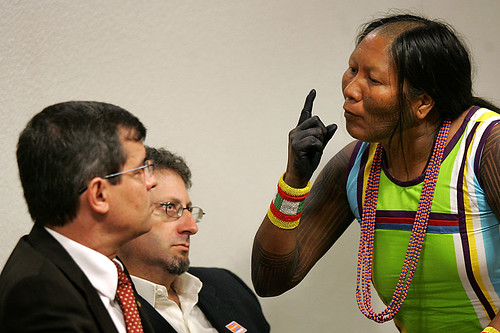
Tuira Kayapo, leader of the indigenous Kayapo tribe, speaks to Aloysio Guapindaia,
director of the National Indian Foundation, FUNAI. (AP Photo/Eraldo Peres)
Yes, indeed! It's a squirmy deal at best, put together hastily in the final moments before a politically insane auction during global Earth Week celebrations.
International Rivers, the global NGO that has filled a key role in disseminating the truth about Belo Monte gives the latest UPDATE
Belo Monte Dam is by no means an inevitability, despite what the Brazilian government and the companies promoting the dam would like you to believe. Legal actions, protests and occupations by indigenous groups, and a growing international campaign could derail the project. Let's recap the events of the last couple of weeks.
After several last-minute legal wranglings, the auction went forward on April 20, 2010, and the dam contract was awarded to a consortium calling itself Norte Energia (North Energy), led by CHESF, an Electrobras subsidiary. The consortium bid to supply power to the grid at a cost of R$77.97 per MWh, well below the government-set price ceiling of R$83 per MWh, a low price which was already scaring away investment. Very soon after the auction, two companies threatened to pull out of the consortium, citing lack of profitability. The consortium itself is in a state of disarray, with some companies pulling out and others from the losing consortium potentially joining in.
Indeed, the lack of economic viability of the project has been an ongoing theme the past couple of weeks. Brazil's pre-eminent national newspaper, O Globo, published an editorial on April 20 entitled "Belo Monte is a bad investment for Brazil". O Globo cites the fact that the winners of the auction will get an unprecedented 30-year loan from BNDES, the Brazilian National Development Bank, with an interest rate of just 4%, less than what the government will be selling bonds for to finance the deal! Because of the lack of private investment, to finance the loan BNDES is drawing from the Workers' Support Fund (Fundo de Amparo ao Trabalhador) and from public pension funds- funds that are supposed to guarantee job security, health, and education provisions, not subsidize the energy consumption of electro-intensive industries! In addition, the government announced tax breaks of 75% for investors in the auction, while around half of the shares in the project will be owned by state-owned enterprises, which generally operate with a minimal return on investment.
Next, a former director of ANEEL, the national electrical regulatory agency, said on April 27 that the government would be "creating a monster" if they go ahead with Belo Monte. Besides the social and environmental problems, the project would threaten energy security because of the large seasonal variations in power production (the dam is expected to generate as little as 1000 MW during the dry season). Afonso Henriques Moreira Santos said that "Belo Monte is not essential for energy security." Indeed he argued that dams in the Amazon are not a good solution for Brazil's energy needs because of the long transmission lines that need to be built to bring the energy to population centers. "Large transmission lines are very fragile," he said.
And as if to reinforce the point that this is a lousy investment for Brazilians, José Ailton de Lima, the president of the winning consortium Norte Energia, said the final price of the project will be somewhere between R$19 billion (US$10.85 billion) and R$30 billion (US$17.13 billion). The higher price is what private construction contractors have thought it will actually cost all along. Such skyrocketing costs can only be absorbed by the huge public subsidies being offered by the government.
Meanwhile, opposition is mounting internally and externally. In Brazil, the Senate is investigating claims that ANEEL held the project auction illegally by ignoring a third restraining order placed on the auction by federal Judge Antonio Carlos Campelo. Reports show that the third order to cancel the auction was issued by 1pm, yet the auction still went forward at 1:20pm behind closed doors. A regional appellate judge overturned the third order, buckling to direct pressure from the government. By pushing Belo Monte through at any cost, the Lula government is making a mockery of Brazil's rule of law.
Abroad, the auction date was marked by massive protests around Brazil and people calling in to Embassies around the world to express their opposition to the project. Soon after, indigenous people from the Big Bend of the Xingu announced that they would be establishing a protest village on Pimental Island, the site where dam construction will take place, in order to block construction. They are planning this village as I write.
In solidarity, the Kayapo Indians from the Xingu National Park have been blocking a major road and river crossing in Mato Grosso state for the past week to protest the government's decision to build the dam. Kayapo leader Megaron Txukarramae released a statement reaffirming his people's intention to resist dam construction, calling President Lula "enemy number one", and stating that "if Lula wants to do away with us as he has been indicating, the whole world will know that we will die fighting for our rights." Heavy words from a warrior tribe.
And just last Wednesday our friends at Amazon Watch organized a protest in front of the Brazilian mission to the United Nations in New York with indigenous people around the world and actress Sigourney Weaver to express opposition to Belo Monte Dam.
Legal actions, protests, a mounting campaign: it ain't over until the fat lady sings, and that fat lady will not be singing for a while.
Friday, April 30, 2010
GRAFFITI BECO
What a weird week of oil spills, deforestation reports, and giant hydroelectric threats to the forest. I never thought that I might be sitting here in lovely Acre State in the Brazilian Amazônia, having my mood rescued by a display of street art from São Paulo.
But that's exactly what happened when Visionshare's good friend OC Brasileiro sent me his marvelous slide show of the walls and alleys of my old stomping ground of Vila Magdalena.
Irreverent art can be a way to hang on to the humor in our often weird (but wondrous) existence. Thanks bro, I don't know what it all means but ya got me giggling again.
GULF OF MEXICO OIL RIG NOT
THE FIRST GIANT TO SINK
On March 20, 2001 the world's then-largest oil rig sank off the Brazilian coast following an explosion that killed 11 workers.
According to the BBC report this was not the first large Petrobras oil spill. More background on the Petrobras oil platform disaster is at Wikipedia.
It is really sad to watch the unfolding gulf tragedy and to experience my own conflicting emotions. I do hope this might be the 911 of off-shore drilling. It might be a game changer -- a political sea change as well as an ecological horror.
That's not what happened after the 2001 Brazilian event but one can hope that times have changed.
Here is a "controlled" burn that is not "out of control" and it might help save the world.
WorldStove founder Nathaniel Mulcahy has just completed two months of work in Haiti, setting up a pilot project that will provide biochar-producing stoves and jobs for the Haitian people. The project was featured in an Earth Day press release from the UN Special Envoy to Haiti (former President Clinton) as an example of "building back better" by incorporating environmental sustainability in the recovery effort.
Before WorldStove, Mulcahy was an award-winning industrial designer creating consumer products for large corporations like Emerson Appliances. Eight years ago, while lying in bed recovering from a life-threatening accident, he realized that he needed to focus his energies on innovative designs to improve the quality of life for people who were less fortunate. The result was his invention of the fuel efficient, low emissions LuciaStove, named after the canine companion who saved his life.
Before WorldStove, Mulcahy was an award-winning industrial designer creating consumer products for large corporations like Emerson Appliances. Eight years ago, while lying in bed recovering from a life-threatening accident, he realized that he needed to focus his energies on innovative designs to improve the quality of life for people who were less fortunate. The result was his invention of the fuel efficient, low emissions LuciaStove, named after the canine companion who saved his life. .
The original breakthrough that set the LuciaStove apart from similar gasifer stoves was Mulcahy’s patented design which uses Bernoulli-principle-driven venturis to create a negative pressure while a flame cap based on Fibonacci spiral geometry prevents oxygen from entering the pyrolysis chamber (this is the shape emblazoned in the World Stove logo). The combination delivers better air control for cleaner combustion of the gases produced from the biomass it uses as fuel. It also produces a nitrogen gas charged biochar (the stove excludes oxygen but not nitrogen) that has a nearly neutral pH (7-7.5) making it ideal for many agricultural applications.
Video showing Lucia in pyrolytic mode courtesy of World Stove
To develop and distribute his invention, Mulcahy founded WorldStove LLC, based in Amherst, Massachusetts (USA) and in Tortona, Italy. Mulcahy says that people are often surprised that such a sophisticated design would be used for such a simple product, a cook stove for developing countries. He answers: “Why should we provide developing nations with stoves that look like cast off scrap? Style or elegance of design usually only involves added thought, not added cost.”
Mulcahy considers it a matter of respect not only to offer a high quality, efficient stove to the world’s poor, but to make sure that the stove is adapted to people’s needs and not the other way around. WorldStove pilot projects in several African countries, Indonesia, and the Philippines have encountered all manner of local conditions that have required changes in the stove setup or manufacturing techniques.
The adaptability of the Lucia stove faced its greatest test in Haiti this winter where Mulcahy carried out a WorldStove Pilot Program in the short space of two months. He not only redesigned the stove to be produced with available tools and materials, but he also completed a camp survey. Crowded camp conditions and the fact that since the quake more children have been forced to take responsibility for cooking made safety a top priority, so Mulcahy developed a Haitian specific pot stand with heat-shield and windscreen to accommodate the wide variety of pots used in Haiti and protect children from burns.
(Photos above: Left: Children have taken on more cooking responsibilities since the earthquake. Right: The blue flame indicates that the Haiti Lucia stove is burning cleanly and efficiently; courtesy of World Stove)
Local versions of the Lucia stove must be tuned to work with available fuels. Peanut shells need different conditions than rice hulls, for instance. An un-tuned stove will smoke and leave behind un-charred material. So, Mulcahy conducted a fuel availability assessment to guide his stove design and dissemination plan. Read the report Fuel Options in Post-Earthquake Haiti here. http://stoves.bioenergylists.org/en/content/fuel-options-post-ea
One of the best moments of Mulcahy’s two months in Haiti was the day he first tuned a locally-built stove to run on the donated pellets. He said, “With only three handfuls of pellets, we cooked a plateful of rice, beans and meat sauce for 21 people.”
Another prize moment was the day that Mulcahy showed up late to a village artisan’s shop only to find the artisan already engaging a crowd of people demonstrating the stove and explaining how the biochar would help restore their soils. “That’s ownership,” Mulcahy said, “and that’s success.” The metal workers started adding lovely decorations of trees and birds to the stoves. Mulcahy said he was told that the pictures represent what will happen if people use the stoves to make biochar – the trees and birds will come back to Haiti.
(Photos above: Left: Nathaniel Mulcahy showing designs that metal workers added to the stove wind screens. Right: The metal workers say that trees and birds will return to Haiti when the soil is rebuilt with biochar; courtesy of World Stove)
Almost a third of the land in Haiti has lost so much topsoil that it is not arable. As a result, Haiti can no longer feed itself and people have fled to the cities where they were most vulnerable during the earthquake. Biochar can be a critical factor not only in restoring topsoil to Haiti but in revitalizing the rural economy.
In preparation for the next phase of the Haiti project, World Stove has established preliminary agreements with 48 agricultural cooperatives that will provide crop waste for pellet production. The farmers will receive a proportionate amount of biochar in return.
Such agreements are part of the WorldStove Five Step Program http://worldstove.com/wp-content/uploads/download/five_step.pdf for integrating stove production and distribution with fuel supplies, crop improvement and job creation. This Five Step model starts with a Stove Hub where stoves are manufactured and progresses to adding a pellet mill and biochar soil-building programs. The model always includes a distribution and exchange program that may use micro-finance, donations or barter, depending on local conditions.
Mulcahy said that the Haiti experience has confirmed the usefulness of the Five Step Program, while adding some new features – like using biochar for much-needed sanitation. Mulcahy built two aerobic composting toilets that use biochar for odor control and composting efficiency. The resulting biochar compost will be used to build soil.
WorldStove is now mapping out the next stage of the Haiti program, working with United Nations Environmental Programme (UNEP), the World Food Programme (WFP) and the Haitian Government to build stove-manufacturing hubs and create thousands of jobs making pellets and distributing biochar in the rural areas.
While this next stage is getting organized, Mulcahy is turning his efforts towards other work, including launching new consumer products for the developed world like a BBQ grill and a home heating furnace. There is also new work in Ghana, Togo, Sierra Leone and Afghanistan that had been placed on hold for Haiti. Mulcahy invites anyone who is interested in learning more about next steps in Haiti or contributing to the next phase of activity, to visit the WorldStove website, www.worldstove.com. For updates, you can sign up for the World Stove Twitter feed @WorldStove and YouTube channel http://www.youtube.com/user/WorldStove.
Wednesday, April 28, 2010
OFF-SHORE OIL COMING ON-SHORE
Chandeleur Islands off the southeastern coast of Louisiana on Tuesday - Gerald Herbert/Associated Press
DAMN IT! I really hate to report this. And I take no solace in suspecting that the burning and sinking oil rig on Earth Day (!) was the archetypal message of the folly of our energy policy. Now as the Gulf of Mexico spill of 42,000 gallons per day spreads toward Louisiana, they are considering a "controlled burn" to save the mainland coast.
Yup! Controlled burns to generate energy in coal-fired plants, to clear forests for beef and soy and palm oil production, and now to clear a dangerous oil spill. How else is there to say it? Controlled burns are what have created our global heating problem.
Is oil pumped off-shore of Louisiana or off-shore of Rio de Janeiro the answer to the energy crisis?
ATTENTION PLEASE: THE US HAS A GREATER PERCENTAGE FOREST LOSS THAN DOES BRAZIL
No wonder that President Lula and many Brazilian government officials get ticked off when they are lectured by gringos about saving the Amazon. A quick look at the graph above tells why.
I personally can report from nearly 30 years of concern for the ancient trees of the US Pacific Northwest that less than 10 percent of the primary forest is left and the old-growth giants are still being logged. The situation is as bad, some years even worse, north of the border in James Cameron's home country of Canada.
For comparison, although the sheer area of deforestation is greatest in Brazil, it is also true that 80 percent of the primary Amazon forest is still standing. That's an 80% Brazil vs 10% USA percent comparison!
Today the Brazilian problem may cover a larger area but so is the opportunity to do something about the future forest. Giant areas of non-fragmented forest and the greatest biodiversity in the world exist here. Conversely, in North America we have only remnants of primary forests. When a 500 year-old remnant cedar or fir falls in British Columbia or in Oregon it's among the last and pretty much over unless we can wait 500 years to get it back.
The Avatar movement is quite correct. The issue is global. It is not about pointing the finger of shame and blame at the developing world. Indeed, it must be stated again and again that the 20th Century development pattern devastated the environments of the so-called "advanced economies." If this pattern is to be changed for the 21st Century, those who first benefited from the destruction of nature, and continue to cause much of the problem, must change their consumption habits and help pay for a new way in the developing world.
United States has higher percentage of forest loss than Brazil Jeremy Hance mongabay.com April 26, 2010
From 2000 to 2005 the world lost over a million square kilometers of forest.
Forests continue to decline worldwide, according to a new study in the Proceedings of the National Academy of Science (PNAS). Employing satellite imagery researchers found that over a million square kilometers of forest were lost around the world between 2000 and 2005. This represents a 3.1 percent loss of total forest as estimated from 2000. Yet the study reveals some surprises: including the fact that from 2000 to 2005 both the United States and Canada had higher percentages of forest loss than even Brazil.
Counting forest loss due either to human disturbance or natural causes, the study found that North America lost the most forest of the world's six forest-containing continents. Perhaps surprisingly, thirty percent of total forest loss occurred in North America alone. Combined with South America—the largest extent of tropical forests in the world—the two continents represent half of the world's total forest loss. Africa, in turn, suffered the least forest loss.
Forest loss by nation
Of the seven nations that contain over a million square kilometers of forest—Russia, Brazil, the United States, Canada, Indonesia, China, and the Democratic Republic of Congo—Brazil lost the most total forest during the five year time period.
According to the researchers Brazil lost 26,000 square kilometers (10,038 square miles) per year of its rainforest, and 7,000 square kilometers (2,702 square miles) in its dry tropical forests. Over the five years, total forest loss in Brazil came to 165,000 square kilometers (63,706 square miles). In all this represents 3.6 percent of its total 2000 forest cover: half a percent higher than the global average.
Canada was close behind Brazil: losing some 160,000 square kilometers (61,776 square miles) of its forest cover. However, proportionally Canada's forest loss equals 5.2 percent of the nation's total forest cover: higher than Brazil's percentage and over two points higher than the global average.
But the United States had the greatest percentage loss of the seven nations—even more than Brazil and Canada—losing 6 percent of its forest cover in just five years time, a total of 120,000 square kilometers (46,332 square miles). While fire and beetle infestation played a role in Alaska and the western US, large-scale logging in the southeast, along the western coast, and in the Midwest play a big role in the nation's continuing forest decline.
The researchers write that "the often publicized phenomenon of forest conversion within the humid tropics is observed in our results, but significant GFCL [i.e. global forest cover loss] is evident in all biomes. For example, rates of GFCL in regions such as the southeast United States are among the highest globally."
This site contains copyrighted material, the use of which has generally not been specifically authorized by the copyright owner. This material is being made available in an attempt to advance understanding of issues of environmental, political, news and humanitarian significance. This site believes this constitutes a "fair use" of any such material as provided in section 107 of the US Copyright Laws.



 The adaptability of the Lucia stove faced its greatest test in Haiti this winter where Mulcahy carried out a WorldStove Pilot Program in the short space of two months. He not only redesigned the stove to be produced with available tools and materials, but he also completed a camp survey. Crowded camp conditions and the fact that since the quake more children have been forced to take responsibility for cooking made safety a top priority, so Mulcahy developed a Haitian specific pot stand with heat-shield and windscreen to accommodate the wide variety of pots used in Haiti and protect children from burns.
 Another prize moment was the day that Mulcahy showed up late to a village artisan’s shop only to find the artisan already engaging a crowd of people demonstrating the stove and explaining how the biochar would help restore their soils. “That’s ownership,” Mulcahy said, “and that’s success.” The metal workers started adding lovely decorations of trees and birds to the stoves. Mulcahy said he was told that the pictures represent what will happen if people use the stoves to make biochar – the trees and birds will come back to Haiti.


