VISISIONSHARE (blog header)_edited
Showing posts with label visionary art. Show all posts

Saturday, May 24, 2008

Hey, Henry is in New York

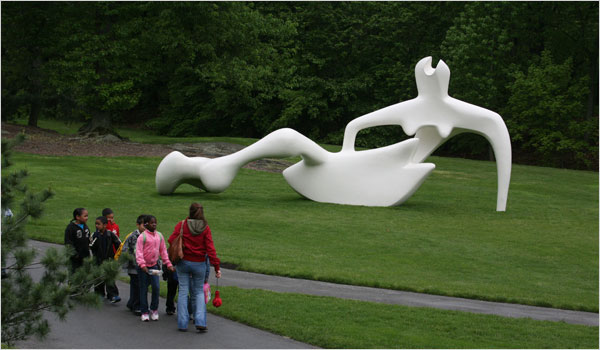
Henry Moore in NY
Librado Romero/The New York Times


The New York Botanical Garden’s “Moore in America” exhibition, which opens today with 18 of Henry Moore’s big, beloved bronzes (and two more in fiberglass), is the largest outdoor collection of his work in a single location ever presented in New York, or anywhere else in the country. (Full story here.)

Of course, it's not the first time that this greatest master of 20th Century form has had a large number of his pieces residing for several months in "America" (as people of the Central and Southern zones also name their continents). Indeed, there was a great exhibition in Brazil during 2005 that had a tremendous effect on me. Since the report that I made at that time has somehow become the most popular single VISIONSHARE post, it seems appropriate to re-blog it now.

HENRY MOORE: RE-VISIONARY ARTIST
img_2847_edited

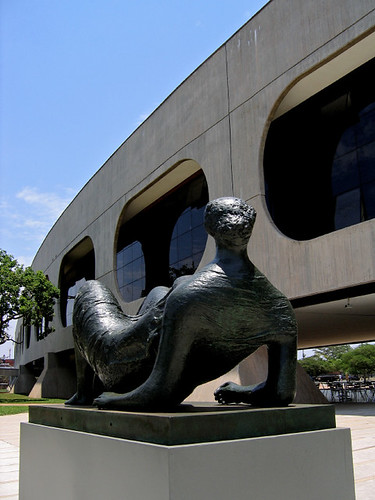
In 2005 I was very fortunate to see the Henry Moore Retrospective Exhibition which traveled from England to Brazil for showings in Rio de Janeiro, São Paulo and Brasília. This was the first time that Moore’s works had been shown in Latin America. I visited the exhibition only briefly in Rio which whetted my appetite. When it arrived in Brasília I was drawn to it as a child is drawn to a candy store. I think that I went to it four times but even that was hardly enough.
img_2686_edited

For me Moore was the greatest sculptor of the 20th Century, presenting a totally radical re-vision, a deeper re-cognition between matter and awareness. I'll try to explain why I feel that way.

Immersing my awareness in the works of a great artist like Moore was a powerful experience. Almost immediately, the way that I perceived the world began to change. It’s not easy to express exactly how it changed but my attention shifted. I began to see objects not as isolated entities but as embedded in larger environments – the inside and outside and surroundings of the subject became more apparent and as important as the piece of art.
img_2816_edited

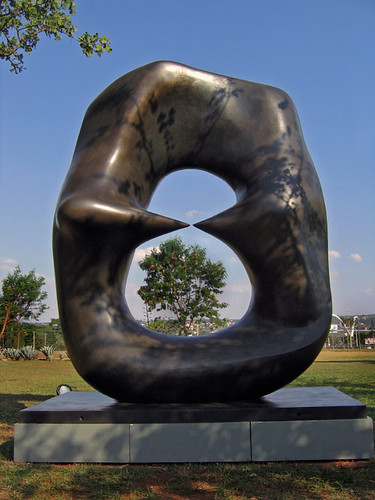
I understood that the final perceived vision is an interaction, a dynamic and participatory dance of form and space. Moore demolished the hierarchical, elitist and monumental vision of art as somehow above, beyond and separate from the viewer. He re-visioned the sculpture, the viewer and environment as part of a participatory world.
img_2822_edited

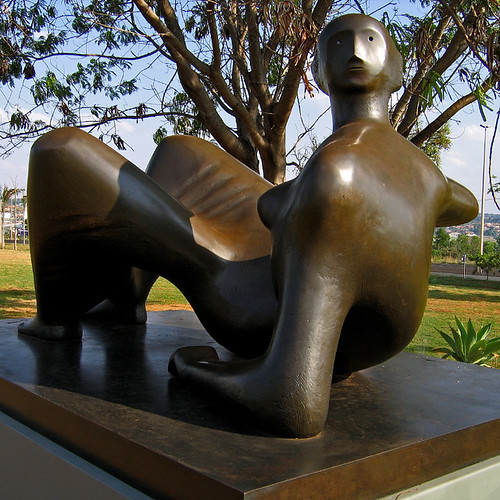
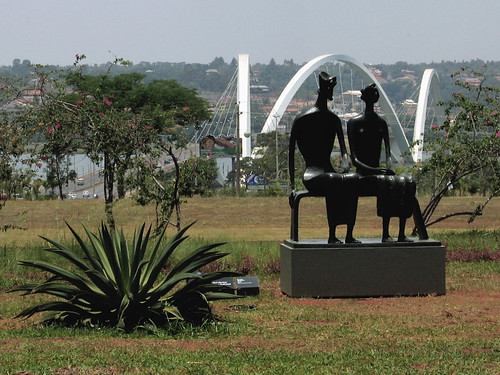
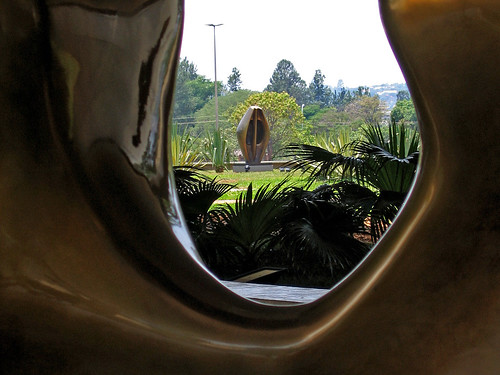
In one of the statements by Moore which was displayed on the exhibit walls he says that he learned that sculpture was not simply a manipulation of the material form but also a shaping of the space around it. He wanted his large pieces to be displayed in nature where they could interact with the surrounding space – as a form, as a window, as a reflection, as occupied and unoccupied space.
img_2674_edited_edited

I thought of the profound Buddhist insight that is the opening of the Heart Sutra: Form is Emptiness. Emptiness is none other than Form. Moore’s sculptures are, of course, solid objects but the presentation of the work is a performance, an interaction with the environment and a living testament to the truth of this Buddhist insight about impermanence. Each location, each perspective, each eye presents something new. Form, emptiness and constant change. Somehow, sculpture now seems to me to be more like a conversation than a permanence.
img_3104_edited

Moore said that he considered art to be his spirituality which I take to mean that the work and the practice of the artist are to discover truth, reveal vision and create beauty.

There is a very poignant moment in the documentary film about his life where Moore recalls the series paintings that he was commissioned to do about the WWII bombing of London. He said that when air raid sirens would start that he would feel a “strange exhilaration.” In the Tubes which served as the bomb shelters he joined the masses of people huddled and stretched out for the night. Moore -- who is arguably the master of the reclining figure -- said, “I had never seen nor imagined so many reclining figures.” Those paintings -- primarily scenes from the bomb shelters -- are hauntingly beautiful portrayals of people nested safely underground.

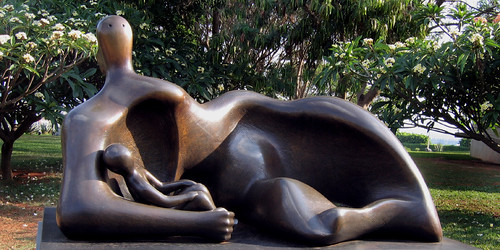
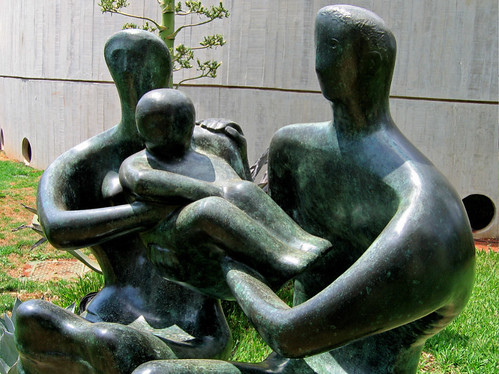
The theme of being safely held is powerfully presented in his sculptures
img_3052_edited

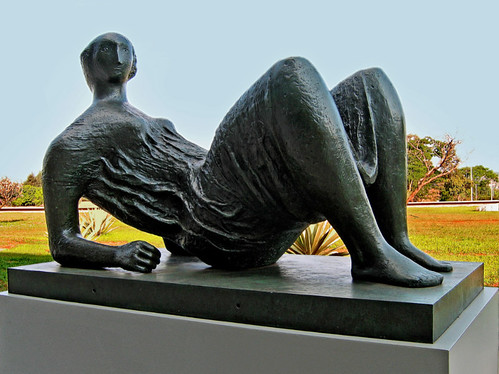
Even with his fallen warrior, the return to the ground, rather than a conquering of it, feels more like a nurturing than a defeat.
img_3024_edited

I understand Moore’s work,
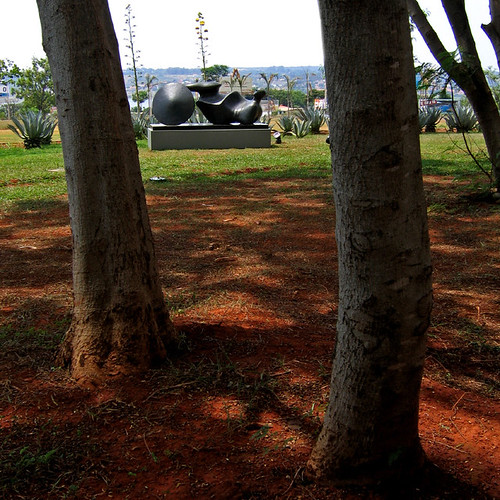
above all, as a "monumental" return to humility. I don’t mean the stylized humility of manners and social forms. I mean “humility” as in the Greek root word -- humus. Moore took artistic beauty off the high pedestal, reclined it close to the ground or reduced it to the simplest of lines and materials, and in the end established beyond any doubt that the humble form is noble.
img_2863-copy_edited

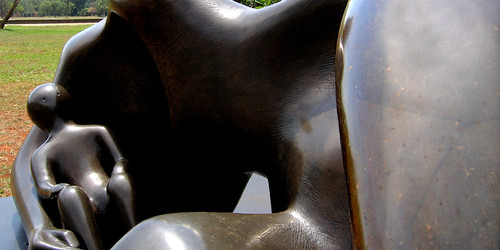
It is the nobility of the Mother, our Mother, Mother Earth. She is the very ground of our existence, the source and foundation of life, the lowliest and most powerful of all beings.
img_3011_edited

I have chosen to refer to Moore as a "re-visionary artist" because his art brings us back to a deeper vision of our relationship to the ground below us, to our Mother, to the earth. Looking once again at a slideshow of his works, I can only feel grateful... and childlike.


Here's my slideslide from the 2005 exhibition in Brasilia:


Here's is the link for the CURRENT NY TIMES SLIDESHOW


Saturday, May 12, 2007

TIME MAGAZINE ASKS:
Was Timothy Leary Right?


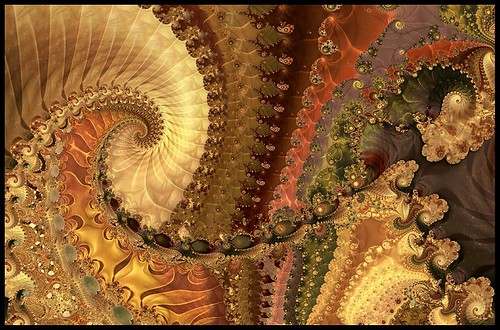
Fractal art by Jock Cooper
Jock Cooper fractal-4174

From TIME magazine.
Thursday, Apr. 19, 2007


By JOHN CLOUD

Are psychedelics good for you? It's such a hippie relic of a question that it's almost embarrassing to ask. But a quiet psychedelic renaissance is beginning at the highest levels of American science, including the National Institute of Mental Health (NIMH) and Harvard, which is conducting what is thought to be its first research into therapeutic uses of psychedelics (in this case, Ecstasy) since the university fired Timothy Leary in 1963. But should we be prying open the doors of perception again? Wasn't the whole thing a disaster the first time?

The answer to both questions is yes. The study of psychedelics in the '50s and '60s eventually devolved into the drug free-for-all of the '70s. But the new research is careful and promising. Last year two top journals, the Archives of General Psychiatry and the Journal of Clinical Psychiatry, published papers showing clear benefits from the use of psychedelics to treat mental illness. Both were small studies, just 27 subjects total. But the Archives paper--whose lead author, Dr. Carlos Zarate Jr., is chief of the Mood and Anxiety Disorders Research Unit at NIMH--found "robust and rapid antidepressant effects" that remained for a week after depressed subjects were given ketamine (colloquial name: Special K or usually just k). In the other study, a team led by Dr. Francisco Moreno of the University of Arizona gave psilocybin (the merrymaking chemical in psychedelic mushrooms) to obsessive-compulsive-disorder patients, most of whom later showed "acute reductions in core OCD symptoms." Now researchers at Harvard are studying how Ecstasy might help alleviate anxiety disorders, and the Beckley Foundation, a British trust, has received approval to begin what will be the first human studies with LSD since the 1970s.

Psychedelics chemically alter the way your brain takes in information and may cause you to lose control of typical thought patterns. The theory motivating the recent research is that if your thoughts are depressed or obsessive, the drugs may reveal a path through them. For Leary and his circle--which influenced millions of Americans to experiment with drugs--psychedelics' seemingly boundless possibilities led to terrible recklessness. There's a jaw-dropping passage in last year's authoritative Leary biography by Robert Greenfield in which Leary and two friends ingest an astonishing 31 psilocybin pills in Leary's kitchen while his 13-year-old daughter has a pajama party upstairs. Stupefied, one of the friends climbs into the girl's bed and has to be pulled from the room.

A half-century later, scientists hope to unstitch psychedelic research from their forebears' excesses. Even as the Clinical Psychiatry paper trumpets psilocybin's potential for "powerful insights," it also urges caution. The paper suggests psilocybin only for severe OCD patients who have failed standard therapies and, as a last resort, may face brain surgery. Similarly, subjects can't take part in the Ecstasy trials unless their illness has continued after ordinary treatment.

Antidrug warriors may argue that the research will lend the drugs an aura of respectability, prompting a new round of recreational use. That's possible, but today we have no priestly Leary figure spewing vertiginous pro-drug proclamations. Instead we have a Leary for a less naive age: Richard Doblin. Also a Harvard guy--his Ph.D. is in public policy--Doblin founded the Multidisciplinary Association for Psychedelic Studies (MAPS) in 1986 to help scientists get funding and approval to study the drugs. (Doblin, 53, says he was too shy for the '60s, but he was inspired by the work of psychologist Stanislav Grof, who authored a 1975 book about promising LSD research--research that ended with antidrug crackdowns.) Doblin has painstakingly worked with intensely skeptical federal authorities to win necessary permissions. MAPS helped launch all four of the current Ecstasy studies, a process that took two decades. It's the antithesis of Leary's approach.

All drugs have benefits and risks, but in psychedelics we have been tempted to see only one or the other. Not anymore.

Some useful links:
Alto das Estrelas
MAPS
Jock Cooper Fractal Art

Wednesday, May 09, 2007

HENRY MOORE: RE-VISIONARY ARTIST

img_2847_edited

I've been thinking a lot about the artistic vision of Henry Moore. So I revisited a short essay that I wrote awhile ago and made a few "refinements" trying to get the words and images to journey together. For me Moore was the greatest sculptor of the 20th Century, presenting a totally radical re-vision, a deeper re-cognition between matter and awareness. I'll try to explain why I feel that way.

In 2005 I was very fortunate to see the Henry Moore Retrospective Exhibition which traveled from England to Brazil for showings in Rio de Janeiro, São Paulo and Brasília. This was the first time that Moore’s works had been shown in Latin America. I visited the exhibition only briefly in Rio which whetted my appetite. When it arrived in Brasília I was drawn to it as a child is drawn to a candy store. I think that I went to it four times but even that was hardly enough.

img_2686_edited

Immersing my awareness in the works of a great artist like Moore was a powerful experience. Almost immediately, the way that I perceived the world began to change. It’s not easy to express exactly how it changed but my attention shifted. I began to see objects not as isolated entities but as embedded in larger environments – the inside and outside and surroundings of the subject became more apparent and as important as the piece of art.

img_2816_edited

I understood that the final perceived vision is an interaction, a dynamic and participatory dance of form and space. Moore demolished the hierarchical, elitist and monumental vision of art as somehow above, beyond and separate from the viewer. He re-visioned the sculpture, the viewer and environment as part of a participatory world.

img_2822_edited

In one of the statements by Moore which was displayed on the exhibit walls he says that he learned that sculpture was not simply a manipulation of the material form but also a shaping of the space around it. He wanted his large pieces to be displayed in nature where they could interact with the surrounding space – as a form, as a window, as a reflection, as occupied and unoccupied space.

img_2674_edited_edited

I thought of the profound Buddhist insight that is the opening of the Heart Sutra: Form is Emptiness. Emptiness is none other than Form. Moore’s sculptures are, of course, solid objects but the presentation of the work is a performance, an interaction with the environment and a living testament to the truth of this Buddhist insight about impermanence. Each location, each perspective, each eye presents something new. Form, emptiness and constant change. Somehow, it seems more like a conversation than a permanence.

img_3104_edited

Moore said that he considered art to be his spirituality which I take to mean that the work and the practice of the artist are to discover truth, reveal vision and create beauty.

There is a very poignant moment in the documentary film about his life where Moore recalls the series paintings that he was commissioned to do about the WWII bombing of London. He said that when air raid sirens would start that he would feel a “strange exhilaration.” In the Tubes which served as the bomb shelters he joined the masses of people huddled and stretched out for the night. Moore -- who is arguably the master of the reclining figure -- said, “I had never seen nor imagined so many reclining figures.” Those paintings -- primarily scenes from the bomb shelters -- are hauntingly beautiful portrayals of people nested safely underground.

The theme of being safely held is powerfully presented in his sculptures

img_3052_edited

Even with his fallen warrior, the return to the ground, rather than a conquering of it, feels more like a nurturing than a defeat.

img_3024_edited

I understand Moore’s work,
above all, as a "monumental" return to humility. I don’t mean the stylized humility of manners and social forms. I mean “humility” as in the Greek root word -- humus. Moore took artistic beauty off the high pedestal, reclined it close to the ground or reduced it to the simplest of lines and materials, and in the end established beyond any doubt that the humble form is noble.

img_2863-copy_edited

It is the nobility of the Mother, our Mother, Mother Earth. She is the very ground of our existence, the source and foundation of life, the lowliest and most powerful of all beings.

img_3011_edited

I chose to refer to Moore as a "re-visionary artist" because his art brings us back to a deeper vision of our relationship to the ground below us, to our Mother, to the earth. Looking once again at a slideshow of his works, I can only feel grateful... and childlike.

Click for the slideshow.