Yup, you read right. After the recent series of line-item vetoes by President Dilma Rousseff, no one knows what Brazil's latest Codigo Florestal text means, only that there will be another period of time for wiggling the weasel words to get final passage in Congress. This places the tough negotiations beyond the global spotlight of the upcoming RIO+20 (June 15-22). Many, suspect that this was the smoke-and-mirrors strategy in the first place. When the Senate compromise that satisfied no one failed to gain support in the lower House, the ruraliststas (extremists among the agribusiness interests) were allowed free-rein, resulting in an ecological nightmare and allowing Dilma to veto the most onerous clauses without defining a clear forest policy. Cleverly, Greenpeace has decided to challenge the whole process.
"D" is for Dilma's Decision, Deforestation, Development, Dams and Drought
Dilma Rousseff, President of Brazil
Tomorrow, 25 May 2012, is the deadline for Brazil's President Dilma Rousseff to decide whether to accept or veto (in whole or part) the devastating new national Forest Code that was passed recently by the Brazilian Congress.
Andrew Revkin of the NY Times blog Dot Earth suggested that I might submit a "Postcard From Acre" describing the view from my perch in Brazil's western-most Amazonian state which borders on Bolivia and Peru.
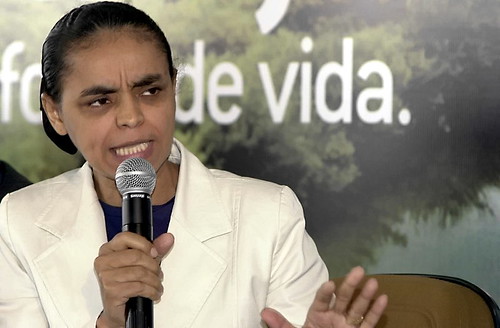
"THE THIRD WORST DAY OF MY LIFE", says Marina Silva
Brazil to sanction illegal colonization in 230,000 sq mi of Amazon rainforest
NOTE: Last year, Marina Silva, a longtime heroine of the international environmental community, resigned from her post as Minister of Environment in protest of Brazil's development policies. Now, there is a fast-growing grassroots movement of citizens working on promoting Marina Silva's name as a candidate for the presidency. Here is the website (in Portuguese).
Mongabay reports on Brazil's program to turn lawlessness into law.
(June 08, 2009) Brazil moved a step closer to passing a controversial law that would allow landowners who illegally deforested land in the Amazon to get legal title to these holdings. Environmentalists say HB 458 — which now only needs the signature of President Lula, an avid supporter — will legitimize years of illegal colonization and may promote new deforestation.
"This could be a big step backward for Amazonian conservation," said William F. Laurance, a researcher at the Smithsonian Tropical Research Institute who has spent nearly three decades staying the Brazilian Amazon. "The Amazonian environment is the clear loser here."
The proposed law will enable a claimant gain title for properties up to 1,500 hectares (3,700 acres) provided the land was occupied before December 2004. Critics note the law favors industrial developers over small holders, allowing those controlling 400-1500 ha to sell their holdings after three years. Farmers or ranchers holding under 400 ha have to wait 10 years to sell.
Former Environment Minister Marina Silva said the Senate's passage of HB 458 was the third worst day of her life, following the death of year father and the assassination of her mentor Chico Mendes, a leader of a rubber tapper union based in the Brazilian state of Acre. She added the law would undermine Brazil's progress in formulating and implementing environmental protections, including the setting aside of 523,592 square kilometers of protected areas between 2003 and 2009, an amount accounting for three-quarters of global protected areas established during that period.
HB 458 would grant land title to 300,000 properties illegally established across some 600,000 square kilometers (230,000 square miles) of protected Amazon forest, more than offsetting the conservation gains of the past six years.
Development interests — including large-scale agroindustrial firms, cattle ranchers, loggers, and plantation forestry companies — have lobbied intensely to get HB 458 passed. Supporters of the legislation say that while it will legitimize land-grabs prior to December 2004, HB 458 move may improve governance in an otherwise lawless region where conflict over land and complete disregard of environmental regulations is widespread.
Friday, June 05, 2009
THE NEXT STEPS
According to treehugger there are some steps you can take to help limit deforestation in the Amazon. Here are their suggestions for action:
You may have seen how a new Greenpeace report ties together the Brazilian cattle industry, deforestation and several popular global shoe brands who are using what is in essence 'deforestation leather'. If you didn't see the story the first time around, check out this quick video which summarizes the issues, dig into the full Slaughtering the Amazon report, and then take action:
Tell Nike, Timberland, Adidas, Reebok, Clark's, and Geox that you don't want your shoes contributing to global climate change by increasing deforestation in the Amazon.
The cattle industry is now the driving factor in deforestation in the Amazon, with cattle pastures now occupying land the size of Iceland. Cattle raising in Brazil is responsible for 14% of all the tropical deforestation in the world, and is their largest source of greenhouse gas emissions. Including emissions from deforestation, Brazil is the third largest emitter of greenhouse gases in the world.
All told, global deforestation and agriculture is a greater source of greenhouse gas emissions than the entire transport sector.
There's more background info and some hopeful signs here.
Monday, June 01, 2009
SLAUGHTERING THE AMAZON
In a series of major reports, Greenpeace is explaining to the world that beef production is the main driver of deforestation in Amazônia. Earlier this year, it issued a report showing that nearly 80 percent of land deforested in the Amazon from 1996-2006 is now used for cattle pasture.
The most recent report, Slaughtering the Amazon, charges that major international companies are unwittingly driving the deforestation of the Amazon rainforest through their purchases of leather, beef and other products supplied from the Brazil cattle industry. Greenpeace found that Brazilian beef companies are important suppliers of raw materials used by leading global brands, including Adidas/Reebok, Nike, Carrefour, Eurostar, Unilever, Johnson & Johnson, Toyota, Honda, Gucci, Louis Vuitton, Prada, IKEA, Kraft, Tesco and Wal-Mart, among others.
Clearly, the intention is to sensitize major global consumers and the corporations that manufacture and deliver beef-related products to bring pressure for real operative conservation practices in Brazil. A few years ago a campaign targeting soybean production resulted in an industry-led soy moratorium on planting in illegally logged areas of the Brazilian Amazon. Similarly, consumer consciousness may be able to reduce the linkage between ranching and future illegal deforestation. As with the soy campaign the hope is that eco-sensitive public opinion in the marketplace -- as in the EU -- might become a wedge toward better practices on the ground.
The global market is capable of delivering carrots as well as sticks. Recently, emerging global climate policies such as REDD have been offering the possibilities of new market incentives. Already they seem to be producing something of a rapprochement between antagonists like Minister of Environment Carlos Minc and Soy King and Mato Grosso Governor Blairo Maggi who recently agreed to new policies intended to guide landowners into a new era of protecting the environment in exchange for payments for ecosystem services.
There are, of course, many doubts concerning the details and distrust of market mechanics. But, also, there are high profile campaigns by world leaders -- such as Prince Charles and Wangari Maathai -- and cautious support from many large environmental groups for payments for avoided deforestation. At this early point, the new carbon economy is full of contradictions and Greenpeace and several other environmental groups remain highly skeptical of using carbon offsets for avoided deforestation.
It's definitely not going to be easy to birth a new era of harmony between conservation and development policies, either for the global economy or for Amazônia where the Brazilian Ministry of Environment has often been sabotaged in Congress or on the ground by the more powerful constituencies of the ministries of Agriculture, Energy and Transportation. Indeed, Minister Minc is already facing many of the obstacles that drove his predecessor Marina Silva to her resignation.
As politics and personalities and promises grab the headlines it is important keep in view the pictures of what is happening on the ground where we citizens of Planet Earth -- in Brazil and in the world -- may be losing the future of the Amazon forest.
INTERVIEW Development crucial to saving the Brazilian Amazon By Todd Benson Reuters
SAO PAULO, May 16 (Reuters) - The best way to preserve the Amazon rain forest is to develop the region and bring viable economic alternatives to the millions of people who live there, a Brazilian cabinet member said on Friday.
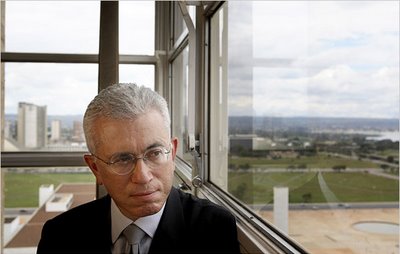
Roberto Mangabeira Unger, a former Harvard law professor picked by President Luiz Inacio Lula da Silva to coordinate an Amazon sustainable development plan, also said Brazil would not be lectured to by foreign countries about conservation.
"We are taken aback by those who scold us, who warn us, since we see countries around the world that are talking from a high chair after having devastated their own forests," Unger, minister for strategic affairs, said in an interview.
"The Amazon is not just a collection of trees. It is also, and above all, a group of people," he added, noting that the vast region is home to 27 million people out of Brazil's total population of 185 million.
"If these people lack economic opportunities, the practical result will be disorganized economic activity, and disorganized economic activity will lead relentlessly to deforestation. The only way to preserve the Amazon is to develop it."
Unger was thrown into an unwanted spotlight this week when Marina Silva, a former rubber tapper who was hailed globally as a champion of the green movement, resigned her post as environment minister after losing a slew of battles in her efforts to protect the Amazon.
According to aides, the last straw came last week when Lula overlooked Silva and instead chose Unger to oversee the implementation of a government initiative to develop the Amazon in a sustainable way.
CALLED LULA GOVERNMENT 'MOST CORRUPT'
Unger, who three years ago denounced the Lula administration as the "most corrupt in Brazil's history," defended the president's decision to put him in charge of the Amazon initiative.
"The people who think it's natural for development of the Amazon to be undertaken by an environment ministry just don't understand that the Amazon is more than a forest," he said.
"An environment ministry lacks the instruments to deal with all the many problems of transport, energy, education, and of industry that are required to formulate and to implement a comprehensive development program."
Unger, who was born in Brazil but has lived most of his life in the United States, has long been politically active in Latin America. He is best known for his efforts to push for an alternative to neoliberalism, the label often given to the view that free-market economics and development go hand-in-hand.
But he is a newcomer to the environmental debate in Brazil, raising doubts about whether he is the right person to oversee the Amazon plan.
Jorge Viana, a Lula ally and former governor of the Amazon state of Acre, said in a radio interview on Thursday: "I respect Professor Mangabeira Unger, he's a Harvard professor, the professor of the professors. But when it comes to the Amazon, I think he's a student."
Silva's successor in the Environment Ministry, Carlos Minc, has suggested that Viana might be better equipped for the job.
Unfazed, Unger is already moving forward with the plan and is about to embark on a tour of the Amazon to hammer out development strategies with state governors.
"The Amazon is the frontier, not just of geography but of the imagination. It is our great national laboratory," he said. "It is the space in which we can best rethink and reorganize the whole country, and define this new model of development."
BRAZIL'S MINISTER OF ENVIRONMENT MARINA SILVA RESIGNS
Marina Silva, a longtime darling of the international environmental community, resigned yesterday in protest of Brazil's development policies.
[UPDATE 15 May 2008: More analysis from the Independent and from the BBC.]
Brazil's Environment Minister Marina Silva Resigns Go to Original
By Adriana Brasileiro and Heloiza Canassa
May 13 (Bloomberg) -- Brazil's Environment Minister Marina Silva quit today after five years in office, citing difficulties in implementing a nationwide environmental agenda.
``During my trajectory, Your Excellency was a witness of the growing resistance found by our team in important sectors of the government and society,'' Silva wrote in a letter to President Luiz Inacio Lula da Silva today. A copy of the letter was e-mailed by Environment Ministry spokeswoman Gerusa Barbosa.
Silva, 50, a former rubber tapper, strengthened laws for logging and farming in the Amazon. She also made it harder for companies to obtain licenses for port, energy and transportation projects.
``She was the environment's guardian angel,'' said Frank Guggenheim, executive director for Greenpeace in Brazil. ``Now Brazil's environment is orphaned.''
Silva gave up after being forced to share some of her responsibilities for drafting policies for the sustainable development of the Amazon region, Guggenheim said.
Strategic Matters Minister Roberto Mangabeira Unger this year designed a plan for sustainable development in the Amazon and last week presented the plan to Lula and his ministers.
Lula last year also removed the responsibilities for environmental licensing from Brazil's Environmental Agency Ibama, weakening Silva's power over concessions for infrastructure projects.
Silva's Efforts
Ibama's president, Bazileu Alves Margarido Neto, also tendered his resignation today following Silva's decision, a spokeswoman with the agency said.
Carlos Minc, Rio de Janeiro state's secretary for the Environment and a Green Party founder, will replace Silva, Folha de S. Paulo's online edition reported today. Rio de Janeiro's state Secretariat didn't return messages seeking confirmation. Barbosa at the Environment Minister declined to comment.
Silva was born in the state of Acre, in the western part of Brazil's Amazon region, and worked extracting rubber from trees in the forests. She met Amazon activist Chico Mendes, and joined his efforts to organize peaceful demonstrations against deforestation. Mendes was assassinated in 1988.
She was elected to Brazil's Senate in 1994 and was appointed Environment Minister in 2003, when Lula won the election for his first four-year term in office.
Environmentalists say her years as ministers were filled with conflicts with government officials and investors, as she set more rigid rules for logging licenses and blocked infrastructure projects that didn't respect legislation.
``She relentlessly stood up to agriculture barons and developers who didn't care what they did to the environment, and she paid a high price for that,'' Guggenheim said.
Tuesday, April 08, 2008
CONDOMS FOR CONSERVATION
I guess that you might also call this one "love it and leave it alone." The Brazilian government has begun producing condoms using rubber from trees in the Amazon.
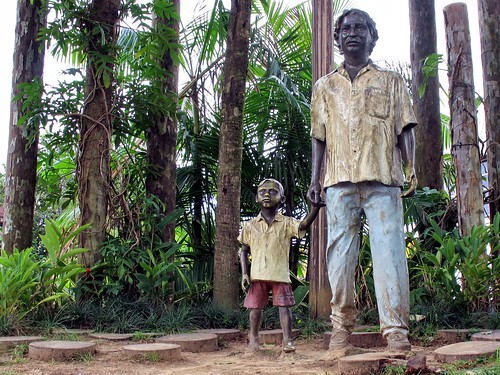
Chico Mendes as memorialized in the central square of Acre state capital Rio Branco. Condoms will be produced from latex collected in the Chico Mendes Extractive Reserve in Xapuri.
The health ministry says the move will help preserve the largest rainforest in the world.
It will also cut dependence on imported contraceptives, which are given away to fight Aids.
The Brazilian government has one of the biggest programmes in the world to distribute free condoms in the fight against the disease.
The new state-run factory is in the north-western state of Acre, and will initially produce 100 million condoms a year, which will be known by the name Natex.
Officials believe that not only will it generate income for Amazon residents, but it will involve using a product which is widely available and can be obtained without destroying large areas of the rainforest.
The latex will come from the Chico Mendes reserve, an area named after the famous conservationist and rubber tapper who was shot dead in 1988 by local ranchers.
The factory will benefit at least 500 families and provide 150 jobs in the town of Xapuri which has a population of around 15,000 people.
The health ministry says the condoms will be the only ones in the world made of latex harvested from a tropical forest, and will reduce the reliance on foreign imports.
The Brazilian government says it is the world's largest single buyer of condoms, purchasing more than a billion of the contraceptives in recent years to give away free as part of the country's national programme to combat Aids.
The policy, which is at its most visible during the Carnival period, has often been criticised by Catholic bishops who say it only encourages promiscuity.
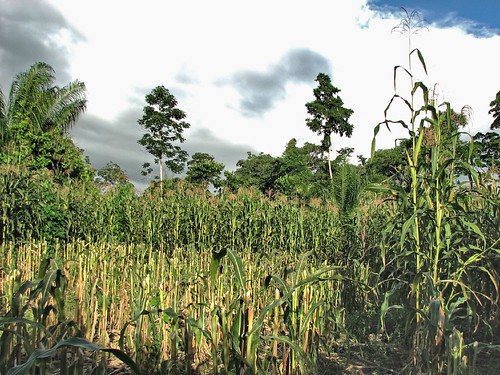
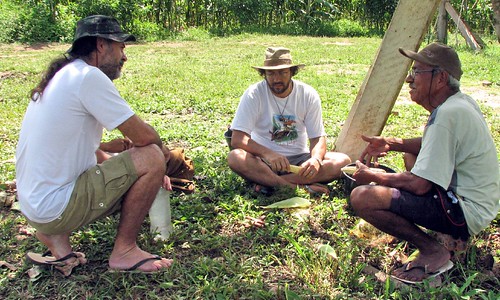
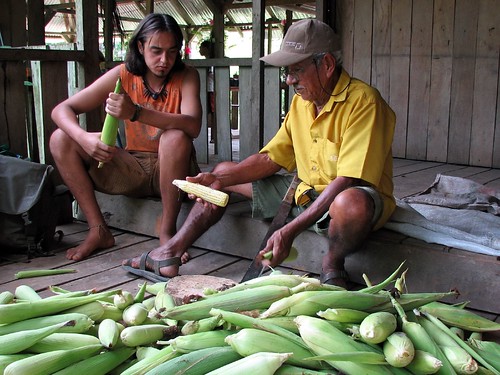
Corn was the "plantation crop" this year at Vila Fortaleza. Because Amazonian soils are easily depleted of nutrients the sustainable agricultural practice is to rotate the annual plantings between corn, manioc and nitrogen-fixing beans. The sight of rows of corn brought back many memories from the US Midwest where I had spent my youth. The tropical variety of corn is quite impressive often growing to a height of over 10 feet. Here it is at the start of the harvest.
At Fortaleza it had been common to see Padrinho Luiz working in the field or cleaning ears of corn for lunch. Often it was an occasion to sit with him helping out with the work and listening to stories.
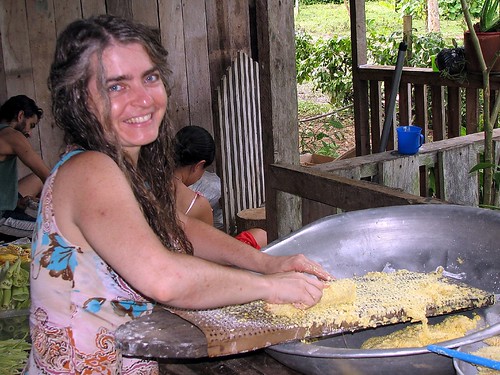
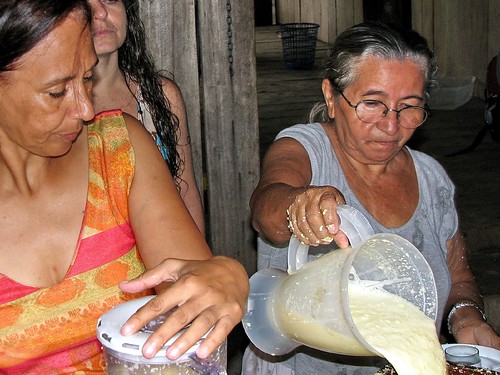
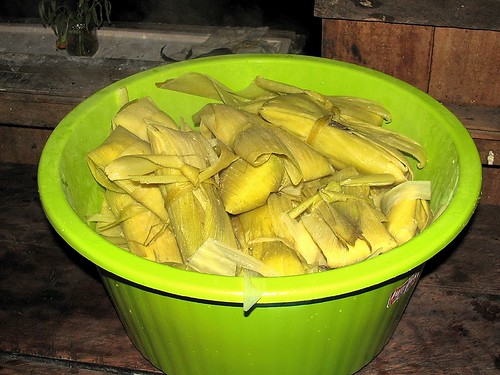
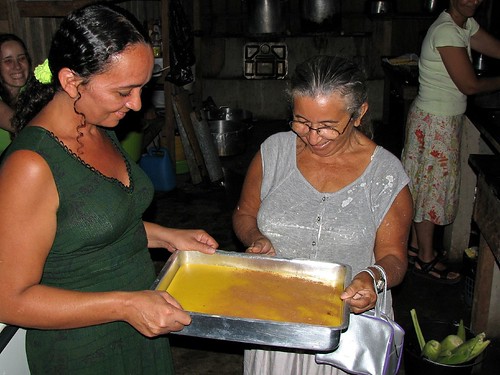
With the feitio recently completed and with the beginning of the harvest, it was now time for another kind of work-party, the Festa de Milho -- Corn Festival -- where we would learn how to make two common Brazilian dishes -- pamonha and cural. Both are made from corn paste and milk: the pamonha being wrapped in corn husks (tamale-style) and boiled; the cural being baked in a pan like a custard.
First step was to shuck the husks off the corn
and then came the long process of grating
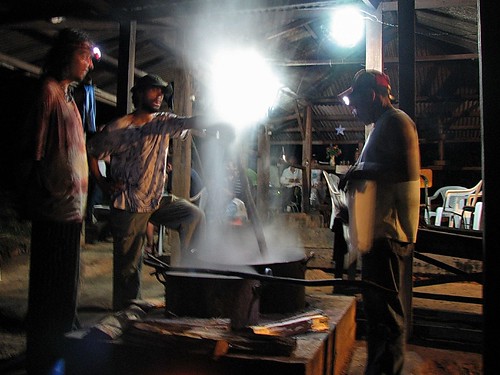
and the cooking
and finally the pamonhas
and cural
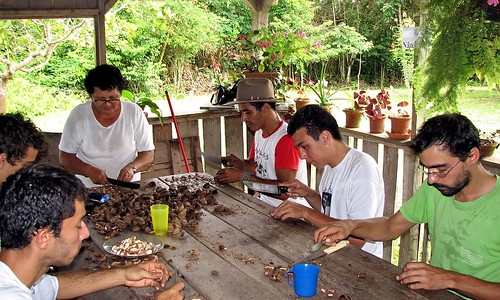
Across the day there was also another work party for cleaning Brazil nuts.
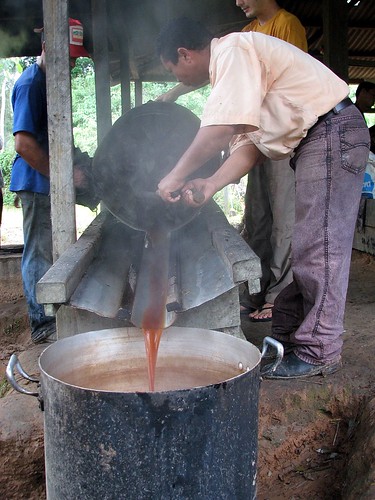
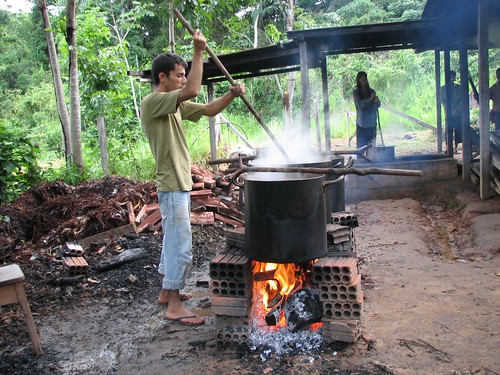
The feitio ritual for making the Santo Daime brings many things together. The leaf, vine, water, fire, music, work, people, friendship, nature, the forest, the place and the Doctrine all forming into a union that fashions a holy drink. The result is much more than the sum of its ingredients. It is something beyond words... a sacrament.
The following video weaves together clips from the several days of the Vila Forteleza feito. It begins with the bateção pounding the jagube vine into long fibers. Saturnino's maraca, the mallets and the voices all work together with the musical Doctrine presented in the hymns of Antônio Gomez (Nosso Mestre). Next comes the days of cooking and more preparation working with the hymns of Padrinhos Sebastião (Vem) and Valdete, and concluding with the final night of the hymns of João Pereira (Lá Vem a Minha Mãe).
VII Encounter for the New Horizon The Closing Days January 8-9, 2008
It's always rather difficult to summarize the annual festival at Vila Fortaleza where so many things get packed into a 10-day intensive of spiritual works. This year the conclusion of the VII Encounter for the New Horizon was especially hard for me to capture into a story, and much less into something that I would consider as "documentary."
The reason for this is that I was very involved in my own inner work of sorting through my life and reaching deeply to find the core of both personal and general meaning(s). It was not easy. Mostly, I felt tired. Often I was caught in thoughts that carried me very far from the present moment. Thus I can only provide a few fragments -- moments that somehow grabbed my attention and caused me to lift my camera.
The closing spiritual work involves singing and dancing two collections of hymns -- the first hinario is Nova Jerusalem from Padrinho Sebastião. In the performance of this ritual singing and dancing, I felt I very special perfection in the way the music, voices and dancing were producing "oneness" of minds and bodies -- music and movement and harmony. And there was a pervading sense of gratefulness.
The hymn offers gratitude -- simply with the precision and union of a single unit working together.
I give thanks to my Father I give thanks to my Mother I give thanks to all beings Who are in this flock
I give thanks to my Mother I give thanks to my Padrinho I give thanks to my brothers and sisters Who are in this garden.
The power of ritual and the Doctrine produces a current of energy that makes one wonder who the dancer, who is the singer?
I'm here because my Father sent me I'm here because I'm the Savior I am bottled, I always live em-bottled And the people are very excited Seeking their worth
I'm here because my Father sent me I'm here because I am the Savior The Master says, the Master sings, the Master speaks And the people get confused In the line of love
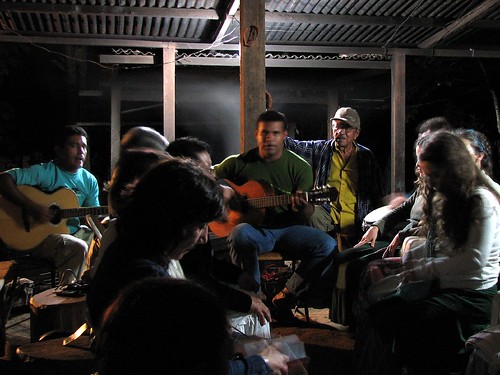
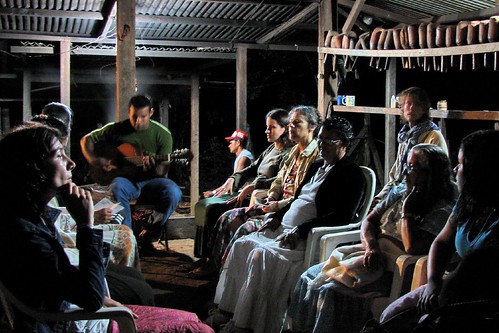
People had come from far away places to participate in this reunion. They came not only to receive put to offer the gift of their participation. During the interval people often spontaneously offered more hymns. This one caught my attention. Reinaldo (from São Paulo) is joined by George (from Portugal), Joanna (from Holland) and by brothers and sisters from Acre.
Here are a few more photos from the last days and the farewells.
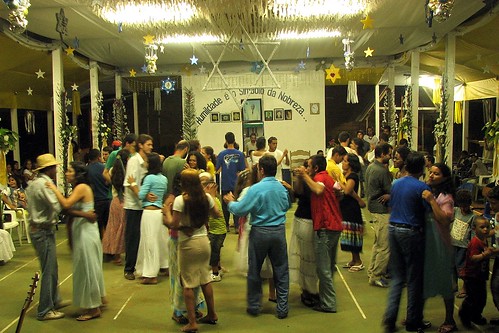
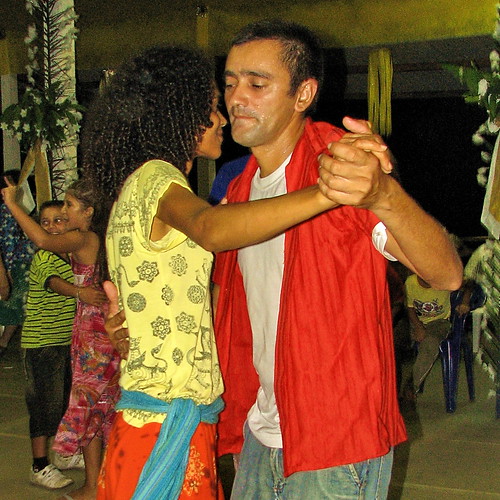
FORRÓ WITH DAIME Encounter for a New Horizon Vila Fortaleza January 2008
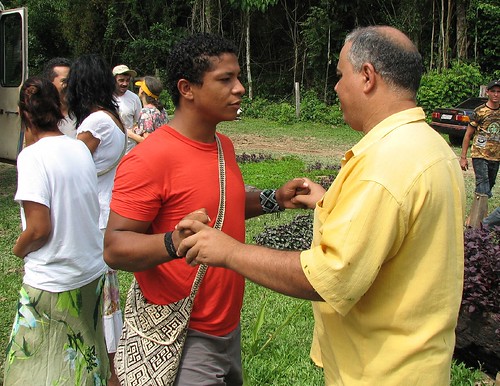
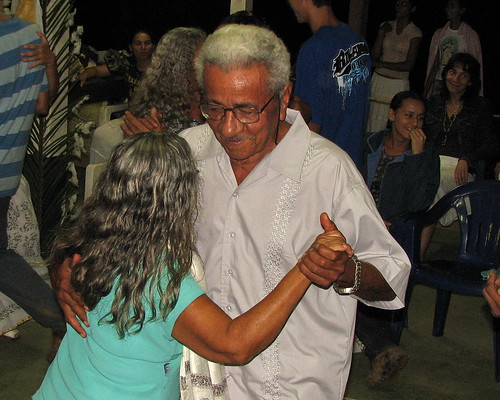
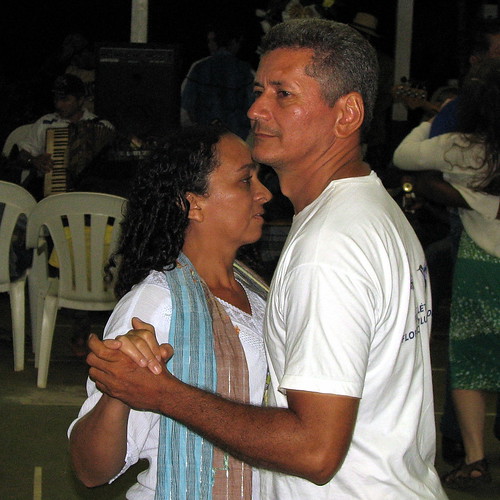
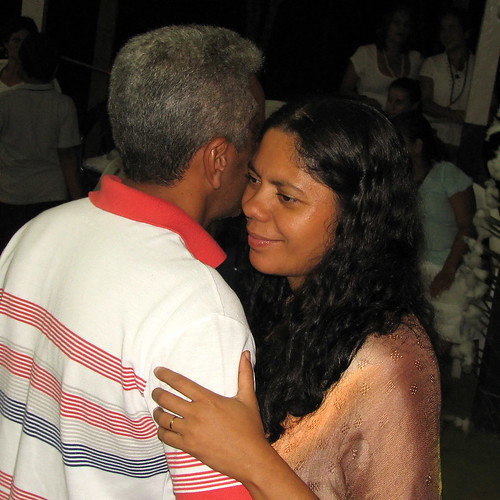
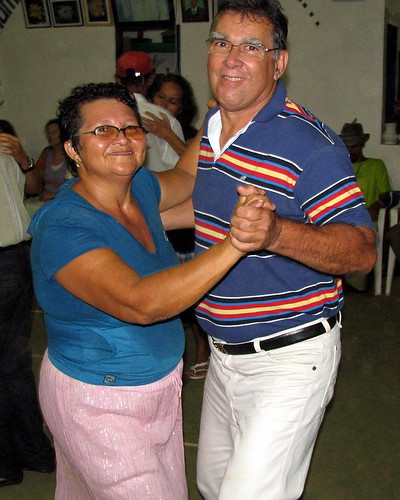
Forró is the popular dance form from Northeastern Brazil where Mestre Irineu was born. In its modern form it is a vigorous dance like a polka but more rhythmic and hip twisting and it has been remixed into forms that are currently popular throughout Brazil, and even in the USA.
In Vila Fortaleza it is danced mostly in the old-fashioned waltz style. Here are the words (in italics) of Padrinho Luiz Mendes recalling forró in the days of Mestre Irienu.
"He provided dance parties. Mestre danced a lot and his favorite dance was precisely the forró. He liked the forró. He was a good and beautiful dancer and was fun in a party. I happened to be in a party that lasted the whole night, but there was a time in the past where they danced for three consecutive nights. ....
"Drinking Daime at a forró… boy, it made a party of it...."
"It is a [spiritual] work. It is a work that gives joy to witness, to dance with your mother, drinking Daime, mirando [visioning], the most beautiful thing that one can appreciate. “Oh! But I don't know how to dance!” The orchestra teaches, the Daime teaches, placing everything in the right way as it should: dancing and mirando."
"There is an expression he [Mestre Irineu] used when he was going to ask a lady for a dance. It is a thing so rich, so rich, the force of this expression upon asking a lady for a dance.... He would stand up and say: “A lady made of silver to dance with a gentleman made of gold.”
"It is very pleasant, it is very good to dance with your woman, to dance with your sister and to dance, finally, with all the ladies, mostly the ones that also took the Daime, because in order for it to work is recommended that the gentleman drinks Daime and the lady also drinks Daime. But it is good, it is very good, it is like a dream that we are just remembering."
"And let’s dance, and let’s cheer up."
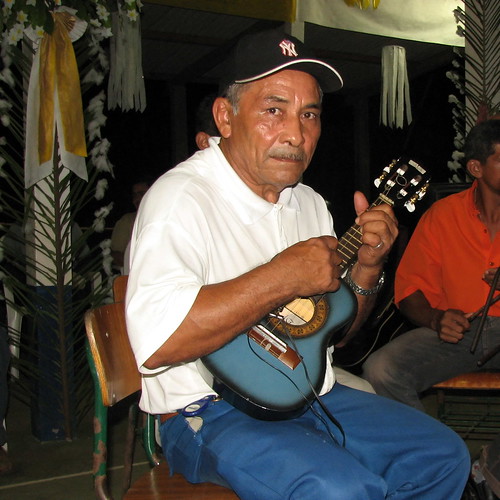
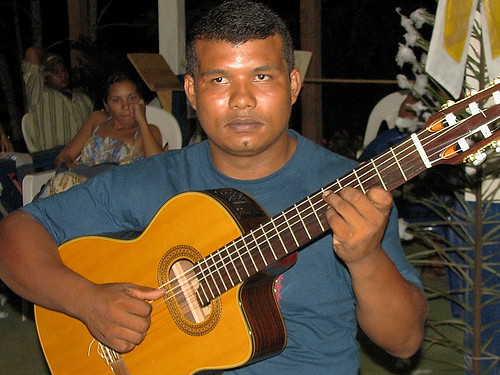
Saturnino singing a Luiz Gonzaga classic.
The song complains about the loss of good air, water, land and of Chico Mendes. At the song's end, Saturnino changes the lyrics slightly to include Mestre Irineu. Chico Mendes and Raimundo Irineu Serra both launched globally significant movements -- political and spiritual -- giving new hope to people and nature from the forests of Acre.
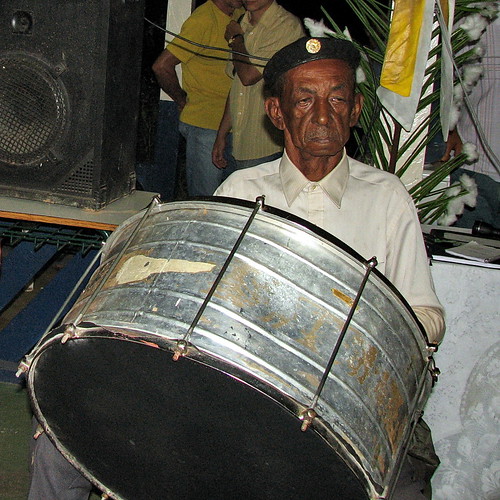
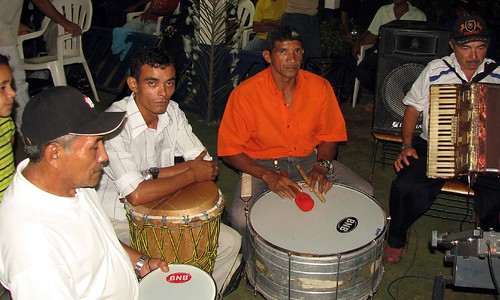
On this night most of the forró musicians (and many guests) were from the local township of Caipixaba which borders on Xapuri where Chico Mendes fought to save the rainforest from the ravages logging and ranching and was murdered in 1988. Across the last 20 years the politics of the area has become more progressive with Acre State programs of land-use planning and sustainable economic development. The old tensions between those who want to preserve and those who want to exploit are being eased in the process.
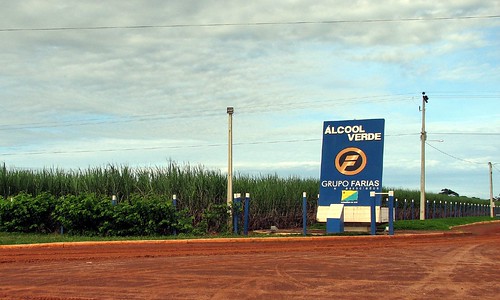
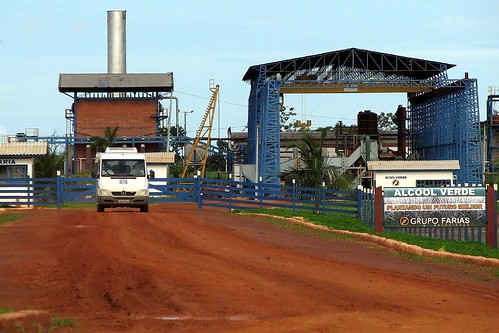
Today, of course, there are new pressures. Signs of globalization are everywhere. There is sugar cane being planted for ethanol
and even gas and oil prospecting (in northern Acre). The road to the west coast is being paved in Peru where, unfortunately, violence and murder have flared up again and illegal logging has penetrated onto Indian lands in Brazil.
The situation is more tranquil in Acre, for sure, but the pressure to develop economically through exports is great. Already, a new bridge to Peru has been opened connecting the roads of Acre and Brazil to Asia and the markets of the Pacific Rim.
On this night of forró at Vila Fortaleza another bridge is being built -- between local people from the rural ranching culture and Santo Daime visitors from the urban centers and abroad. Here, in tiny Vila Fortaleza, they are singing and dancing along the "inner road" of Santo Daime where the important "export products" are friendship and joy. Perhaps, this exuberance and happiness may also have global significance.
NOTE: I think it's important to state that the Daime-Forró shown in this post is not a common experience along the Santo Daime path, and it is not presented by the Luiz Mendes group outside of the home ground of Vila Fortaleza.
Ayahuasca-based rituals involve a very strong psychoactive substance that is often purgative and extremely difficult. In no sense can they be considered as "party drugs." In order to achieve what is shown above, there must be a very strong spiritual container and many well-practiced people. Fortunately, that is what exists at Vila Fortaleza.
This site contains copyrighted material, the use of which has generally not been specifically authorized by the copyright owner. This material is being made available in an attempt to advance understanding of issues of environmental, political, news and humanitarian significance. This site believes this constitutes a "fair use" of any such material as provided in section 107 of the US Copyright Laws.