VISISIONSHARE (blog header)_edited
Showing posts with label Environment. Show all posts

Monday, June 08, 2009

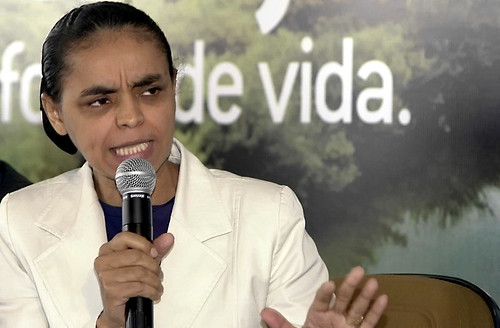
"THE THIRD WORST DAY OF MY LIFE", says Marina Silva

Marina Silva
Brazil to sanction illegal colonization in 230,000 sq mi of Amazon rainforest


NOTE: Last year, Marina Silva, a longtime heroine of the international environmental community, resigned from her post as Minister of Environment in protest of Brazil's development policies. Now, there is a fast-growing grassroots movement of citizens working on promoting Marina Silva's name as a candidate for the presidency. Here is the website (in Portuguese).

Mongabay reports on Brazil's program to turn lawlessness into law.

Go to original article.

(June 08, 2009) Brazil moved a step closer to passing a controversial law that would allow landowners who illegally deforested land in the Amazon to get legal title to these holdings. Environmentalists say HB 458 — which now only needs the signature of President Lula, an avid supporter — will legitimize years of illegal colonization and may promote new deforestation.

"This could be a big step backward for Amazonian conservation," said William F. Laurance, a researcher at the Smithsonian Tropical Research Institute who has spent nearly three decades staying the Brazilian Amazon. "The Amazonian environment is the clear loser here."

The proposed law will enable a claimant gain title for properties up to 1,500 hectares (3,700 acres) provided the land was occupied before December 2004. Critics note the law favors industrial developers over small holders, allowing those controlling 400-1500 ha to sell their holdings after three years. Farmers or ranchers holding under 400 ha have to wait 10 years to sell.

Former Environment Minister Marina Silva said the Senate's passage of HB 458 was the third worst day of her life, following the death of year father and the assassination of her mentor Chico Mendes, a leader of a rubber tapper union based in the Brazilian state of Acre. She added the law would undermine Brazil's progress in formulating and implementing environmental protections, including the setting aside of 523,592 square kilometers of protected areas between 2003 and 2009, an amount accounting for three-quarters of global protected areas established during that period.

HB 458 would grant land title to 300,000 properties illegally established across some 600,000 square kilometers (230,000 square miles) of protected Amazon forest, more than offsetting the conservation gains of the past six years.

Development interests — including large-scale agroindustrial firms, cattle ranchers, loggers, and plantation forestry companies — have lobbied intensely to get HB 458 passed. Supporters of the legislation say that while it will legitimize land-grabs prior to December 2004, HB 458 move may improve governance in an otherwise lawless region where conflict over land and complete disregard of environmental regulations is widespread.

Monday, June 01, 2009

SLAUGHTERING THE AMAZON

slaughtering-the-amazon-cover
In a series of major reports, Greenpeace is explaining to the world that beef production is the main driver of deforestation in Amazônia. Earlier this year, it issued a report showing that nearly 80 percent of land deforested in the Amazon from 1996-2006 is now used for cattle pasture.

The most recent report, Slaughtering the Amazon, charges that major international companies are unwittingly driving the deforestation of the Amazon rainforest through their purchases of leather, beef and other products supplied from the Brazil cattle industry. Greenpeace found that Brazilian beef companies are important suppliers of raw materials used by leading global brands, including Adidas/Reebok, Nike, Carrefour, Eurostar, Unilever, Johnson & Johnson, Toyota, Honda, Gucci, Louis Vuitton, Prada, IKEA, Kraft, Tesco and Wal-Mart, among others.

Clearly, the intention is to sensitize major global consumers and the corporations that manufacture and deliver beef-related products to bring pressure for real operative conservation practices in Brazil. A few years ago a campaign targeting soybean production resulted in an industry-led soy moratorium on planting in illegally logged areas of the Brazilian Amazon. Similarly, consumer consciousness may be able to reduce the linkage between ranching and future illegal deforestation. As with the soy campaign the hope is that eco-sensitive public opinion in the marketplace -- as in the EU -- might become a wedge toward better practices on the ground.

The global market is capable of delivering carrots as well as sticks. Recently, emerging global climate policies such as REDD have been offering the possibilities of new market incentives. Already they seem to be producing something of a rapprochement between antagonists like Minister of Environment Carlos Minc and Soy King and Mato Grosso Governor Blairo Maggi who recently agreed to new policies intended to guide landowners into a new era of protecting the environment in exchange for payments for ecosystem services.

There are, of course, many doubts concerning the details and distrust of market mechanics. But, also, there are high profile campaigns by world leaders -- such as Prince Charles and Wangari Maathai -- and cautious support from many large environmental groups for payments for avoided deforestation. At this early point, the new carbon economy is full of contradictions and Greenpeace and several other environmental groups remain highly skeptical of using carbon offsets for avoided deforestation.

It's definitely not going to be easy to birth a new era of harmony between conservation and development policies, either for the global economy or for Amazônia where the Brazilian Ministry of Environment has often been sabotaged in Congress or on the ground by the more powerful constituencies of the ministries of Agriculture, Energy and Transportation. Indeed, Minister Minc is already facing many of the obstacles that drove his predecessor Marina Silva to her resignation.

As politics and personalities and promises grab the headlines it is important keep in view the pictures of what is happening on the ground where we citizens of Planet Earth -- in Brazil and in the world -- may be losing the future of the Amazon forest.


Photos of Mato Grosso and Para by Leonardo F. Freitas.


*********

More Information -- The Guardian UK has an excellent series on the latest Greenpeace Report:

Amazon rainforests pay the price as demand for beef soars

Supermarkets accused over destruction of rainforest

How our appetite for beef is felling the Amazon

Thursday, May 28, 2009

WHITE IS WONDERFUL

White Houses

Steven Chu, the US Secretary of Energy and a Nobel prize-winning scientist, said yesterday that making roofs and pavements white or light-colored ... would be the equivalent of taking all the cars in the world off the road for 11 years.

"Now you smile, but if you look at all the buildings and make all the roofs white, and if you make the pavement a more concrete-type of colour than a black-type of colour, and you do this uniformly... It's the equivalent of reducing the carbon emissions due to all the cars in the world by 11 years," he said.

"It's like you've just taken them off the road for 11 years. It's actually geoengineering."

Read the full article at The Independent.

Tuesday, May 12, 2009

STUFF GOES VIRAL

Can you imagine it?

Not only has Annie Leonard's “The Story of Stuff” -- a 2007 video warning about the effects of human consumption -- become a viral Internet hit, but now a story about it is #1 on the NY Times "most popular" list.

According to the NYT: "So far, six million people have viewed the film at its site, storyofstuff.com, and millions more have seen it on YouTube. More than 7,000 schools, churches and others have ordered a DVD version, and hundreds of teachers have written Ms. Leonard to say they have assigned students to view it on the Web."

This is the power of the Internet to move a message around the inertias and resistances of the MainStreamMedia which is revenue-dependent on advertising... STUFF!

The STORY carries a Creative Commons license that permits free and open distribution for non-commercial purposes, it has its own blog where you can follow the growing movement (and opposition) to control stuff, and, now, there's an international page with 10 language translations including one for Portuguese.

The "Story of Stuff" exposes the connections between a huge number of environmental and social issues, and calls us together to create a more sustainable and just world. It'll give you something to do in response to the Edward Burtynsky video in the previous post.


THE BEAUTY AND THE BEAST

As we enter the the New Age of the Anthropocene we discover (once again!) that nothing is clearly "this way or that..." but that human beings have a choice. So it is with our newly "made landscapes" -- the form of our emerging times is really a question of which vision will be most widely made.

Two extraordinary contemporary artists have devoted their lives to giving us their views.
First, the "manufactured landscapes" documented by the Canadian photographer Edward Burtynsky.


And, second, the "collaborated landscapes" of British sculptor-photographer Andy Goldsworthy.


Of course, there are enormous differences of intention, effort and scale between these works. Some would argue (with justification) that I'm comparing manufacturing and art. Perhaps, that's the point.

Tuesday, November 20, 2007

TERRA PRETA STORY-TELLING LAUNCHED
ON BLACK AWARENESS DAY IN BRAZIL


São Paulo
Brazil
Black Awareness Day
20 November 2007

Hi Folks,

OK -- I'm still crazy after all these years -- and loving it. I'm well and thriving with the help of many wonderful friends. Brazil has to be the most cordial place in the world. It seems that this is the time and place for me to come out of retirement.

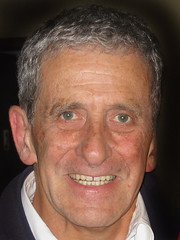
Here's a current pic:

IMG_0036-copy_edited

Here is what I used to look like:


I used to tell a story called
Lessons From the Ancient Forest: Earth Wisdom and Political Action (click to view).

Now, I've got the best story ever to tell. Terra preta de indio (Indian Black Earth) can save the world.

The story needs to go viral, spreading through the Internet. To do this we need storytellers and and song writers and networkers and a lot more conversation.

Maybe you can put it out to your email list(s).

Maybe get the kids (young and old) who are in the internet social networks to talk it up.

We can all do it just by spreading the news - by being a storyteller spreading a healing conversation around the globe.

We need to spread not just an awareness of a terra preta techinique but, even more importantly, we need to inspire folks with the knowledge that a lost Amazonian wisdom showed that large numbers of people could live in balance without destroying the earth.

PLEASE do what you can do.

hugs, lou

*******

I shared the story here.

Kelpie Wilson's easy-to-read and inspiring Terra Preta primer is here.

The BBC transcript of "TheSecret of El Dorado" is here .

The ABC video about the the modern version of terra preta called "Agrichar" is here.

Sunday, November 18, 2007

“What we do in the next two to three
years will determine our future. This
is the defining moment.”


-- Rajendra Pachauri,
director of the UN's International Panel on Climate Change


The story that defines what we might do has been
emerging from Brazil.

It's a golden opportunity.


First, the story...

Once upon a time, way back in the sixteenth century, the Spanish Conquistador Francisco de Orellanawas the first European explorer to travel down length of the Amazon River. Starting in Peru and into the Rio Negro, a huge tributary, upriver from present-day Manaus, the exploration traversed the continent to the Atlantic Ocean. For Orellana and his unfortunate companions it was a terrible trip plagued with every kind of adversity which, in the end, left him as the sole survivor to return to the Court of the King of Spain to tell the story.

But what a story it was. We might even speculate that Orellana survived the ordeal in order to complete his mission of telling of having found Eldorado -- fantastic golden cities in the heart of the forest of the New World. Orellana reported something even more unbelievable than gold -- there was an advanced indigenous civilization with many high density human settlements. Huge Indian populations were living along the waterways of Amazônia and, according to Orellana, at one place there was a city of continuous side-by-side houses stretching for twenty miles. His tale was both fantasic and fabulous. I doubt that the Spanish Court could really embrace the thought of a civilization more advanced than their own but they sure could imagine the gold.

Gold lust inspired many later adventures across the New World but none could find the fabled Eldorado. It was nearly a century later that missionaries came to the region explored by Orellana, but they reported finding only small nomadic bands of hunter-gathers roaming the forest. The obvious conclusion was that Orellana had fabricated a great tale to mask his own failed expedition. And, much later, a whole generation of modern scientists confirmed the implausibility of an Eldorado in the forest by noting that the nutrient poor Amazon soils could not have supported a large-scale agriculture which is the prerequisite of civilization.

But this "well etablished view" that the Amazon basin could not have contained large human populations has started to crumble. First with new research in Bolivia and, more recently, in central Amazõnia, scientists are discovering tell-tale signs of ancient large-scale populations. The indians appear to have figured out how to transform the nutrient-poor yellowish soils into deep deposits of an extremely fertile dark earth called terra preta de indio. What are these tell-tale signs? Terra preta soils are loaded with pottery sherds and charcoal. The pieces of ceramic are in the contour of large pots and vessels that could have been used only by stationary populations. And the charcoal -- apparently char from cleared forest -- has been ground into small pieces indicating that these soils were "made" by the local residents.

The resulting soils are amazingly fertile -- sometimes producing nearly 800% more plant growth compared with nearby untreated soil -- and clearly capable of supporting a large-scale agriculture. Also anthropologists have found at least one small tribe with an hierarchical cultural structure suggesting a distant past of living among large sedentary populations and not always as nomadic hunter-gathers.

Recent efforts to map the areas of terra preta soils along the Tapajos River have unearthed esquisite 2000 year-old pottery. Carbon dating of soils in some other areas suggest that they may be 2500-4000 years old -- and still fully fertile which is extraordinary in the Amazon where heavy rainfall typically leaches the nutrients out of the soils rather quickly. Interestingly, the mapping efforts are revealing a close correspondence with the Eldorado areas talked about by Orellana.

So what happened to these lost civilizations? No one knows for certain. There's little hard evidence because there is no stone in the area and the wooden structures were quickly reclaimed by the tropical forest. But the best speculation is that the first European expeditions carried in diseases -- smallpox, measels, flu, even the common cold -- to a population that had so harmoniously co-evolved with its niche that it had no disease ... and no need for immunity. After a catastrophic die-off there were only a few survivors who had devolved back into hunter-gathers. The sole legacy of the civilization remained hidden in the soil.

Today, in some areas, terra preta is harvested and sold as potting soils. If a limited amount (about 20 cm deep) is retained and the area then left fallow it will grow back to full depth in about 20 years. Apparently -- get this! -- terra preta soils develop into organic communities that are capable of growing like a biotic culture as in sourdough bread or yogurt, truly a living earth.

Five years ago, England's BBC did a special TV documentary called The Secret of Eldorado that concluded with these words: "So there is a true irony to the story of the hunt for El Dorado. There was once a great civilisation in the Amazon, one the Europeans destroyed even as they discovered it, but the Amazonians may have left us a legacy far more precious than the gold the Conquistadors were seeking. That black earth, the terra preta, may mean a better future for us all."

A golden opportunity.

At the time of the 2002 BBC documentary, a better future was understood as gaining the ability to BOTH save the rainforest and feed more people. But, now, global warming has added an incredibibly important new dimension -- the need to remove CO2 from the atmosphere and sequester it somewhere. This is exactly what terra preta does because 1) plants that grow faster, also remove CO2 from the atmosphere faster and 2) if the agricultural waste (unused portions of the plants) are made into charcoal, it can be used to renew the soil and sequester carbon.

The result of such a system would mean better soil, more food, cleaner fuel, less deforestation and, if Kyoto is revised to include payment for carbon negative sequestration in the soil, developing countries like Brazil and poor farmers everywhere will be paid to save the earth, while growing both food and fuel. This is why terra preta is being called the "new black gold".

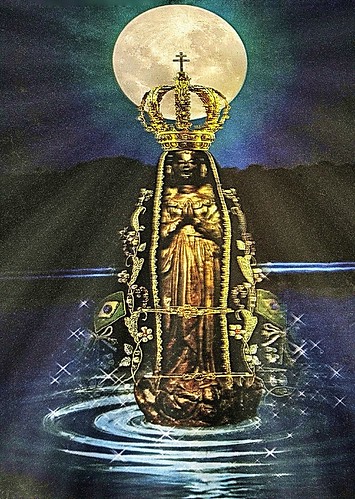
Everyone, who thinks of Brazil, knows of its gifts of samba and soccer which are world renown. But Brazil is also the place where the gift of light emerges out of darkness. When gold was discovered in the state of Minas Gerais, it was given the name ouro preto (black gold) because the nuggets had a dark coating. Later, when a statue of the Virgin with dark skin was discovered in a river bed, it was named, Nossa Senhora Conceição de Aparecida (Our Lady of Conception who Appeared) because it appeared to have wish-granting and healing powers. And, for me, this image is one of the great symbols of the fertility and abundance of Mother Earth.

Nossa Senhora Conceição de Aparecida

This Black Madonna became the patroness of Brazil and the center of the largest healing shrine in the world. Perhaps She is also a powerful symbol for the possibility of healing the earth.

Nowadays, we have the rediscovery of an empowering dark earth brew called terra preta, along with speculation of an ancient and highly advanced Indian civilization. Perhaps terra preta will be Brazil's greatest gift yet to the world. Perhaps we can all spread the story about how there once was a time when large numbers of people lived in a bountiful harmony with the earth in a place called Eldorado and that, with love and care and attention, we can repeat the performance.

Here are links to more information:

Australian Broadcasting Company video (11 min) about the global terra preta movement.

GREAT BBC Documentary "The Secret of El Dorado" (49 min video)

Full transcript of BBC El Dorado documentary.

Easy to read primer on Terra Preta.

Expandable Google map of Terra Preta sites.

Pdfs of the best magazine articles.

Continuous updates of all relevant links.

How biofuels can become carbon-negative and save the planet.

US Senator introduces bio-char legislation.

Research confirms bio-char in soil increases yields.

Biopact on the IPCC bio-fuel recommendations.

UPDATE: This post has been linked in a roundup by Global Voices Online, and translated to Portuguese here.


Friday, November 02, 2007

Dot Earth

I've been following Andrew Revkin's new blog at the NY Times.

revkin.125vert

It's quite wonderful.

Somehow, I feel a special connection with him -- perhaps because of his 1990 book The Burning Season which told the story of Chico Mendes and the struggle against the destruction of the Amazon forest in Xapuri, Acre State. This is quite close to my spiritual heart home with the family of Luiz Mendes at Vila Fortaleza in neighboring Caipixaba.

At Andrew's blog there are also a great set of earth links.

Check it out.

Tuesday, October 30, 2007

Heart Song for a Hermit


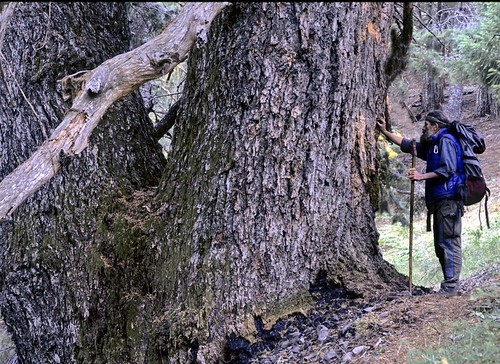
Once upon a time, not terribly long ago, I spent my summers with the "Great Standing Ones.":


'Lou


At that time I used to sit on a mountain in Oregon during the summer and this little bird used to sing to me


Hermit Thrush
Hermit Thrush Photo by Velo Steve

Here is the story:


"Bald Mountain Vigil" originally appeared as two earlier articles in Siskiyou Country, Vols. 8 & 15 (1984 and 1985). Later, it was excerpted and edited for publication in The Soul Unearthed, edited by Cass Adams (Tarcher/Putnam, 1996).


BALD MOUNTAIN VIGIL

For days we had been making preparations for my second summer on the mountain. A series of sweat lodge ceremonies had been conducted to purify our minds and bodies. The Takilma Peace Circle had dedicated Bald Mountain as a special sanctuary to pray for world peace. A group of friends had formed a support group to deliver food to the trailhead throughout the summer. Everything was ready: we were anxious to go, but the storm continued.

Waiting is difficult-it makes me think too much. I thought about the so-called "Wilderness Bill" which had just released over two million acres of Oregon’s roadless areas to the timber industry. I thought about the threat now posed to the great old-growth forest that still flourishes above Silver and Indigo creeks. I thought about the senseless greed and destructiveness of today’s world. Nearly half of all the forests on earth have been cut down since 1950.

Like the rain, my wondering continued. What sense does it make to ask a society that discards its old people to save its old trees? What sense does it make to ask a society that regularly abuses its children to preserve the forest for our great, great grandchildren? What sense does it make to ask a government, which is continually preparing for war, to maintain the peacefulness of the natural world? And what was I doing hiking up to Bald Mountain with people from distant lands, to maintain a forest sanctuary in the middle of nowhere?

Storytelling was a better way to wait. So I shared the tale of how my vigil had begun in the first place. Over a year ago, in May of 1983, I had been arrested in the first activist blockades of logging roads in our National Forests. Our blockade came in the middle of a series of six actions. On that day eight of us sat in front of a bulldozer. Eventually forty-four people got arrested. The court made our probation conditional on not reentering National Forest land for one year. Less than a week later I was back in the Kalmiopsis declaring, "My purpose is peaceful and religious. I shall remain to bear witness to the present attack upon the forest and pray for its safety."

My camp was near the top of the mountain, next to a crystal-clear spring that bubbled out from under a rock. The young ferns, miner’s lettuce, and violets growing around it provided a ready supply of fresh salad greens. A great Douglas fir, ten feet in diameter, created a thick carpet of needles, and its branches shielded my tent from wind and rain.

Within a few days of my arrival I began to sense a growing trust among my new neighbors. The local squirrels, blue jays and juncos were now content merely to announce my presence rather than scold my every move. Deer began to travel the trail through my camp in daylight. The mouse family, which lived in a nearby stump, scampered across my feet as I sat by the fire at night. One afternoon, as I basked in the warm sun, a hummingbird lighted on my shoulder. It made me feel that I had arrived at some sort of harmony with my relatives in the natural world.

My life on the mountain became magical in many ways. Occasional visits from folks bringing supplies felt like a combination of Christmas and family reunion. This kind of experience was not limited to my friends or "support people." Total strangers, just hiking through found themselves hanging out, camping overnight, or readjusting their plans. Sometimes the reaction was extraordinary, as in the case of an Ashland man who made a special return trip to bring me two weeks’ worth of provisions. Nearly everyone tried to offer some kind of assistance: extra food or reading material or a clean pair of socks. Best of all, for me, was just watching people fall in love with the mountain.

The top of Bald Mountain is like Friar Tuck’s head, a flat, barren area about thirty feet in diameter, with a view of the untouched North Kalmiopsis. It is a holy place: good for seeing the four directions, for touching the four winds, for sleeping under the stars, and for talking to God. The overall ambiance of the mountain is more "old growth forest" than "mountain." Decaying remains of ancestral trees still feed the soil and house creepy-crawlers. Grandmother and grandfather trees, the old living ones, stand proudly as secure anchors on steep, fragile slopes. All around there is a feeling of connection with earth and critters and vibrant growing energy. Wendell Berry, in one of his poems, describes feeling "the earth’s empowering brew rise in root and branch." Yes, it was like that.

My daily routine was simple. Gather wood, prepare meals, keep warm and dry, hike down to watch the illegal construction on the Bald Mountain Road, and explore the forest. Walking was a good time for prayer and I often found myself reciting a traditional Navaho chant --

In beauty I walk.
With beauty before me, I walk.
With beauty behind me, I walk.
With beauty above me, I walk.
With beauty below me, I walk.
With beauty all around me, I walk.

This was not ritual. It was simple appreciation.

One day, as I was returning from a morning of road watching, I found a beautiful Knobcone Pine branch, which seemed to have potential for a walking stick. As I passed through a high meadow about a quarter a mile from my camp, however, I plunged the stick into the ground. I had found my meditation spot.

The view from this south-facing slope overlooked seven mountain ridges, which seemed to drift off into the ocean some fifty miles away. Often the ridges rose through low misty clouds, looking like Oriental paintings. For centuries, Buddhist monks have chosen places like my meditation spot to sit and contemplate the impermanence of worldly things. It was a good place to unburden my mind.

During those early days on the mountain, perhaps as a reaction to aloneness, my mind often got terribly busy. I found myself concocting great dramas, holding arguments with the logging industry or delivering self-righteous lectures to the Josephine County Court. But this wasn’t why I had come to the mountain - my purpose was "peaceful and religious" - and these mental debates were making me feel furious and angry.

I meditated and watched my own thoughts come and go like the clouds. I saw that I had no perfect solutions to offer. As my mind emptied, I remembered the awe with which I had, as a child, watched the clouds; I could see that we are all innocent as we attempt to confront the problems of our modern world. For the future of our planet will not turn on our ability to produce the "right solution" as much as on our fundamental values toward life. As the Native American religions tell us, "The two-leggeds have been given a choice."

After my meditation, I would cross over the ridge and drop into the deep, dense forest on the north slope. While the south side was mountain views and sunlight and thoughts, here it was dark and cool. Dewy ferns and decaying branches commingled on the forest floor in an eternal dance of life and death while huge firs rose to form a protective canopy. I could feel the tremendous surge of Mother Earth as the forest enveloped me like a giant womb.

Sometimes I would talk to the trees. I would tell them that a government had drawn a line along the ridge and declared that the forest on one side of the mountain protected, the other side not . . . I would tell them I was just a little guy who wanted to help, who was foolish enough to think that my being there might matter. I would ask the trees to temper my folly with their wisdom, to guide me toward whatever might help them. Each day, without fail, a particular tree or spot would emerge and grip my consciousness. "Just be here," it would say, "live in harmony with us and you will learn whatever you need to know."

Going down to the road was full of another kind of unavoidable reality. The roar of diesel engines and blasting could be heard throughout the forest and reached up to my camp. Hikers told of hearing road work all the way from Pine Flat, which was 2,500 feet below along the Illinois River, to Polar Spring Camp, six miles beyond on the other side of Bald Mountain. As I walked down the trail the grunts and sighs of machines became louder, and the air filled with anxiety.

I watched from a high vantage point about a mile away. From there I could see the full length of the road up to the clearcuts and barren slopes near its beginning on Flat Top. The places directly on the ridge where the trail and road nearly touched each other seemed especially battle-scarred. Freshly felled trees, oozing stumps, deep wounds in the earth and giant equipment all made me shudder.

One day, while sitting there with a visitor, I said, "Perhaps I’m exaggerating, but that looks like a road bringing a war into a peaceful area." The visitor told me about working in a Forest Service survey crew on Flat Top several years earlier. His supervisor looked out over the Wilderness Area and said, "Those trees are protected now, but someday we will get them."

The Illinois River Trail formed the northern boundary of the protected Kalmiopsis Wilderness and the Forest Service had posted many signs. On the road side of the trail the signs read:

ROAD CLOSED
NO TRESPASSING
BY ORDER OF USFS

On the other side:

WILDERNESS AREA
NO MOTORIZED VEHICLES OR EQUIPMENT
VIOLATIONS PUNISHABLE.

The trail felt like a demilitarized zone between warring armies.
I remembered some lines from the 74th Psalm:

The enemy has damaged everything
within the sanctuary;
Thine adversaries have roared in
the midst of Thy meeting place;
They have set up their own
standards for signs.
It seems as if one had lifted up
his axe in a forest of trees.

My first reaction was anger - I wanted to tear down all the signs. Instead, I carved a sign of my own, and hung it on a tree farther down the trail. It read:

BALD MOUNTAIN SANCTUARY
FOLLOW THE BEAUTY TRAIL
COME IN PEACE

I wanted to stay on Bald Mountain as long as the forest was threatened, but the coming of winter forced me off. I had kept my first Bald Mountain vigil for fifty-six days.

Now, nine months later, I was ready to return for my second summer on the mountain.
The storm broke in the night and Karin (from Germany), Pablo (from Spain) and I left for the trailhead early the next morning.

The first few miles of the trail snake upward along perilously steep cliffs high above the Illinois River. My body soon registered the effects of my long rainy season hibernation. As my muscles screamed, every questionable item I had put into my pack danced in front of my mind and grew in size and weight. To make things worse, the clouds had reformed and we were soon putting on our rain gear. This was not going to be an easy hike. The combined burden of a heavy pack and bad weather left little space for my weighty thoughts of the day before. I was forced to set aside all my "wondering" and concentrate on taking one step at a time. When we reached our campsite, the clouds scattered and sunlight began to play across the forest floor. This last storm of spring had ended. Sore and tired, I cast off my pack and felt somehow younger, as if inner burdens born of the world below had been released.

I was excited to visit familiar spots in the forest and led the group on a whirlwind tour. The forest was full of the dense green lushness of late spring and the air was heady with the smells of new growth. The local blue jays, juncos and pine squirrels chattered at us and I wondered if they remembered me. I felt like an enthusiastic child bringing new friends home.

Last summer I had done much of my praying on my hands and knees, picking up bits of broken glass and rusty nails left years ago when the Forest Service had burned down the old lookout. Before leaving the mountain I had constructed a traditional American Indian Medicine Wheel - a prayer circle with flagpoles marking the four directions, the sky and the earth - and the mountaintop was reasonably clean. Now the flagpoles were bent over and a whole new layer of glass and debris had been uncovered by nine months of fierce winds, rain and snow.

Karin, Pablo and I committed ourselves to a regular routine of mountaintop clean-up. Restoring the Medicine Wheel for the approaching Summer Solstice became our most important task. The activity evolved into a meditation - we were not only cleaning up the mountain, but clearing away the thoughts and emotional debris that had been cluttering up our minds. Sometimes one of us would consider a particular piece of glass or rusty nail as a special treasure, seriously discussing its peculiar properties until there was nothing left to do but throw it away. In the humor of the situation, we also faced many of the meanings and absurdities within our own lives.

There were times during those mountaintop clean-up sessions when we’d laugh hard enough to send tears rolling down our cheeks. Then, cleansed with laughter, we’d sit quietly listening to the song of the Hermit Thrush - who we named "Sunsinger"- and watch the sun sink slowly into the ocean beyond the distant ridgeline. Light-hearted and giddy, we’d stumble down the trail toward hot chocolate and stories around the campfire before sleep.

It was over a week until the first group of hikers came through, a 4-H Club outing from Brookings. The leaders of the group, two middle-aged women tired from the long hike up the mountain, looked at our neatly stacked kindling and asked, "Are you planning to stay here all summer?" They were obviously disappointed that their hoped for camping spot was occupied. I thought about the Forest Service fourteen-day camping limitation and responded evasively, "We’ll stay as long as we are supposed to."

Fortunately, there was another campsite nearby with a good source of water and excellent forage for their pack animals. I told them about our mountaintop clean-up project and invited them to join us. About an hour later, three boys - Clint, Adam and Jay - came running up the trail. They turned trash gathering into a competitive game and soon several more buckets of glass were dumped into burlap sacks.

At sunset, Pablo, Karin and I sat quietly in the prayer circle, but the boys couldn’t stop laughing. Jay and Adam would try to hold back, as if in church, but Clint’s infectious giggle would soon get them started again. Finally I said, "Go ahead and laugh. That happens to us all the time," and we joined together in a circle hug of laughter. In that moment, the sound of laughing children seemed like the finest prayer. Listening, I imagined a future full of old trees and happy children and knew then, with a deep certainty, why I was maintaining a wilderness sanctuary on top of Bald Mountain.

The next morning Clint organized another clean-up party at sunrise. We were just rolling out of our sleeping bags when the boys came down from the mountaintop. Clint looked at me with a wink and said, "We left a present for you up there." They had filled seven sacks, over three hundred and fifty pounds of glass and nails. The clean-up task had been completed and I only wished for some way to get it all off the mountain.

A few days later the Forest Service trail maintenance supervisor, Harvey Timeus, visited our camp. I offered him some fresh-brewed coffee. When he asked how long we were planning to stay, I responded, matter-of-factly, "All summer, if the food keeps coming." He frowned, mentioned the fourteen-day rule, and said he would have to do something if there were complaints. I wondered if the leaders of the 4-H Club outing had already produced some. Our conversation reached an impasse. After a long silence, Harvey said, "By the way, we’ll pay our trail maintenance crew to pack out all that trash you picked up. If you went to all that trouble, the least we can do is get it out of here." My wish had been granted.

The next day the Forest Service again visited us, this time by District Ranger Bill Butler. We talked about the wilderness values of the area and some of the hard decisions that lay ahead. I waited for him to raise the issue of the fourteen-day rule but, instead, he asked if I would like to do some volunteer work and mentioned brushing out an old trail. I said, "As long as the work doesn’t carry me too far from the mountaintop." He said, "Fine, I’ll send in some tools."

A week later Harvey returned with tools and an "Agreement for Voluntary Services." The agreement called for me to maintain the Bald Mountain Lookout Loop Trail. "Wow, that sort of makes me the caretaker of the Bald Mountain Sanctuary, doesn’t it?" I said. He smiled and his son, who had come along for the hike, gave me a wink. Harvey’s son was Clint, the boy from the 4-H Club outing.

By Summer Solstice, the Medicine Wheel had been fully restored. Brightly colored flags waved in the strong breeze and fresh strings of tobacco ties decorated the flagpoles. On Solstice we spent twenty-four hours within the prayer circle, fasting and remaining in silence. The night before, we had gone to sleep blanketed by wet clouds that hovered about the mountaintop. At dawn a patch of blue sky opened directly above us. All day we watched as the sun burned off the moisture, and mountain ridges rose out of the low-lying fog and the clear sky spread away from us toward the coast. It felt as if a light or energy was radiating outward from Bald Mountain.

Everything had a quality of sacredness on that longest day. We walked the circle casting tobacco to the winds. We burned cedar and sage in the fire pit near the centerpole. We prayed for the trees, gave thanks for the many wonders of this existence, and thought of loved ones near and far. The circle was complete: we stood humbly in the midst of a great natural harmony and the world, for the moment, seemed in order. Then I had a vision of many prayer circles, forest and mountain shrines throughout our region - places of power and renewal, of peace and pilgrimage. They would be, like Bald Mountain, safe spots in confusing times, rallying points and sanctuaries for those who love this earth and HER peoples.

###########################

Back then, over 20 years ago, I wasn't quite sure who SHE was but later I came to know her as the Queen of the Forest, Rainha da Floresta, as she is called in Brazil and that's why I'm here in São Paulo now trying to make connections that might help protect the greatest forest on earth.

But São Paulo is a tough place facing, like most mega-cities, huge problems. Nature and the forest seem far away and are thought of mostly for recreation and retreat, but not for truth or necessity. Indeed, it's hard to get people to give it much thought let alone a real priority. Sometimes I can feel very far from home and very alone. Sometimes I get sad that our world is, unfortunately, the way it is.

But today, thanks to a new Internet friend Tim, I discovered that that little bird, the Hermit Thrush, can still sing to the hermit in my heart. It's the finest hymn that I have ever heard.

Listen to the Song of the Hermit Thrush


Friday, May 25, 2007

POWERFUL WORDS

Fifteen years ago at the 1992 Earth Summit in Rio de Janeiro, Severn Suzuki (the daughter of Canada's main environmental voice David Suzuki) spoke plain simple words to the leaders of the world. Now it has been placed on YouTube with a Portuguese translation. I feel that it is especially important to listen to her words again (and again), especially since everything she was talking about is even more challenging today.


Severn said it all. When will we hear it?


Severn Cullis-Suzuki has been active in environmental and social justice work ever since kindergarten. She was twelve years old in 1992 when she gave this speech, and she received a standing ovation.


"Hello, I'm Severn Suzuki speaking for E.C.O. - The Environmental Children's Organisation.

We are a group of twelve and thirteen-year-olds from Canada trying to make a difference:
Vanessa Suttie, Morgan Geisler, Michelle Quigg and me. We raised all the money ourselves to come six thousand miles to tell you adults you must change your ways. Coming here today, I have no hidden agenda. I am fighting for my future.

Losing my future is not like losing an election or a few points on the stock market. I am here to speak for all generations to come.

I am here to speak on behalf of the starving children around the world whose cries go unheard.

I am here to speak for the countless animals dying across this planet because they have nowhere left to go. We cannot afford to be not heard.

I am afraid to go out in the sun now because of the holes in the ozone. I am afraid to breathe the air because I don't know what chemicals are in it.

I used to go fishing in Vancouver with my dad until just a few years ago we found the fish full of cancers. And now we hear about animals and plants going exinct every day -- vanishing forever.

In my life, I have dreamt of seeing the great herds of wild animals, jungles and rainforests full of birds and butterfilies, but now I wonder if they will even exist for my children to see.

Did you have to worry about these little things when you were my age?

All this is happening before our eyes and yet we act as if we have all the time we want and all the solutions. I'm only a child and I don't have all the solutions, but I want you to realise, neither do you!

* You don't know how to fix the holes in our ozone layer.
* You don't know how to bring salmon back up a dead stream.
* You don't know how to bring back an animal now extinct.
* And you can't bring back forests that once grew where there is now desert.

If you don't know how to fix it, please stop breaking it!

Here, you may be delegates of your governments, business people, organisers, reporters or poiticians - but really you are mothers and fathers, brothers and sister, aunts and uncles - and all of you are somebody's child.
I'm only a child yet I know we are all part of a family, five billion strong, in fact, 30 million species strong and we all share the same air, water and soil -- borders and governments will never change that.

I'm only a child yet I know we are all in this together and should act as one single world towards one single goal.

In my anger, I am not blind, and in my fear, I am not afraid to tell the world how I feel.

In my country, we make so much waste, we buy and throw away, buy and throw away, and yet northern countries will not share with the needy. Even when we have more than enough, we are afraid to lose some of our wealth, afraid to share.

In Canada, we live the privileged life, with plenty of food, water and shelter -- we have watches, bicycles, computers and television sets.

Two days ago here in Brazil, we were shocked when we spent some time with some children living on the streets. And this is what one child told us: "I wish I was rich and if I were, I would give all the street children food, clothes, medicine, shelter and love and affection."

If a child on the street who has nothing, is willing to share, why are we who have everyting still so greedy?

I can't stop thinking that these children are my age, that it makes a tremendous difference where you are born, that I could be one of those children living in the Favellas of Rio; I could be a child starving in Somalia; a victim of war in the Middle East or a beggar in India.

I'm only a child yet I know if all the money spent on war was spent on ending poverty and finding environmental answers, what a wonderful place this earth would be!

At school, even in kindergarten, you teach us to behave in the world. You teach us:

* not to fight with others,
* to work things out,
* to respect others,
* to clean up our mess,
* not to hurt other creatures
* to share - not be greedy.

Then why do you go out and do the things you tell us not to do?

Do not forget why you're attending these conferences, who you're doing this for -- we are your own children. You are deciding what kind of world we will grow up in. Parents should be able to comfort their children by saying "everyting's going to be alright" , "we're doing the best we can" and "it's not the end of the world".

But I don't think you can say that to us anymore. Are we even on your list of priorities? My father always says "You are what you do, not what you say."

Well, what you do makes me cry at night. You grown ups say you love us. I challenge you, please make your actions reflect your words. Thank you for listening"