VISISIONSHARE (blog header)_edited
Showing posts with label global warming. Show all posts

Tuesday, May 27, 2008

SHAME ON

WIRED MAGAZINE: ISSUE 16.06


It is really unfortunate that WIRED saw fit to pass on so much superficiality (and some down right errors) in its special section on global warming. This will sell magazines the same way that climate change skepticism does -- by toying with ignorance. But in this vital area -- that will being affecting all of us -- we really need deep education rather than puff and flame. WIRED has stooped toward the lower and more ignorant poles of the discourse. It's sad to see such an important topic reduced to tabloid treatment.

Here are some brief comments on the various sections (with links to the WIRED text).

CITIES

High density metropolitan area centers are definitely much more efficient than suburbs. But there are cities and cities. A lot of it is about car use. Manhattan is probably one of the best in the world because driving is so impossible and it has a great subway. On the other hand, modernist Brasilia is heading toward being one of the worst because it is completely auto-dependent. But cities are efficient, for example, it is much more efficient to heat/cool people in buildings than in single family homes. The critical questions really don't focus on cities but should deal with out-of-control suburban sprawl.

AIR-CONDITIONING

True, cooling takes less energy than heating. Of course, it's all relative to base temperatures and how comfortable people want to be. If heating and cooling become adopted as comfort symbols in tropical zones where it can also turn pretty cool, it will have a tremendous impact. In Brazil, for example, people generally have no heating or cooling or expensive insulation in their homes. They simply dress for the weather which is much more efficient than trying to heat and cool all of those boxes. And, the writer seems to reveal his urban intellectual bias with his bucolic image of the country dweller chopping wood and siting around the pot-bellied stove. When I lived in the Oregon backcountry most people had already shifted to more efficient oil heaters precisely because of their awareness of the environmental consequences.

ORGANICS

Food questions are real tricky. In general I like the lines of thinking presented by Michael Polan here and here. I think the bottom line conclusion is correct that both eating less meat and eating foods grown locally are extremely important. In Brazil, for example, it is the expansion of range for cattle that is the first line of cutting and burning the forest. Feed lot production would be much more efficient and reduce deforestation.

FORESTS

This one is simply off-the-wall crazy. Yes, forests are carbon neutral and not carbon negative, recycling rather that sequestering carbon across the very long term. The Canadian study is correct -- standing forests do not capture and sequester MORE carbon if they have reached maturity and equilibrium. So Canada can't get carbon offset funds to meet its Kyoto obligations by claiming its mature forests are removing and storing carbon (especially since climate change is already producing drought and more forest fires). But the issue is totally different -- it is about DEFORESTATION. Suddenly enormous amounts of stored CO2 are released from disturbed soil, from burning, from processing much of wood fiber into many short-term products like paper. Thus, 1000s of years of carbon stored stored in tree trunks and soil can be propelled into the atmosphere in a single logging season. It is all even much more problematic in the tropics where the soils degrade so quickly that forests may never return. This is why Brazil is hoping for REDD funds (carbon credits for avoided deforestation). In the temperate zones, (contrary to the interpretation given) it absolutely essential to protect places like the pictured Redwoods and the Headwaters Forest precisely because they don't burn.

CHINA

I agree. China is the main experimental location of the interface between population, development and environment. Technological innovation will emerge in China out of necessity. One caution though is the dynamic of global trade -- it might be cheaper for China to get commodities and resources from Brazil than to become more efficient at home in some areas. It's the old story of where you put the waste and destruction. The rich generally "outsource" it to poorer areas within their own countries or abroad. So, the truth is that we are globally connected and technological innovations in places like Brazil will be very important in determining the ultimate viability of the Chinese experiment.

GENETIC ENGINEERING

Genetically engineered crops are here to stay. They will produce many new advantages. The problem (mostly) will be that some crops will be so successful that they will come to dominate everywhere and natural biodiversity and variation will be lost. A simplified gene pool and less-varied agriculture will also be a weakened and more vulnerable agriculture. Nature's insurance policy is biodiversity which increases the chances that when abrupt or unforeseen changes occur there will be something available with good adaptive qualities. Nature shifts around all the time. The labs are going to be challenged to keep up with it all. Don't toss out the results of eons of natural evolution.

CARBON TRADING

This one really suffers from shallowness. The issue is very complicated and responses will probably involve a mixture of markets and taxes.
Fortune magazine predicts that a 3 trillion dollar carbon market is coming. The problem is working out the details and the devil is always in the details. It will take many years and much trial and error to reach a stable institutional platform for dealing with carbon but it's coming for sure and its architecture will include both trading and taxes.

NUCLEAR POWER

[UPDATE: May 30, 2008 WorldChanging ran an interesting article by Amory Lovins that says, "The punch line: nuclear expansion buys two to 10 times less climate protection per dollar, far slower than its winning competitors."]

I think this one has the correct drift but there are still big problems of waste disposal, relative costs, political will and weapons proliferation. Nuclear is coming but not for all. For example Google, facing the uncomfortable fact that the Internet will soon be the single largest draw-down of electrical energy, is now betting on solar technology.

USED CARS

Right now used cars are the better deal. Mass transportation often is even better, especially in metropolitan areas. Currently excessive car ownership is concentrated in the developed world but autos are quickly becoming a status symbol for rising middle classes worldwide -- even in street-clogged cities of India. We need to find something better than used cars.

THE WORST CASE

Yes, the greenhouse gas load already traveling into the atmosphere is going to push the tipping points. Adaptation is going to be more and more important. But like personal health it's got to be a mixture of prevention, cure and acceptance.



Monday, April 21, 2008

WHY BOTHER?

Michael Pollan - Salon Photo
Michael Pollan graphic from Salon.


"Why Bother" is the title of a brilliant article that appeared yesterday in the NY Times Magazine. In it Michael Pollan asked why, -- if half of the world is standing in line wanting to experience the American habits of material consumption [it used to be called the "American Standard of Living"] -- why on earth, should Americans bother trying to reduce their carbon footprint? He actually offers some very good reasons. I urge you to consider what he says. Read the article.

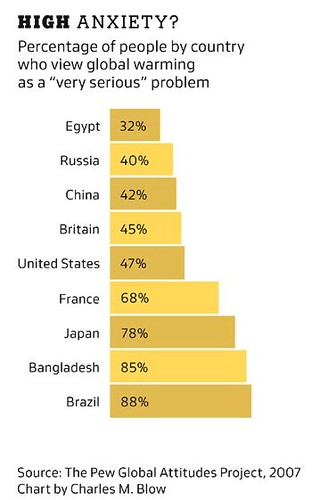
Meanwhile I am very pleased to report that Brazil is now the leader in public opinion considering global warming as a "very serious problem."

Concern about Global Warming

You may wonder why I am pleased? It is because Brazil is both a natural resource giant and a rapidly developing economy. The United States did not have much of an ecological consciousness as it bulldozed its development path through the destruction of 90% of its original forests. But Brazil, with 80% of its vast forests (an area the size of Western Europe) and a treasure trove of natural beauties still in a pristine state has an opportunity to choose more ecologically aware strategies. The already developed world can best "make up" for its own highly destructive ways of the past by supporting Brazil in its efforts to find better ways now.

Friday, April 11, 2008

TIME TO ACT

IMG_0346_edited_1_edited

According to Al Gore's recent TED Talk, "If we had just one week's worth of what we spend on the Iraq war, we could be well on the way to solving the [global warming] challenge."


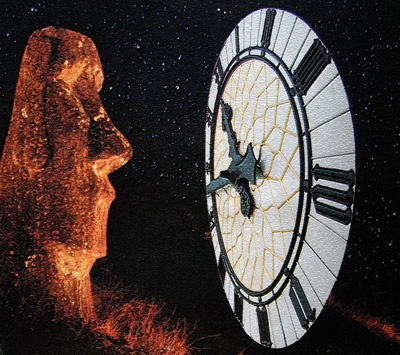
Our time is running


IMG_0340_edited_1_edited


Let's not let it run out


IMG_0350_edited_1_edited


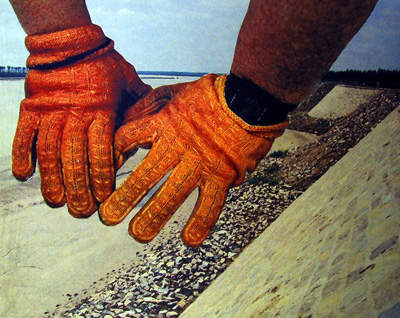
Support change now. CLICK HERE

Sunday, March 23, 2008

Resurrection of the Earth
seems like a perfect post for an Easter Sunday.

But, first I'd like you to consider an image -- a photo montage created by the Brazilian visionary artist and designer Guta.

Rainha


I'm sure that Guta would have presented a much more professional-looking rendering of this magnificent image. (I simply "posterized" a poor photo of his work.) It captures the interweaving of two great Brazilian religious traditions -- Aparecida and Santo Daime -- both of which manifest the spiritual energy of this Brazilian
and universal Goddess. And, now, I have an additional connection in mind.

Back in November I reported a newspaper article that said:

"God is Brazilian",
said Brazilian President Luiz Inacio Lula da Silva in response to his government's announcement that massive new oil reserves had been discovered offshore.
But, it turns out that there is more than one kind of Black Gold. The recent "rediscovery" of Terra Preta soils of the ancient Amazonian Indians may prove to be more valuable than off-shore oil. If God is Brazilian, She just might be Black.


This image is of the much-revered Black Madonna of Brazil, Nossa Senhora de Conceição Aparecida -- Our Lady of Conception Who Appeared.

Aparecida

The story is that a statue of the Virgin made around 1650 was somehow lost. Then, in 1717, some government people were traveling north to the gold mining region of Minas Gerais where the precious metal was called Ouro Preto due to a dark coating on the nuggets. Along the way fishermen cast their nets in a river hoping to catch fish for a big banquet. Instead of fish, they found the statue -- all darkened by years in the river bed. The travelers went on but the statue was kept in a little family shrine.

Soon the statue appeared to have healing and wish-granting powers -- at least for some faithful ones -- and a cult began to grow around it. As time passed, it had to be housed in larger and larger quarters and came to be venerated throughout Brazil. In 1929, the Virgin was proclaimed Queen of Brazil and its official Patron Saint. Today its Basilica, in the city of Aparecida near São Paulo, receives about 7 million visitors yearly and is the largest Marian shrine in the world.

From the first time I saw this great Black Madonna, this symbol appeared to me as more than an artifact of the Catholic Church. Indeed, it seemed even more like an icon of the power of the earth.

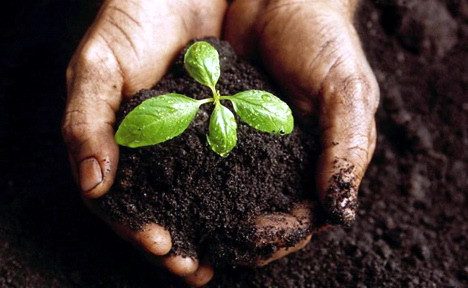
Nowadays, there is an emerging parallel story. As the world searches for solutions to hunger, fuel shortages, deforestation and climate change, Terra Preta soil from deep in Amazônia may be emerging as as a way to heal the earth. YES, biochar -- the modern equivalent of Terra Preta de Indios -- may be rising into our awareness truly as the resurrection of the earth.

And, yes, the Goddess is Black.

Biochar_Hand

Can you imagine fighting hunger, energy poverty, deforestation and climate change SIMULTANEOUSLY?

Please stay tuned.


Tuesday, November 20, 2007

TERRA PRETA STORY-TELLING LAUNCHED
ON BLACK AWARENESS DAY IN BRAZIL


São Paulo
Brazil
Black Awareness Day
20 November 2007

Hi Folks,

OK -- I'm still crazy after all these years -- and loving it. I'm well and thriving with the help of many wonderful friends. Brazil has to be the most cordial place in the world. It seems that this is the time and place for me to come out of retirement.

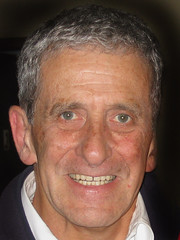
Here's a current pic:

IMG_0036-copy_edited

Here is what I used to look like:


I used to tell a story called
Lessons From the Ancient Forest: Earth Wisdom and Political Action (click to view).

Now, I've got the best story ever to tell. Terra preta de indio (Indian Black Earth) can save the world.

The story needs to go viral, spreading through the Internet. To do this we need storytellers and and song writers and networkers and a lot more conversation.

Maybe you can put it out to your email list(s).

Maybe get the kids (young and old) who are in the internet social networks to talk it up.

We can all do it just by spreading the news - by being a storyteller spreading a healing conversation around the globe.

We need to spread not just an awareness of a terra preta techinique but, even more importantly, we need to inspire folks with the knowledge that a lost Amazonian wisdom showed that large numbers of people could live in balance without destroying the earth.

PLEASE do what you can do.

hugs, lou

*******

I shared the story here.

Kelpie Wilson's easy-to-read and inspiring Terra Preta primer is here.

The BBC transcript of "TheSecret of El Dorado" is here .

The ABC video about the the modern version of terra preta called "Agrichar" is here.

Friday, November 09, 2007

AMAZÔNIA: WHAT WILL BE THE FUTURE?

1016co_nasa

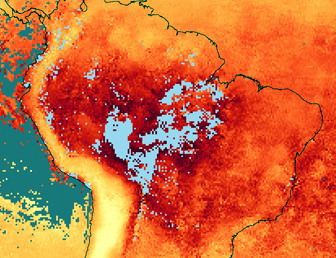
The above photo from NASA shows the concentrations of carbon monoxide (grey areas) hovering over Amazônia during September 2007. Carbon monoxide indicates smoke, fire, greenhouse gas pollution and, of course, deforestation. Burning and cutting the tropical rainforests now contributes more than 20% of global greenhouse gas pollution.

It is now believed that the eastern half of the Amazon forest, located in Brazil, may be seriously at risk. "It's not out of the question to think that half of the basin will be either cleared or severely impoverished just 20 years from now," stated Dr. Daniel Nepstad, head of the Woods Hole Research Center's Amazon program. "The nightmare scenario is one where we have a 2005-like year that extended for a couple years, coupled with a high deforestation where we get huge areas of burning, which would produce smoke that would further reduce rainfall, worsening the cycle. A situation like this is very possible." Read more at Mongabay.

The future Amazon will be the result of choices made by Brazil and the rest of the world in coming years. John Terborgh, writing in the current NY Review of Books tells us how it looks from the highest levels in Brazil:

What is the attitude of the Brazilian government toward a possible climatic calamity in the Amazon? On being shown the predictions of some climate models, President Luiz Inácio Lula da Silva reputedly posed two alternatives. If the rest of the world is so concerned about the future of the Amazon, then let the rich countries pay us not to cut it down. Otherwise, if the forest is going to succumb to drought and fire, then we ought to cut it down first so that we can benefit from the resources before they are lost to the ravages of nature.

Not everyone will be happy with these alternatives, but Lula's pronouncements may not be that far off the mark. The Amazon is being logged at a prodigious rate and with further improvements in transportation envisioned under the Avança Brasil program, logging, and with it the risk of fire, is bound to spread over much of the basin. Slowing or stopping the logging would require a political will that simply doesn't exist in a country obsessed with maximizing development.

Which of Lula's alternatives will the future bring, a green Amazon supported by an international community united against the specter of radical climate change, or a brown Amazon, parched by deforestation and scorched by fire? In my view, the prospects of the green alternative will be determined by the treaty that will succeed Kyoto. At Kyoto, it was decided not to include forests in a system by which carbon emissions are controlled through "cap-and-trade"—i.e., by allowing countries that cut back on emissions to receive tradable credits for doing so. Many now feel that the omission was a mistake because forests store such huge stocks of carbon. Yet how forests will be brought into a second-generation treaty is anyone's guess. Short of significant international intervention through financial incentives or other mechanisms, the business-as-usual scenario will certainly prevail.


Kyoto is about to be reformulated. The choice over the future of Amazônia is likely to come soon. There's been some foolish talk about who owns the Amazon forest. Without doubt, it is owned by Brazil and its neighbors. But the financial choice over its future is clearly owned by all of us.

Wednesday, November 07, 2007

US Ethanol Subsidies Help Fuel Range Wars and Fires in the Amazon


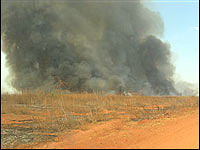
On Monday (11-05-07) US National Public Radio ran a feature segment on "All Things Considered" about the record 2007 fire
season in the Amazon and the situation in Mato Grosso. The photo at the left shows a fire that was intentionally set on neighboring property in the struggle over land titles but spread and eventually burned 90% of John Carter's 22,000 acre ranch.
(photo credit: npr)
Click to hear John tell the story.

This year's fire season dominated the US news for many days as a "national disaster" was declared in southern California because Santa Ana winds whipped about 25 fires into a local frenzy. But compared to the Amazon it would seem no more than a few embers. Mongabay reported some astonishing fire statistics -- depending on which satellite data set is used, this season there were between 50,729 and 72,329 Amazon fires, close to or more than the all-time record.

Here is a NASA satellite view of the fires burning in the states of Mato Grosso, Para and Amazônas on September 29, 2007. The most intense burning is located in areas that had been opened by roads, and now the fires were spreading across agricultural lands and protected reserves as well. Road-building comes first, then a mix of development and protection but fire respects neither.

1016nasa

Unfortunately, these data seem to end speculation that the reductions of fire and deforestation seen in Brazil across the last 2-3 years were the results of aggressive new government initiatives of regulation, monitoring and enforcement. Instead, it appears that variations in the amount fire and deforestation are more closely correlated with fluctuations in global commodity prices, which now are recovering from a recent slump.

While many factors influence the rate of fire and deforestation, the main driving force seems to be the planting of soybeans. The Mongabay report offered the views of two leading scientists:


Dr. Philip M. Fearnside, one of the most widely cited experts on the Amazon, says that the rise of soy in the region has provided support for infrastructure projects which, in turn, have fueled forest destruction.

"Soybean farms cause some forest clearing directly. But they have a much greater impact on deforestation by consuming cleared land, savanna, and transitional forests, thereby pushing ranchers and slash-and-burn farmers ever deeper into the forest frontier," he explained after co-authoring a 2004 paper in Science on the impact of soy. "Soybean farming also provides a key economic and political impetus for new highways and infrastructure projects, which accelerate deforestation by other actors."

"What’s most striking is that fires in 2007 have increased dramatically in the main soy-production states in the Brazilian Amazon—Mato Grosso, Para, Maranhao, and Tocantins—but have dropped or remain stable in other Amazonian states," said Dr. William Laurance, a senior researcher at the Smithsonian Tropical Research Institute (STRI) in Panama and another noted Amazon scientist. "Clearly, soy farming is becoming a major driver of land-use change in the Amazon. The international consumers of Brazilian soy need to understand its key role in driving Amazon deforestation"
Rhett A. Butler, 2007 Amazon Fires Among the Worst Ever, October 22, 2007.

And what has caused soybean prices to recover in the global market? Many factors, but chief among them are the new US ethanol agricultural subsidies that have been been causing midwestern farmers to shift from beans to corn. The new "greening of fuel" in the US -- supposedly to fight global warming -- is a big force fueling the fires in the Amazon. It is now thought that, tropical deforestation accounts for more than 20% of the greenhouse gas emissions worldwide, which is more than the amount contributed by the entire transportation sector.

It's a small world where everything is connected to everything. There simply is no people, nor place, nor process that does not bump up against everything else.


Tuesday, November 06, 2007

SOY IN THE AMAZON

joseph-01-thumbnail
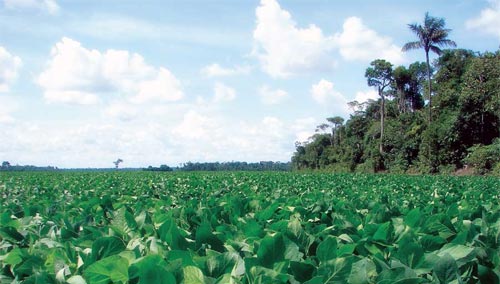
Photo by Pat Joseph

Pat Joseph, writing in the special South American edition of the Virginia Quarterly Review, has given us one of the most thorough, honest and challenging reports on the dynamics of deforestation in the Cerrado and Amazon that I have encountered. I'm going to draw heavily from it in this post. I really urge you to read it in full as there's no way a few excerpts can do it justice.

Pat's report is from Mato Grosso State which in recent years has been the scene of massive burning, deforestation and a center stage for global environmental concern.

He traveled the area with an "americano-brasilieiro" agricultural consultant who wrote him an email saying:

Dear Pat: I am a Brazil/Mato Grosso fanatic. I love the pioneer spirit, the wide-open spaces, and positive attitude among the dynamic farmers in the area. Lucas do Rio Verde, Mato Grosso, is the Garden of Eden in my opinion. My friends there are a pioneer success story. ... in the middle of “soybean ground zero” on the whole planet.

joseph-02-thumbnail
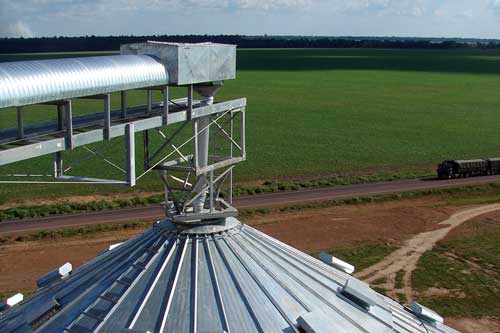
Photos and italicized text above and below from Virginia Quarterly Review

I know this success story. I was born in Chicago. Later, I lived for 14 years among the corn and soybean fields of central Illinois. Many of my friends were the children of the similarly enterprising pioneer families that had drained the wetlands and wiped out the native prairie. They were hard-working, ambitious, and no-nonsense Midwesterner farmers and also very friendly, generous and justifiably proud folks, mostly of German heritage. Just like in Mato Grosso, except for the fact that the average farm size in Illinois was about 600 acres, whereas here it can run 20,000 acres (and upwards) and the new success stories can put Horatio Alger to shame.

I didn't remain in Illinois, I found that I just wasn't a flatlander by nature. In 1982 I moved from the corn and bean fields to the forests and mountains of Oregon seeking the romance of wild places and wilderness solitude. I was part monk, part adventurer, part burned-out political activist and part hippie dropout. Oregon seemed like the perfect spot. I even found a place to live in the Illinois Valley, the river of which begins at a spring flowing from a mountain called Chicago Peak. But, as a midwesterner, I had no idea of the massive deforestation taking place in National Forests. When I saw it, I was shocked. My new home, where I had come to get away from it all, quickly thrust me back into politics as a tree-hugging hermit activist trying to save the remaining 10% of the US ancient forests.

Twenty-five years later, I am now in Brazil, as sort of a spiritual pilgrim following the Queen of the Forest by exploring the path of Santo Daime. And that leads me to places like Acre State where I am finding the spirit of America in Amazônia and facing the classic dilemma confronting a visitor from a rich and consuming society to a new world of economic development and rising expectations. One can not look at this most incredible forest on earth, witness the massive deforestation and not wonder, "whose forest is this anyway, does it not also belong to the world?"

That very same question confronted Pat Joseph in Mato Grosso (two states away from Acre but also in what is called the Amazon "arc of deforestation"). Here's his description of the historical context and the confrontation he faced on the ground:

Settlement of the Brazilian Amazon was sparked by the paranoia of the military government. The generals who ran the country for two decades worried that their unsettled borders and vast empty interior would tempt foreign encroachment on Brazilian soil. Occupar para não entregar. That was the slogan. One of many. “Occupy so as not to surrender.” Another was, “Land without men for men without land.” The generals built roads to encourage migration, then did little to manage how the process unfolded. ...

Even today, an undercurrent of paranoia runs through Brazilian society when it comes to the Amazon, their sense of threatened sovereignty stoked in part by the ill-considered comments of well-meaning politicians such as Al Gore, who once insisted that, “Contrary to what Brazilians think, the Amazon is not their property. It belongs to all of us.” One need only imagine how Americans would feel if foreign leaders made similar pronouncements about, say, Alaska. Not long before I arrived in Brazil, David Miliband, the British environment secretary, was touting a proposal—one enthusiastically supported by Tony Blair—to set up an international trust that would effectively buy a vast portion of the Amazon and manage it as a preserve. The Brazilian response to the idea was swift and unequivocal. President da Silva issued a resounding demurral. “The Amazon,” he said flatly, “is not for sale.”

On a long bus ride across the Cerrado, I sat next to a schoolteacher on vacation and a pastor who was returning to his flock. ... While reclined in his seat, the young pastor ... turned his head toward me and said, “Tell me, why do Americans worry so much about our forest when they cut theirs down in the name of progress?”

In one form or another, I’d had the question put to me many times in Brazil. ... the pastor had a point. What difference did it make that our frontier had closed a century ago? All that meant was that our ancestors did the dirty work for us. And dirty work it was. In conquering the continent, North American settlers had exercised every kind of depravity. We dammed and straightened and diverted our rivers and riprapped their banks. We overgrazed our prairies and drained our wetlands. We cut down our old-growth forests and introduced alien species that grew like weeds in their stead. We hunted down and poisoned predators because they ate our livestock and “our” game. We killed off most of the bison and decimated the salmon. Even now, we’re draining our aquifers, blowing the tops off mountains to get at the coal seams, sinking wells in the gas fields of the West as fast as we can. And how did it all look from Brazil? The United States exploited its resources with a vengeance, and it was rich, the most powerful country in the world. To Brazilians, our high-minded concerns about the rainforest were the rankest sort of hypocrisy—or worse, a conspiracy to keep Brazil from developing into a major economic force in the hemisphere.

Near the end of my trip, Kory and I spent a morning in Sinop being lectured to by the president of the rural syndicate (a coalition of local farmers and loggers). Antonio Galvan is an irascible man with steely eyes, the build of a wrestling coach, and a voice like a broken horn. He was clearly annoyed by the presence in his office of two meddlesome gringos, and, after one question, set off on a tirade that lasted the better part of an hour. His rant was peppered with the words absurd and ridiculous, each point punctuated by a forearm pounding the desk. If you don’t want me to farm, then pay me, Galvan cried. Bam. No one else in the world produces and preserves at the same time! We leave 80 percent of the Amazon untouched! We leave the forest along the rivers standing! Bam. Who else does this? Don’t tell me about how many football fields of Amazon are disappearing every minute. It’s absurd! Bam. Ridiculous!


If you think that Pat Joseph might be exaggerating the tensions facing an outside reporter or (worst) an environmentalist in Mato Grosso, just watch this video from Greenpeace:


What can I say about this? Yes, I (and many friends) have "been there, done that." We sat in front of the bulldozers, climbed the trees, faced the angry locals, made it all the way to the national and international media, and guess what? The big trees are still being cut in Oregon. I came to Brazil in hopes of finding a better way, one that might go beyond the first step of raising awareness (thank God for Greenpeace), to find a path along which true preservation and local sustainability might be achieved. So here in Brazil, I am doing something that I wasn't very good at back in Oregon -- I am listening to the local people.

I read the words of the local leader Antonio Galvan:

If you don’t want me to farm, then pay me.

We leave 80 percent of the Amazon untouched!

No one else in the world produces and preserves at the same time!


I believe that he is asking the right questions:

Who will pay the developing world to avoid the the easy but mistaken path that was followed by the developed world?

Brazilian law requires that 80% of the forest be preserved. But so what, when much of the present logging is done illegally? What will give local people an incentive to follow the rules and protect the forest?

It's true that no one protects and produces at the same time -- at least that's the way it has been. But there is a new world of global warming that demands that we do both and a dream of restoration and renewal that promises that we can.

These, indeed, are the three questions that must be answered. I will be discussing them in coming posts. Stay tuned, and please read Pat's full story Soy in the Amazon.

Wednesday, August 08, 2007

ExpoAcre

img_0911_edited

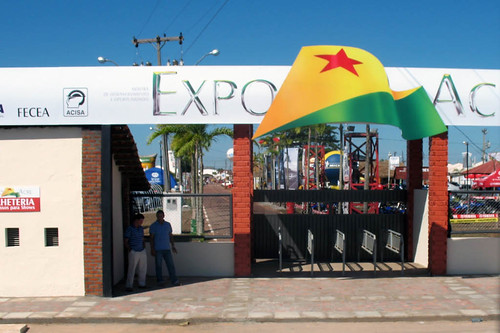
A few nights ago I went to the rodeo at ExpoAcre in Rio Branco, Brazil. Believe it or not, it was my first time at a rodeo. Brazil has been a curious experience for a backwoods no-TV-Luddite like me. I used my first cell phone here. I got introduced to the Internet and to digital culture here. And now on the Amazon frontier I am receiving a major dose of Americana.

Somehow, Acre State and the city of Rio Branco have always reminded me of Texas.


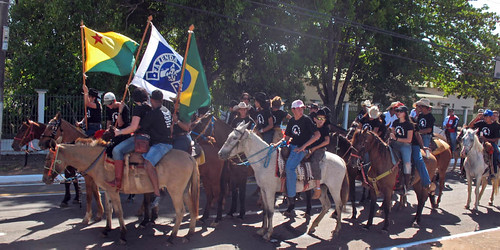
Street parade at the opening of ExpoAcre

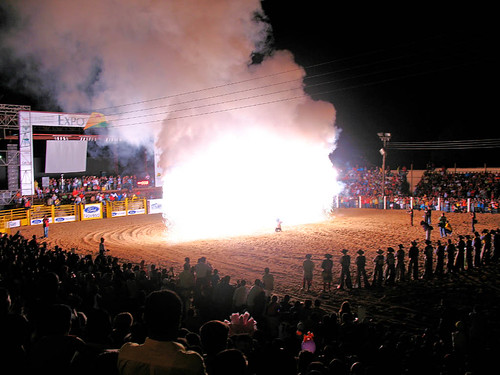
That’s what I got at ExpoAcre to the max. Lots of partying people, flowing beer, cowboy hats and baseball caps, fireworks, roaring 4x4 pick-ups, sound blasting country music mixed with disco and Brazilian beats presented DJ-style by a shouting MC who really knew how work the crowd in the packed arena.

Fireworks and Rodeo

It was country-style Americana, straight from TV, now packaged for this medium size state capital city in Brazil’s western Amazon near the frontiers of Bolivia and Peru. Is this the “Wild West” of the 21st Century? My guide, a local resident, flashed a big enthusiastic smile and said, “Look at what we now have in Rio Branco!”

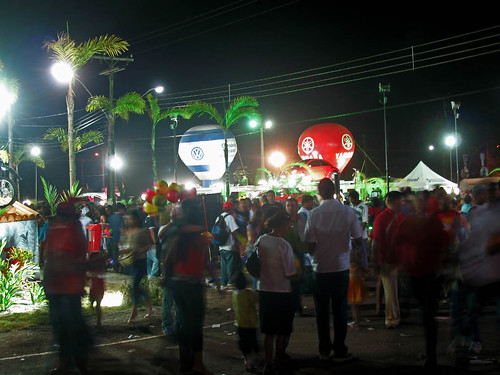
Crowds at ExpoAcre

The enthusiasm of the crowd was both palpable and infectious. Despite my own “politically correct, eco-aware, anti-materialism, global citizen consciousness”, I found myself being carried along as if within the force of a powerful current. And, yes, I had fun -- lots of fun. There was an innocent joy about the whole thing, somehow familiar to me from my own experience as an adolescent coming of age in post World War II America.

During the 1950’s my family and my neighborhood in Chicago were emerging from the material deprivations of the depression and the war. We were soaring forth into an unbounded sense of progress as the vast technological capabilities and mass mobilizations developed during wartime were turned toward creating a peacetime economy of consumption. The seriousness of sacrifice was being replaced by the exuberance of shopping and the promise of more and more stuff. We were all teenagers.

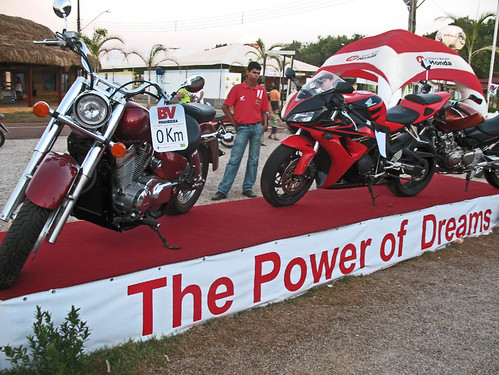
Now, I was witnessing these forces in Acre,

Honda Motorcycles

forces that also relentlessly eat forests.

The best deal in Brazil.

I recalled the simple words of Brazil’s President Lula, a very practical politician who is very in touch with the hopes and aspirations of the common Brazilian -- “the 20 million people who live in the Amazon want TV and refrigerators too.”

img_1365_edited

Of course, it’s not limited to the Amazon. Perhaps half the world has been waiting for the opportunity to experience the American standard of material consumption. It’s easy to turn judgmental about all this -- too easy, I’m afraid. But it’s important to understand that consumerism is one of the powerful currents now running through the greatest river basin on earth and transforming its forest.

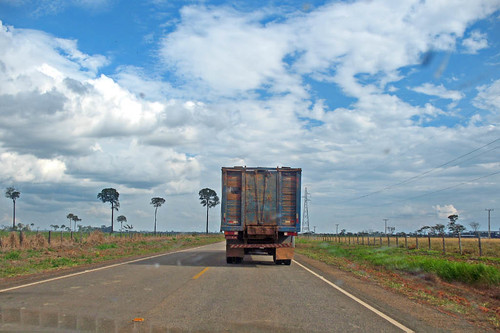
Highway through Acre (1)

The next day I had the opportunity to discuss this with one of the main environmentalists in Acre. I told him of my memories of entering the brave new world of shopping and how familiar this all feels now in Acre. He agreed that stopping the urge to consume would be most difficult but then he added, “Lou, you experienced this in America fifty years ago when there was no awareness of the global consequences. But now we are in the time of global warming. The situation is urgent. We must find a way to halt the deforestation.” Of course, I agreed.

We discussed this at length. He told me of the cycle of the interconnections of burning the forest, illegal logging, ranching, new roads, soybeans, the spread of global agribusiness and now, ethanol. The main threat during the 70s and 80s had been the spread of beef production and ranching through previously forested areas. The forest was burned to clear the understory, log it for the valuable tropical hardwoods and open it for ranching. This is what had triggered the “peoples of the forest movement” lead by Chico Mendes.

Chico Mendes Memorial

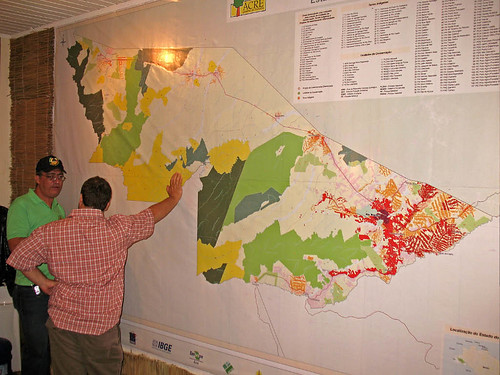
As the movement gained international attention and support, and as Chico Mendes was martyred by murder in 1988, pressure was directed at Brazil’s national government which responded by creating many new protected areas -- parks and so-called extractive reserves where local people could engage in sustainable practices such as gathering latex or seeds or nuts which can be turned into a range of products. Additionally, many new environmental laws were enacted. And some very good things have begun to happen. For example, here in Acre the State government has introduced an innovative master plan of land-use zoning called the Sistema de Produção Sustentável (System of Sustainable Production).

Master zoning map for Acre

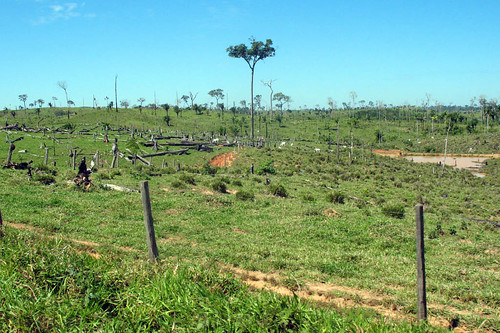
It looks pretty good -- on paper. But, the general pattern has been for the overall rate of Amazon deforestation to be governed more by global market demands for agricultural commodities -- and, now, biofuels -- than by environmental laws. Much is made of the fact that Brazil has vast areas of uncultivated land which are available for agricultural production without any new deforestation. But, a great deal of it is pasture land for Brazil’s vast herds of cattle. (Today, Brazil is the leading beef producer in the world.) As land is converted from pasture to row-crops, the forest frontier is pushed back -- burned, cleared and deforested to create areas for ranching.

Land recently converted from forest to ranching (2)

So far the most effective global constraint on the logging of tropical hardwoods worldwide has come through various green certification programs (largely in the European market) and the willingness of conscious consumers in the highly developed world to boycott uncertified products. But this has little impact in Brazil where it is approximated that 80 percent of the illegal logging goes into the domestic market to feed the appetites of an expanding urban -- and not particularly environmentally conscious -- middle-class that are acquiring modern homes, apartments and furnishings.

This sign on a building in central São Paulo seems iconic.

Sign on building in central São Paulo

In Acre there are an increasing number of "value-added" wood products that are being produced according to sustainable forest practices

Locally produced high-quality furniture

but it is not easy to compete with with the prices set by illegal logging and mass production.

Policing the vast Amazon frontier is an incredible challenge plagued by sheer scale, lack of funding and by corruption. The forest is nearly the size of western Europe. New methods of satellite pictures and Internet for monitoring by Indian tribes in remote areas have been introduced recently but it remains to be seen how effective this will be. For the moment, the domestic demand for wood-products and the global prices for beef, soy or ethanol seem to have more impact on deforestation rates than environmental regulation.

It is important to note that, although the Amazon is the global poster child, the incredible biodiversity of Brazil has so far been hit hardest in its second largest biome, the highland plateau or cerrado where more than 75% of the most diverse grassland on earth either has been replaced by the monocultures of industrial agriculture or seriously degraded by cattle grazing. But, today, it is probably global warming more than the loss of biodiversity that is placing the global spotlight on Brazil where burning (both for deforestation and for agriculture) has made it one of the top 10 greenhouse gas polluters in the world.

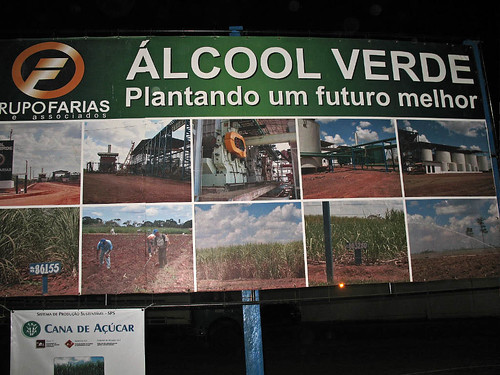
One sees the forces of globalization and development everywhere. A new ethanol plant has been built,

Álcôol Verde exhibit - ExpoAcre

and the surrounding pasture land is being converted to monocultures of sugar cane.

New monoculture of sugar-cane

A new bridge has been completed into Peru thus connecting the Brazil to the Pacific ports for the first time. The program of rural electrification is being completed and satellite dishes for TV and LAN Houses for Internet are appearing everywhere. And the Brazilian National Congress has just appropriated 35 million dollars (US) to prospect for oil and gas. This last item has a particular irony to it. Marina Silva, the globally recognized environmental leader from the Chico Mendes movement who is now Brazil’s Minister of Environment recalls that as a child facing the deforestation caused by ranching, she used to tell herself, “Thank God that at least we do not have oil or gold in Acre.”

Judging from my experience of ExpoAcre I would have to say that much of the local population certainly seems pro-development and that the prospect of exporting commodities (oil, gas, ethanol or whatever) to the world is very appealing. And, there is also a lot of evidence of efforts to create and encourage sustainable forms of development. Somehow, the world and Acre are already meeting each other in a new way. Another friend of mine says, “people used to say that Acre was at the end of the world but now it may be moving into the center of the Universe.”

Acre does seem to have it all -- the spirituality, the indigenous cultures, the forest and its peoples, and all the contradictions and opportunities of development and globalization. Can these forces be balanced into a life in harmony with nature? That question is what now makes Acre at least one of the centers of the Universe -- a place where a great study of sustainable development is taking place. The outcome here is likely to have meaning for the world.

My Acreano friend points out that Brazil simply cannot follow the development path of the past without disastrous consequences, that the urgency of climate change must influence the practical choices that will be made. For me, ExpoAcre was surely a heavy dose of agribusiness and development -- in both sustainable and not-so-sustainable forms. I am aware that my view as a foreigner is limited but I have a very strong intuition that what happens in Acre will flow out into the world -- in material, political and spiritual forms. Surely, this is one of the crucibles in the ever-evolving march of human technology and ecological awareness. This is a place where local consciousness and government planning can truly make a difference.
There was a magical moment during my visit to ExpoAcre that is worth reporting. I was looking at the art and crafts displayed in the artisan section, looking at some wonderful products from Peru. The saleswoman, who evidently was not a local resident, looked at my T-shirt from the Chico Mendes Park and asked, “who is he, this Chico Mendes?” I tried to answer with my minimal Portuguese but it didn’t work. Suddenly, a boy standing next to me (about 6 years old I think) delivered a long “lecture” about Chico Mendes. She smiled approvingly.
Click for more photos at Flickr.

Thursday, March 15, 2007

GLOBAL WARMING.

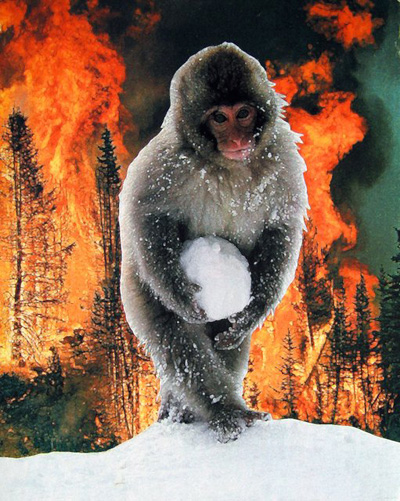
With human induced global warming and climate change very much in the news, it seems timely to post some images that I made on the topic.


Here is the full set:


IMG_0350_edited_1_edited

IMG_0327_edited_1_edited

IMG_0351_edited_edited

IMG_0371_edited_edited

IMG_0340_edited_1_edited

IMG_0333_edited_1

IMG_0330_edited_1_edited

IMG_0346_edited_1_edited