
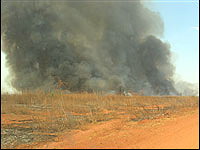
 On Monday (11-05-07) US National Public Radio ran a feature segment on "All Things Considered" about the record 2007 fire
season in the Amazon and the situation in Mato Grosso. The photo at the left shows a fire that was intentionally set on neighboring property in the struggle over land titles but spread and eventually burned 90% of John Carter's 22,000 acre ranch.
(photo credit: npr)
Click to hear John tell the story.
This year's fire season dominated the US news for many days as a "national disaster" was declared in southern California because Santa Ana winds whipped about 25 fires into a local frenzy. But compared to the Amazon it would seem no more than a few embers. Mongabay reported some astonishing fire statistics -- depending on which satellite data set is used, this season there were between 50,729 and 72,329 Amazon fires, close to or more than the all-time record.
Here is a NASA satellite view of the fires burning in the states of Mato Grosso, Para and Amazônas on September 29, 2007. The most intense burning is located in areas that had been opened by roads, and now the fires were spreading across agricultural lands and protected reserves as well. Road-building comes first, then a mix of development and protection but fire respects neither.

Unfortunately, these data seem to end speculation that the reductions of fire and deforestation seen in Brazil across the last 2-3 years were the results of aggressive new government initiatives of regulation, monitoring and enforcement. Instead, it appears that variations in the amount fire and deforestation are more closely correlated with fluctuations in global commodity prices, which now are recovering from a recent slump.
While many factors influence the rate of fire and deforestation, the main driving force seems to be the planting of soybeans. The Mongabay report offered the views of two leading scientists:
Dr. Philip M. Fearnside, one of the most widely cited experts on the Amazon, says that the rise of soy in the region has provided support for infrastructure projects which, in turn, have fueled forest destruction.
"Soybean farms cause some forest clearing directly. But they have a much greater impact on deforestation by consuming cleared land, savanna, and transitional forests, thereby pushing ranchers and slash-and-burn farmers ever deeper into the forest frontier," he explained after co-authoring a 2004 paper in Science on the impact of soy. "Soybean farming also provides a key economic and political impetus for new highways and infrastructure projects, which accelerate deforestation by other actors."
"What’s most striking is that fires in 2007 have increased dramatically in the main soy-production states in the Brazilian Amazon—Mato Grosso, Para, Maranhao, and Tocantins—but have dropped or remain stable in other Amazonian states," said Dr. William Laurance, a senior researcher at the Smithsonian Tropical Research Institute (STRI) in Panama and another noted Amazon scientist. "Clearly, soy farming is becoming a major driver of land-use change in the Amazon. The international consumers of Brazilian soy need to understand its key role in driving Amazon deforestation" Rhett A. Butler, 2007 Amazon Fires Among the Worst Ever, October 22, 2007.
And what has caused soybean prices to recover in the global market? Many factors, but chief among them are the new US ethanol agricultural subsidies that have been been causing midwestern farmers to shift from beans to corn. The new "greening of fuel" in the US -- supposedly to fight global warming -- is a big force fueling the fires in the Amazon. It is now thought that, tropical deforestation accounts for more than 20% of the greenhouse gas emissions worldwide, which is more than the amount contributed by the entire transportation sector.
It's a small world where everything is connected to everything. There simply is no people, nor place, nor process that does not bump up against everything else.


