VISISIONSHARE (blog header)_edited
Showing posts with label South America. Show all posts

Friday, November 09, 2007

AMAZÔNIA: WHAT WILL BE THE FUTURE?

1016co_nasa

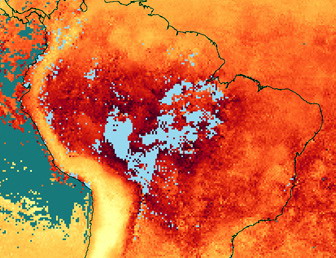
The above photo from NASA shows the concentrations of carbon monoxide (grey areas) hovering over Amazônia during September 2007. Carbon monoxide indicates smoke, fire, greenhouse gas pollution and, of course, deforestation. Burning and cutting the tropical rainforests now contributes more than 20% of global greenhouse gas pollution.

It is now believed that the eastern half of the Amazon forest, located in Brazil, may be seriously at risk. "It's not out of the question to think that half of the basin will be either cleared or severely impoverished just 20 years from now," stated Dr. Daniel Nepstad, head of the Woods Hole Research Center's Amazon program. "The nightmare scenario is one where we have a 2005-like year that extended for a couple years, coupled with a high deforestation where we get huge areas of burning, which would produce smoke that would further reduce rainfall, worsening the cycle. A situation like this is very possible." Read more at Mongabay.

The future Amazon will be the result of choices made by Brazil and the rest of the world in coming years. John Terborgh, writing in the current NY Review of Books tells us how it looks from the highest levels in Brazil:

What is the attitude of the Brazilian government toward a possible climatic calamity in the Amazon? On being shown the predictions of some climate models, President Luiz Inácio Lula da Silva reputedly posed two alternatives. If the rest of the world is so concerned about the future of the Amazon, then let the rich countries pay us not to cut it down. Otherwise, if the forest is going to succumb to drought and fire, then we ought to cut it down first so that we can benefit from the resources before they are lost to the ravages of nature.

Not everyone will be happy with these alternatives, but Lula's pronouncements may not be that far off the mark. The Amazon is being logged at a prodigious rate and with further improvements in transportation envisioned under the Avança Brasil program, logging, and with it the risk of fire, is bound to spread over much of the basin. Slowing or stopping the logging would require a political will that simply doesn't exist in a country obsessed with maximizing development.

Which of Lula's alternatives will the future bring, a green Amazon supported by an international community united against the specter of radical climate change, or a brown Amazon, parched by deforestation and scorched by fire? In my view, the prospects of the green alternative will be determined by the treaty that will succeed Kyoto. At Kyoto, it was decided not to include forests in a system by which carbon emissions are controlled through "cap-and-trade"—i.e., by allowing countries that cut back on emissions to receive tradable credits for doing so. Many now feel that the omission was a mistake because forests store such huge stocks of carbon. Yet how forests will be brought into a second-generation treaty is anyone's guess. Short of significant international intervention through financial incentives or other mechanisms, the business-as-usual scenario will certainly prevail.


Kyoto is about to be reformulated. The choice over the future of Amazônia is likely to come soon. There's been some foolish talk about who owns the Amazon forest. Without doubt, it is owned by Brazil and its neighbors. But the financial choice over its future is clearly owned by all of us.

Wednesday, November 07, 2007

US Ethanol Subsidies Help Fuel Range Wars and Fires in the Amazon


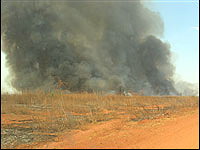
On Monday (11-05-07) US National Public Radio ran a feature segment on "All Things Considered" about the record 2007 fire
season in the Amazon and the situation in Mato Grosso. The photo at the left shows a fire that was intentionally set on neighboring property in the struggle over land titles but spread and eventually burned 90% of John Carter's 22,000 acre ranch.
(photo credit: npr)
Click to hear John tell the story.

This year's fire season dominated the US news for many days as a "national disaster" was declared in southern California because Santa Ana winds whipped about 25 fires into a local frenzy. But compared to the Amazon it would seem no more than a few embers. Mongabay reported some astonishing fire statistics -- depending on which satellite data set is used, this season there were between 50,729 and 72,329 Amazon fires, close to or more than the all-time record.

Here is a NASA satellite view of the fires burning in the states of Mato Grosso, Para and Amazônas on September 29, 2007. The most intense burning is located in areas that had been opened by roads, and now the fires were spreading across agricultural lands and protected reserves as well. Road-building comes first, then a mix of development and protection but fire respects neither.

1016nasa

Unfortunately, these data seem to end speculation that the reductions of fire and deforestation seen in Brazil across the last 2-3 years were the results of aggressive new government initiatives of regulation, monitoring and enforcement. Instead, it appears that variations in the amount fire and deforestation are more closely correlated with fluctuations in global commodity prices, which now are recovering from a recent slump.

While many factors influence the rate of fire and deforestation, the main driving force seems to be the planting of soybeans. The Mongabay report offered the views of two leading scientists:


Dr. Philip M. Fearnside, one of the most widely cited experts on the Amazon, says that the rise of soy in the region has provided support for infrastructure projects which, in turn, have fueled forest destruction.

"Soybean farms cause some forest clearing directly. But they have a much greater impact on deforestation by consuming cleared land, savanna, and transitional forests, thereby pushing ranchers and slash-and-burn farmers ever deeper into the forest frontier," he explained after co-authoring a 2004 paper in Science on the impact of soy. "Soybean farming also provides a key economic and political impetus for new highways and infrastructure projects, which accelerate deforestation by other actors."

"What’s most striking is that fires in 2007 have increased dramatically in the main soy-production states in the Brazilian Amazon—Mato Grosso, Para, Maranhao, and Tocantins—but have dropped or remain stable in other Amazonian states," said Dr. William Laurance, a senior researcher at the Smithsonian Tropical Research Institute (STRI) in Panama and another noted Amazon scientist. "Clearly, soy farming is becoming a major driver of land-use change in the Amazon. The international consumers of Brazilian soy need to understand its key role in driving Amazon deforestation"
Rhett A. Butler, 2007 Amazon Fires Among the Worst Ever, October 22, 2007.

And what has caused soybean prices to recover in the global market? Many factors, but chief among them are the new US ethanol agricultural subsidies that have been been causing midwestern farmers to shift from beans to corn. The new "greening of fuel" in the US -- supposedly to fight global warming -- is a big force fueling the fires in the Amazon. It is now thought that, tropical deforestation accounts for more than 20% of the greenhouse gas emissions worldwide, which is more than the amount contributed by the entire transportation sector.

It's a small world where everything is connected to everything. There simply is no people, nor place, nor process that does not bump up against everything else.


Monday, November 05, 2007

SOUTH AMERICA IN THE TWENTY-FIRST CENTURY

252_252_2007F-cvr

The Virginia Quartery Review has produced a GREAT special edition on South America. Editor Daniel Alarcón says, "After eighteen months of work, we are extraordinarily proud of this project and delighted finally to be able to share it with you. We hope that you will be as challenged and enthralled in reading this issue as we were in editing it."

"Enthralled" may be too weak a word. You really should check it out. I found the article "Soy in the Amazon" by Pat Roberts to be an absolute "must read."