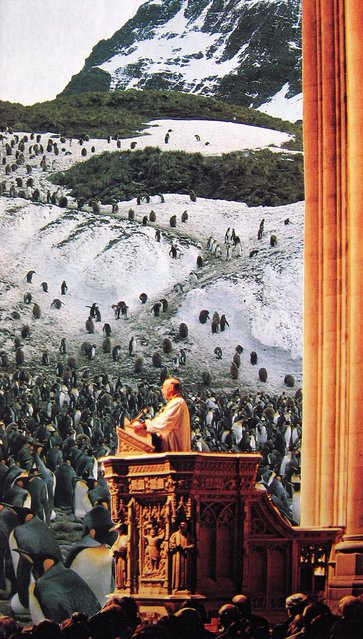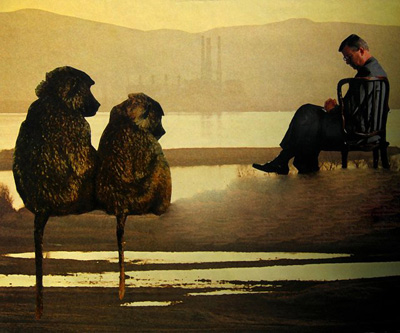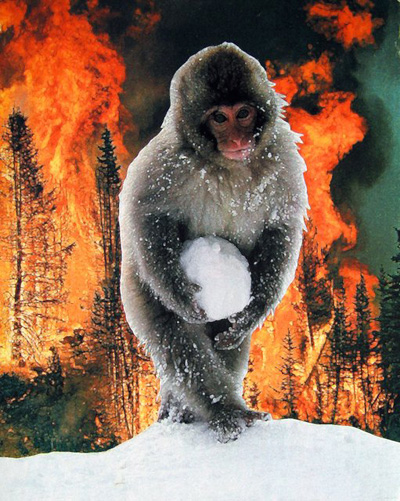
VISISIONSHARE (blog header)_edited
Showing posts with label climate change. Show all posts

Sunday, March 23, 2008

Resurrection of the Earth
seems like a perfect post for an Easter Sunday.

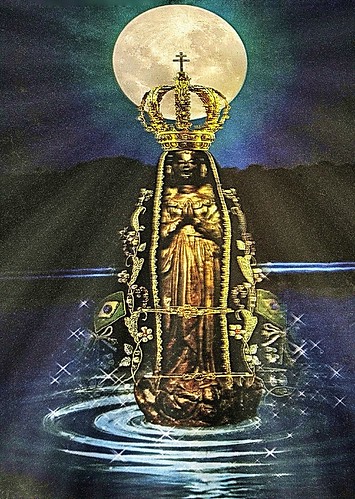
But, first I'd like you to consider an image -- a photo montage created by the Brazilian visionary artist and designer Guta.

Rainha


I'm sure that Guta would have presented a much more professional-looking rendering of this magnificent image. (I simply "posterized" a poor photo of his work.) It captures the interweaving of two great Brazilian religious traditions -- Aparecida and Santo Daime -- both of which manifest the spiritual energy of this Brazilian
and universal Goddess. And, now, I have an additional connection in mind.

Back in November I reported a newspaper article that said:

"God is Brazilian",
said Brazilian President Luiz Inacio Lula da Silva in response to his government's announcement that massive new oil reserves had been discovered offshore.
But, it turns out that there is more than one kind of Black Gold. The recent "rediscovery" of Terra Preta soils of the ancient Amazonian Indians may prove to be more valuable than off-shore oil. If God is Brazilian, She just might be Black.


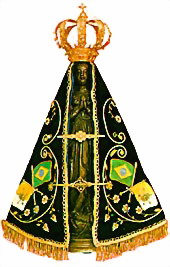
This image is of the much-revered Black Madonna of Brazil, Nossa Senhora de Conceição Aparecida -- Our Lady of Conception Who Appeared.

Aparecida

The story is that a statue of the Virgin made around 1650 was somehow lost. Then, in 1717, some government people were traveling north to the gold mining region of Minas Gerais where the precious metal was called Ouro Preto due to a dark coating on the nuggets. Along the way fishermen cast their nets in a river hoping to catch fish for a big banquet. Instead of fish, they found the statue -- all darkened by years in the river bed. The travelers went on but the statue was kept in a little family shrine.

Soon the statue appeared to have healing and wish-granting powers -- at least for some faithful ones -- and a cult began to grow around it. As time passed, it had to be housed in larger and larger quarters and came to be venerated throughout Brazil. In 1929, the Virgin was proclaimed Queen of Brazil and its official Patron Saint. Today its Basilica, in the city of Aparecida near São Paulo, receives about 7 million visitors yearly and is the largest Marian shrine in the world.

From the first time I saw this great Black Madonna, this symbol appeared to me as more than an artifact of the Catholic Church. Indeed, it seemed even more like an icon of the power of the earth.

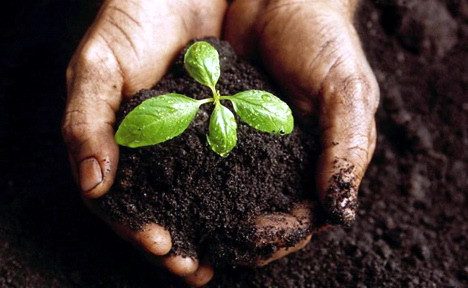
Nowadays, there is an emerging parallel story. As the world searches for solutions to hunger, fuel shortages, deforestation and climate change, Terra Preta soil from deep in Amazônia may be emerging as as a way to heal the earth. YES, biochar -- the modern equivalent of Terra Preta de Indios -- may be rising into our awareness truly as the resurrection of the earth.

And, yes, the Goddess is Black.

Biochar_Hand

Can you imagine fighting hunger, energy poverty, deforestation and climate change SIMULTANEOUSLY?

Please stay tuned.


Sunday, November 18, 2007

“What we do in the next two to three
years will determine our future. This
is the defining moment.”


-- Rajendra Pachauri,
director of the UN's International Panel on Climate Change


The story that defines what we might do has been
emerging from Brazil.

It's a golden opportunity.


First, the story...

Once upon a time, way back in the sixteenth century, the Spanish Conquistador Francisco de Orellanawas the first European explorer to travel down length of the Amazon River. Starting in Peru and into the Rio Negro, a huge tributary, upriver from present-day Manaus, the exploration traversed the continent to the Atlantic Ocean. For Orellana and his unfortunate companions it was a terrible trip plagued with every kind of adversity which, in the end, left him as the sole survivor to return to the Court of the King of Spain to tell the story.

But what a story it was. We might even speculate that Orellana survived the ordeal in order to complete his mission of telling of having found Eldorado -- fantastic golden cities in the heart of the forest of the New World. Orellana reported something even more unbelievable than gold -- there was an advanced indigenous civilization with many high density human settlements. Huge Indian populations were living along the waterways of Amazônia and, according to Orellana, at one place there was a city of continuous side-by-side houses stretching for twenty miles. His tale was both fantasic and fabulous. I doubt that the Spanish Court could really embrace the thought of a civilization more advanced than their own but they sure could imagine the gold.

Gold lust inspired many later adventures across the New World but none could find the fabled Eldorado. It was nearly a century later that missionaries came to the region explored by Orellana, but they reported finding only small nomadic bands of hunter-gathers roaming the forest. The obvious conclusion was that Orellana had fabricated a great tale to mask his own failed expedition. And, much later, a whole generation of modern scientists confirmed the implausibility of an Eldorado in the forest by noting that the nutrient poor Amazon soils could not have supported a large-scale agriculture which is the prerequisite of civilization.

But this "well etablished view" that the Amazon basin could not have contained large human populations has started to crumble. First with new research in Bolivia and, more recently, in central Amazõnia, scientists are discovering tell-tale signs of ancient large-scale populations. The indians appear to have figured out how to transform the nutrient-poor yellowish soils into deep deposits of an extremely fertile dark earth called terra preta de indio. What are these tell-tale signs? Terra preta soils are loaded with pottery sherds and charcoal. The pieces of ceramic are in the contour of large pots and vessels that could have been used only by stationary populations. And the charcoal -- apparently char from cleared forest -- has been ground into small pieces indicating that these soils were "made" by the local residents.

The resulting soils are amazingly fertile -- sometimes producing nearly 800% more plant growth compared with nearby untreated soil -- and clearly capable of supporting a large-scale agriculture. Also anthropologists have found at least one small tribe with an hierarchical cultural structure suggesting a distant past of living among large sedentary populations and not always as nomadic hunter-gathers.

Recent efforts to map the areas of terra preta soils along the Tapajos River have unearthed esquisite 2000 year-old pottery. Carbon dating of soils in some other areas suggest that they may be 2500-4000 years old -- and still fully fertile which is extraordinary in the Amazon where heavy rainfall typically leaches the nutrients out of the soils rather quickly. Interestingly, the mapping efforts are revealing a close correspondence with the Eldorado areas talked about by Orellana.

So what happened to these lost civilizations? No one knows for certain. There's little hard evidence because there is no stone in the area and the wooden structures were quickly reclaimed by the tropical forest. But the best speculation is that the first European expeditions carried in diseases -- smallpox, measels, flu, even the common cold -- to a population that had so harmoniously co-evolved with its niche that it had no disease ... and no need for immunity. After a catastrophic die-off there were only a few survivors who had devolved back into hunter-gathers. The sole legacy of the civilization remained hidden in the soil.

Today, in some areas, terra preta is harvested and sold as potting soils. If a limited amount (about 20 cm deep) is retained and the area then left fallow it will grow back to full depth in about 20 years. Apparently -- get this! -- terra preta soils develop into organic communities that are capable of growing like a biotic culture as in sourdough bread or yogurt, truly a living earth.

Five years ago, England's BBC did a special TV documentary called The Secret of Eldorado that concluded with these words: "So there is a true irony to the story of the hunt for El Dorado. There was once a great civilisation in the Amazon, one the Europeans destroyed even as they discovered it, but the Amazonians may have left us a legacy far more precious than the gold the Conquistadors were seeking. That black earth, the terra preta, may mean a better future for us all."

A golden opportunity.

At the time of the 2002 BBC documentary, a better future was understood as gaining the ability to BOTH save the rainforest and feed more people. But, now, global warming has added an incredibibly important new dimension -- the need to remove CO2 from the atmosphere and sequester it somewhere. This is exactly what terra preta does because 1) plants that grow faster, also remove CO2 from the atmosphere faster and 2) if the agricultural waste (unused portions of the plants) are made into charcoal, it can be used to renew the soil and sequester carbon.

The result of such a system would mean better soil, more food, cleaner fuel, less deforestation and, if Kyoto is revised to include payment for carbon negative sequestration in the soil, developing countries like Brazil and poor farmers everywhere will be paid to save the earth, while growing both food and fuel. This is why terra preta is being called the "new black gold".

Everyone, who thinks of Brazil, knows of its gifts of samba and soccer which are world renown. But Brazil is also the place where the gift of light emerges out of darkness. When gold was discovered in the state of Minas Gerais, it was given the name ouro preto (black gold) because the nuggets had a dark coating. Later, when a statue of the Virgin with dark skin was discovered in a river bed, it was named, Nossa Senhora Conceição de Aparecida (Our Lady of Conception who Appeared) because it appeared to have wish-granting and healing powers. And, for me, this image is one of the great symbols of the fertility and abundance of Mother Earth.

Nossa Senhora Conceição de Aparecida

This Black Madonna became the patroness of Brazil and the center of the largest healing shrine in the world. Perhaps She is also a powerful symbol for the possibility of healing the earth.

Nowadays, we have the rediscovery of an empowering dark earth brew called terra preta, along with speculation of an ancient and highly advanced Indian civilization. Perhaps terra preta will be Brazil's greatest gift yet to the world. Perhaps we can all spread the story about how there once was a time when large numbers of people lived in a bountiful harmony with the earth in a place called Eldorado and that, with love and care and attention, we can repeat the performance.

Here are links to more information:

Australian Broadcasting Company video (11 min) about the global terra preta movement.

GREAT BBC Documentary "The Secret of El Dorado" (49 min video)

Full transcript of BBC El Dorado documentary.

Easy to read primer on Terra Preta.

Expandable Google map of Terra Preta sites.

Pdfs of the best magazine articles.

Continuous updates of all relevant links.

How biofuels can become carbon-negative and save the planet.

US Senator introduces bio-char legislation.

Research confirms bio-char in soil increases yields.

Biopact on the IPCC bio-fuel recommendations.

UPDATE: This post has been linked in a roundup by Global Voices Online, and translated to Portuguese here.


Friday, November 02, 2007

Dot Earth

I've been following Andrew Revkin's new blog at the NY Times.

revkin.125vert

It's quite wonderful.

Somehow, I feel a special connection with him -- perhaps because of his 1990 book The Burning Season which told the story of Chico Mendes and the struggle against the destruction of the Amazon forest in Xapuri, Acre State. This is quite close to my spiritual heart home with the family of Luiz Mendes at Vila Fortaleza in neighboring Caipixaba.

At Andrew's blog there are also a great set of earth links.

Check it out.

Wednesday, August 08, 2007

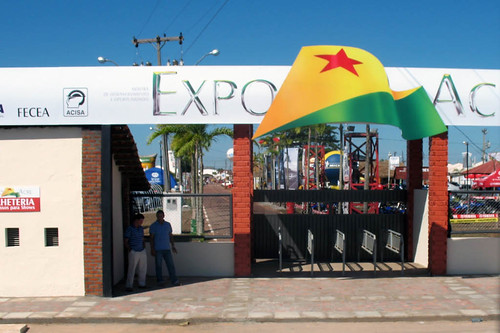
ExpoAcre

img_0911_edited

A few nights ago I went to the rodeo at ExpoAcre in Rio Branco, Brazil. Believe it or not, it was my first time at a rodeo. Brazil has been a curious experience for a backwoods no-TV-Luddite like me. I used my first cell phone here. I got introduced to the Internet and to digital culture here. And now on the Amazon frontier I am receiving a major dose of Americana.

Somehow, Acre State and the city of Rio Branco have always reminded me of Texas.
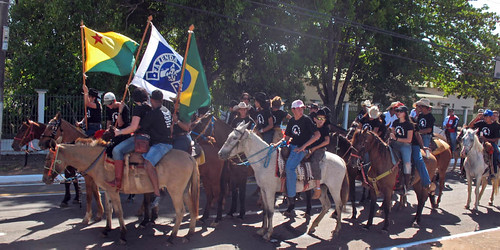


Street parade at the opening of ExpoAcre

That’s what I got at ExpoAcre to the max. Lots of partying people, flowing beer, cowboy hats and baseball caps, fireworks, roaring 4x4 pick-ups, sound blasting country music mixed with disco and Brazilian beats presented DJ-style by a shouting MC who really knew how work the crowd in the packed arena.
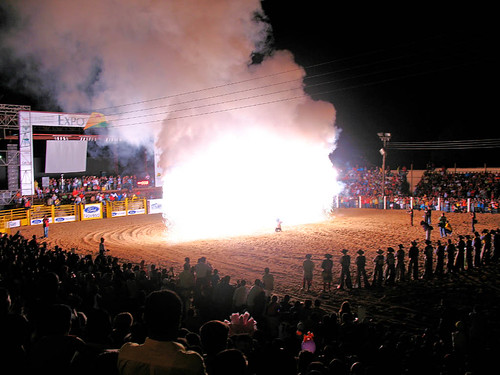
Fireworks and Rodeo

It was country-style Americana, straight from TV, now packaged for this medium size state capital city in Brazil’s western Amazon near the frontiers of Bolivia and Peru. Is this the “Wild West” of the 21st Century? My guide, a local resident, flashed a big enthusiastic smile and said, “Look at what we now have in Rio Branco!”
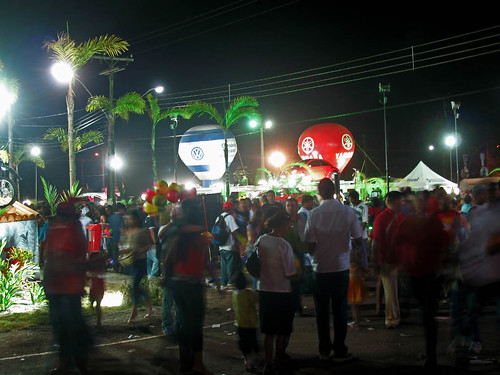
Crowds at ExpoAcre

The enthusiasm of the crowd was both palpable and infectious. Despite my own “politically correct, eco-aware, anti-materialism, global citizen consciousness”, I found myself being carried along as if within the force of a powerful current. And, yes, I had fun -- lots of fun. There was an innocent joy about the whole thing, somehow familiar to me from my own experience as an adolescent coming of age in post World War II America.

During the 1950’s my family and my neighborhood in Chicago were emerging from the material deprivations of the depression and the war. We were soaring forth into an unbounded sense of progress as the vast technological capabilities and mass mobilizations developed during wartime were turned toward creating a peacetime economy of consumption. The seriousness of sacrifice was being replaced by the exuberance of shopping and the promise of more and more stuff. We were all teenagers.

Now, I was witnessing these forces in Acre,
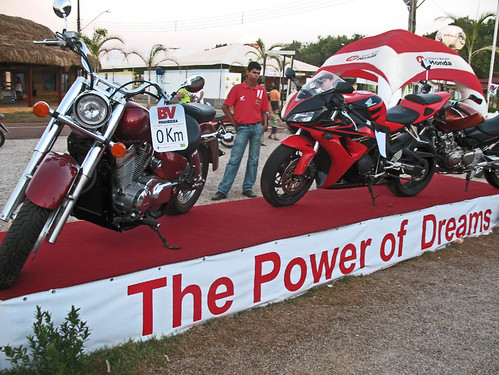
Honda Motorcycles

forces that also relentlessly eat forests.

The best deal in Brazil.

I recalled the simple words of Brazil’s President Lula, a very practical politician who is very in touch with the hopes and aspirations of the common Brazilian -- “the 20 million people who live in the Amazon want TV and refrigerators too.”

img_1365_edited

Of course, it’s not limited to the Amazon. Perhaps half the world has been waiting for the opportunity to experience the American standard of material consumption. It’s easy to turn judgmental about all this -- too easy, I’m afraid. But it’s important to understand that consumerism is one of the powerful currents now running through the greatest river basin on earth and transforming its forest.
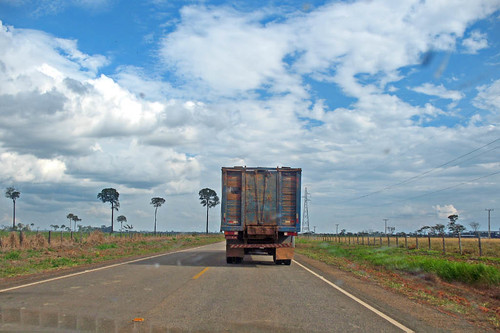
Highway through Acre (1)

The next day I had the opportunity to discuss this with one of the main environmentalists in Acre. I told him of my memories of entering the brave new world of shopping and how familiar this all feels now in Acre. He agreed that stopping the urge to consume would be most difficult but then he added, “Lou, you experienced this in America fifty years ago when there was no awareness of the global consequences. But now we are in the time of global warming. The situation is urgent. We must find a way to halt the deforestation.” Of course, I agreed.

We discussed this at length. He told me of the cycle of the interconnections of burning the forest, illegal logging, ranching, new roads, soybeans, the spread of global agribusiness and now, ethanol. The main threat during the 70s and 80s had been the spread of beef production and ranching through previously forested areas. The forest was burned to clear the understory, log it for the valuable tropical hardwoods and open it for ranching. This is what had triggered the “peoples of the forest movement” lead by Chico Mendes.

Chico Mendes Memorial

As the movement gained international attention and support, and as Chico Mendes was martyred by murder in 1988, pressure was directed at Brazil’s national government which responded by creating many new protected areas -- parks and so-called extractive reserves where local people could engage in sustainable practices such as gathering latex or seeds or nuts which can be turned into a range of products. Additionally, many new environmental laws were enacted. And some very good things have begun to happen. For example, here in Acre the State government has introduced an innovative master plan of land-use zoning called the Sistema de Produção Sustentável (System of Sustainable Production).
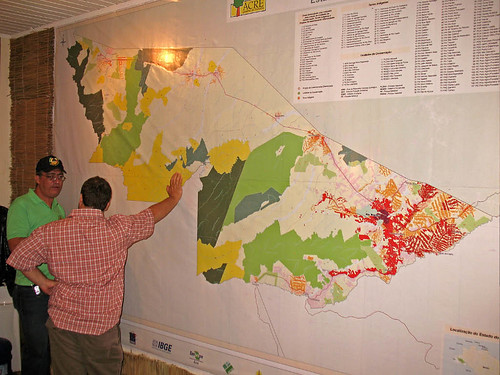
Master zoning map for Acre

It looks pretty good -- on paper. But, the general pattern has been for the overall rate of Amazon deforestation to be governed more by global market demands for agricultural commodities -- and, now, biofuels -- than by environmental laws. Much is made of the fact that Brazil has vast areas of uncultivated land which are available for agricultural production without any new deforestation. But, a great deal of it is pasture land for Brazil’s vast herds of cattle. (Today, Brazil is the leading beef producer in the world.) As land is converted from pasture to row-crops, the forest frontier is pushed back -- burned, cleared and deforested to create areas for ranching.
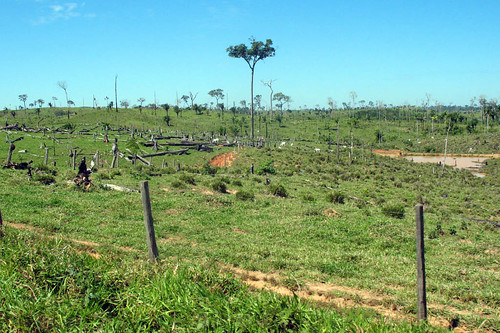
Land recently converted from forest to ranching (2)

So far the most effective global constraint on the logging of tropical hardwoods worldwide has come through various green certification programs (largely in the European market) and the willingness of conscious consumers in the highly developed world to boycott uncertified products. But this has little impact in Brazil where it is approximated that 80 percent of the illegal logging goes into the domestic market to feed the appetites of an expanding urban -- and not particularly environmentally conscious -- middle-class that are acquiring modern homes, apartments and furnishings.

This sign on a building in central São Paulo seems iconic.

Sign on building in central São Paulo

In Acre there are an increasing number of "value-added" wood products that are being produced according to sustainable forest practices

Locally produced high-quality furniture

but it is not easy to compete with with the prices set by illegal logging and mass production.

Policing the vast Amazon frontier is an incredible challenge plagued by sheer scale, lack of funding and by corruption. The forest is nearly the size of western Europe. New methods of satellite pictures and Internet for monitoring by Indian tribes in remote areas have been introduced recently but it remains to be seen how effective this will be. For the moment, the domestic demand for wood-products and the global prices for beef, soy or ethanol seem to have more impact on deforestation rates than environmental regulation.

It is important to note that, although the Amazon is the global poster child, the incredible biodiversity of Brazil has so far been hit hardest in its second largest biome, the highland plateau or cerrado where more than 75% of the most diverse grassland on earth either has been replaced by the monocultures of industrial agriculture or seriously degraded by cattle grazing. But, today, it is probably global warming more than the loss of biodiversity that is placing the global spotlight on Brazil where burning (both for deforestation and for agriculture) has made it one of the top 10 greenhouse gas polluters in the world.

One sees the forces of globalization and development everywhere. A new ethanol plant has been built,
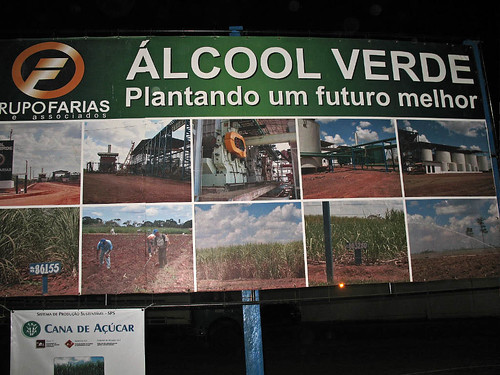
Álcôol Verde exhibit - ExpoAcre

and the surrounding pasture land is being converted to monocultures of sugar cane.

New monoculture of sugar-cane

A new bridge has been completed into Peru thus connecting the Brazil to the Pacific ports for the first time. The program of rural electrification is being completed and satellite dishes for TV and LAN Houses for Internet are appearing everywhere. And the Brazilian National Congress has just appropriated 35 million dollars (US) to prospect for oil and gas. This last item has a particular irony to it. Marina Silva, the globally recognized environmental leader from the Chico Mendes movement who is now Brazil’s Minister of Environment recalls that as a child facing the deforestation caused by ranching, she used to tell herself, “Thank God that at least we do not have oil or gold in Acre.”

Judging from my experience of ExpoAcre I would have to say that much of the local population certainly seems pro-development and that the prospect of exporting commodities (oil, gas, ethanol or whatever) to the world is very appealing. And, there is also a lot of evidence of efforts to create and encourage sustainable forms of development. Somehow, the world and Acre are already meeting each other in a new way. Another friend of mine says, “people used to say that Acre was at the end of the world but now it may be moving into the center of the Universe.”

Acre does seem to have it all -- the spirituality, the indigenous cultures, the forest and its peoples, and all the contradictions and opportunities of development and globalization. Can these forces be balanced into a life in harmony with nature? That question is what now makes Acre at least one of the centers of the Universe -- a place where a great study of sustainable development is taking place. The outcome here is likely to have meaning for the world.

My Acreano friend points out that Brazil simply cannot follow the development path of the past without disastrous consequences, that the urgency of climate change must influence the practical choices that will be made. For me, ExpoAcre was surely a heavy dose of agribusiness and development -- in both sustainable and not-so-sustainable forms. I am aware that my view as a foreigner is limited but I have a very strong intuition that what happens in Acre will flow out into the world -- in material, political and spiritual forms. Surely, this is one of the crucibles in the ever-evolving march of human technology and ecological awareness. This is a place where local consciousness and government planning can truly make a difference.

There was a magical moment during my visit to ExpoAcre that is worth reporting. I was looking at the art and crafts displayed in the artisan section, looking at some wonderful products from Peru. The saleswoman, who evidently was not a local resident, looked at my T-shirt from the Chico Mendes Park and asked, “who is he, this Chico Mendes?” I tried to answer with my minimal Portuguese but it didn’t work. Suddenly, a boy standing next to me (about 6 years old I think) delivered a long “lecture” about Chico Mendes. She smiled approvingly.

Click for more photos at Flickr.

Thursday, March 15, 2007

GLOBAL WARMING.

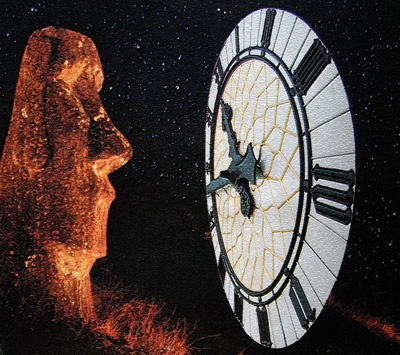
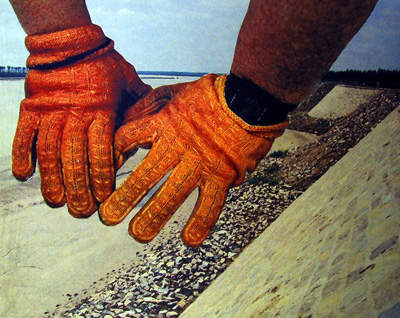
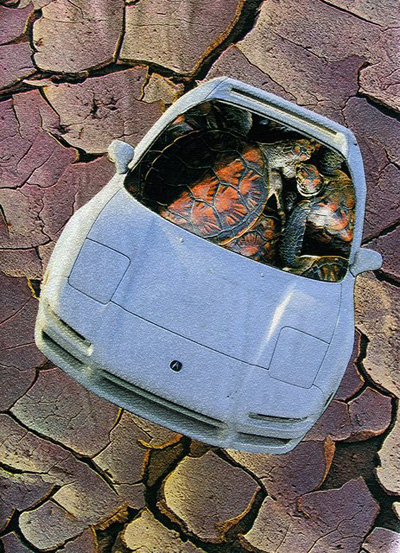
With human induced global warming and climate change very much in the news, it seems timely to post some images that I made on the topic.


Here is the full set:


IMG_0350_edited_1_edited

IMG_0327_edited_1_edited

IMG_0351_edited_edited

IMG_0371_edited_edited

IMG_0340_edited_1_edited

IMG_0333_edited_1

IMG_0330_edited_1_edited

IMG_0346_edited_1_edited